A French Word to Live By
How to Conjugate Boucaner in French
/bu.ka.ne/
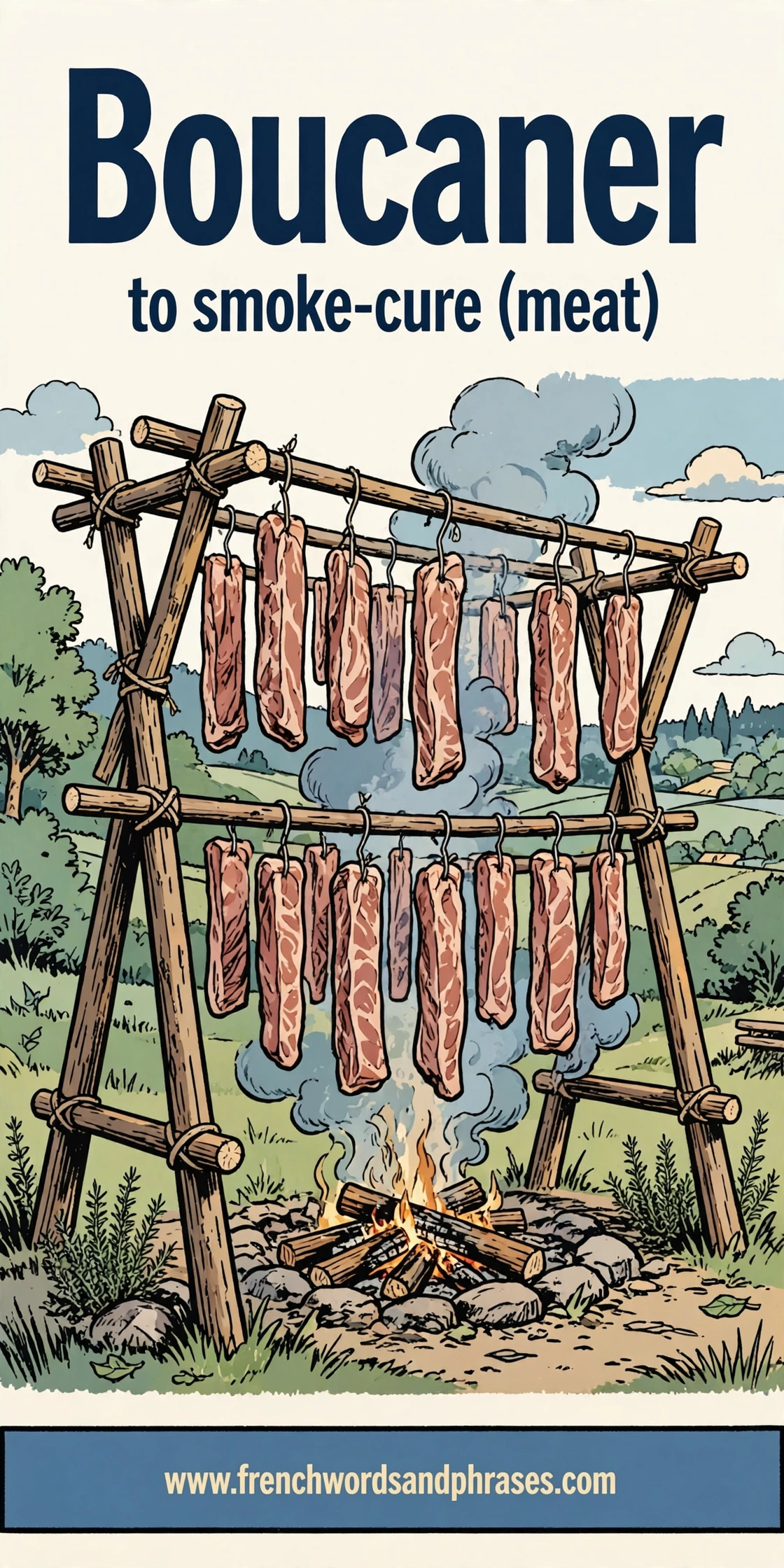
Boucaner means to smoke-cure — to dry meat or fish slowly over smoke on a wooden frame, the way the first Caribbean buccaneers did.
Strips of pork laid over a wooden grill, thin smoke rising for days under the tropical sun, hunters living wild far from any town — boucaner is the verb of that smoke: to cure meat the slow, smoky way, and it gave English its buccaneers.
In this guide, you’ll learn how to conjugate boucaner in all the major French tenses and moods. Explore complete conjugation tables, French examples, English translations, and practice quizzes.
Understanding the French Verb Boucaner
Boucaner is a regular French verb belonging to the first group of verbs, those ending in-er.
It means to smoke-cure (meat). It survives today in the French Caribbean and in food writing for meat and fish cured over smoke, and everywhere else it carries a whiff of adventure — to boucaner something is to prepare it the wild hunters’ way, not the factory way.
Verb classification: First group (-er)
Auxiliary verb: Avoir
Past participle: boucané
Present participle: boucanant
English equivalents: To smoke-cure, to dry over smoke; boucaner de la viande — to smoke-cure meat; boucaner du poisson — to smoke fish; un boucan — the wooden smoking frame (and the meat cured on it); un boucanier — a buccaneer, originally a hunter who smoked meat.
One important detail: boucaner has nothing to do with noise, even though modern French un boucan is familiar slang for a racket — quel boucan !, what a din! The verb keeps the word’s older life: a boucan was the wooden frame, borrowed from a Tupi word through Portuguese, on which hunters in the Caribbean smoked meat. The men who lived by that frame, the boucaniers, became the buccaneers of English pirate stories. The verb itself is a perfectly regular -er: je boucane, nous boucanons, ils boucanent.
Experience the Word
Boucaner is the verb of meat, smoke and patience — food preserved by days of thin smoke under a hot sun.
Imagine a clearing on a Caribbean island in the 1600s. A hunter has built a rough wooden frame over a slow fire, laid out strips of wild pork, and settled down to wait. For three days he boucane his catch, turning it in the smoke, while the forest watches and the salt wind does the rest.
No fridge, no shop, just smoke and time. He has boucané — cured — enough meat to survive the season.
How to Conjugate Boucaner: Complete French Conjugation Guide
Let’s explore every major conjugation of boucaner, beginning with the indicative mood.
How to Conjugate Boucaner in the Indicative Mood
The indicative mood is used to express facts, observations, actions, and events.
How to Conjugate Boucaner in the Present Tense (Présent)
Used for actions happening now, habitual actions, and general truths.
| Subject | Conjugation |
|---|---|
| je | boucane |
| tu | boucanes |
| il / elle | boucane |
| nous | boucanons |
| vous | boucanez |
| ils / elles | boucanent |
Example
Les pêcheurs boucanent le poisson sur la plage.
The fishermen smoke-cure the fish on the beach.
Quick Quiz 1
Complete the sentence:
Nous ______ le porc pendant trois jours.
Reveal the answer
boucanons
Nous boucanons le porc pendant trois jours.
We smoke-cure the pork for three days.
How to Conjugate Boucaner in the Passé Composé
Used for completed actions in the past. Boucaner takes the auxiliary verb avoir.
| Subject | Conjugation |
|---|---|
| j’ | ai boucané |
| tu | as boucané |
| il / elle | a boucané |
| nous | avons boucané |
| vous | avez boucané |
| ils / elles | ont boucané |
Example
Ils ont boucané le porc pendant trois jours.
They smoke-cured the pork for three days.
How to Conjugate Boucaner in the Imparfait (Imperfect Tense)
Used for habitual past actions, descriptions, and ongoing situations in the past.
| Subject | Conjugation |
|---|---|
| je | boucanais |
| tu | boucanais |
| il / elle | boucanait |
| nous | boucanions |
| vous | boucaniez |
| ils / elles | boucanaient |
Example
Autrefois, les chasseurs boucanaient la viande sur des claies en bois.
In the old days, hunters used to smoke-cure meat on wooden frames.
Quick Quiz 2
Choose the correct form:
They smoke-cured the fish.
Ils ______ le poisson. (ont boucané / sont boucané)
Reveal the answer
ont boucané
Ils ont boucané le poisson.
Boucaner takes avoir.
How to Conjugate Boucaner in the Plus-que-parfait
Used to describe an action that had already been completed before another past event.
| Subject | Conjugation |
|---|---|
| j’ | avais boucané |
| tu | avais boucané |
| il / elle | avait boucané |
| nous | avions boucané |
| vous | aviez boucané |
| ils / elles | avaient boucané |
Example
Elle avait boucané le poisson avant l’arrivée des pluies.
She had smoke-cured the fish before the rains arrived.
How to Conjugate Boucaner in the Passé Simple
Primarily used in formal writing, literature, and historical narratives. It is rarely used in everyday conversation.
| Subject | Conjugation |
|---|---|
| je | boucanai |
| tu | boucanas |
| il / elle | boucana |
| nous | boucanâmes |
| vous | boucanâtes |
| ils / elles | boucanèrent |
Example
Le vieux chasseur boucana sa viande loin du village.
The old hunter smoke-cured his meat far from the village.
How to Conjugate Boucaner in the Passé Antérieur
A literary tense used to express an action completed immediately before another past action, generally in the passé simple.
| Subject | Conjugation |
|---|---|
| j’ | eus boucané |
| tu | eus boucané |
| il / elle | eut boucané |
| nous | eûmes boucané |
| vous | eûtes boucané |
| ils / elles | eurent boucané |
Example
Quand ils eurent boucané le gibier, ils le cachèrent dans des feuilles.
When they had smoke-cured the game, they hid it in leaves.
How to Conjugate Boucaner in the Future Tense (Futur Simple)
Used to describe actions that will take place in the future.
| Subject | Conjugation |
|---|---|
| je | boucanerai |
| tu | boucaneras |
| il / elle | boucanera |
| nous | boucanerons |
| vous | boucanerez |
| ils / elles | boucaneront |
Example
Demain, nous boucanerons les maquereaux pêchés ce matin.
Tomorrow, we will smoke-cure the mackerel caught this morning.
How to Conjugate Boucaner in the Futur Antérieur (Future Perfect)
Used for an action that will have been completed before a particular point in the future.
| Subject | Conjugation |
|---|---|
| j’ | aurai boucané |
| tu | auras boucané |
| il / elle | aura boucané |
| nous | aurons boucané |
| vous | aurez boucané |
| ils / elles | auront boucané |
Example
À la fin de la semaine, ils auront boucané tout le cochon.
By the end of the week, they will have smoke-cured the whole pig.
How to Conjugate Boucaner in the Near Future (Futur Proche)
Used to describe something that is going to happen soon. Formed with aller + infinitive.
| Subject | Conjugation |
|---|---|
| je | vais boucaner |
| tu | vas boucaner |
| il / elle | va boucaner |
| nous | allons boucaner |
| vous | allez boucaner |
| ils / elles | vont boucaner |
Example
Le feu est prêt, on va boucaner le poisson.
The fire is ready, we are going to smoke-cure the fish.
How to Conjugate Boucaner in the Conditional Mood
The conditional mood expresses what would happen under certain circumstances. It is also frequently used to make polite requests or express wishes.
How to Conjugate Boucaner in the Present Conditional
| Subject | Conjugation |
|---|---|
| je | boucanerais |
| tu | boucanerais |
| il / elle | boucanerait |
| nous | boucanerions |
| vous | boucaneriez |
| ils / elles | boucaneraient |
Example
Sans fumée lente, la viande boucanerait mal.
Without slow smoke, the meat would cure badly.
How to Conjugate Boucaner in the Past Conditional
| Subject | Conjugation |
|---|---|
| j’ | aurais boucané |
| tu | aurais boucané |
| il / elle | aurait boucané |
| nous | aurions boucané |
| vous | auriez boucané |
| ils / elles | auraient boucané |
Example
Il aurait boucané plus de viande avec un meilleur feu.
He would have smoke-cured more meat with a better fire.
Boucaner in the Literary Past Conditional Form
This less common literary form uses the imperfect subjunctive of avoir.
| Subject | Conjugation |
|---|---|
| j’ | eusse boucané |
| tu | eusses boucané |
| il / elle | eût boucané |
| nous | eussions boucané |
| vous | eussiez boucané |
| ils / elles | eussent boucané |
Example
Le boucanier eût boucané son gibier avant la nuit.
The buccaneer would have smoke-cured his game before nightfall.
How to Conjugate Boucaner in the Subjunctive Mood
The subjunctive is used to express wishes, emotions, doubts, necessity, and uncertainty. It frequently follows expressions such as il faut que (it is necessary that) or bien que (although).
How to Conjugate Boucaner in the Present Subjunctive
| Subject | Conjugation |
|---|---|
| que je | boucane |
| que tu | boucanes |
| qu’il / qu’elle | boucane |
| que nous | boucanions |
| que vous | boucaniez |
| qu’ils / qu’elles | boucanent |
Example
Il faut que le poisson boucane lentement, sans flamme.
The fish must cure slowly in the smoke, without flame.
Quick Quiz 3
Complete the sentence using the subjunctive:
Il faut que vous ______ la viande lentement.
Reveal the answer
boucaniez
Il faut que vous boucaniez la viande lentement.
You must smoke-cure the meat slowly.
How to Conjugate Boucaner in the Imperfect Subjunctive
A literary tense, rarely encountered in modern spoken French.
| Subject | Conjugation |
|---|---|
| que je | boucanasse |
| que tu | boucanasses |
| qu’il / qu’elle | boucanât |
| que nous | boucanassions |
| que vous | boucanassiez |
| qu’ils / qu’elles | boucanassent |
Example
On voulait que la viande boucanât trois jours entiers.
They wanted the meat to cure for three whole days.
How to Conjugate Boucaner in the Pluperfect Subjunctive
A literary construction used to express an action completed before another past action.
| Subject | Conjugation |
|---|---|
| que j’ | eusse boucané |
| que tu | eusses boucané |
| qu’il / qu’elle | eût boucané |
| que nous | eussions boucané |
| que vous | eussiez boucané |
| qu’ils / qu’elles | eussent boucané |
Example
On racontait que les chasseurs eussent boucané le porc avant l’orage.
People said the hunters had smoke-cured the pork before the storm.
How to Conjugate Boucaner in the Past Subjunctive
| Subject | Conjugation |
|---|---|
| que j’ | aie boucané |
| que tu | aies boucané |
| qu’il / qu’elle | ait boucané |
| que nous | ayons boucané |
| que vous | ayez boucané |
| qu’ils / qu’elles | aient boucané |
Example
Je suis content qu’ils aient boucané le poisson à l’ancienne.
I am glad they smoke-cured the fish the old way.
How to Conjugate Boucaner in the Imperative
The imperative is used to give commands, instructions, invitations, or suggestions. Subject pronouns are omitted.
How to Conjugate Boucaner in the Present Imperative
| Person | Conjugation |
|---|---|
| (tu) | boucane |
| (nous) | boucanons |
| (vous) | boucanez |
Example
Boucane ce poisson avant qu’il ne se gâte !
Smoke-cure this fish before it spoils!
Quick Quiz 4
How would you say Smoke-cure this fish (tu form)?
Reveal the answer
Boucane ce poisson !
French Participles of Boucaner
Participles are verb forms that can be used in compound tenses and other grammatical constructions.
Present Participle of Boucaner
boucanant
En boucanant la viande, les chasseurs la conservaient des mois.
By smoke-curing meat, hunters kept it for months.
Past Participle of Boucaner
boucané
Boucané pendant trois jours, le porc se gardait tout l’hiver.
Smoke-cured for three days, the pork kept all winter.
Boucaner in Everyday French: Real-Life Examples
Now that you know the conjugations, let’s see how boucaner appears in everyday French.
Example 1 — Present
Les pêcheurs boucanent le poisson sur la plage.
The fishermen smoke-cure the fish on the beach.
Example 2 — Passé composé
Ils ont boucané le porc pendant trois jours.
They smoke-cured the pork for three days.
Example 3 — Imparfait
Les chasseurs boucanaient la viande sur des claies.
The hunters used to smoke-cure meat on frames.
Example 4 — Future
Demain, nous boucanerons les maquereaux.
Tomorrow, we will smoke-cure the mackerel.
Example 5 — Conditional
Il boucanerait plus de viande avec un meilleur feu.
He would smoke-cure more meat with a better fire.
Example 6 — Imperative
Boucane ce poisson avant qu’il ne se gâte !
Smoke-cure this fish before it spoils!
Beyond Translation: The Meaning of Boucaner
English speakers know this verb without knowing it: buccaneer is simply a boucanier, a man of the boucan — and the fearsome pirates began as humble meat-smokers selling cured pork to passing ships.
Barbecue travels the same road.
The boucan frame is a cousin of the barbacoa that gave English barbecue: two words for the same wooden grill, one becoming pirates, the other garden parties.
How to Remember the French Verb Boucaner
Remember it this way: Boucaner is about meat smoking for days over the pirates’ wooden frame.
- A boucan is the smoking frame; boucaner is what you do on it — cure meat in smoke.
- The boucaniers who boucanaient became the buccaneers of pirate fame.
- Regular -er: je boucane, nous boucanons, past participle boucané.
The key idea is meat smoking for days over the pirates’ wooden frame.
Test Your Knowledge of Boucaner
Let’s see how much you’ve learned. Try answering these questions before revealing the answers.
Question 1
Where does the word boucaner come from?
Reveal the answer
The boucan — the wooden frame over which Caribbean hunters smoked meat; the men were called boucaniers, English buccaneers.
Question 2
How do you say The fishermen smoke-cure the fish in French?
Reveal the answer
Les pêcheurs boucanent le poisson.
Question 3
Translate: They smoke-cured the pork for three days.
Reveal the answer
Ils ont boucané le porc pendant trois jours.
Question 4
What is the past participle of boucaner?
Reveal the answer
Boucané.
Question 5
Complete the sentence:
Il faut que le poisson ______ lentement, sans flamme.
Reveal the answer
boucane
Il faut que le poisson boucane lentement, sans flamme.
The fish must cure slowly in the smoke, without flame.
Your Final Challenge
Can You Use It?
How would you say this in French?
On the beach, the fishermen smoke-cure the fish just as the buccaneers of old used to do.
Reveal the answer
Sur la plage, les pêcheurs boucanent le poisson comme le faisaient les boucaniers d’autrefois.
On the beach, the fishermen smoke-cure the fish just as the buccaneers of old used to do.
A little French. A little curiosity. A richer everyday life.
LEARN FRENCH ONE WORD AT A TIME