A French Word to Live By
How to Conjugate Se botter in French
/sə bɔ.te/
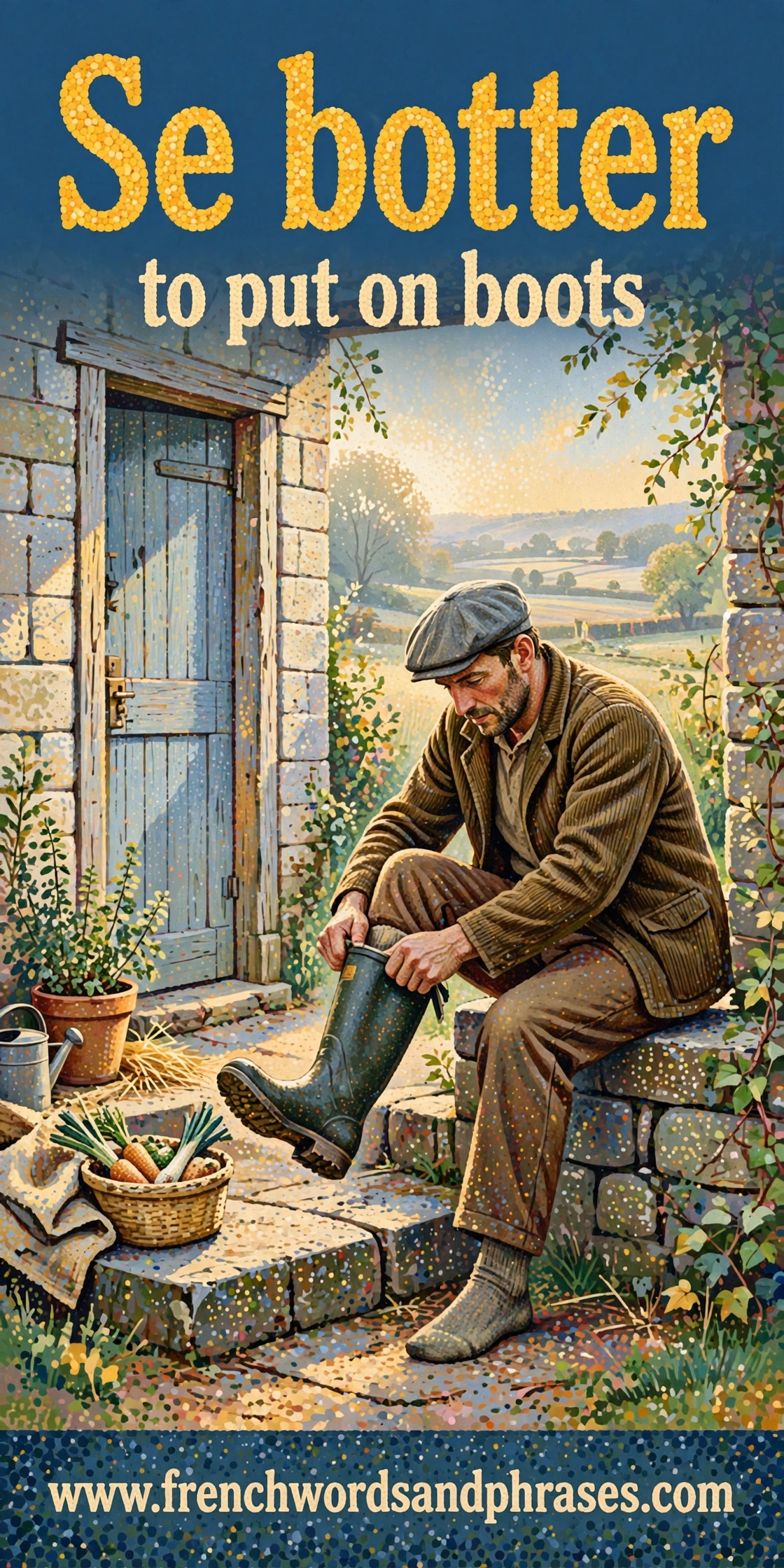
Se botter means to put on boots — to pull on your boots before the mud, the snow or the stable yard.
Rain on the farmyard, snow at the door, a stable to muck out — se botter is the small reflexive ceremony of pulling on boots, one leg at a time, before facing the weather.
In this guide, you’ll learn how to conjugate se botter in all the major French tenses and moods. Explore complete conjugation tables, French examples, English translations, and practice quizzes.
Understanding the French Verb Se botter
Se botter is a regular French verb belonging to the first group of verbs, those ending in-er.
It means to put on boots. It is a word of farms, stables, building sites and snowy mornings — anywhere boots are the uniform of the day — and its participle botté often does the describing by itself: un enfant bien botté is a child ready for the puddles.
Verb classification: First group (-er), reflexive
Auxiliary verb: Être
Past participle: botté
Present participle: bottant
English equivalents: To put on one’s boots, to boot up; se botter avant de sortir — to put your boots on before going out; botté, bottée — booted, wearing boots; bien botté — well booted, ready for the weather; se chausser — the general verb for putting shoes on.
The machinery is the reflexive standard: être in every compound tense, and the past participle agrees with the subject — elle s’est bottée, ils se sont bottés, nous nous sommes bottées. The stem itself is perfectly regular: je me botte, tu te bottes, nous nous bottons, ils se bottent. The tu imperative tucks the pronoun behind the verb: botte-toi ! One distinction matters: se chausser covers putting on any footwear, but se botter is boots only — tall, waterproof, and pulled on with a tug.
Experience the Word
Se botter is the verb of the doorstep ritual — wellingtons by the door, one foot, then the other, then the weather.
Imagine a farmhouse kitchen on a rainy November morning. Coats on, scarves on, and by the door the whole family se botte en silence: father, mother, children, each pulling on the tall boots that the mud outside demands.
The rain has not stopped. They are booted — bottés — and the farmyard can do its worst.
How to Conjugate Se botter: Complete French Conjugation Guide
Let’s explore every major conjugation of se botter, beginning with the indicative mood.
How to Conjugate Se botter in the Indicative Mood
The indicative mood is used to express facts, observations, actions, and events.
How to Conjugate Se botter in the Present Tense (Présent)
Used for actions happening now, habitual actions, and general truths.
| Subject | Conjugation |
|---|---|
| je | me botte |
| tu | te bottes |
| il / elle | se botte |
| nous | nous bottons |
| vous | vous bottez |
| ils / elles | se bottent |
Example
Les enfants se bottent avant de sortir.
The children put their boots on before going out.
Quick Quiz 1
Complete the sentence:
Nous nous ______ avant la pluie.
Reveal the answer
bottons
Nous nous bottons avant la pluie.
We put our boots on before the rain.
How to Conjugate Se botter in the Passé Composé
Used for completed actions in the past. Se botter takes the auxiliary verb être.
| Subject | Conjugation |
|---|---|
| je | me suis botté / me suis bottée |
| tu | t’es botté / t’es bottée |
| il / elle | s’est botté / s’est bottée |
| nous | nous sommes bottés / nous sommes bottées |
| vous | vous êtes bottés / vous êtes bottées / vous êtes botté / vous êtes bottée |
| ils / elles | se sont bottés / se sont bottées |
Example
Elle s’est bottée en deux minutes.
She got her boots on in two minutes.
How to Conjugate Se botter in the Imparfait (Imperfect Tense)
Used for habitual past actions, descriptions, and ongoing situations in the past.
| Subject | Conjugation |
|---|---|
| je | me bottais |
| tu | te bottais |
| il / elle | se bottait |
| nous | nous bottions |
| vous | vous bottiez |
| ils / elles | se bottaient |
Example
Chaque matin, il se bottait avant l’aube.
Every morning, he used to put his boots on before dawn.
Quick Quiz 2
Choose the correct form:
She got her boots on in two minutes.
Elle ______ en deux minutes. (s’est bottée / a botté)
Reveal the answer
s’est bottée
Elle s’est bottée en deux minutes.
Se botter is reflexive: être, and the participle agrees — bottée.
How to Conjugate Se botter in the Plus-que-parfait
Used to describe an action that had already been completed before another past event.
| Subject | Conjugation |
|---|---|
| je | m’étais botté / m’étais bottée |
| tu | t’étais botté / t’étais bottée |
| il / elle | s’était botté / s’était bottée |
| nous | nous étions bottés / nous étions bottées |
| vous | vous étiez bottés / vous étiez bottées / vous étiez botté / vous étiez bottée |
| ils / elles | s’étaient bottés / s’étaient bottées |
Example
Ils s’étaient bottés avant l’arrivée de la neige.
They had put their boots on before the snow arrived.
How to Conjugate Se botter in the Passé Simple
Primarily used in formal writing, literature, and historical narratives. It is rarely used in everyday conversation.
| Subject | Conjugation |
|---|---|
| je | me bottai |
| tu | te bottas |
| il / elle | se botta |
| nous | nous bottâmes |
| vous | vous bottâtes |
| ils / elles | se bottèrent |
Example
Le fermier se botta et sortit dans la cour boueuse.
The farmer put his boots on and went out into the muddy yard.
How to Conjugate Se botter in the Passé Antérieur
A literary tense used to express an action completed immediately before another past action, generally in the passé simple.
| Subject | Conjugation |
|---|---|
| je | me fus botté / me fus bottée |
| tu | te fus botté / te fus bottée |
| il / elle | se fut botté / se fut bottée |
| nous | nous fûmes bottés / nous fûmes bottées |
| vous | vous fûtes bottés / vous fûtes bottées / vous fûtes botté / vous fûtes bottée |
| ils / elles | se furent bottés / se furent bottées |
Example
Dès qu’elle se fut bottée, elle ouvrit la porte de l’étable.
As soon as she had put her boots on, she opened the stable door.
How to Conjugate Se botter in the Future Tense (Futur Simple)
Used to describe actions that will take place in the future.
| Subject | Conjugation |
|---|---|
| je | me botterai |
| tu | te botteras |
| il / elle | se bottera |
| nous | nous botterons |
| vous | vous botterez |
| ils / elles | se botteront |
Example
Demain, nous nous botterons pour la chasse.
Tomorrow, we shall put our boots on for the hunt.
How to Conjugate Se botter in the Futur Antérieur (Future Perfect)
Used for an action that will have been completed before a particular point in the future.
| Subject | Conjugation |
|---|---|
| je | me serai botté / me serai bottée |
| tu | te seras botté / te seras bottée |
| il / elle | se sera botté / se sera bottée |
| nous | nous serons bottés / nous serons bottées |
| vous | vous serez bottés / vous serez bottées / vous serez botté / vous serez bottée |
| ils / elles | se seront bottés / se seront bottées |
Example
À sept heures, tout le monde se sera botté.
By seven o’clock, everyone will have their boots on.
How to Conjugate Se botter in the Near Future (Futur Proche)
Used to describe something that is going to happen soon. Formed with aller + infinitive.
| Subject | Conjugation |
|---|---|
| je | vais me botter |
| tu | vas te botter |
| il / elle | va se botter |
| nous | allons nous botter |
| vous | allez vous botter |
| ils / elles | vont se botter |
Example
Vite, on va se botter, il pleut !
Quick, let’s get our boots on, it’s raining!
How to Conjugate Se botter in the Conditional Mood
The conditional mood expresses what would happen under certain circumstances. It is also frequently used to make polite requests or express wishes.
How to Conjugate Se botter in the Present Conditional
| Subject | Conjugation |
|---|---|
| je | me botterais |
| tu | te botterais |
| il / elle | se botterait |
| nous | nous botterions |
| vous | vous botteriez |
| ils / elles | se botteraient |
Example
Sans la boue, je ne me botterais pas.
Without the mud, I would not put boots on.
How to Conjugate Se botter in the Past Conditional
| Subject | Conjugation |
|---|---|
| je | me serais botté / me serais bottée |
| tu | te serais botté / te serais bottée |
| il / elle | se serait botté / se serait bottée |
| nous | nous serions bottés / nous serions bottées |
| vous | vous seriez bottés / vous seriez bottées / vous seriez botté / vous seriez bottée |
| ils / elles | se seraient bottés / se seraient bottées |
Example
Elle se serait bottée si elle avait su pour la neige.
She would have put her boots on if she had known about the snow.
Se botter in the Literary Past Conditional Form
This less common literary form uses the imperfect subjunctive of être.
| Subject | Conjugation |
|---|---|
| je | me fusse botté / me fusse bottée |
| tu | te fusses botté / te fusses bottée |
| il / elle | se fût botté / se fût bottée |
| nous | nous fussions bottés / nous fussions bottées |
| vous | vous fussiez bottés / vous fussiez bottées / vous fussiez botté / vous fussiez bottée |
| ils / elles | se fussent bottés / se fussent bottées |
Example
Il se fût botté avant l’aube sans sa blessure au pied.
He would have put his boots on before dawn but for his injured foot.
How to Conjugate Se botter in the Subjunctive Mood
The subjunctive is used to express wishes, emotions, doubts, necessity, and uncertainty. It frequently follows expressions such as il faut que (it is necessary that) or bien que (although).
How to Conjugate Se botter in the Present Subjunctive
| Subject | Conjugation |
|---|---|
| que je | me botte |
| que tu | te bottes |
| qu’il / qu’elle | se botte |
| que nous | nous bottions |
| que vous | vous bottiez |
| qu’ils / qu’elles | se bottent |
Example
Il faut que tu te bottes avant de sortir.
You must put your boots on before going out.
Quick Quiz 3
Complete the sentence using the subjunctive:
Il faut que vous vous ______ avant de sortir.
Reveal the answer
bottiez
Il faut que vous vous bottiez avant de sortir.
You must put your boots on before going out.
How to Conjugate Se botter in the Imperfect Subjunctive
A literary tense, rarely encountered in modern spoken French.
| Subject | Conjugation |
|---|---|
| que je | me bottasse |
| que tu | te bottasses |
| qu’il / qu’elle | se bottât |
| que nous | nous bottassions |
| que vous | vous bottassiez |
| qu’ils / qu’elles | se bottassent |
Example
Maman voulait que nous nous bottassions avant la pluie.
Mother wanted us to get our boots on before the rain.
How to Conjugate Se botter in the Pluperfect Subjunctive
A literary construction used to express an action completed before another past action.
| Subject | Conjugation |
|---|---|
| que je | me fusse botté / me fusse bottée |
| que tu | te fusses botté / te fusses bottée |
| qu’il / qu’elle | se fût botté / se fût bottée |
| que nous | nous fussions bottés / nous fussions bottées |
| que vous | vous fussiez bottés / vous fussiez bottées / vous fussiez botté / vous fussiez bottée |
| qu’ils / qu’elles | se fussent bottés / se fussent bottées |
Example
On racontait qu’ils se fussent bottés dès l’aube.
People said they had put their boots on at dawn.
How to Conjugate Se botter in the Past Subjunctive
| Subject | Conjugation |
|---|---|
| que je | me sois botté / me sois bottée |
| que tu | te sois botté / te sois bottée |
| qu’il / qu’elle | se soit botté / se soit bottée |
| que nous | nous soyons bottés / nous soyons bottées |
| que vous | vous soyez bottés / vous soyez bottées / vous soyez botté / vous soyez bottée |
| qu’ils / qu’elles | se soient bottés / se soient bottées |
Example
Je suis content que les enfants se soient bottés tout seuls.
I am glad the children put their boots on by themselves.
How to Conjugate Se botter in the Imperative
The imperative is used to give commands, instructions, invitations, or suggestions. Subject pronouns are omitted.
How to Conjugate Se botter in the Present Imperative
| Person | Conjugation |
|---|---|
| (tu) | botte-toi |
| (nous) | bottons-nous |
| (vous) | bottez-vous |
Example
Botte-toi vite, on part !
Get your boots on quickly, we’re leaving!
Quick Quiz 4
How would you say Get your boots on (tu form)?
Reveal the answer
Botte-toi !
French Participles of Se botter
Participles are verb forms that can be used in compound tenses and other grammatical constructions.
Present Participle of Se botter
bottant
En se bottant, il a renversé la boue partout.
While putting his boots on, he spilt mud everywhere.
Past Participle of Se botter
botté
Bottée dès l’aube, la fermière traverse la cour sans crainte.
Booted from dawn, the farmer’s wife crosses the yard without fear.
Se botter in Everyday French: Real-Life Examples
Now that you know the conjugations, let’s see how se botter appears in everyday French.
Example 1 — Present
Les enfants se bottent avant de sortir.
The children put their boots on before going out.
Example 2 — Passé composé
Elle s’est bottée en deux minutes.
She got her boots on in two minutes.
Example 3 — Imparfait
Il se bottait avant l’aube.
He used to put his boots on before dawn.
Example 4 — Future
Nous nous botterons pour la chasse.
We shall put our boots on for the hunt.
Example 5 — Conditional
Sans la boue, je ne me botterais pas.
Without the mud, I would not put boots on.
Example 6 — Imperative
Botte-toi vite, on part !
Get your boots on quickly, we’re leaving!
Beyond Translation: The Meaning of Se botter
Une botte again — the boot this time, not the bundle of hay: French dresses its feet with reflexive verbs, se chausser for shoes in general and se botter for the tall pull-on kind.
The participle has become a badge of readiness.
Bien botté, bien ganté — booted and gloved — describes anyone properly dressed against winter, and a child botté at the door is a small ceremony completed: the weather may now do what it likes.
How to Remember the French Verb Se botter
Remember it this way: Se botter is about wellingtons by the farmhouse door, one foot then the other.
- Reflexive plus être, with agreement: elle s’est bottée, ils se sont bottés.
- Boots only: shoes in general are se chausser — se botter is the tall, pull-on, mud-proof kind.
- Regular stem: je me botte, nous nous bottons, past participle botté; imperative botte-toi.
The key idea is wellingtons by the farmhouse door, one foot then the other.
Test Your Knowledge of Se botter
Let’s see how much you’ve learned. Try answering these questions before revealing the answers.
Question 1
Which auxiliary does se botter use, and how does the participle behave?
Reveal the answer
Être — it is reflexive, and the participle agrees: elle s’est bottée.
Question 2
How do you say The children put their boots on before going out in French?
Reveal the answer
Les enfants se bottent avant de sortir.
Question 3
Translate: Elle s’est bottée en deux minutes.
Reveal the answer
She got her boots on in two minutes.
Question 4
What is the past participle of se botter?
Reveal the answer
Botté — agreeing: bottée, bottés, bottées.
Question 5
Complete the sentence:
Il faut que tu te ______ avant de sortir.
Reveal the answer
bottes
Il faut que tu te bottes avant de sortir.
You must put your boots on before going out.
Your Final Challenge
Can You Use It?
How would you say this in French?
She puts her boots on at the barn door, and the November mud may do its worst.
Reveal the answer
Elle se botte à la porte de la grange, et la boue de novembre peut bien venir.
She puts her boots on at the barn door, and the November mud may do its worst.
A little French. A little curiosity. A richer everyday life.
LEARN FRENCH ONE WORD AT A TIME