A French Word to Live By
How to Conjugate Se bosseler in French
/sə bɔ.sle/
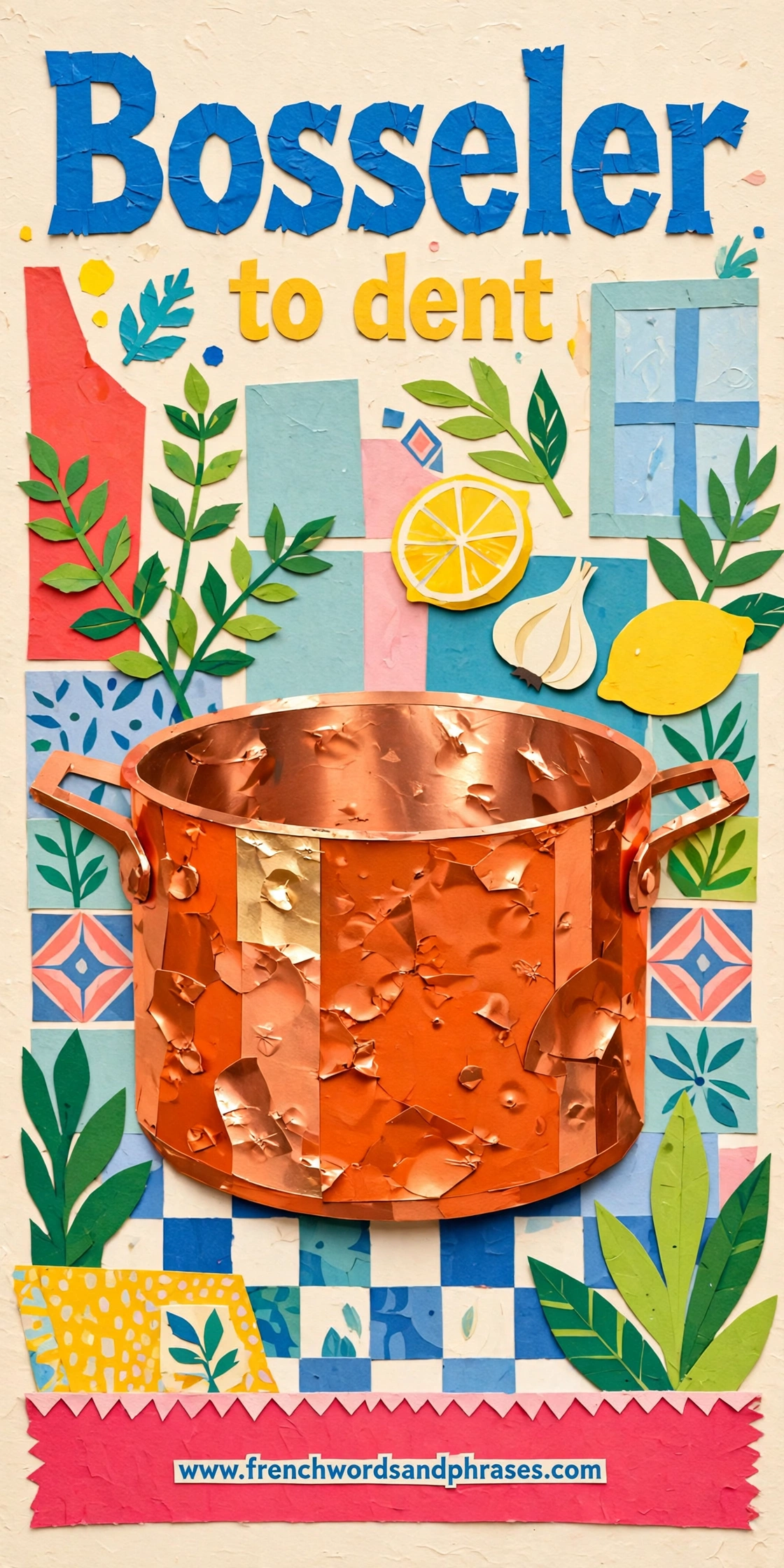
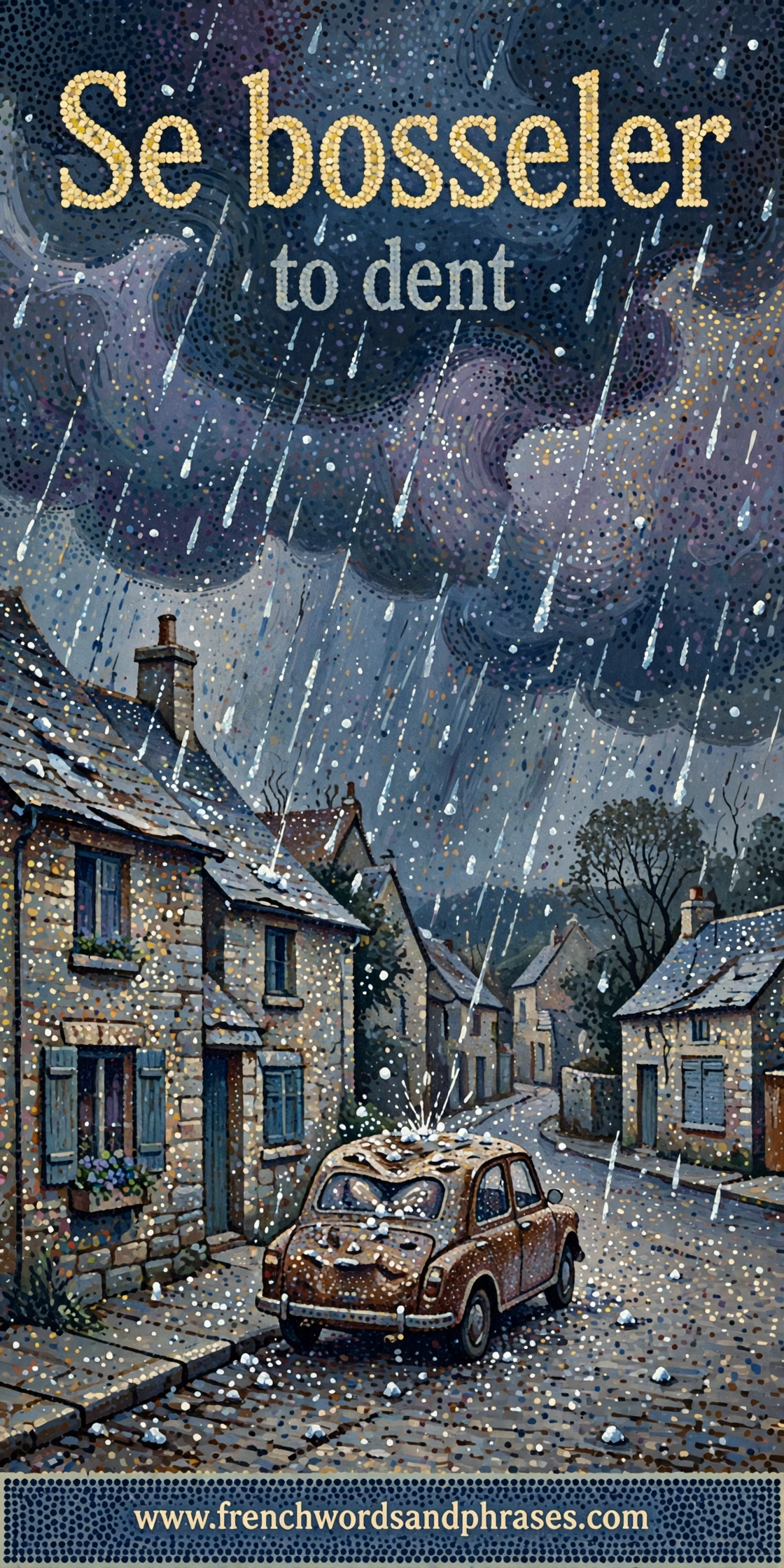
Se bosseler means to dent — to get a dent, to come away with a hollow where a smooth surface used to be.
A careless supermarket trolley, a dropped saucepan, a hailstorm over the car park — se bosseler is the verb for the moment a smooth surface gives way and keeps the mark: the panel, the pot or the bumper comes away dented.
In this guide, you’ll learn how to conjugate se bosseler in all the major French tenses and moods. Explore complete conjugation tables, French examples, English translations, and practice quizzes.
Understanding the French Verb Se bosseler
Se bosseler is a regular French verb belonging to the first group of verbs, those ending in-er.
It means to dent. It is the everyday verb of car bodywork and kitchenware — garages, insurers and cooks all use it — and its subject is almost always the damaged object, not the driver: on dit la portière s’est bosselée, jamais le conducteur s’est bosselé la portière.
Verb classification: First group (-er), reflexive
Auxiliary verb: Être
Past participle: bosselé
Present participle: bosselant
English equivalents: To get dented, to dent; la carrosserie se bosselle — the bodywork gets dented; une casserole qui se bosselle facilement — a pan that dents easily; se bosseler contre un mur — to get dented against a wall; une aile bosselée — a dented wing.
Two things to master. First, the doubling: bosseler is an appeler-type verb — the l doubles wherever the next syllable is mute: je me bosselle, tu te bosselles, il se bosselle, ils se bossellent, and in the future and conditional, je me bossellerai. The l stays single where the ending is sounded: nous nous bosselons, vous vous bosselez, je me bosselais, en me bosselant, and in the participle, bosselé. Second, the reflexive machinery: être in every compound tense, and the participle agrees with the subject: elle s’est bosselée, les portières se sont bosselées. And note the division of labour: the thing that receives the dent se bosselle; the person who makes the dent bosselle something — the plain verb, in its own entry.
Experience the Word
Se bosseler is the verb of the wound that metal remembers — a smooth skin, one sharp knock, and a hollow that never quite comes out.
Imagine a brand-new car in a supermarket car park. A runaway trolley gathers speed, clips the rear wing — clang — and rolls on. The paint is barely scratched, but the wing keeps a fine hollow: elle s’est bosselée, and no amount of polishing will argue otherwise.
The trolley is long gone. The wing keeps the dent — bosselée, quietly, for the rest of its life.
How to Conjugate Se bosseler: Complete French Conjugation Guide
Let’s explore every major conjugation of se bosseler, beginning with the indicative mood.
How to Conjugate Se bosseler in the Indicative Mood
The indicative mood is used to express facts, observations, actions, and events.
How to Conjugate Se bosseler in the Present Tense (Présent)
Used for actions happening now, habitual actions, and general truths.
| Subject | Conjugation |
|---|---|
| je | me bosselle |
| tu | te bosselles |
| il / elle | se bosselle |
| nous | nous bosselons |
| vous | vous bosselez |
| ils / elles | se bossellent |
Example
Cette tôle se bosselle au moindre choc.
This sheet metal dents at the slightest knock.
Quick Quiz 1
Complete the sentence:
Au moindre choc, cette tôle se ______.
Reveal the answer
bosselle
Au moindre choc, cette tôle se bosselle.
At the slightest knock, this sheet metal dents — double l before the mute e.
How to Conjugate Se bosseler in the Passé Composé
Used for completed actions in the past. Se bosseler takes the auxiliary verb être.
| Subject | Conjugation |
|---|---|
| je | me suis bosselé / me suis bosselée |
| tu | t’es bosselé / t’es bosselée |
| il / elle | s’est bosselé / s’est bosselée |
| nous | nous sommes bosselés / nous sommes bosselées |
| vous | vous êtes bosselés / vous êtes bosselées / vous êtes bosselé / vous êtes bosselée |
| ils / elles | se sont bosselés / se sont bosselées |
Example
La portière s’est bosselée contre le poteau.
The door got dented against the post.
How to Conjugate Se bosseler in the Imparfait (Imperfect Tense)
Used for habitual past actions, descriptions, and ongoing situations in the past.
| Subject | Conjugation |
|---|---|
| je | me bosselais |
| tu | te bosselais |
| il / elle | se bosselait |
| nous | nous bosselions |
| vous | vous bosseliez |
| ils / elles | se bosselaient |
Example
Sur les vieilles voitures, les ailes se bosselaient facilement.
On old cars, the wings used to dent easily.
Quick Quiz 2
Choose the correct form:
The saucepan got dented as it fell.
La casserole ______ en tombant. (s’est bosselée / a bosselé)
Reveal the answer
s’est bosselée
La casserole s’est bosselée en tombant.
Se bosseler is reflexive: être, and the participle agrees — bosselée.
How to Conjugate Se bosseler in the Plus-que-parfait
Used to describe an action that had already been completed before another past event.
| Subject | Conjugation |
|---|---|
| je | m’étais bosselé / m’étais bosselée |
| tu | t’étais bosselé / t’étais bosselée |
| il / elle | s’était bosselé / s’était bosselée |
| nous | nous étions bosselés / nous étions bosselées |
| vous | vous étiez bosselés / vous étiez bosselées / vous étiez bosselé / vous étiez bosselée |
| ils / elles | s’étaient bosselés / s’étaient bosselées |
Example
Le pare-chocs s’était déjà bosselé deux fois avant l’hiver.
The bumper had already got dented twice before the winter.
How to Conjugate Se bosseler in the Passé Simple
Primarily used in formal writing, literature, and historical narratives. It is rarely used in everyday conversation.
| Subject | Conjugation |
|---|---|
| je | me bosselai |
| tu | te bosselas |
| il / elle | se bossela |
| nous | nous bosselâmes |
| vous | vous bosselâtes |
| ils / elles | se bosselèrent |
Example
Sous la grêle, le toit se bossela en mille endroits.
Under the hail, the roof got dented in a thousand places.
How to Conjugate Se bosseler in the Passé Antérieur
A literary tense used to express an action completed immediately before another past action, generally in the passé simple.
| Subject | Conjugation |
|---|---|
| je | me fus bosselé / me fus bosselée |
| tu | te fus bosselé / te fus bosselée |
| il / elle | se fut bosselé / se fut bosselée |
| nous | nous fûmes bosselés / nous fûmes bosselées |
| vous | vous fûtes bosselés / vous fûtes bosselées / vous fûtes bosselé / vous fûtes bosselée |
| ils / elles | se furent bosselés / se furent bosselées |
Example
Dès que la casserole se fut bosselée, elle ne tint plus droit.
As soon as the saucepan had got dented, it no longer stood straight.
How to Conjugate Se bosseler in the Future Tense (Futur Simple)
Used to describe actions that will take place in the future.
| Subject | Conjugation |
|---|---|
| je | me bossellerai |
| tu | te bosselleras |
| il / elle | se bossellera |
| nous | nous bossellerons |
| vous | vous bossellerez |
| ils / elles | se bosselleront |
Example
Si tu laisses tomber ce faitout, il se bossellera.
If you drop that pot, it will get dented.
How to Conjugate Se bosseler in the Futur Antérieur (Future Perfect)
Used for an action that will have been completed before a particular point in the future.
| Subject | Conjugation |
|---|---|
| je | me serai bosselé / me serai bosselée |
| tu | te seras bosselé / te seras bosselée |
| il / elle | se sera bosselé / se sera bosselée |
| nous | nous serons bosselés / nous serons bosselées |
| vous | vous serez bosselés / vous serez bosselées / vous serez bosselé / vous serez bosselée |
| ils / elles | se seront bosselés / se seront bosselées |
Example
À ce rythme, la carrosserie se sera bosselée partout avant Noël.
At this rate, the bodywork will have got dented all over before Christmas.
How to Conjugate Se bosseler in the Near Future (Futur Proche)
Used to describe something that is going to happen soon. Formed with aller + infinitive.
| Subject | Conjugation |
|---|---|
| je | vais me bosseler |
| tu | vas te bosseler |
| il / elle | va se bosseler |
| nous | allons nous bosseler |
| vous | allez vous bosseler |
| ils / elles | vont se bosseler |
Example
Attention, le bidon va se bosseler !
Careful, the can is going to get dented!
How to Conjugate Se bosseler in the Conditional Mood
The conditional mood expresses what would happen under certain circumstances. It is also frequently used to make polite requests or express wishes.
How to Conjugate Se bosseler in the Present Conditional
| Subject | Conjugation |
|---|---|
| je | me bossellerais |
| tu | te bossellerais |
| il / elle | se bossellerait |
| nous | nous bossellerions |
| vous | vous bosselleriez |
| ils / elles | se bosselleraient |
Example
Sans le garage, la voiture se bossellerait à chaque grêle.
Without the garage, the car would get dented with every hailstorm.
How to Conjugate Se bosseler in the Past Conditional
| Subject | Conjugation |
|---|---|
| je | me serais bosselé / me serais bosselée |
| tu | te serais bosselé / te serais bosselée |
| il / elle | se serait bosselé / se serait bosselée |
| nous | nous serions bosselés / nous serions bosselées |
| vous | vous seriez bosselés / vous seriez bosselées / vous seriez bosselé / vous seriez bosselée |
| ils / elles | se seraient bosselés / se seraient bosselées |
Example
La portière se serait bosselée si le poteau n’avait pas cédé.
The door would have got dented if the post had not given way.
Se bosseler in the Literary Past Conditional Form
This less common literary form uses the imperfect subjunctive of être.
| Subject | Conjugation |
|---|---|
| je | me fusse bosselé / me fusse bosselée |
| tu | te fusses bosselé / te fusses bosselée |
| il / elle | se fût bosselé / se fût bosselée |
| nous | nous fussions bosselés / nous fussions bosselées |
| vous | vous fussiez bosselés / vous fussiez bosselées / vous fussiez bosselé / vous fussiez bosselée |
| ils / elles | se fussent bosselés / se fussent bosselées |
Example
Le toit se fût bosselé sous la grêle sans la bâche.
The roof would have got dented under the hail without the tarpaulin.
How to Conjugate Se bosseler in the Subjunctive Mood
The subjunctive is used to express wishes, emotions, doubts, necessity, and uncertainty. It frequently follows expressions such as il faut que (it is necessary that) or bien que (although).
How to Conjugate Se bosseler in the Present Subjunctive
| Subject | Conjugation |
|---|---|
| que je | me bosselle |
| que tu | te bosselles |
| qu’il / qu’elle | se bosselle |
| que nous | nous bosselions |
| que vous | vous bosseliez |
| qu’ils / qu’elles | se bossellent |
Example
Il est dommage que le capot se bosselle si vite.
It is a pity the bonnet dents so quickly.
Quick Quiz 3
Complete the sentence using the subjunctive:
Il est dommage que le capot se ______ si vite.
Reveal the answer
bosselle
Il est dommage que le capot se bosselle si vite.
It is a pity the bonnet dents so quickly.
How to Conjugate Se bosseler in the Imperfect Subjunctive
A literary tense, rarely encountered in modern spoken French.
| Subject | Conjugation |
|---|---|
| que je | me bosselasse |
| que tu | te bosselasses |
| qu’il / qu’elle | se bosselât |
| que nous | nous bosselassions |
| que vous | vous bosselassiez |
| qu’ils / qu’elles | se bosselassent |
Example
Le garagiste craignait que l’aile se bosselât davantage.
The mechanic feared the wing might get dented further.
How to Conjugate Se bosseler in the Pluperfect Subjunctive
A literary construction used to express an action completed before another past action.
| Subject | Conjugation |
|---|---|
| que je | me fusse bosselé / me fusse bosselée |
| que tu | te fusses bosselé / te fusses bosselée |
| qu’il / qu’elle | se fût bosselé / se fût bosselée |
| que nous | nous fussions bosselés / nous fussions bosselées |
| que vous | vous fussiez bosselés / vous fussiez bosselées / vous fussiez bosselé / vous fussiez bosselée |
| qu’ils / qu’elles | se fussent bosselés / se fussent bosselées |
Example
On racontait que la voiture se fût bosselée pendant la nuit.
People said the car had got dented during the night.
How to Conjugate Se bosseler in the Past Subjunctive
| Subject | Conjugation |
|---|---|
| que je | me sois bosselé / me sois bosselée |
| que tu | te sois bosselé / te sois bosselée |
| qu’il / qu’elle | se soit bosselé / se soit bosselée |
| que nous | nous soyons bosselés / nous soyons bosselées |
| que vous | vous soyez bosselés / vous soyez bosselées / vous soyez bosselé / vous soyez bosselée |
| qu’ils / qu’elles | se soient bosselés / se soient bosselées |
Example
Je suis surpris que la casserole se soit bosselée en tombant de si bas.
I am surprised the saucepan got dented falling such a short way.
How to Conjugate Se bosseler in the Imperative
The imperative is used to give commands, instructions, invitations, or suggestions. Subject pronouns are omitted.
How to Conjugate Se bosseler in the Present Imperative
| Person | Conjugation |
|---|---|
| (tu) | bosselle-toi |
| (nous) | bosselons-nous |
| (vous) | bosselez-vous |
Example
Ne te bosselle pas contre ce mur, petite voiture !
Do not dent yourself against that wall, little car!
Quick Quiz 4
How would you say Do not dent yourself against the wall (tu form)?
Reveal the answer
Ne te bosselle pas contre le mur !
French Participles of Se bosseler
Participles are verb forms that can be used in compound tenses and other grammatical constructions.
Present Participle of Se bosseler
bosselant
En se bosselant contre le trottoir, le bidon a perdu son couvercle.
By getting dented against the kerb, the can lost its lid.
Past Participle of Se bosseler
bosselé
Bosselée de partout, la vieille casserole sert encore tous les jours.
Dented all over, the old saucepan still serves every day.
Se bosseler in Everyday French: Real-Life Examples
Now that you know the conjugations, let’s see how se bosseler appears in everyday French.
Example 1 — Present
Cette tôle se bosselle au moindre choc.
This metal dents at the slightest knock.
Example 2 — Passé composé
La portière s’est bosselée contre le poteau.
The door got dented against the post.
Example 3 — Imparfait
Les ailes se bosselaient facilement autrefois.
Wings used to dent easily in the old days.
Example 4 — Future
Le faitout se bossellera si tu le laisses tomber.
The pot will get dented if you drop it.
Example 5 — Conditional
Sans garage, elle se bossellerait à chaque orage.
Without a garage, it would get dented in every storm.
Example 6 — Imperative
Ne te bosselle pas contre le mur !
Do not dent yourself against the wall!
Beyond Translation: The Meaning of Se bosseler
Everything starts from la bosse — a bump, a lump, a hollow’s opposite twin: a knock raises a bosse on a forehead and presses one into a car wing, and French uses the same word for both sides of the blow.
The family is large.
Bossu is hunchbacked — Quasimodo is le Bossu de Notre-Dame — bosseler dents things, and se bosseler is what happens to the thing itself. English boss, the raised ornament on a shield, crossed the Channel from this same Old French word centuries ago.
How to Remember the French Verb Se bosseler
Remember it this way: Se bosseler is about the wing after the trolley — smooth yesterday, hollow today.
- Appeler-type doubling: je me bosselle with double l, but nous nous bosselons with one.
- The victim is reflexive, the culprit is not: la portière se bosselle, le conducteur bosselle la portière.
- Être, and the participle agrees: elle s’est bosselée, ils se sont bosselés.
The key idea is the wing after the trolley — smooth yesterday, hollow today.
Test Your Knowledge of Se bosseler
Let’s see how much you’ve learned. Try answering these questions before revealing the answers.
Question 1
Which auxiliary does se bosseler use, and how does the participle behave?
Reveal the answer
Être — it is reflexive, and the participle agrees: elle s’est bosselée.
Question 2
How do you say The door got dented against the post in French?
Reveal the answer
La portière s’est bosselée contre le poteau.
Question 3
Translate: This sheet metal dents at the slightest knock.
Reveal the answer
Cette tôle se bosselle au moindre choc.
Question 4
What is the past participle of se bosseler?
Reveal the answer
Bosselé — agreeing: bosselée, bosselés, bosselées.
Question 5
Complete the sentence:
Si tu laisses tomber le bidon, il se ______.
Reveal the answer
bossellera
Si tu laisses tomber le bidon, il se bossellera.
If you drop the can, it will get dented — note the double l in the future.
Your Final Challenge
Can You Use It?
How would you say this in French?
The car got dented against the post, but it still drives on proudly.
Reveal the answer
La voiture s’est bosselée contre le poteau, mais elle roule toujours fièrement.
The car got dented against the post, but it still drives on proudly.
A little French. A little curiosity. A richer everyday life.
LEARN FRENCH ONE WORD AT A TIME