A French Word to Live By
How to Conjugate Border in French
/bɔʁ.de/
Border means to border, to bound — to run along the edge of a road, a coast or a field, and to tuck the edges of a bed firmly in.
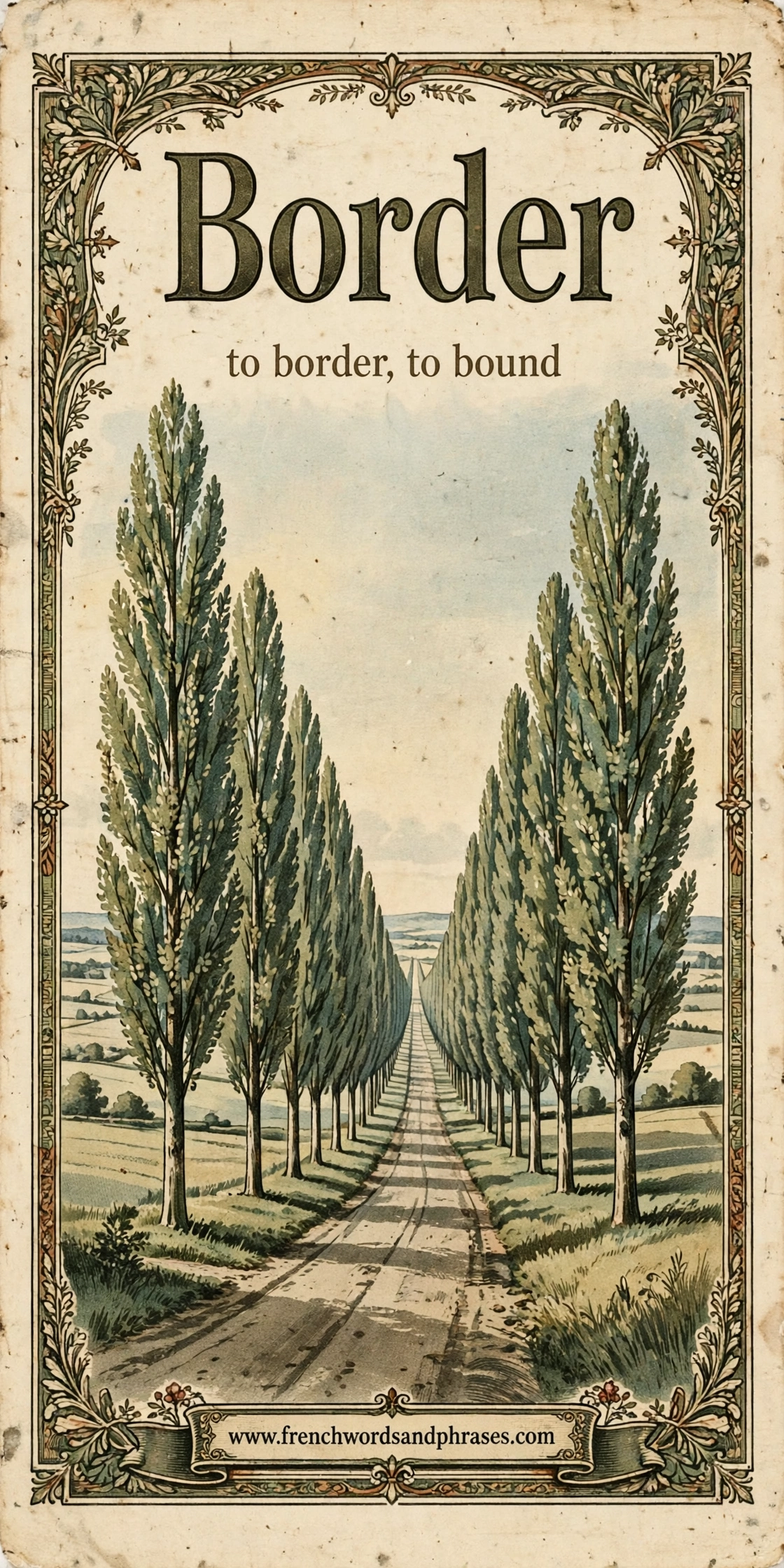
Poplars standing guard along a country road, waves running the length of a coast, a mother tucking the sheet tight around a sleeping child — border is the verb of the edge: whatever runs along a boundary, or folds a loose edge safely in, borde.
In this guide, you’ll learn how to conjugate border in all the major French tenses and moods. Explore complete conjugation tables, French examples, English translations, and practice quizzes.
Understanding the French Verb Border
Border is a regular French verb belonging to the first group of verbs, those ending in-er.
It means to border, to bound. It is the standard verb for anything that lines or flanks — roads, rivers, coasts, gardens — and the tender domestic verb of bedtime, where border les enfants is the last act of the parental evening round.
Verb classification: First group (-er)
Auxiliary verb: Avoir
Past participle: bordé
Present participle: bordant
English equivalents: To border, to line, to edge, to bound; border une route — to line a road; border un lit — to tuck in a bed; border un enfant — to tuck a child in; border une robe — to trim a dress; la mer borde la côte — the sea borders the coast.
One important detail: border leads two lives, and both grow from le bord, the edge. In the landscape it means to run along an edge: les arbres bordent la route. In the bedroom it means to fold the edge in: border un lit is to tuck the sheets in tight, and border un enfant is to tuck the child himself in for the night. The verb is perfectly regular: je borde, nous bordons, ils bordent. Sailors add a third life: border une voile, to haul a sail in tight.
Experience the Word
Border is the verb of the edge — it walks the line between two things and, in the bedroom, folds that line safely under the mattress.
Imagine a lane in Provence at dusk. On both sides the cypresses stand in dark rows, bordant la route like an honour guard, and at the lane’s end a mother is doing the other border: sheet folded, blanket tucked, border l’enfant — and the day is edged in on every side.
Road and bed obey the same word. Both are bordered — bordés, lined and tucked along their edges.
How to Conjugate Border: Complete French Conjugation Guide
Let’s explore every major conjugation of border, beginning with the indicative mood.
How to Conjugate Border in the Indicative Mood
The indicative mood is used to express facts, observations, actions, and events.
How to Conjugate Border in the Present Tense (Présent)
Used for actions happening now, habitual actions, and general truths.
| Subject | Conjugation |
|---|---|
| je | borde |
| tu | bordes |
| il / elle | borde |
| nous | bordons |
| vous | bordez |
| ils / elles | bordent |
Example
Les peupliers bordent la route du village.
Poplars line the road to the village.
Quick Quiz 1
Complete the sentence:
Nous ______ le lit du bébé.
Reveal the answer
bordons
Nous bordons le lit du bébé.
We tuck in the baby’s bed.
How to Conjugate Border in the Passé Composé
Used for completed actions in the past. Border takes the auxiliary verb avoir.
| Subject | Conjugation |
|---|---|
| j’ | ai bordé |
| tu | as bordé |
| il / elle | a bordé |
| nous | avons bordé |
| vous | avez bordé |
| ils / elles | ont bordé |
Example
Elle a bordé les enfants avant de descendre.
She tucked the children in before going downstairs.
How to Conjugate Border in the Imparfait (Imperfect Tense)
Used for habitual past actions, descriptions, and ongoing situations in the past.
| Subject | Conjugation |
|---|---|
| je | bordais |
| tu | bordais |
| il / elle | bordait |
| nous | bordions |
| vous | bordiez |
| ils / elles | bordaient |
Example
Une haie de roses bordait le jardin.
A hedge of roses bordered the garden.
Quick Quiz 2
Choose the correct form:
She tucked the children in.
Elle ______ les enfants. (a bordé / est bordée)
Reveal the answer
a bordé
Elle a bordé les enfants.
Border takes avoir.
How to Conjugate Border in the Plus-que-parfait
Used to describe an action that had already been completed before another past event.
| Subject | Conjugation |
|---|---|
| j’ | avais bordé |
| tu | avais bordé |
| il / elle | avait bordé |
| nous | avions bordé |
| vous | aviez bordé |
| ils / elles | avaient bordé |
Example
Il avait bordé le lit avec soin.
He had tucked in the bed carefully.
How to Conjugate Border in the Passé Simple
Primarily used in formal writing, literature, and historical narratives. It is rarely used in everyday conversation.
| Subject | Conjugation |
|---|---|
| je | bordai |
| tu | bordas |
| il / elle | borda |
| nous | bordâmes |
| vous | bordâtes |
| ils / elles | bordèrent |
Example
La rivière borda longtemps la frontière du royaume.
The river long bordered the frontier of the kingdom.
How to Conjugate Border in the Passé Antérieur
A literary tense used to express an action completed immediately before another past action, generally in the passé simple.
| Subject | Conjugation |
|---|---|
| j’ | eus bordé |
| tu | eus bordé |
| il / elle | eut bordé |
| nous | eûmes bordé |
| vous | eûtes bordé |
| ils / elles | eurent bordé |
Example
Quand elle eut bordé le petit, elle éteignit la lampe.
When she had tucked the little one in, she switched off the lamp.
How to Conjugate Border in the Future Tense (Futur Simple)
Used to describe actions that will take place in the future.
| Subject | Conjugation |
|---|---|
| je | borderai |
| tu | borderas |
| il / elle | bordera |
| nous | borderons |
| vous | borderez |
| ils / elles | borderont |
Example
Des lampadaires borderont la nouvelle avenue.
Street lamps will line the new avenue.
How to Conjugate Border in the Futur Antérieur (Future Perfect)
Used for an action that will have been completed before a particular point in the future.
| Subject | Conjugation |
|---|---|
| j’ | aurai bordé |
| tu | auras bordé |
| il / elle | aura bordé |
| nous | aurons bordé |
| vous | aurez bordé |
| ils / elles | auront bordé |
Example
À la tombée de la nuit, elle aura bordé tous les lits.
By nightfall, she will have tucked in all the beds.
How to Conjugate Border in the Near Future (Futur Proche)
Used to describe something that is going to happen soon. Formed with aller + infinitive.
| Subject | Conjugation |
|---|---|
| je | vais border |
| tu | vas border |
| il / elle | va border |
| nous | allons border |
| vous | allez border |
| ils / elles | vont border |
Example
Je vais border le bébé, il s’endort.
I am going to tuck the baby in, he is falling asleep.
How to Conjugate Border in the Conditional Mood
The conditional mood expresses what would happen under certain circumstances. It is also frequently used to make polite requests or express wishes.
How to Conjugate Border in the Present Conditional
| Subject | Conjugation |
|---|---|
| je | borderais |
| tu | borderais |
| il / elle | borderait |
| nous | borderions |
| vous | borderiez |
| ils / elles | borderaient |
Example
Sans les arbres, rien ne borderait ce chemin.
Without the trees, nothing would line this path.
How to Conjugate Border in the Past Conditional
| Subject | Conjugation |
|---|---|
| j’ | aurais bordé |
| tu | aurais bordé |
| il / elle | aurait bordé |
| nous | aurions bordé |
| vous | auriez bordé |
| ils / elles | auraient bordé |
Example
Tu aurais bordé la robe d’un ruban bleu.
You would have trimmed the dress with a blue ribbon.
Border in the Literary Past Conditional Form
This less common literary form uses the imperfect subjunctive of avoir.
| Subject | Conjugation |
|---|---|
| j’ | eusse bordé |
| tu | eusses bordé |
| il / elle | eût bordé |
| nous | eussions bordé |
| vous | eussiez bordé |
| ils / elles | eussent bordé |
Example
La forêt eût bordé la plaine entière.
The forest would have bordered the whole plain.
How to Conjugate Border in the Subjunctive Mood
The subjunctive is used to express wishes, emotions, doubts, necessity, and uncertainty. It frequently follows expressions such as il faut que (it is necessary that) or bien que (although).
How to Conjugate Border in the Present Subjunctive
| Subject | Conjugation |
|---|---|
| que je | borde |
| que tu | bordes |
| qu’il / qu’elle | borde |
| que nous | bordions |
| que vous | bordiez |
| qu’ils / qu’elles | bordent |
Example
Il faut que tu bordes bien le lit du bébé.
You must tuck the baby’s bed in properly.
Quick Quiz 3
Complete the sentence using the subjunctive:
Il faut que vous ______ la route d’arbres.
Reveal the answer
bordiez
Il faut que vous bordiez la route d’arbres.
You must line the road with trees.
How to Conjugate Border in the Imperfect Subjunctive
A literary tense, rarely encountered in modern spoken French.
| Subject | Conjugation |
|---|---|
| que je | bordasse |
| que tu | bordasses |
| qu’il / qu’elle | bordât |
| que nous | bordassions |
| que vous | bordassiez |
| qu’ils / qu’elles | bordassent |
Example
On voulait que la haie bordât tout le champ.
They wanted the hedge to border the whole field.
How to Conjugate Border in the Pluperfect Subjunctive
A literary construction used to express an action completed before another past action.
| Subject | Conjugation |
|---|---|
| que j’ | eusse bordé |
| que tu | eusses bordé |
| qu’il / qu’elle | eût bordé |
| que nous | eussions bordé |
| que vous | eussiez bordé |
| qu’ils / qu’elles | eussent bordé |
Example
On racontait que la mer eût bordé jadis ces collines.
People said the sea had once bordered these hills.
How to Conjugate Border in the Past Subjunctive
| Subject | Conjugation |
|---|---|
| que j’ | aie bordé |
| que tu | aies bordé |
| qu’il / qu’elle | ait bordé |
| que nous | ayons bordé |
| que vous | ayez bordé |
| qu’ils / qu’elles | aient bordé |
Example
Je suis content que tu aies bordé les enfants.
I am glad you tucked the children in.
How to Conjugate Border in the Imperative
The imperative is used to give commands, instructions, invitations, or suggestions. Subject pronouns are omitted.
How to Conjugate Border in the Present Imperative
| Person | Conjugation |
|---|---|
| (tu) | borde |
| (nous) | bordons |
| (vous) | bordez |
Example
Borde ton lit avant de partir !
Tuck your bed in before you leave!
Quick Quiz 4
How would you say Tuck the baby in (tu form)?
Reveal the answer
Borde le bébé !
French Participles of Border
Participles are verb forms that can be used in compound tenses and other grammatical constructions.
Present Participle of Border
bordant
En bordant la route, les arbres font une voûte verte.
By lining the road, the trees form a green vault.
Past Participle of Border
bordé
Bordée de maisons anciennes, la place semble dormir.
Bordered by old houses, the square seems asleep.
Border in Everyday French: Real-Life Examples
Now that you know the conjugations, let’s see how border appears in everyday French.
Example 1 — Present
Les peupliers bordent la route.
Poplars line the road.
Example 2 — Passé composé
Elle a bordé les enfants.
She tucked the children in.
Example 3 — Imparfait
Une haie bordait le jardin.
A hedge bordered the garden.
Example 4 — Future
Des lampadaires borderont l’avenue.
Street lamps will line the avenue.
Example 5 — Conditional
Rien ne borderait ce chemin sans les arbres.
Nothing would line this path without the trees.
Example 6 — Imperative
Borde le bébé, il s’endort !
Tuck the baby in, he is falling asleep!
Beyond Translation: The Meaning of Border
English border is the same word wearing a slightly different coat — both come from the old Germanic word for a board, a plank, an edge.
One noun carries the whole family.
Le bord is the edge of anything: the shore (au bord de la mer), the rim of a glass, the side of a ship — à bord, on board. And the verb simply puts things along that edge, whether the things are poplars, street lamps or the folded corner of a child’s blanket.
How to Remember the French Verb Border
Remember it this way: Border is about trees along the road — and tucked-in sheets.
- Le bord is the edge: border is to run along it — or to tuck it in.
- Two scenes, one verb: les arbres bordent la route; border un enfant avant la nuit.
- Regular -er: je borde, nous bordons, past participle bordé, auxiliary avoir.
The key idea is trees along the road — and tucked-in sheets.
Test Your Knowledge of Border
Let’s see how much you’ve learned. Try answering these questions before revealing the answers.
Question 1
What are the two everyday lives of border?
Reveal the answer
To line or bound a place (les peupliers bordent la route) and to tuck in (border un lit, border un enfant).
Question 2
How do you say Poplars line the road in French?
Reveal the answer
Les peupliers bordent la route.
Question 3
Translate: She tucked the children in.
Reveal the answer
Elle a bordé les enfants.
Question 4
What is the past participle of border?
Reveal the answer
Bordé.
Question 5
Complete the sentence:
Il faut que tu ______ bien le lit du bébé.
Reveal the answer
bordes
Il faut que tu bordes bien le lit du bébé.
You must tuck the baby’s bed in properly.
Your Final Challenge
Can You Use It?
How would you say this in French?
The cypresses line the road, the sea borders the coast, and the mother tucks in the child: the world is well guarded.
Reveal the answer
Les cyprès bordent la route, la mer borde la côte, et la mère borde l’enfant : le monde est bien gardé.
The cypresses line the road, the sea borders the coast, and the mother tucks in the child: the world is well guarded.
A little French. A little curiosity. A richer everyday life.
LEARN FRENCH ONE WORD AT A TIME