A French Word to Live By
How to Conjugate Bibeloter in French
/bi.bə.lo.te/
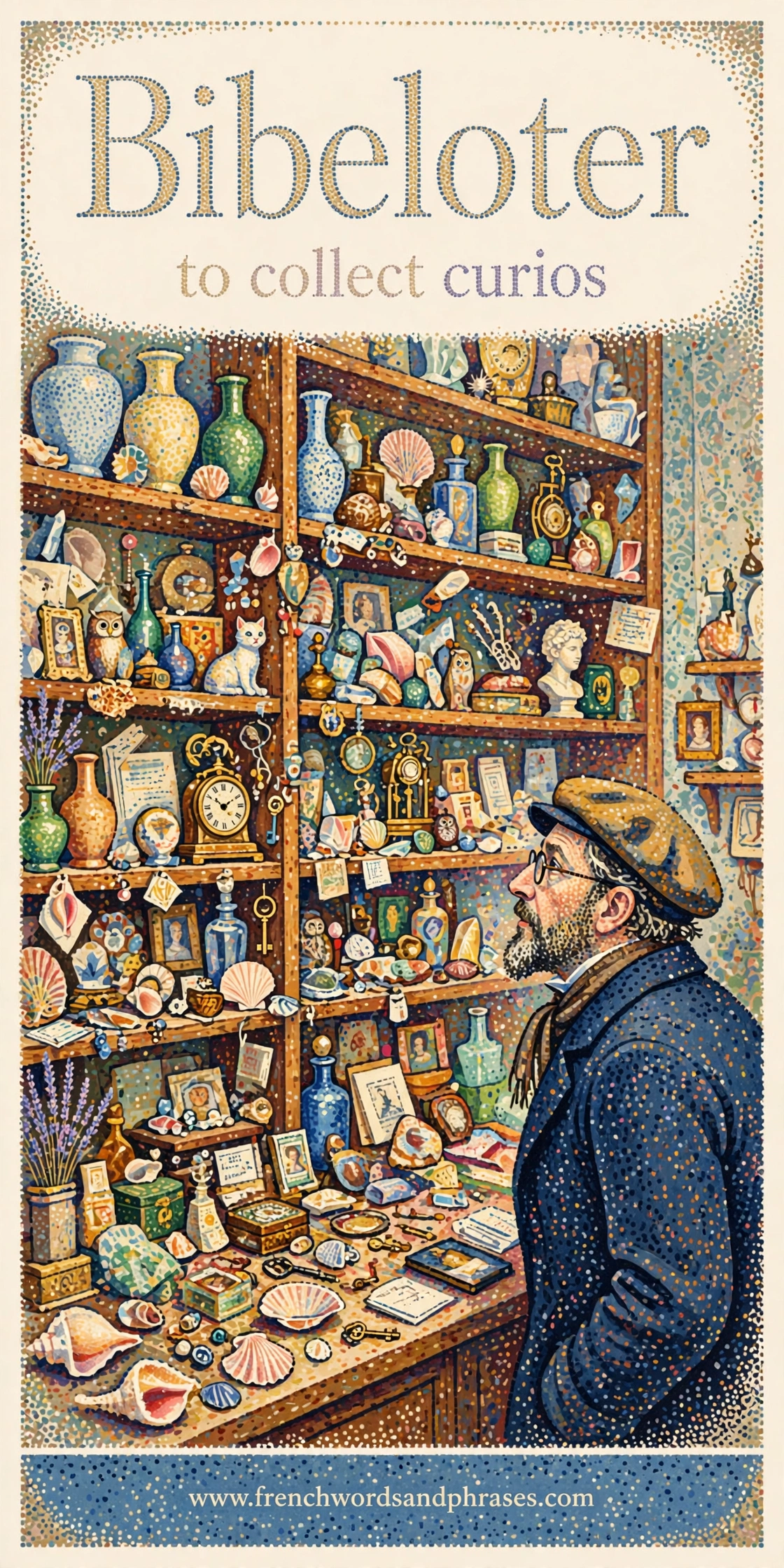
Bibeloter means to collect curios — to hunt down knick-knacks, trinkets and pretty little objects and fill your shelves with them.
A Sunday-morning flea market, a stall of porcelain dogs, brass bells and painted boxes, and one browser who cannot possibly leave empty-handed — bibeloter is the verb of the knick-knack hunter: collecting small, useless, delightful objects for the pure pleasure of owning them.
In this guide, you’ll learn how to conjugate bibeloter in all the major French tenses and moods. Explore complete conjugation tables, French examples, English translations, and practice quizzes.
Understanding the French Verb Bibeloter
Bibeloter is a regular French verb belonging to the first group of verbs, those ending in -er.
It means to collect curios. It belongs to the world of brocantes, vide-greniers and antique stalls. Where collectionner is the neutral verb for any collection at all, bibeloter is only ever about small decorative things — charming, slightly dusty, and loved precisely because they serve no purpose.
Verb classification: First group (-er)
Auxiliary verb: Avoir
Past participle: bibeloté
Present participle: bibelotant
English equivalents: To collect knick-knacks, to collect curios; bibeloter aux puces — to hunt for trinkets at the flea market; bibeloter des objets anciens — to collect little antiques; un bibelot — a knick-knack, a curio.
One important detail: bibeloter is simply the verb of un bibelot, a knick-knack — whoever bibelote collects bibelots. The verb is perfectly regular, and the little middle vowel is a quiet schwa: je bibelote, nous bibelotons, ils bibelotent. It is a gentle, slightly old-fashioned word, at home among collectors, brocante dealers and lovers of vide-greniers (garage sales), and it always implies small decorative objects — nobody bibelote stamps in an album or paintings in a gallery; for serious collecting French uses collectionner.
Experience the Word
Bibeloter is the verb of the crowded shelf — every object useless, every object loved, and always room for one more.
Imagine an old lady at the Marché aux Puces at dawn. The dealers know her; they keep the painted boxes under the counter for her. She turns a porcelain shepherdess over in her hands, haggles for two minutes, and tucks it into her bag — elle a bibeloté, once again, and her sitting room gains another citizen.
She does not need it, and that is the whole point. She has collected — bibeloté — a little piece of beauty that serves nothing at all.
How to Conjugate Bibeloter: Complete French Conjugation Guide
Let’s explore every major conjugation of bibeloter, beginning with the indicative mood.
How to Conjugate Bibeloter in the Indicative Mood
The indicative mood is used to express facts, observations, actions, and events.
How to Conjugate Bibeloter in the Present Tense (Présent)
Used for actions happening now, habitual actions, and general truths.
| Subject | Conjugation |
|---|---|
| je | bibelote |
| tu | bibelotes |
| il / elle | bibelote |
| nous | bibelotons |
| vous | bibelotez |
| ils / elles | bibelotent |
Example
Elle bibelote dans tous les vide-greniers du dimanche.
She hunts for knick-knacks at every Sunday garage sale.
Quick Quiz 1
Complete the sentence:
Nous ______ aux puces chaque dimanche.
Reveal the answer
bibelotons
Nous bibelotons aux puces chaque dimanche.
We collect curios at the flea market every Sunday.
How to Conjugate Bibeloter in the Passé Composé
Used for completed actions in the past. Bibeloter takes the auxiliary verb avoir.
| Subject | Conjugation |
|---|---|
| j’ | ai bibeloté |
| tu | as bibeloté |
| il / elle | a bibeloté |
| nous | avons bibeloté |
| vous | avez bibeloté |
| ils / elles | ont bibeloté |
Example
Il a bibeloté pendant des années avant d’ouvrir sa boutique.
He collected curios for years before opening his shop.
How to Conjugate Bibeloter in the Imparfait (Imperfect Tense)
Used for habitual past actions, descriptions, and ongoing situations in the past.
| Subject | Conjugation |
|---|---|
| je | bibelotais |
| tu | bibelotais |
| il / elle | bibelotait |
| nous | bibelotions |
| vous | bibelotiez |
| ils / elles | bibelotaient |
Example
Ma grand-mère bibelotait chaque dimanche aux puces.
My grandmother used to hunt for trinkets at the flea market every Sunday.
Quick Quiz 2
Choose the correct form:
He collected trinkets for years.
Il ______ pendant des années. (a bibeloté / est bibeloté)
Reveal the answer
a bibeloté
Il a bibeloté pendant des années.
Bibeloter takes avoir.
How to Conjugate Bibeloter in the Plus-que-parfait
Used to describe an action that had already been completed before another past event.
| Subject | Conjugation |
|---|---|
| j’ | avais bibeloté |
| tu | avais bibeloté |
| il / elle | avait bibeloté |
| nous | avions bibeloté |
| vous | aviez bibeloté |
| ils / elles | avaient bibeloté |
Example
Ils avaient bibeloté tant d’objets que la maison débordait.
They had collected so many objects that the house was overflowing.
How to Conjugate Bibeloter in the Passé Simple
Primarily used in formal writing, literature, and historical narratives. It is rarely used in everyday conversation.
| Subject | Conjugation |
|---|---|
| je | bibelotai |
| tu | bibelotas |
| il / elle | bibelota |
| nous | bibelotâmes |
| vous | bibelotâtes |
| ils / elles | bibelotèrent |
Example
Elle bibelota tout l’été sur les marchés de Provence.
She spent the whole summer collecting curios at the markets of Provence.
How to Conjugate Bibeloter in the Passé Antérieur
A literary tense used to express an action completed immediately before another past action, generally in the passé simple.
| Subject | Conjugation |
|---|---|
| j’ | eus bibeloté |
| tu | eus bibeloté |
| il / elle | eut bibeloté |
| nous | eûmes bibeloté |
| vous | eûtes bibeloté |
| ils / elles | eurent bibeloté |
Example
Quand il eut bibeloté assez de montres anciennes, il les exposa dans une vitrine.
When he had collected enough old watches, he displayed them in a glass case.
How to Conjugate Bibeloter in the Future Tense (Futur Simple)
Used to describe actions that will take place in the future.
| Subject | Conjugation |
|---|---|
| je | bibeloterai |
| tu | bibeloteras |
| il / elle | bibelotera |
| nous | bibeloterons |
| vous | bibeloterez |
| ils / elles | bibeloteront |
Example
Dimanche prochain, nous bibeloterons au marché aux puces.
Next Sunday, we will hunt for knick-knacks at the flea market.
How to Conjugate Bibeloter in the Futur Antérieur (Future Perfect)
Used for an action that will have been completed before a particular point in the future.
| Subject | Conjugation |
|---|---|
| j’ | aurai bibeloté |
| tu | auras bibeloté |
| il / elle | aura bibeloté |
| nous | aurons bibeloté |
| vous | aurez bibeloté |
| ils / elles | auront bibeloté |
Example
À la fin de l’année, elle aura bibeloté plus de cent figurines.
By the end of the year, she will have collected more than a hundred figurines.
How to Conjugate Bibeloter in the Near Future (Futur Proche)
Used to describe something that is going to happen soon. Formed with aller + infinitive.
| Subject | Conjugation |
|---|---|
| je | vais bibeloter |
| tu | vas bibeloter |
| il / elle | va bibeloter |
| nous | allons bibeloter |
| vous | allez bibeloter |
| ils / elles | vont bibeloter |
Example
Regarde-la, elle va encore bibeloter toute la matinée !
Look at her, she is going to spend the whole morning collecting trinkets again!
How to Conjugate Bibeloter in the Conditional Mood
The conditional mood expresses what would happen under certain circumstances. It is also frequently used to make polite requests or express wishes.
How to Conjugate Bibeloter in the Present Conditional
| Subject | Conjugation |
|---|---|
| je | bibeloterais |
| tu | bibeloterais |
| il / elle | bibeloterait |
| nous | bibeloterions |
| vous | bibeloteriez |
| ils / elles | bibeloteraient |
Example
Avec plus de place, je bibeloterais encore davantage.
With more room, I would collect even more curios.
How to Conjugate Bibeloter in the Past Conditional
| Subject | Conjugation |
|---|---|
| j’ | aurais bibeloté |
| tu | aurais bibeloté |
| il / elle | aurait bibeloté |
| nous | aurions bibeloté |
| vous | auriez bibeloté |
| ils / elles | auraient bibeloté |
Example
Il aurait bibeloté toute sa vie sans les conseils de sa femme.
He would have collected knick-knacks all his life without his wife’s advice.
Bibeloter in the Literary Past Conditional Form
This less common literary form uses the imperfect subjunctive of avoir.
| Subject | Conjugation |
|---|---|
| j’ | eusse bibeloté |
| tu | eusses bibeloté |
| il / elle | eût bibeloté |
| nous | eussions bibeloté |
| vous | eussiez bibeloté |
| ils / elles | eussent bibeloté |
Example
Elle eût bibeloté jusqu’au bout si la brocante eût fermé moins tôt.
She would have gone on collecting until the very end if the market had closed later.
How to Conjugate Bibeloter in the Subjunctive Mood
The subjunctive is used to express wishes, emotions, doubts, necessity, and uncertainty. It frequently follows expressions such as il faut que (it is necessary that) or bien que (although).
How to Conjugate Bibeloter in the Present Subjunctive
| Subject | Conjugation |
|---|---|
| que je | bibelote |
| que tu | bibelotes |
| qu’il / qu’elle | bibelote |
| que nous | bibelotions |
| que vous | bibelotiez |
| qu’ils / qu’elles | bibelotent |
Example
Je doute qu’elle bibelote encore à son âge.
I doubt she still collects curios at her age.
Quick Quiz 3
Complete the sentence using the subjunctive:
Je doute que vous ______ encore dans ce magasin.
Reveal the answer
bibelotiez
Je doute que vous bibelotiez encore dans ce magasin.
I doubt you still hunt for knick-knacks in that shop.
How to Conjugate Bibeloter in the Imperfect Subjunctive
A literary tense, rarely encountered in modern spoken French.
| Subject | Conjugation |
|---|---|
| que je | bibelotasse |
| que tu | bibelotasses |
| qu’il / qu’elle | bibelotât |
| que nous | bibelotassions |
| que vous | bibelotassiez |
| qu’ils / qu’elles | bibelotassent |
Example
Il fallait qu’il bibelotât avec modération.
He had to collect knick-knacks in moderation.
How to Conjugate Bibeloter in the Pluperfect Subjunctive
A literary construction used to express an action completed before another past action.
| Subject | Conjugation |
|---|---|
| que j’ | eusse bibeloté |
| que tu | eusses bibeloté |
| qu’il / qu’elle | eût bibeloté |
| que nous | eussions bibeloté |
| que vous | eussiez bibeloté |
| qu’ils / qu’elles | eussent bibeloté |
Example
On disait qu’ils eussent bibeloté dans toute l’Europe.
People said they had collected curios all over Europe.
How to Conjugate Bibeloter in the Past Subjunctive
| Subject | Conjugation |
|---|---|
| que j’ | aie bibeloté |
| que tu | aies bibeloté |
| qu’il / qu’elle | ait bibeloté |
| que nous | ayons bibeloté |
| que vous | ayez bibeloté |
| qu’ils / qu’elles | aient bibeloté |
Example
Je suis ravi qu’elle ait bibeloté de si jolies choses.
I am delighted she picked up such pretty things.
How to Conjugate Bibeloter in the Imperative
The imperative is used to give commands, instructions, invitations, or suggestions. Subject pronouns are omitted.
How to Conjugate Bibeloter in the Present Imperative
| Person | Conjugation |
|---|---|
| (tu) | bibelote |
| (nous) | bibelotons |
| (vous) | bibelotez |
Example
Bibelote moins, ta maison déborde déjà !
Collect fewer trinkets, your house is already overflowing!
Quick Quiz 4
How would you say Collect fewer trinkets (tu form)?
Reveal the answer
Bibelote moins !
French Participles of Bibeloter
Participles are verb forms that can be used in compound tenses and other grammatical constructions.
Present Participle of Bibeloter
bibelotant
En bibelotant aux puces, il a trouvé une lampe rare.
While hunting for curios at the flea market, he found a rare lamp.
Past Participle of Bibeloter
bibeloté
Bibelotés au fil des ans, ces objets racontent toute sa vie.
Collected over the years, these objects tell the story of her whole life.
Bibeloter in Everyday French: Real-Life Examples
Now that you know the conjugations, let’s see how bibeloter appears in everyday French.
Example 1 — Present
Elle bibelote aux puces chaque dimanche.
She collects curios at the flea market every Sunday.
Example 2 — Passé composé
Il a bibeloté une jolie boîte en porcelaine.
He picked up a pretty porcelain box.
Example 3 — Imparfait
Nous bibelotions dans les brocantes du village.
We used to hunt for trinkets in the village junk shops.
Example 4 — Future
Tu bibeloteras encore demain, je te connais.
You will be collecting knick-knacks again tomorrow, I know you.
Example 5 — Conditional
Elle bibeloterait toute la journée si elle pouvait.
She would collect curios all day if she could.
Example 6 — Imperative
Bibelote un peu moins, les étagères sont pleines !
Collect a few fewer trinkets, the shelves are full!
Beyond Translation: The Meaning of Bibeloter
A bibelot is probably a prettier cousin of the old word bimbelot, a child’s toy or bauble — and English bauble plays exactly the same role: a shiny little thing of no use and great charm.
The verb keeps the tenderness of the noun.
To say someone bibelote is never an accusation; it is a smile at the universal urge to bring home one more porcelain dog, one more brass bell, one more painted box.
How to Remember the French Verb Bibeloter
Remember it this way: Bibeloter is about the flea-market shelf of porcelain dogs and brass bells.
- Un bibelot is a knick-knack; bibeloter is what the flea-market hunter does with bibelots.
- Small and decorative only: bibeloter is for trinkets, collectionner is for serious collections.
- Regular -er: je bibelote, nous bibelotons, past participle bibeloté.
The key idea is the flea-market shelf of porcelain dogs and brass bells.
Test Your Knowledge of Bibeloter
Let’s see how much you’ve learned. Try answering these questions before revealing the answers.
Question 1
What exactly does a person who bibelote collect?
Reveal the answer
Small decorative objects — knick-knacks and curios: porcelain figures, brass bells, painted boxes.
Question 2
How do you say She collects curios at the flea market in French?
Reveal the answer
Elle bibelote aux puces.
Question 3
Translate: He collected trinkets for years.
Reveal the answer
Il a bibeloté pendant des années.
Question 4
What is the past participle of bibeloter?
Reveal the answer
Bibeloté.
Question 5
Complete the sentence:
Je doute qu’elle ______ encore à son âge.
Reveal the answer
bibelote
Je doute qu’elle bibelote encore à son âge.
I doubt she still collects curios at her age.
Your Final Challenge
Can You Use It?
How would you say this in French?
She has been collecting curios for fifty years, and every shelf in her house tells of a market Sunday.
Reveal the answer
Elle bibelote depuis cinquante ans, et chaque étagère de sa maison raconte un dimanche de marché.
She has been collecting curios for fifty years, and every shelf in her house tells of a market Sunday.
A little French. A little curiosity. A richer everyday life.
LEARN FRENCH ONE WORD AT A TIME