A French Word to Live By
Translate Avoir l’habitude de to English
/a.vwaʁ la.bi.tyd də/
Avoir l’habitude de means to be used to — to usually do something.
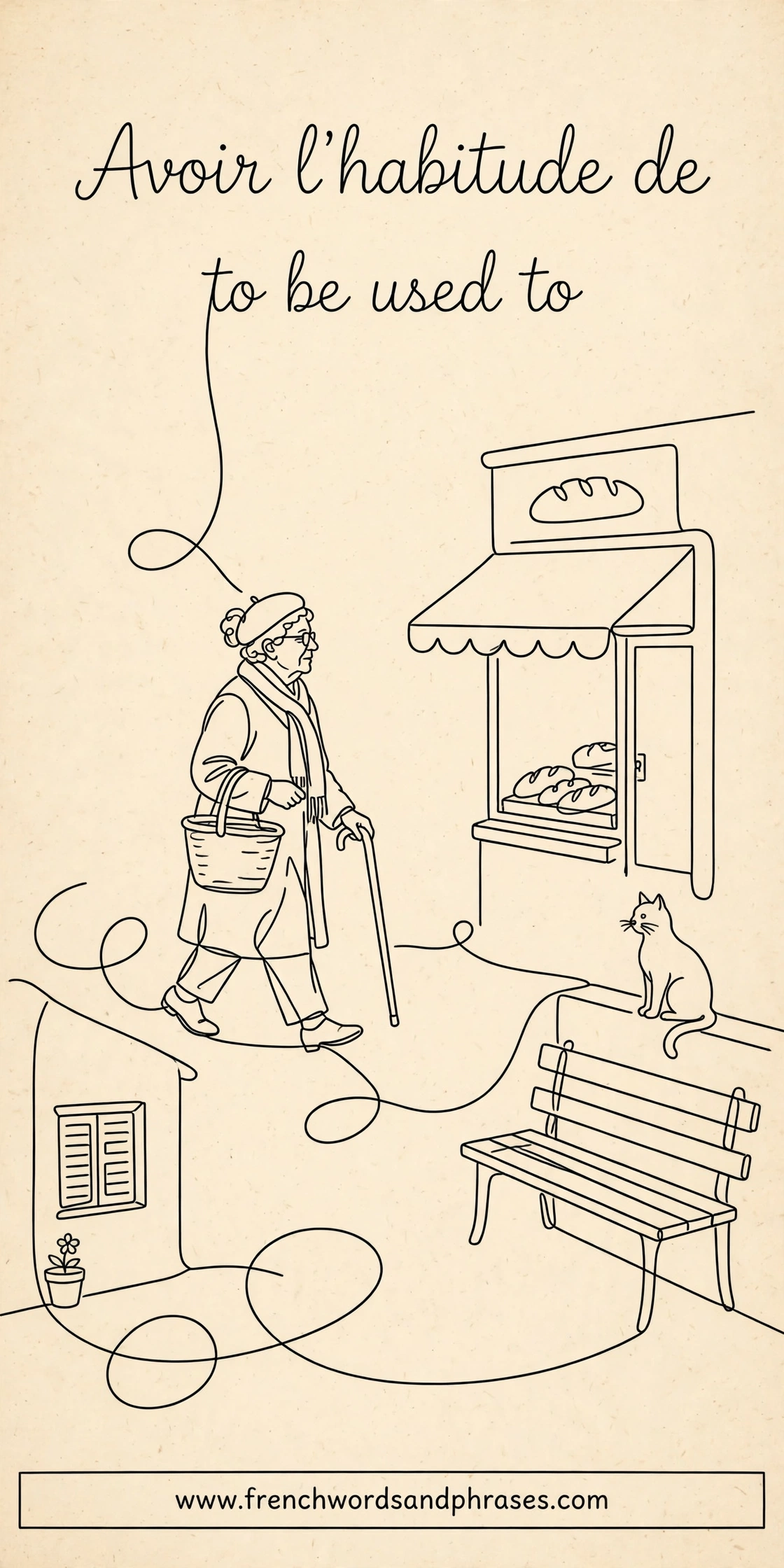
The baker on the corner does not ask you anything any more. You push the door at eight, and the croissant is already in its bag, warm, with the receipt tucked under the string. She shrugs, smiling: « Vous avez l’habitude de venir à huit heures. » Your routine has become part of hers.
Let’s explore how avoir l’habitude de works in French, beginning with the whole phrase on one card.
Understanding the French Phrase Avoir l’habitude de
Avoir l’habitude de is a French expression built from avoir (to have), l’habitude (the habit, the custom) and de followed by an infinitive. It says that something is your normal, settled way of doing things — you are used to it, and you usually do it.
It means to be used to doing something, to usually do it. The habit can be a daily routine — j’ai l’habitude de me lever tôt, I usually get up early — or a settled familiarity: il a l’habitude des longs trajets, he is used to long journeys. Either way, the phrase describes what repetition has made normal for you.
Type: Expression — habit (avoir + noun + de + infinitive)
Answers the need: Saying what you usually do, or what you are accustomed to
Register: Neutral — safe everywhere, in speech and writing
Strength: Calm and factual — it describes a routine, not a craving or a compulsion
One important usage detail: the infinitive follows de directly — j’ai l’habitude de prendre le train, never with à. For a habit in the past that is over, French switches to the imperfect alone (je prenais le train) or to autrefois; avoir l’habitude de always describes a pattern that still holds or held at the time you are describing.
Experience the Word
Avoir l’habitude de is the quiet phrase of routines — the one that explains why your feet take the same street without asking you.
Imagine the night porter of a small hotel in Lyon, thirty years at the same desk. He knows which guest wants tea, which door sticks, which stair creaks. Nothing surprises him, and he says so without pride: it is simply l’habitude.
French treats habit as a possession. You do not just do a thing repeatedly — you have the habit of it, like a coat you have worn into shape.
How to Use Avoir l’habitude de in French: Complete Guide
Let’s explore how avoir l’habitude de works in French, beginning with the whole phrase on one card.
Avoir l’habitude de at a Glance
The Whole Phrase on One Card
Real meaning, literal building blocks, English twin and register — avoir l’habitude de in five lines.
| Point | Avoir l’habitude de |
|---|---|
| What it really means | to be used to doing something — to usually do it |
| Word for word | to have the habit of |
| English equivalent | to be used to / to usually / to be in the habit of |
| Register | neutral — safe everywhere |
| Use it for | routines, customs, settled ways of doing things |
Example
J’ai l’habitude de marcher jusqu’au bureau.
I usually walk to the office.
Word by Word: Building the Habit
Three pieces — the having verb, the habit itself, and the little link that attaches the action.
| Word | Literal meaning | Its job in the phrase |
|---|---|---|
| avoir | to have | the verb that holds the habit — you possess it, like the routines you own |
| l’habitude | the habit, the custom | the noun at the centre: a way of doing things, built by repetition |
| de | of, to | the link before the infinitive — de + verb, always, never à |
Example
Elle a l’habitude de lire avant de dormir.
She usually reads before sleeping.
Quick Quiz 1
Which little word links the habit to the action — de or à?
Reveal the answer
De — avoir l’habitude de + infinitive, always.
Nous avons l’habitude de partir tôt.
We usually leave early.
When You Say It: The Routine Moments
Avoir l’habitude de fires at moments like these — wherever a pattern needs naming.
| Situation | Example |
|---|---|
| A morning routine | j’ai l’habitude de me lever à six heures — I usually get up at six |
| Explaining a preference | il a l’habitude de travailler le soir — he usually works in the evening |
| Being used to a thing | elle a l’habitude des hivers froids — she is used to cold winters |
| A warning about your ways | j’ai l’habitude de tout vérifier deux fois — I am in the habit of checking everything twice |
| Asking about someone else | tu as l’habitude de prendre ce train ? — do you usually take this train? |
Example
Les enfants ont l’habitude de goûter à quatre heures.
The children usually have their snack at four o’clock.
Make It Yours: The Habit for Every Person
Avoir conjugates as usual; the infinitive after de never changes.
| Form | French | In English |
|---|---|---|
| I usually | j’ai l’habitude de prendre le bus | I usually take the bus |
| She is used to | elle a l’habitude de conduire la nuit | she is used to driving at night |
| In the past | nous avions l’habitude de venir ici | we used to come here (at that time) |
| Negative | je n’ai pas l’habitude de fumer | I am not in the habit of smoking |
| Question | vous avez l’habitude de réserver ? | do you usually book? |
| With a noun, no verb | il a l’habitude des voyages | he is used to travelling |
Example
Vous aviez l’habitude de fermer à midi ?
Did you used to close at midday?
Quick Quiz 2
Spot the error: j’ai l’habitude à courir le matin.
Reveal the answer
À should be de — avoir l’habitude de courir: the link is always de.
J’ai l’habitude de courir le matin avant le travail.
I usually run in the morning before work.
Everyday Expressions: Building on the Habit
Avoir l’habitude de slots into these everyday frames — each one ready to use as it stands.
| Frame | In English |
|---|---|
| avoir l’habitude de + infinitive | to usually do, to be used to doing |
| avoir l’habitude de quelque chose | to be used to something |
| comme d’habitude | as usual — the famous shortcut, literally ‘as of habit’ |
| prendre l’habitude de | to get into the habit of |
| perdre l’habitude de | to get out of the habit of |
Example
Comme d’habitude, le train avait du retard.
As usual, the train was late.
Close Cousins: The Other Routine Words
French describes routine in several shades — l’habitude is the settled one; its cousins stress frequency, tendency or familiarity.
| Expression | The difference |
|---|---|
| avoir l’habitude de | to be used to, to usually do — the settled pattern |
| avoir tendance à | to tend to — a leaning, not yet a fixed habit |
| être habitué à | to be accustomed to — the state of being used to a thing or person |
| d’habitude | usually, ordinarily — the adverb, no verb needed: d’habitude, je marche |
| souvent | often — plain frequency, without the idea of a settled custom |
Example
D’habitude, le magasin ouvre à neuf heures.
Usually, the shop opens at nine o’clock.
Quick Quiz 3
Which cousin means ‘usually’ all on its own, with no verb phrase needed?
Reveal the answer
D’habitude — d’habitude, je prends le train: usually, I take the train.
D’habitude, elle arrive en avance.
Usually, she arrives early.
Avoir l’habitude de and Its Neighbours
The routine shelf around the phrase — habits forming, holding and breaking.
| French | In English |
|---|---|
| une habitude | a habit |
| prendre l’habitude de | to get into the habit of |
| une mauvaise habitude | a bad habit |
| comme d’habitude | as usual |
| changer ses habitudes | to change your ways, your routines |
| être habitué à | to be used to, accustomed to |
Example
Il a pris l’habitude de noter toutes ses idées.
He got into the habit of writing down all his ideas.
Watch Out: The Traps Around Avoir l’habitude de
The traps: the wrong little word, the English gerund, and a cousin that looks identical.
| Trap | The truth |
|---|---|
| à instead of de | the link is de + infinitive: l’habitude de partir — à belongs to être habitué à |
| translating ‘used to’ word for word | English ‘I used to smoke’ (a finished past habit) is usually just the imperfect: je fumais — avoir l’habitude describes a pattern that holds |
| the -ing trap | English says ‘used to doing’; French says de + infinitive: l’habitude de courir, never de courant |
| habitude vs coutume | une coutume is a custom of a group or a country; une habitude is personal — your routines are habitudes |
Example
Autrefois, je fumais, mais je n’en ai plus l’habitude.
In the old days I smoked, but I am no longer in the habit.
Quick Quiz 4
True or false: avoir l’habitude de is the normal way to say a finished childhood habit, like ‘I used to play outside all day’.
Reveal the answer
False — for a finished past habit French usually uses the imperfect alone: je jouais dehors toute la journée.
Petit, je jouais dehors jusqu’au soir.
As a child, I used to play outside until evening.
Avoir l’habitude de in Everyday French: Real-Life Examples
Now that you know the word, let’s see how avoir l’habitude de appears in everyday French.
Example 1 — At the bakery
La boulangère sait que j’ai l’habitude de prendre un croissant.
The baker knows I usually have a croissant.
Example 2 — Morning routine
J’ai l’habitude de me lever avant le soleil en été.
I usually get up before the sun in summer.
Example 3 — At work
Elle a l’habitude de répondre aux messages le soir.
She usually answers messages in the evening.
Example 4 — On the road
Il a l’habitude des longs trajets en train.
He is used to long train journeys.
Example 5 — A new habit
Depuis janvier, j’ai pris l’habitude de marcher après le dîner.
Since January, I have got into the habit of walking after dinner.
Example 6 — As usual
Comme d’habitude, il a oublié ses clés.
As usual, he forgot his keys.
Beyond Translation: The Meaning of Avoir l’habitude de
English ‘used to’ looks backwards with a sigh; French avoir l’habitude holds the habit in your hands, in the present. A habit, in this picture, is not something that happens to you — it is something you own, maintain, and can decide to put down.
Avoir l’habitude de turns repetition into property: your routines are yours.
That is why the same noun gives French its most affectionate shrug — comme d’habitude, as usual — the phrase with which a whole country forgives its own predictability.
How to Remember the French Phrase Avoir l’habitude de
Remember it this way: Avoir l’habitude de is habit as a possession — you hold your routines the way you hold a well-worn coat.
- You keep the link de — l’habitude de + infinitive, always; à belongs to être habitué à.
- You think of the baker who knows your order — a habit is what repetition has made normal.
- You hear comme d’habitude inside it — as usual, the everyday shortcut built from the same noun.
The key idea is avoir l’habitude de means to be used to, to usually do — the habit you hold, linked by de.
Test Your Knowledge of Avoir l’habitude de
Let’s see how much you’ve learned. Try answering these questions before revealing the answers.
Question 1
What does avoir l’habitude de mean?
Reveal the answer
To be used to doing something, to usually do it — a settled pattern built by repetition.
Question 2
Which word links the phrase to the infinitive?
Reveal the answer
De — avoir l’habitude de prendre, de partir, de lire; never à.
Question 3
How do you say ‘as usual’?
Reveal the answer
Comme d’habitude — literally ‘as of habit’, the famous everyday shortcut.
Question 4
What is the difference between avoir l’habitude de and être habitué à?
Reveal the answer
Habitude names the pattern of doing; habitué names the state of being accustomed — and they take different links: de + infinitive, à + noun or infinitive.
Question 5
Complete the sentence:
Nous avons l’habitude ______ partir de bonne heure. (We usually leave early.)
Reveal the answer
de
Nous avons l’habitude de partir de bonne heure.
We usually leave early.
Your Final Challenge
Can You Use It?
How would you say this in French?
“I usually get up early.”
Reveal the answer
J’ai l’habitude de me lever tôt.
I usually get up early.
A little French. A little curiosity. A richer everyday life.
LEARN FRENCH ONE WORD AT A TIME