A French Word to Live By
Translate Avoir l’heure to English
/a.vwaʁ lœʁ/
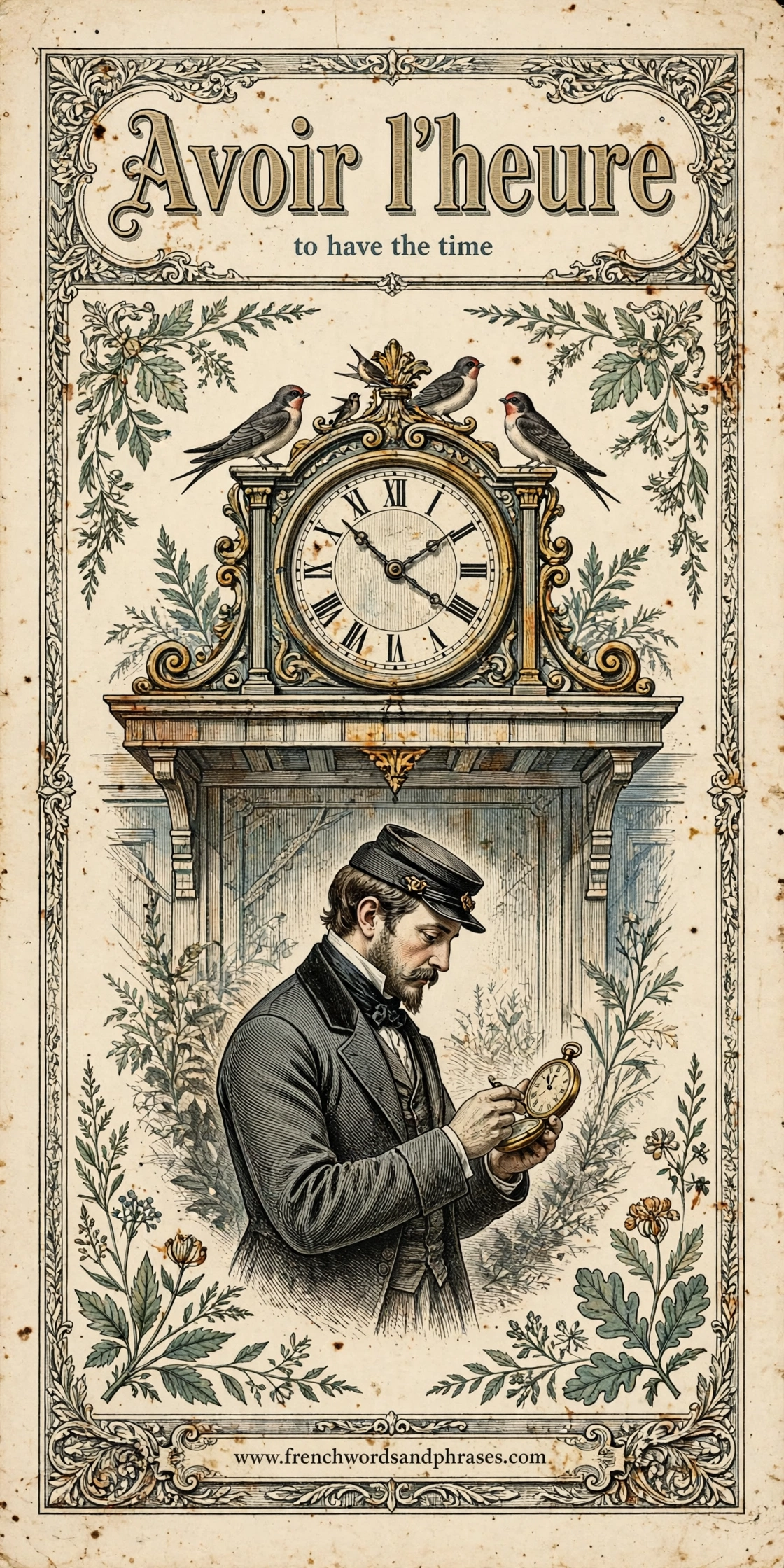
Avoir l’heure means to have the time — to know what time it is.
Your phone died an hour ago, somewhere between the market and the old town, and your train leaves at a time you suddenly need to be sure of. You stop a woman with a watch and ask the question French travellers have asked for a century: « Pardon, madame, vous avez l’heure ? »
Let’s explore how avoir l’heure works in French, beginning with the whole phrase on one card.
Understanding the French Phrase Avoir l’heure
Avoir l’heure is a French expression built from avoir (to have) and l’heure (the hour, the time of day). It means to have the time on you — to be carrying a watch, a phone or any way of knowing what time it is, so that you can tell someone else.
It means to have the time — in the clock sense, not the free-time sense. Vous avez l’heure ? is the standard polite way to ask a stranger the time: literally, do you have the hour? The answer comes back with il est…: il est trois heures, it is three o’clock. For free time, French uses a different phrase entirely: avoir le temps.
Type: Expression — time of day (avoir + l’heure)
Answers the need: Asking or telling the time of day
Register: Neutral and polite — the classic way to ask a stranger
Strength: Practical — a small, everyday courtesy phrase
One important usage detail: avoir l’heure is almost always a question — vous avez l’heure ? — or the answer to one: oui, j’ai l’heure, il est midi. Note the l’: heure begins with a silent h, so le and la become l’heure. And mind the near-twin: avoir le temps means having free time, a completely different question.
Experience the Word
Avoir l’heure belongs to the age of the wristwatch — to platforms, church squares and station clocks, when the time was something a person carried and could share.
Imagine a village square in Provence in 1960: one clock on the church, and one man whose watch everyone trusts. Asking him the time is a small ceremony — a nod, a sleeve pulled back, an announcement. The phrase still carries that courtesy in it.
French keeps the hour as an object you can hold. To avoir l’heure is to be, for one moment, the village clock for somebody else.
How to Use Avoir l’heure in French: Complete Guide
Let’s explore how avoir l’heure works in French, beginning with the whole phrase on one card.
Avoir l’heure at a Glance
The Whole Phrase on One Card
Real meaning, literal building blocks, English twin and register — avoir l’heure in five lines.
| Point | Avoir l’heure |
|---|---|
| What it really means | to have the time — to know what time it is |
| Word for word | to have the hour |
| English equivalent | do you have the time? / have you got the time? |
| Register | neutral and polite — made for strangers |
| Use it for | asking the time when your phone or watch has failed you |
Example
Pardon, monsieur, vous avez l’heure ?
Excuse me, sir, do you have the time?
Word by Word: Building the Question
Two pieces — the having verb, and the hour itself, elided with its silent h.
| Word | Literal meaning | Its job in the phrase |
|---|---|---|
| avoir | to have | the verb of possession — the time is something you carry on you |
| l’heure | the hour, the time | heure is feminine with a silent h, so la becomes l’ — l’heure |
Example
Oui, j’ai l’heure : il est presque midi.
Yes, I have the time: it is almost midday.
Quick Quiz 1
Why is it l’heure and not la heure?
Reveal the answer
Because heure begins with a silent h — la shortens to l’ before it, as in l’habitude and l’impression.
Elle regarde sa montre : elle a l’heure exacte.
She looks at her watch: she has the exact time.
When You Say It: The Time-Asking Moments
Avoir l’heure fires at moments like these — a dead phone, a distant train, a clock you cannot see.
| Situation | Example |
|---|---|
| Asking a stranger | vous avez l’heure, s’il vous plaît ? — do you have the time, please? |
| Answering yes | oui, j’ai l’heure, il est neuf heures — yes, it is nine o’clock |
| Answering no | désolé, je n’ai pas l’heure — sorry, I don’t have the time |
| Between friends | tu as l’heure ? mon téléphone est éteint — have you got the time? my phone is off |
| Checking before leaving | tu as l’heure ? on doit partir dans dix minutes — what’s the time? we have to leave in ten minutes |
Example
Je n’ai pas l’heure, ma montre est arrêtée.
I don’t have the time, my watch has stopped.
Make It Yours: The Time for Every Person
Avoir conjugates as usual — and the answer to the question always begins il est.
| Form | French | In English |
|---|---|---|
| Polite question | vous avez l’heure ? | do you have the time? |
| Friendly question | tu as l’heure ? | have you got the time? |
| The answer | il est trois heures | it is three o’clock |
| Half past | il est trois heures et demie | it is half past three |
| Quarter to | il est quatre heures moins le quart | it is quarter to four |
| Noon and midnight | il est midi, il est minuit | it is midday, it is midnight |
Example
Il est huit heures moins le quart, dépêchons-nous.
It is quarter to eight, let’s hurry.
Quick Quiz 2
A stranger answers il est deux heures et demie. What time is it?
Reveal the answer
Half past two — et demie adds the half hour after the hour named.
Le train part à deux heures et demie précises.
The train leaves at exactly half past two.
Everyday Expressions: Building on the Hour
Avoir l’heure slots into these everyday frames — each one ready to use as it stands.
| Frame | In English |
|---|---|
| vous avez l’heure ? | do you have the time? |
| il est + heure | it is … o’clock — the way every answer is built |
| à quelle heure ? | at what time? — asking when something happens |
| être à l’heure | to be on time — a different phrase: punctual, not clock-carrying |
| l’heure de pointe | rush hour — literally ‘the peak hour’ |
Example
À quelle heure commence le film ?
At what time does the film start?
Close Cousins: The Other Time Phrases
French time phrases look alike and mean different things — l’heure is the clock; its cousins measure freedom, punctuality and duration.
| Expression | The difference |
|---|---|
| avoir l’heure | to have the time of day — to know what time it is |
| avoir le temps | to have free time — time available, not the clock |
| être à l’heure | to be on time, punctual |
| demander l’heure | to ask the time — the asking itself |
| il est l’heure de partir | it is time to leave — the moment has come |
Example
J’ai le temps, mais je n’ai pas l’heure : mon téléphone est éteint.
I have time, but I don’t have the time: my phone is off.
Quick Quiz 3
You want to say a colleague is never late. Avoir l’heure or être à l’heure?
Reveal the answer
Être à l’heure — that is punctuality. Avoir l’heure only says he can tell you the time.
Ce train est toujours à l’heure.
This train is always on time.
Avoir l’heure and Its Neighbours
The clock shelf around the phrase — asking, telling and keeping time.
| French | In English |
|---|---|
| une montre | a watch — the classic carrier of l’heure |
| midi | midday, noon |
| minuit | midnight |
| et demie | half past (after the hour) |
| moins le quart | quarter to (before the hour) |
| en avance, en retard | early, late |
Example
Il arrive toujours en avance, jamais en retard.
He always arrives early, never late.
Watch Out: The Traps Around Avoir l’heure
The traps: the famous twin, the silent h, and an answer that changes its shape.
| Trap | The truth |
|---|---|
| l’heure vs le temps | avoir l’heure is the clock; avoir le temps is free time — swapping them changes the question completely |
| writing la heure | heure has a silent h: always l’heure, never la heure |
| answering with j’ai trois heures | you answer the question with il est: il est trois heures — j’ai trois heures would mean three hours of something |
| o’clock does not translate | English adds ‘o’clock’; French just says il est trois heures, with nothing after heures |
Example
Il est cinq heures, pas ‘cinq heures o’clock’.
It is five o’clock — French needs no extra word.
Quick Quiz 4
True or false: vous avez l’heure ? asks whether someone is free this afternoon.
Reveal the answer
False — it asks what time it is. Free time is avoir le temps.
Vous avez l’heure ? J’ai peur de rater mon train.
Do you have the time? I am afraid of missing my train.
Avoir l’heure in Everyday French: Real-Life Examples
Now that you know the word, let’s see how avoir l’heure appears in everyday French.
Example 1 — At the station
Pardon, vous avez l’heure ? Mon train part bientôt.
Excuse me, do you have the time? My train leaves soon.
Example 2 — In the street
Tu as l’heure ? Mon téléphone n’a plus de batterie.
Have you got the time? My phone is out of battery.
Example 3 — Answering
Oui, j’ai l’heure : il est dix heures et demie.
Yes, I have the time: it is half past ten.
Example 4 — No watch
Désolée, je n’ai pas l’heure sur moi.
Sorry, I don’t have the time on me.
Example 5 — Before a meeting
Vous avez l’heure ? La réunion commence dans cinq minutes.
Do you have the time? The meeting starts in five minutes.
Example 6 — At the market
Il demande l’heure au marchand, sa montre est cassée.
He asks the stallholder the time, his watch is broken.
Beyond Translation: The Meaning of Avoir l’heure
Before telephones, the time was a public thing — held by church bells, station clocks, and the one reliable watch in any group of strangers. Avoir l’heure keeps that world alive: the hour is a possession, and asking for it is a small, polite transaction between people who will never meet again.
To ask vous avez l’heure ? is to borrow somebody’s watch with words.
Phones have made the phrase rarer, but not dead: every dead battery in France still revives it, several times a day.
How to Remember the French Phrase Avoir l’heure
Remember it this way: Avoir l’heure is the hour in your pocket — you carry the time on a watch, and you can lend it to a stranger.
- You picture the wristwatch — l’heure is the clock reading, the thing a watch carries.
- You answer with il est — il est trois heures, never with j’ai.
- You split the twins — l’heure is the clock; le temps is free time.
The key idea is avoir l’heure means to have the time — to know what time it is, and to be able to tell it.
Test Your Knowledge of Avoir l’heure
Let’s see how much you’ve learned. Try answering these questions before revealing the answers.
Question 1
What does vous avez l’heure ? ask?
Reveal the answer
What time it is — literally, do you have the hour: can you tell me the time?
Question 2
How do you answer ‘it is three o’clock’?
Reveal the answer
Il est trois heures — answers begin with il est, not with j’ai.
Question 3
Why l’heure and not la heure?
Reveal the answer
Because heure begins with a silent h — la becomes l’ before it.
Question 4
What is the difference between avoir l’heure and avoir le temps?
Reveal the answer
L’heure is the clock; le temps is free time — one tells the time, the other says you are not busy.
Question 5
Complete the sentence:
Pardon, madame, vous avez ______ ? (Excuse me, madam, do you have the time?)
Reveal the answer
l’heure
Pardon, madame, vous avez l’heure ?
Excuse me, madam, do you have the time?
Your Final Challenge
Can You Use It?
How would you say this in French?
“Excuse me, do you have the time?”
Reveal the answer
Pardon, vous avez l’heure ?
Excuse me, do you have the time?
A little French. A little curiosity. A richer everyday life.
LEARN FRENCH ONE WORD AT A TIME