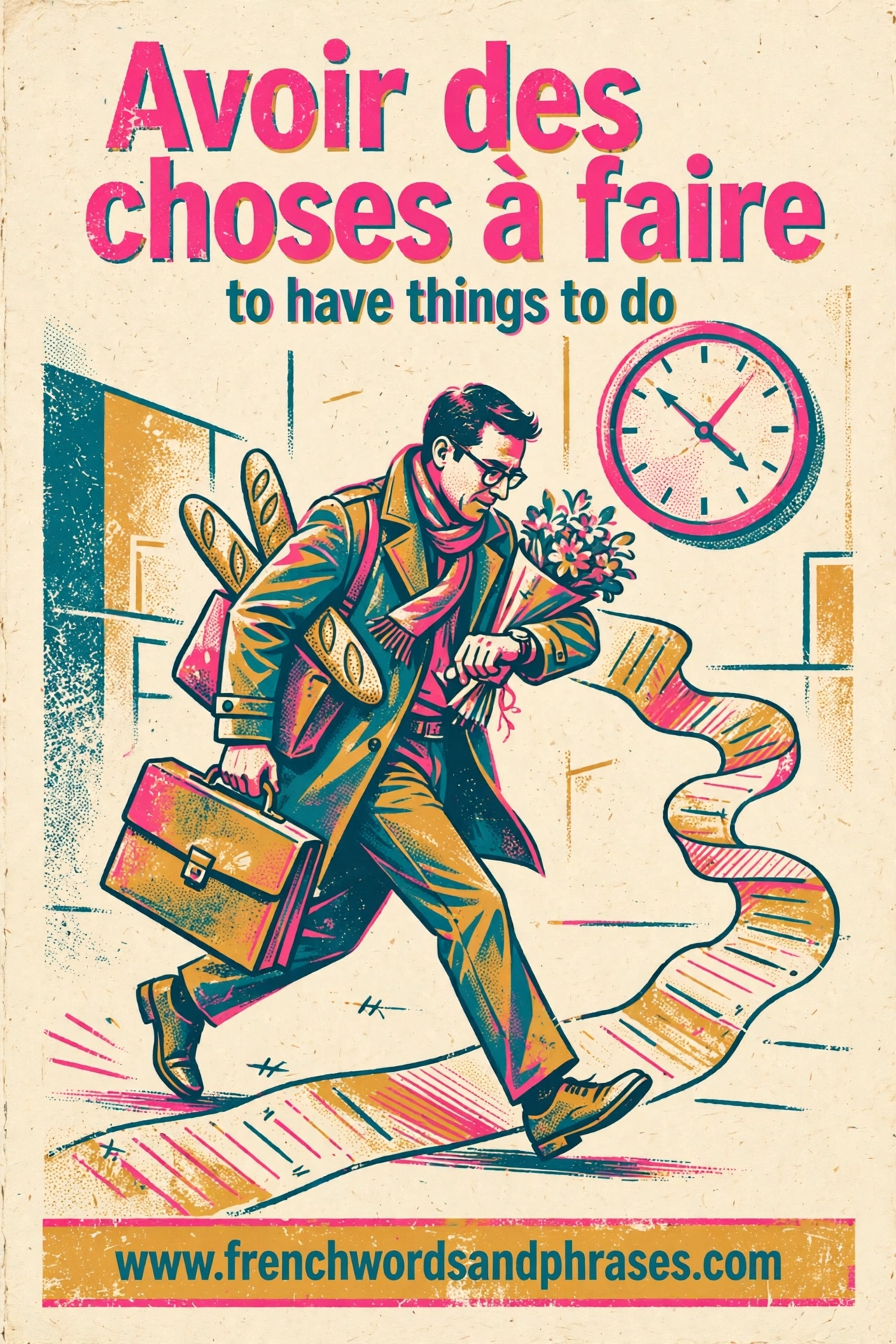
A French Word to Live By
Translate Avoir des choses à faire to English
/a.vwaʁ de ʃoz a fɛʁ/
Avoir des choses à faire means to have things to do — to be busy with tasks waiting.
Friday, six o’clock, and your colleague closes her laptop, looks at the list pinned above her desk — calls, forms, a parcel, a plumber — and turns down the invitation to the café with a practised smile: « Désolée, j’ai des choses à faire. » The list is real. It is also, everyone understands, wonderfully unspecific.
Let’s explore how avoir des choses à faire works in French, beginning with the whole phrase on one card.
Understanding the French Phrase Avoir des choses à faire
Avoir des choses à faire is a French set phrase built from avoir (to have), des choses (things — chose is a feminine noun) and à faire (to do, to be done). The à + infinitive turns the things into pending tasks: not things that exist, but things that are waiting for you to do them.
It means to have things to do — errands, tasks, business pending. It lives a double life: it is the honest report of a busy Saturday, and it is also French’s most diplomatic refusal, the polite fog that declines an invitation without inventing a grandmother’s funeral. Context and tone tell you which one you are hearing; the speaker is under no obligation to specify the choses.
Type: Set phrase — occupation (avoir + des choses + à + infinitive)
Answers the need: Saying you are busy, or declining something without details
Register: Neutral — everyday speech everywhere
Strength: Gentle and vague — from a real list to a diplomatic fog
One important usage detail: the pending-task pattern is à + infinitive — des choses à faire, à régler, à terminer. The à is what makes the things unfinished; des choses alone would just be some things. And the vagueness is protected by custom: replying ‘what things?’ to j’ai des choses à faire is allowed between intimates, and slightly rude from anyone else.
Experience the Word
Avoir des choses à faire is the busiest sentence in French and the least informative — a full diary behind a closed door.
Imagine the Saturday it describes when it is true: the market before nine, the bank before noon, the shelf to fix, the aunt to phone, the forms that breed in the hallway drawer. By evening the phrase has earned itself. And imagine the other Saturday, the sofa one, where the same sentence guards a nap like a loyal dog.
French politeness keeps a few phrases deliberately unfurnished. Des choses à faire is a room nobody is invited to inspect.
How to Use Avoir des choses à faire in French: Complete Guide
Let’s explore how avoir des choses à faire works in French, beginning with the whole phrase on one card.
Avoir des choses à faire at a Glance
The Whole Phrase on One Card
Real meaning, literal building blocks, English twin and register — avoir des choses à faire in five lines.
| Point | Avoir des choses à faire |
|---|---|
| What it really means | to have things to do — tasks pending, a schedule already spoken for |
| Word for word | to have some things to do |
| English equivalent | to have things to do / to be busy / to have stuff on |
| Register | neutral — everyday, at work and at home |
| Use it for | busy Saturdays, errands, declining invitations politely |
Example
Je ne peux pas venir, j’ai des choses à faire.
I can’t come, I have things to do.
Word by Word: Building the Busy Day
Four pieces — a holding verb, some unnamed things, and the à that leaves them unfinished.
| Word | Literal meaning | Its job in the phrase |
|---|---|---|
| avoir | to have | the holding verb — it conjugates for the busy person |
| des choses | some things | deliberately unnamed: chose is feminine, and its vagueness is the point |
| à | to | the pending mark — what follows is waiting to be done |
| faire | to do | the default doing verb; réglé, terminé can take its place |
Example
Elle a des choses à régler avant ce soir.
She has things to sort out before tonight.
Quick Quiz 1
Which little word marks the things as still to be done — à or de?
Reveal the answer
À — des choses à faire: the à + infinitive pattern means ‘to be done’, pending.
Il a des lettres à écrire.
He has letters to write.
When You Say It: The Occupied Moments
Avoir des choses à faire fires at moments like these — the diary is full, or the evening is being defended.
| Situation | Example |
|---|---|
| Declining an invitation | désolé, j’ai des choses à faire samedi — sorry, I have things to do on Saturday |
| A real errand day | j’ai plein de choses à faire en ville — I have loads of things to do in town |
| Leaving early | je dois partir, j’ai des choses à faire — I have to go, I have things to do |
| At work | elle a des choses à terminer avant vendredi — she has things to finish before Friday |
| The diplomatic fog | ce soir ? j’ai des choses à faire… — tonight? I have things to do… |
Example
On se voit dimanche ? Samedi, j’ai des choses à faire.
Shall we meet Sunday? On Saturday I have things to do.
Make It Yours: The Busy Day for Every Person
Avoir bends, the choses multiply, and à welcomes any verb of unfinished business.
| Form | French | In English |
|---|---|---|
| I have things to do | j’ai des choses à faire | I have things to do |
| Loads of things | j’ai plein de choses à faire | I have loads of things to do |
| Too many things | j’ai trop de choses à faire | I have too many things to do |
| Things to finish | des choses à terminer | things to finish |
| In the past | j’avais des choses à faire | I had things to do |
| Nothing to do | je n’ai rien à faire | I have nothing to do |
Example
Quand je n’ai rien à faire, je m’ennuie vite.
When I have nothing to do, I get bored quickly.
Quick Quiz 2
How do you strengthen the phrase to ‘I have loads of things to do’?
Reveal the answer
J’ai plein de choses à faire — plein de, full of, pours the tasks in by the bucket.
Ce week-end, j’ai plein de choses à faire.
This weekend, I have loads of things to do.
Everyday Expressions: Building on the List
Avoir des choses à faire slots into these everyday frames — each one ready to use as it stands.
| Frame | In English |
|---|---|
| avoir des choses à faire | to have things to do |
| avoir plein de choses à faire | to have loads of things to do |
| avoir des choses à régler | to have things to sort out |
| avoir mieux à faire | to have better things to do — the sharper refusal |
| une chose à la fois | one thing at a time — the busy person’s motto |
Example
Une chose à la fois, sinon je m’y perds.
One thing at a time, otherwise I lose track.
Close Cousins: The Other Ways to Be Busy
French is busy at several volumes — des choses à faire is the mild, vague one; its cousins specify, saturate or drown.
| Expression | The difference |
|---|---|
| avoir des choses à faire | to have things to do — vague, mild, possibly diplomatic |
| être occupé | to be busy — the state itself, no list implied |
| avoir du travail | to have work to do — the tasks are professional |
| être débordé | to be overwhelmed, snowed under — busy past the limit |
| avoir une course à faire | to have an errand to run — one specific, nameable task |
Example
Elle est débordée, ce n’est plus des choses à faire, c’est une montagne.
She’s snowed under — it’s no longer things to do, it’s a mountain.
Quick Quiz 3
Your colleague is drowning in files and staying late every night. Des choses à faire or être débordé?
Reveal the answer
Être débordé — snowed under. Des choses à faire is an ordinary list; débordé is the flood.
Depuis septembre, il est débordé de travail.
Since September, he has been snowed under with work.
Avoir des choses à faire and Its Neighbours
The errand shelf around the phrase — the tasks, the lists, and the putting-off.
| French | In English |
|---|---|
| une course | an errand — the out-and-about task |
| une tâche | a task — one item on the list |
| une liste | a list — the choses, written down |
| remettre à demain | to put off until tomorrow |
| un emploi du temps chargé | a busy schedule — the official version |
Example
Sa liste grandit : encore trois courses à faire.
Her list is growing: three more errands to do.
Watch Out: The Traps Around Avoir des choses à faire
The traps: the wrong little word, an errand mistaken for a race, and vagueness interrogated.
| Trap | The truth |
|---|---|
| pour faire instead of à faire | pending tasks take à: des choses à faire — pour faire would announce a purpose, not a pending list |
| course is not a race here | une course à faire is an errand; the running race is also une course, but the shopping kind owns this phrase |
| asking ‘what things?’ | between friends, fine; from a colleague, it breaches the custom — the vagueness is the message |
| chose’s gender | chose is feminine: des choses, une chose — never un chose |
Example
Une chose à la fois : d’abord la course, ensuite le courrier.
One thing at a time: first the errand, then the mail.
Quick Quiz 4
True or false: des choses pour faire is the correct form of the phrase.
Reveal the answer
False — pending things take à: des choses à faire.
J’ai des choses à faire, pas le temps de bavarder.
I have things to do, no time to chat.
Avoir des choses à faire in Everyday French: Real-Life Examples
Now that you know the word, let’s see how avoir des choses à faire appears in everyday French.
Example 1 — The refusal
Désolé, ce soir j’ai des choses à faire.
Sorry, tonight I have things to do.
Example 2 — The Saturday list
Samedi matin, j’ai plein de choses à faire en ville.
Saturday morning, I have loads of things to do in town.
Example 3 — Leaving the office
Je pars, j’ai encore des choses à régler.
I’m off, I still have things to sort out.
Example 4 — The student
Elle a des devoirs à faire et des choses à réviser.
She has homework to do and things to revise.
Example 5 — The quiet day
Aujourd’hui, je n’ai rien à faire, et ça me repose.
Today I have nothing to do, and it’s restful.
Example 6 — The promise
J’ai des choses à terminer, mais je t’appelle ce soir.
I have things to finish, but I’ll call you tonight.
Beyond Translation: The Meaning of Avoir des choses à faire
Every polite culture keeps a sentence that means no without saying it. French’s champion is this one: a diary so full it cannot be opened to visitors. Its genius is that it might be true — the choses are unverifiable by design, and honouring that design is the whole courtesy.
Avoir des choses à faire is a door closed gently: behind it, a mountain of errands or a sofa and a novel, and it is not your business which.
Use it with a smile, receive it with grace, and never, ever ask for the list.
How to Remember the French Phrase Avoir des choses à faire
Remember it this way: Avoir des choses à faire keeps a full diary behind a closed door — à faire marks the tasks pending, and nobody gets to inspect the list.
- You mark pending with à — des choses à faire; à + infinitive is the grammar of unfinished business.
- You pour with plein de — plein de choses à faire is the busy day at full volume.
- You respect the fog — the phrase may be a mountain or a sofa; asking for the list breaks the custom.
The key idea is avoir des choses à faire means to have things to do — honestly busy, or politely unspecific.
Test Your Knowledge of Avoir des choses à faire
Let’s see how much you’ve learned. Try answering these questions before revealing the answers.
Question 1
What does j’ai des choses à faire mean?
Reveal the answer
I have things to do — tasks pending, from a real list to a diplomatic refusal.
Question 2
What does the à in à faire do?
Reveal the answer
It marks the things as pending — à + infinitive means ‘to be done’: des lettres à écrire, letters to write.
Question 3
How do you say ‘I have nothing to do’?
Reveal the answer
Je n’ai rien à faire — rien replaces des choses in the negative.
Question 4
What is the difference between avoir des choses à faire and être débordé?
Reveal the answer
Des choses à faire is an ordinary list; être débordé is being snowed under, past the limit.
Question 5
Complete the sentence:
J’ai plein de choses ______ faire. (I have loads of things to do.)
Reveal the answer
à
J’ai plein de choses à faire.
I have loads of things to do.
Your Final Challenge
Can You Use It?
How would you say this in French?
“Sorry, I can’t come, I have things to do.”
Reveal the answer
Désolé, je ne peux pas venir, j’ai des choses à faire.
Sorry, I can’t come, I have things to do.
A little French. A little curiosity. A richer everyday life.
LEARN FRENCH ONE WORD AT A TIME