A French Word to Live By
Translate Avoir de la chance to English
/a.vwaʁ də la ʃɑ̃s/
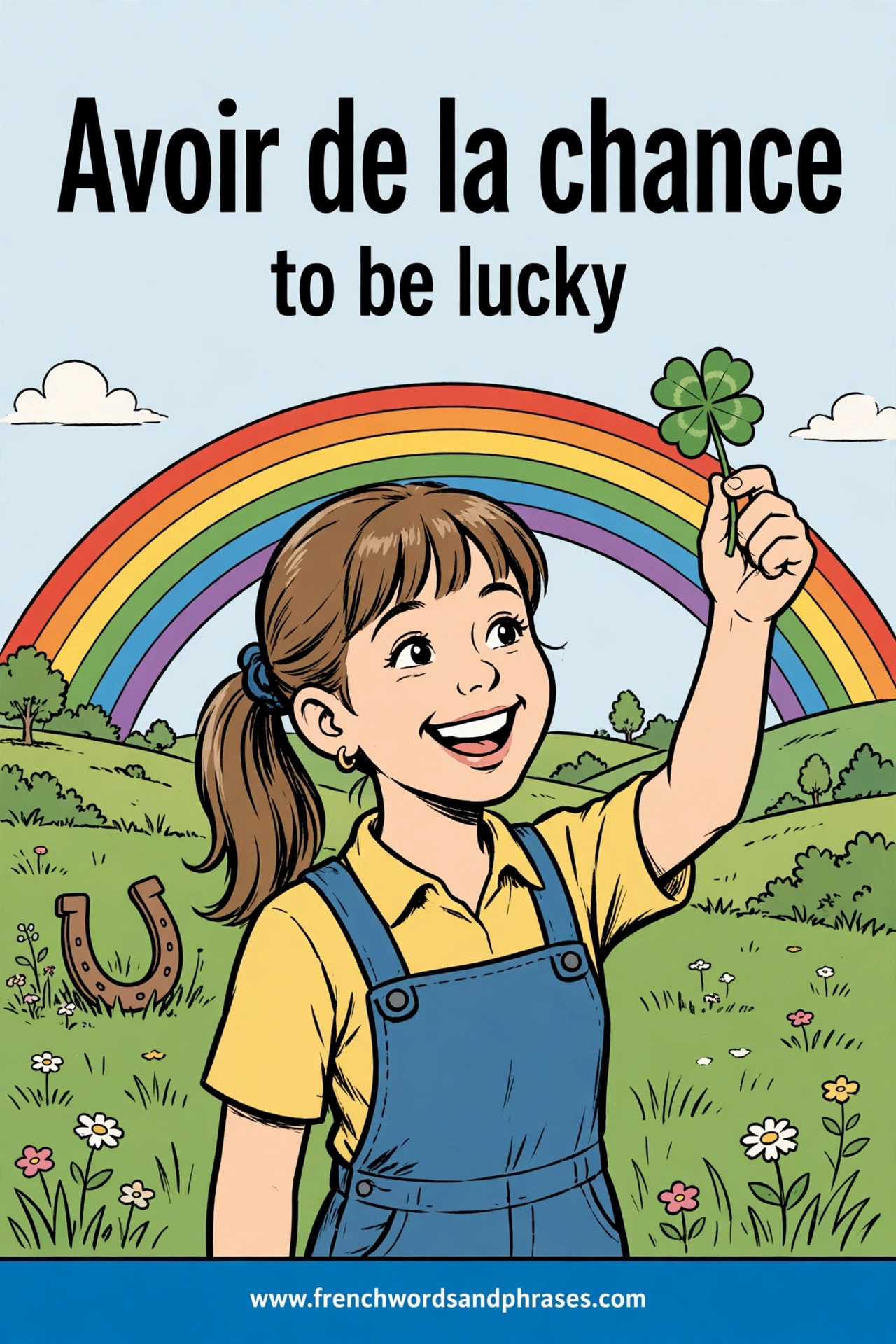
Avoir de la chance means to be lucky — to have luck on your side, in a moment or in general.
The exam hall empties, and one student stands in the corridor laughing with relief. Of the twenty chapters she could have drawn, the paper asked the only three she had revised the night before. She shakes her head at the ceiling: « J’ai de la chance ! » Luck, in French, is not a character trait — it is a portion you happen to hold.
Let’s explore how avoir de la chance works in French, beginning with the whole phrase on one card.
Understanding the French Phrase Avoir de la chance
Avoir de la chance is a French set phrase built from avoir (to have), de la (some — the partitive) and chance (luck, a feminine noun). The partitive is the philosophy: luck comes in portions, like water or bread. You have some of it today, none tomorrow, and nobody holds the whole supply.
It means to be lucky. The phrase works at both scales: for the single moment — j’ai eu de la chance, le train était en retard aussi, I was lucky, the train was late too — and for a life: il a de la chance, tout lui réussit, he’s lucky, everything works out for him. Its opposite is built into the same frame: ne pas avoir de chance, to be unlucky, or manquer de chance, to lack luck.
Type: Set phrase — fortune (avoir + de la + chance)
Answers the need: Saying someone is lucky, in a moment or by nature
Register: Neutral — everywhere, in speech and writing
Strength: Warm and pleased — graded from un peu de chance to une chance incroyable
One important usage detail: the partitive de la never becomes la. J’ai de la chance, I have some luck — saying j’ai la chance usually shifts the meaning toward opportunity: j’ai la chance de vivre ici, I have the good fortune to live here, followed by de + infinitive. Keep de la chance for luck itself, and la chance de for the fortunate chance to do something.
Experience the Word
Avoir de la chance is French gratitude in its most everyday dress — said at station platforms, exam doors and hospital corridors.
Imagine the driver who stops for coffee and misses the falling tree by two minutes, the fisherman whose net finds the one clear patch of sea, the traveller whose lost passport is handed in at the desk. Three strangers, one sentence each, identical in shape.
French measures luck like a liquid because it behaves like one. It fills your cup today and leaves it dry tomorrow — avoir de la chance is simply noticing the level.
How to Use Avoir de la chance in French: Complete Guide
Let’s explore how avoir de la chance works in French, beginning with the whole phrase on one card.
Avoir de la chance at a Glance
The Whole Phrase on One Card
Real meaning, literal picture, English twin and register — avoir de la chance in five lines.
| Point | Avoir de la chance |
|---|---|
| What it really means | to be lucky — to have luck on your side |
| Word for word | to have some luck — luck in portions, like water or bread |
| English equivalent | to be lucky / to be in luck / to have luck |
| Register | neutral — the everyday way to say it, everywhere |
| Use it for | narrow escapes, good draws, found objects, lucky meetings |
Example
Tu as de la chance, il reste une place.
You’re lucky, there’s one seat left.
Word by Word: Building the Luck
Three pieces — a holding verb, the partitive of portions, and luck itself.
| Word | Literal meaning | Its job in the phrase |
|---|---|---|
| avoir | to have | the holding verb — it conjugates for the person and the tense |
| de la | some (of the) | the partitive: luck as an uncountable substance, held in portions |
| chance | luck | a feminine noun: la chance — the fortune itself |
Example
Elle a de la chance au jeu comme dans la vie.
She’s lucky in games as in life.
Quick Quiz 1
Is it j’ai la chance or j’ai de la chance for ‘I’m lucky’?
Reveal the answer
J’ai de la chance — the partitive de la gives ‘some luck’. J’ai la chance de… means I have the good fortune to…
J’ai de la chance, le soleil revient.
I’m lucky, the sun is coming back.
When You Say It: The Lucky Moments
Avoir de la chance fires at moments like these — fortune noticed, usually with relief.
| Situation | Example |
|---|---|
| A narrow escape | tu as eu de la chance, la branche est tombée juste après — you were lucky, the branch fell just after |
| Good weather | nous avons de la chance, pas une goutte de pluie — we’re lucky, not a drop of rain |
| A lucky find | j’ai eu de la chance, j’ai retrouvé mes clés — I was lucky, I found my keys |
| A draw or a raffle | il a de la chance, il gagne toutes les tombolas — he’s lucky, he wins every raffle |
| A lucky meeting | vous avez de la chance de vous être rencontrés — you’re lucky to have met |
Example
On a eu de la chance, le magasin fermait dans cinq minutes.
We were lucky, the shop was closing in five minutes.
Make It Yours: The Luck for Every Person
Avoir bends through people and tenses; de la chance stays, and degree words pour more in.
| Form | French | In English |
|---|---|---|
| I am lucky | j’ai de la chance | I’m lucky |
| You are lucky | tu as de la chance | you’re lucky |
| A lot of luck | avoir beaucoup de chance | to be very lucky |
| In the past | j’ai eu de la chance | I was lucky |
| No luck | ne pas avoir de chance | to be unlucky, to have no luck |
| Always lucky | il a toujours de la chance | he’s always lucky |
Example
Elle n’a pas eu de chance à ce concours.
She had no luck in that exam competition.
Quick Quiz 2
How do you say ‘I was lucky’ — in the past — with this phrase?
Reveal the answer
J’ai eu de la chance — avoir doubles up: the auxiliary avoir plus eu, its own past participle.
J’ai eu de la chance, le dernier train était en retard.
I was lucky, the last train was delayed.
Everyday Expressions: Building on the Luck
Avoir de la chance slots into these everyday frames — each one ready to use as it stands.
| Frame | In English |
|---|---|
| avoir de la chance | to be lucky |
| avoir beaucoup de chance | to be very lucky |
| un coup de chance | a stroke of luck |
| porter chance | to bring luck — ce bracelet me porte chance |
| la chance de + infinitive | the good fortune to do something |
| par chance | luckily, by luck |
Example
Par chance, elle avait pris son parapluie.
Luckily, she had taken her umbrella.
Close Cousins: The Other Fortunes
French is lucky in several registers — avoir de la chance is the neutral one; its cousins slang it, personify it, or reverse it.
| Expression | The difference |
|---|---|
| avoir de la chance | to be lucky — the neutral, standard phrase |
| avoir du bol | to be lucky — slang: bol is a bowl; informal and cheerful |
| avoir de la veine | to be lucky — informal; la veine is a vein of ore, luck as a seam to mine |
| être chanceux | to be a lucky person — chanceux describes the character, not the moment |
| la malchance | bad luck — the opposite substance, also in portions |
Example
Tu as du bol, le contrôleur n’est pas passé !
You’re in luck, the ticket inspector didn’t come round!
Quick Quiz 3
In a formal letter, which do you write — avoir du bol or avoir de la chance?
Reveal the answer
Avoir de la chance — du bol is friendly slang for the café, not the letter.
Nous avons eu la chance de vous rencontrer, écrira la lettre ; tu as du bol, dira l’ami.
We had the good fortune to meet you, the letter will say; you’re in luck, the friend will say.
Avoir de la chance and Its Neighbours
The fortune shelf around the phrase — charms, chances, and luck wished aloud.
| French | In English |
|---|---|
| bonne chance ! | good luck! — the wish itself |
| un trèfle à quatre feuilles | a four-leaf clover — luck you can pick |
| un hasard heureux | a happy coincidence |
| tenter sa chance | to try your luck |
| la roue tourne | the wheel turns — luck changes, for better or worse |
Example
Bonne chance pour demain, tente ta chance !
Good luck for tomorrow, try your luck!
Watch Out: The Traps Around Avoir de la chance
The traps: the vanishing partitive, a chance that is only a probability, and luck wished in the wrong word.
| Trap | The truth |
|---|---|
| dropping de la | j’ai chance is not French — the partitive is part of the phrase: j’ai de la chance |
| chance as probability | une chance sur deux is a one-in-two chance — there, chance counts odds, not fortune |
| wishing luck | to wish it, say bonne chance ! — never bon chance; chance is feminine |
| chanceux for a moment | il est chanceux describes a lucky nature; for today’s escape, say il a eu de la chance |
Example
Une chance sur deux de pluie, mais par chance, rien.
A one-in-two chance of rain, but luckily, nothing.
Quick Quiz 4
True or false: une chance sur deux means ‘half of my luck’.
Reveal the answer
False — it means a one-in-two chance, a probability. Luck itself takes de la chance.
Il a une chance sur deux de réussir, et beaucoup de chance de son côté.
He has a one-in-two chance of passing, and a lot of luck on his side.
Avoir de la chance in Everyday French: Real-Life Examples
Now that you know the word, let’s see how avoir de la chance appears in everyday French.
Example 1 — The last train
Nous avons eu de la chance, le train avait dix minutes de retard.
We were lucky, the train was ten minutes late.
Example 2 — The exam draw
J’ai de la chance, c’est le chapitre que je préférais.
I’m lucky, it’s the chapter I liked best.
Example 3 — The parking space
Tu as de la chance, une place se libère juste devant.
You’re lucky, a space is freeing up right in front.
Example 4 — The lost keys
Elle a eu de la chance, ses clés étaient chez la voisine.
She was lucky, her keys were at the neighbour’s.
Example 5 — The holiday sun
On a beaucoup de chance avec ce temps.
We’re very lucky with this weather.
Example 6 — The raffle
Il a toujours de la chance aux tombolas, c’est incroyable.
He’s always lucky in raffles, it’s incredible.
Beyond Translation: The Meaning of Avoir de la chance
English is lucky the way a person is tall — a quality, a kind of fate worn in the face. French has luck the way a traveller has water: in a flask, in portions, liable to run out. The partitive de la is a small masterpiece of honesty: nobody owns fortune, we only hold a measure of it, for now.
Avoir de la chance is gratitude with a measuring jug — it says exactly how much of the world’s kindness you are currently holding.
And because it is measured, it can be shared in wishes: bonne chance ! is the pouring of a little of yours into someone else’s cup.
How to Remember the French Phrase Avoir de la chance
Remember it this way: Avoir de la chance measures luck like water in a flask — de la is the partitive of portions, and nobody holds the whole river.
- You keep the de la — luck is a portion, never the whole stock: j’ai de la chance.
- You pour the past with eu — j’ai eu de la chance, I was lucky, when the moment has closed.
- You wish it as bonne chance — feminine, always, when you pour some into another’s cup.
The key idea is avoir de la chance means to be lucky — luck held in portions, like water.
Test Your Knowledge of Avoir de la chance
Let’s see how much you’ve learned. Try answering these questions before revealing the answers.
Question 1
What does tu as de la chance mean?
Reveal the answer
You’re lucky — literally, you have some luck.
Question 2
Why de la chance and not la chance?
Reveal the answer
Because luck is uncountable and comes in portions — the partitive de la means ‘some’; la chance de + infinitive is the good fortune to do something.
Question 3
How do you say ‘I was lucky’?
Reveal the answer
J’ai eu de la chance — the past of avoir inside the phrase is eu.
Question 4
What is the slang twin of avoir de la chance?
Reveal the answer
Avoir du bol — informal and cheerful; avoir de la veine is another informal cousin.
Question 5
Complete the sentence:
Nous avons ______ de chance avec ce soleil. (We are very lucky with this sun.)
Reveal the answer
beaucoup
Nous avons beaucoup de chance avec ce soleil.
We are very lucky with this sun.
Your Final Challenge
Can You Use It?
How would you say this in French?
“We were lucky, the train was late too.”
Reveal the answer
Nous avons eu de la chance, le train était en retard aussi.
We were lucky, the train was late too.
A little French. A little curiosity. A richer everyday life.
LEARN FRENCH ONE WORD AT A TIME