A French Word to Live By
Translate Méfiance to English
/me.fjɑ̃s/
La méfiance means distrust.
The stranger at the village café is offering to sell a watch, cash only, today only, and he cannot quite say where he got it. The room does not shout or argue. It simply goes quiet, forks pause, and every eye studies him over the rims of glasses — la méfiance has entered the room.
In this guide, you’ll learn what méfiance means in English, how to use it with its articles, how to form its plural, and how it appears in everyday French. Explore French examples, English translations, and practice quizzes.
Understanding the French Noun Méfiance
Méfiance is a feminine French noun. It is learned together with its article: la méfiance, une méfiance. The word is built from the prefix mé-, badly, wrongly, and an old noun from Latin fides, faith, trust — distrust is trust that has gone wrong.
It means distrust, mistrust — the settled refusal to take people or promises at face value: regarder quelqu’un avec méfiance (to look at someone with distrust), la méfiance envers les étrangers (distrust of strangers). It is the exact opposite of la confiance, trust, and French keeps the pair side by side: every relationship is measured somewhere between the two.
Gender: Feminine
Definite article: la — la méfiance (distrust)
Indefinite article: une — une méfiance (a distrust)
Plural: les méfiances — rare; the word is usually uncountable
English equivalents: Distrust, mistrust, wariness.
One important usage detail: méfiance has a living verb — se méfier de, to be wary of, to distrust, to watch out for — and its imperative is a classic warning between friends: méfie-toi de lui, be wary of him. The adjective is méfiant (masculine), méfiante (feminine): un regard méfiant, a distrustful look. And do not confuse méfiance with la défiance — défiance is defiance, a challenge thrown down, not distrust.
Experience the Word
Méfiance is more than suspicion. It is trust’s immune system — the quiet pause before the handshake, the second look at the too-good offer, the door locked without thinking.
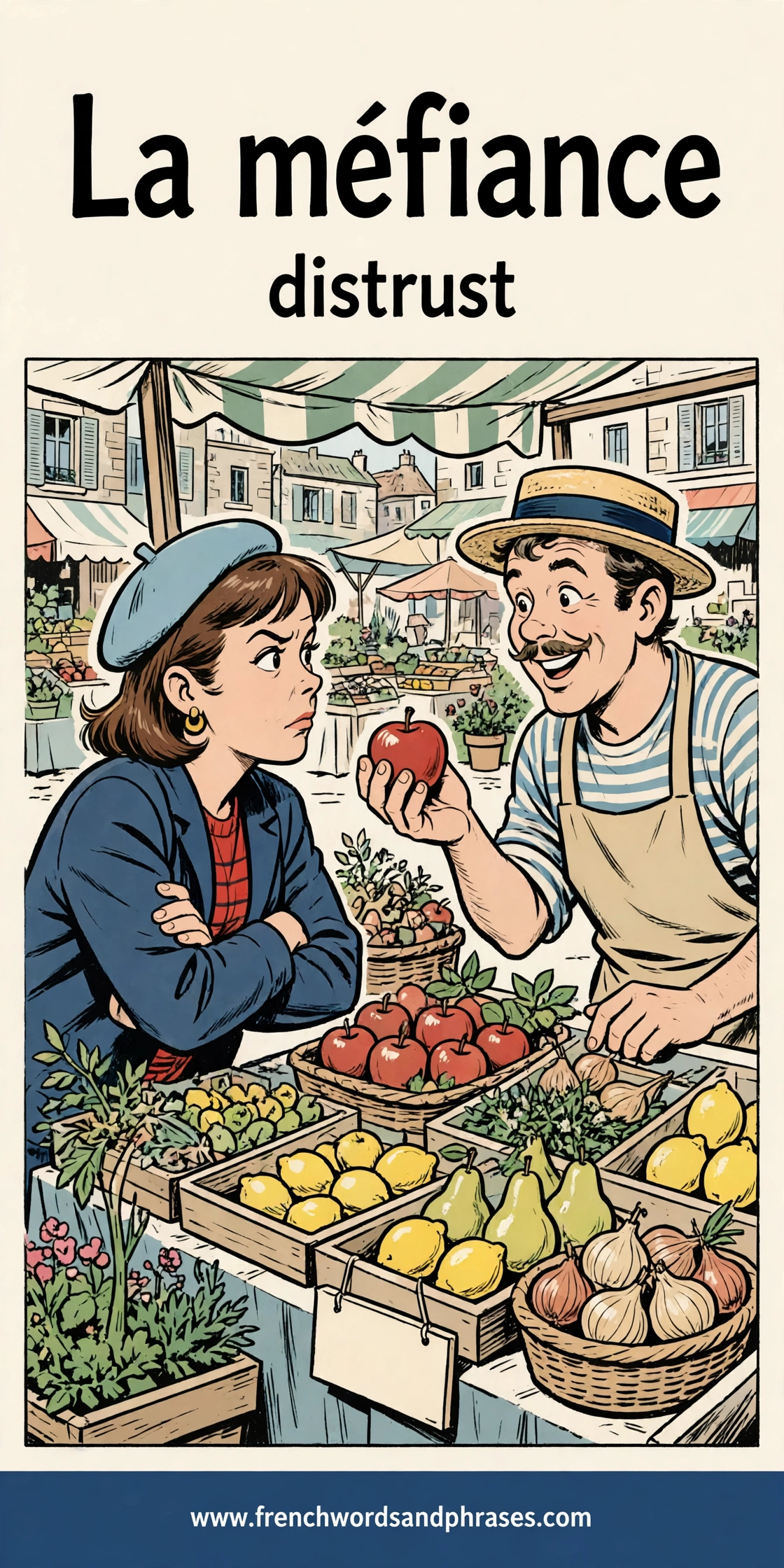
Imagine a market gardener in Provence counting the change from a new wholesaler twice, slowly, in plain sight. No insult is intended; a lifetime of seasons has taught her that méfiance, in small doses, is simply experience wearing its working clothes.
You have not just doubted. You have withheld trust until it is earned — that is méfiance.
How to Use Méfiance in French: Complete Guide
Let’s explore how méfiance works in French, beginning with its articles.
Méfiance with the Definite Article (La, Les)
Used for the attitude itself — la méfiance, the distrust in the room that everyone can feel.
| Number | French |
|---|---|
| Singular | la méfiance |
| Plural | les méfiances (rare) |
Example
La méfiance règne entre les deux villages depuis des années.
Distrust has reigned between the two villages for years.
Méfiance with the Indefinite Article (Une, Des)
Une méfiance names one particular distrust — aimed at one person, one promise, one offer.
| Number | French |
|---|---|
| Singular | une méfiance |
| Plural | des méfiances (rare) |
Example
Il garde une méfiance profonde envers les vendeurs pressés.
He keeps a deep distrust of pushy salesmen.
Méfiance in Action: Trust Withheld
Looks, verbs and instincts — the frames through which French distrust does its work.
| French | In English |
|---|---|
| avec méfiance | with distrust, warily |
| se méfier de quelqu’un | to be wary of someone, to distrust someone |
| inspirer la méfiance | to arouse distrust |
| la méfiance envers les étrangers | distrust of strangers |
| regarder avec méfiance | to look warily, with distrust |
| une méfiance instinctive | an instinctive distrust |
Example
Le chien regarde l’inconnu avec méfiance, sans aboyer.
The dog watches the stranger with distrust, without barking.
Quick Quiz 1
What is the verb built on méfiance?
Reveal the answer
Se méfier — se méfier de quelqu’un, to be wary of someone, to distrust them.
Méfie-toi des offres trop belles.
Be wary of offers that are too good.
The Plural of Méfiance
Honestly stated: les méfiances can be written, but French treats méfiance as a mass attitude and keeps it in the singular — one distrust per room is quite enough.
| Number | French |
|---|---|
| Singular | la méfiance |
| Plural | les méfiances (rare) |
Example
Sa méfiance ne vise personne en particulier.
His distrust is not aimed at anyone in particular.
Méfiance with Possessive Adjectives (Ma, Ta, Sa…)
Possessives agree with the noun, not with the owner — and méfiance is feminine, so it takes ma, ta, sa.
| Owner | French |
|---|---|
| my | ma méfiance |
| your (tu) | ta méfiance |
| his / her | sa méfiance |
| our | notre méfiance |
| your (vous) | votre méfiance |
| their | leur méfiance |
Example
Sa méfiance envers les inconnus est bien connue.
His distrust of strangers is well known.
Quick Quiz 2
Complete the sentence:
______ méfiance grandit à chaque nouvelle promesse. (Their)
Reveal the answer
Leur
Leur méfiance grandit à chaque nouvelle promesse.
Their distrust grows with every new promise.
Méfiance with Demonstrative Adjectives (Cette, Ces)
Used to point: this distrust here — the one this affair created.
| Number | French |
|---|---|
| Singular | cette méfiance |
| Plural | ces méfiances (rare) |
Example
Cette méfiance entre voisins n’existait pas autrefois.
This distrust between neighbours did not exist in the old days.
Méfiance with Adjectives
Adjectives agree with méfiance, feminine — instinctive, profonde, mutuelle.
| Adjective | With Méfiance |
|---|---|
| instinctive (instinctive) | une méfiance instinctive |
| profonde (deep) | une méfiance profonde |
| grande (great) | une grande méfiance |
| mutuelle (mutual) | une méfiance mutuelle |
| naturelle (natural) | une méfiance naturelle |
Example
Une méfiance mutuelle empoisonne leurs relations.
A mutual distrust poisons their relations.
Quick Quiz 3
Complete the sentence:
Ils se regardent avec une méfiance ______. (mutual)
Reveal the answer
mutuelle
Ils se regardent avec une méfiance mutuelle.
They look at each other with mutual distrust.
Everyday Expressions with Méfiance
Too-good offers and second looks — the méfiance phrases of daily life.
| Expression | In English |
|---|---|
| avec méfiance | with distrust, warily |
| se méfier de | to be wary of, to distrust |
| inspirer la méfiance | to arouse distrust |
| faire preuve de méfiance | to show distrust |
| la méfiance règne | distrust reigns |
| un regard méfiant | a distrustful look |
Example
Elle écoute ses promesses avec méfiance, sans répondre.
She listens to his promises with distrust, without answering.
Words from the Same Family as Méfiance
Trust and its opposite, from the same Latin root — the words that travel with méfiance.
| French | In English |
|---|---|
| se méfier | to be wary, to distrust |
| méfiant, méfiante | distrustful, wary |
| la confiance | trust, confidence (the opposite) |
| faire confiance à | to trust |
| la défiance | defiance (not distrust) |
| prudent | careful, cautious |
Example
Il faut du temps pour passer de la méfiance à la confiance.
It takes time to go from distrust to trust.
Quick Quiz 4
Is la méfiance the same word as la défiance?
Reveal the answer
No — la défiance is defiance, a challenge; la méfiance is distrust, trust withheld. The two look alike and mean very different things.
Sa méfiance n’est pas de la défiance, c’est de la prudence.
His distrust is not defiance, it is caution.
Méfiance in Everyday French: Real-Life Examples
Now that you know the word, let’s see how méfiance appears in everyday French.
Example 1 — At the market
Elle compte la monnaie avec méfiance, deux fois.
She counts the change with distrust, twice.
Example 2 — A stranger’s offer
Il regarde l’inconnu avec méfiance avant de répondre.
He looks at the stranger with distrust before answering.
Example 3 — Between neighbours
Une méfiance ancienne sépare les deux familles.
An old distrust separates the two families.
Example 4 — Online shopping
Elle lit les avis avec méfiance avant d’acheter.
She reads the reviews with distrust before buying.
Example 5 — A warning
Méfie-toi de cet homme, il promet trop.
Be wary of that man, he promises too much.
Example 6 — Slowly thawing
Avec le temps, la méfiance fait place à la confiance.
With time, distrust gives way to trust.
Beyond Translation: The Meaning of Méfiance
Méfiance and confiance are twins separated at birth: both descend from Latin fides, faith, trust — confiance is trust placed, méfiance is trust refused, marked by the little prefix mé- that French uses for things gone wrong. A whole national temperament hides in the pair. French politeness hands out confiance slowly, in instalments, and méfiance is not rudeness but bookkeeping: the account of trust, kept carefully, audited often.
To say méfiance is to keep the account of trust honestly.
It evokes the counted change at the market stall, the pause before the signature, the village watching the stranger’s too-cheap watch — a wariness that protects the very possibility of trusting later, once trust has been earned.
How to Remember the French Noun Méfiance
Remember it this way: Méfiance is feminine — la méfiance — trust withheld: mé-, gone wrong, built on the same Latin root as confiance, its opposite.
- You split the twins — la confiance donne, la méfiance retient.
- You use the verb — méfie-toi de lui, be wary of him.
- You dodge the lookalike — la défiance défie, la méfiance se méfie.
The key idea is la méfiance withholds trust — la défiance throws a challenge.
Test Your Knowledge of Méfiance
Let’s see how much you’ve learned. Try answering these questions before revealing the answers.
Question 1
Is méfiance masculine or feminine?
Reveal the answer
Feminine — la méfiance, une méfiance.
Question 2
How do you say ‘to be wary of someone’?
Reveal the answer
Se méfier de quelqu’un — méfie-toi de lui, be wary of him.
Question 3
Translate: She looks at strangers with distrust.
Reveal the answer
Elle regarde les inconnus avec méfiance.
Question 4
What is the opposite of la méfiance?
Reveal the answer
La confiance — trust. The two words share the Latin root fides, faith.
Question 5
Complete the sentence:
Il écoute le vendeur avec ______ méfiance instinctive. (an)
Reveal the answer
une
Il écoute le vendeur avec une méfiance instinctive.
He listens to the salesman with an instinctive distrust.
Your Final Challenge
Can You Use It?
How would you say this in French?
“She looks at strangers with distrust.”
Reveal the answer
Elle regarde les inconnus avec méfiance.
She looks at strangers with distrust.
A little French. A little curiosity. A richer everyday life.
LEARN FRENCH ONE WORD AT A TIME