A French Word to Live By
Translate Avoir … ans to English
/a.vwaʁ … ɑ̃/
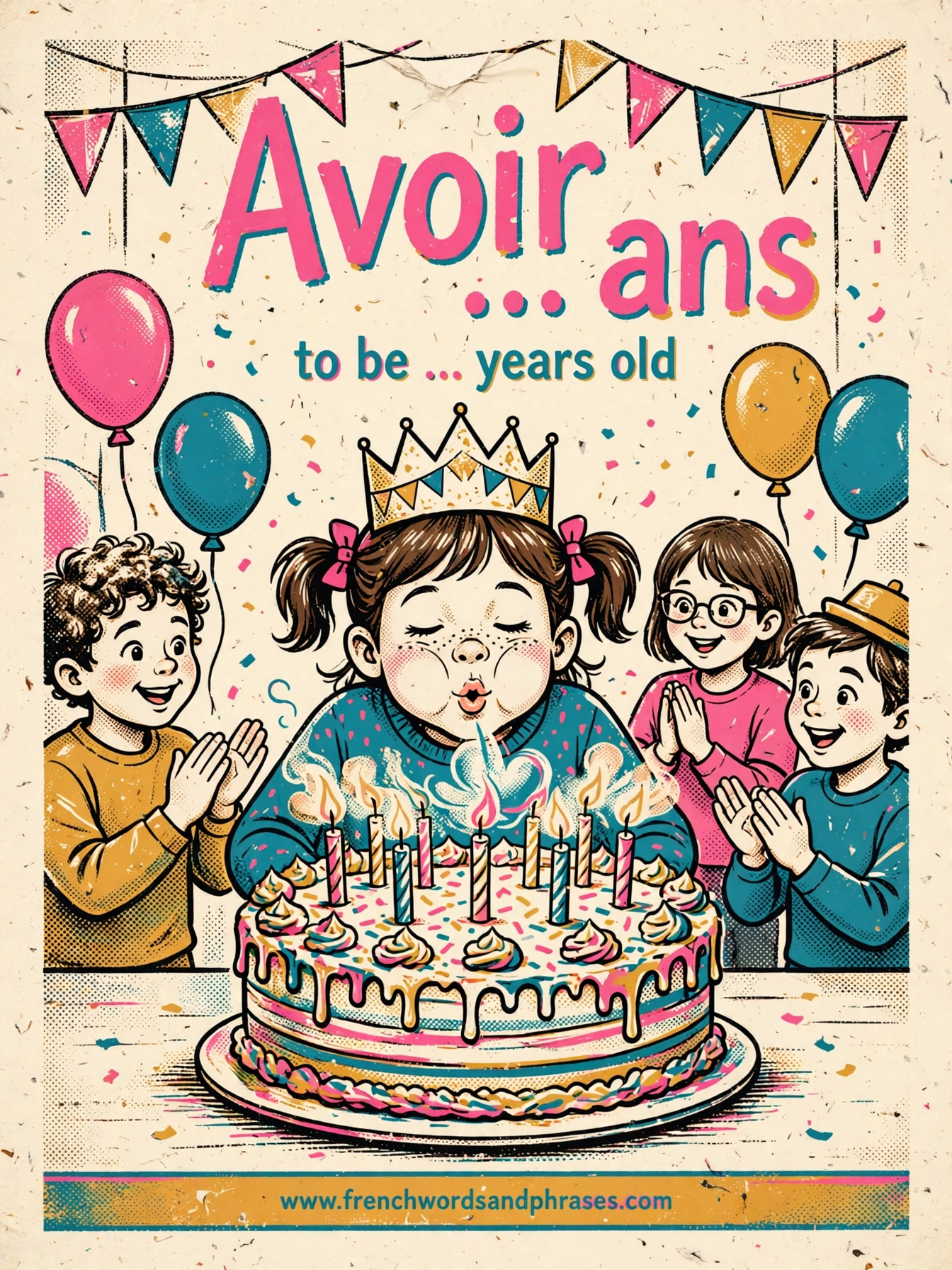
Avoir … ans means to be … years old — in French, age is something you have, not something you are.
A birthday lunch in Lyon, and the candles take up half the cake. The youngest grandson counts them twice, gives up, and asks his great-grandmother directly how old she is. She sits up straight, proud as a queen: « J’ai quatre-vingt-dix ans. » I have ninety years.
Let’s explore how avoir … ans works in French, beginning with the whole phrase on one card.
Understanding the French Phrase Avoir … ans
Avoir … ans is a French set phrase built from avoir (to have), a number, and ans — the plural of an, a year. Where English says you are your age, French says you have your years: they are something you carry, like coins in a pocket.
It means to be a certain number of years old: j’ai vingt ans, I am twenty years old. The number slot is open — avoir cinq ans, avoir quarante ans, avoir cent ans — and the frame never changes. Of all the avoir phrases, this is the one you will use first and most: every introduction, every form, every birthday runs on it.
Type: Set phrase — age (avoir + number + ans)
Answers the need: Saying how old someone or something is
Register: Neutral — the standard way to give an age, in speech and writing alike
Strength: Plain and exact — no colouring, just the number of years
One important usage detail: ans is never dropped and never replaced. J’ai vingt ans is complete; j’ai vingt is not French, and je suis vingt ans is the classic English-speaker’s mistake. To ask, French changes the question, not the answer: quel âge as-tu ? — literally, what age have you? — and the reply still uses avoir: j’ai dix ans.
Experience the Word
Avoir … ans is the first personal fact French asks of you — before your job, before your address, comes the count of your years.
Imagine the school register on the first day of term: name, then age. Each child stands and delivers the number like a small medal — j’ai six ans, j’ai sept ans. The years are theirs, held up for everyone to see.
French treats age as a possession, and possessions can be treasured. You do not become your years; you collect them, one birthday at a time.
How to Use Avoir … ans in French: Complete Guide
Let’s explore how avoir … ans works in French, beginning with the whole phrase on one card.
Avoir … ans at a Glance
The Whole Phrase on One Card
Real meaning, literal picture, English twin and register — avoir … ans in five lines.
| Point | Avoir … ans |
|---|---|
| What it really means | to be … years old — the standard way to state an age |
| Word for word | to have … years |
| English equivalent | to be … years old |
| Register | neutral — everywhere, for everyone, in speech and on forms |
| Use it for | introductions, birthdays, forms, doctors, children, grandparents |
Example
Ma fille a sept ans.
My daughter is seven years old.
Word by Word: Building the Age
Three pieces — a verb of possession, an open slot for the number, and the years themselves.
| Word | Literal meaning | Its job in the phrase |
|---|---|---|
| avoir | to have | the verb that holds the years — age is something you possess |
| … (the number) | five, twenty, ninety… | the open slot: any number fits, from un an to cent ans |
| ans | years | the plural of an, a year — the word that must never be dropped |
Example
Il a quatre-vingt-dix ans et il jardine encore.
He is ninety years old and he still gardens.
Quick Quiz 1
Which verb gives an age in French — être or avoir?
Reveal the answer
Avoir — you have your years: j’ai trente ans, I am thirty years old.
Quel âge as-tu ? J’ai douze ans.
How old are you? I am twelve years old.
When You Say It: The Age Moments
Avoir … ans fires at moments like these — wherever a number of years needs stating.
| Situation | Example |
|---|---|
| Introducing a child | mon fils a cinq ans — my son is five years old |
| At a birthday | elle a dix-huit ans aujourd’hui — she is eighteen today |
| At the doctor’s | le patient a soixante ans — the patient is sixty years old |
| About an animal | ce chien a deux ans — this dog is two years old |
| About a house or a car | la maison a cent ans — the house is a hundred years old |
Example
Notre chat a quinze ans, c’est un vieux monsieur.
Our cat is fifteen, he’s an old gentleman.
Make It Yours: The Age for Every Person
Avoir conjugates, the number changes, and ans stays exactly where it is.
| Form | French | In English |
|---|---|---|
| I am twenty | j’ai vingt ans | I am twenty years old |
| You are sixteen | tu as seize ans | you are sixteen years old |
| She is forty | elle a quarante ans | she is forty years old |
| We are the same age | nous avons le même âge | we are the same age |
| In the past | quand j’avais dix ans | when I was ten years old |
| Asking | quel âge avez-vous ? | how old are you? |
Example
Quand j’avais dix ans, je voulais être pilote.
When I was ten, I wanted to be a pilot.
Quick Quiz 2
How do you ask a child his age — quel âge as-tu ? or combien d’ans es-tu ?
Reveal the answer
Quel âge as-tu ? — literally ‘what age have you?’. The answer keeps avoir: j’ai neuf ans.
Quel âge as-tu ? J’ai neuf ans.
How old are you? I am nine years old.
Everyday Expressions: Building on the Years
Avoir … ans slots into these everyday frames — each one ready to use as it stands.
| Frame | In English |
|---|---|
| avoir … ans | to be … years old |
| quel âge as-tu ? | how old are you? (to a child or a friend) |
| avoir l’âge de + infinitive | to be old enough to do something |
| à l’âge de dix ans | at the age of ten |
| il a l’air plus jeune que son âge | he looks younger than his age |
Example
À l’âge de six ans, elle lisait déjà des romans.
At the age of six, she was already reading novels.
Close Cousins: The Other Ways to Count Years
French counts years in several ways — avoir … ans is the everyday one; its cousins formalise, approximate or admire.
| Expression | The difference |
|---|---|
| avoir … ans | to be … years old — the neutral, standard frame |
| être âgé de … ans | to be aged … years — formal, written, for reports and documents |
| avoir une vingtaine d’années | to be about twenty — an approximation, no exact number |
| prendre de l’âge | to be getting on, ageing — the years accumulating |
| faire son âge | to look your age — about appearance, not the number |
Example
Elle a une trentaine d’années, peut-être un peu plus.
She is about thirty, perhaps a little more.
Quick Quiz 3
You are not sure of the number — she looks roughly fifty. Avoir cinquante ans or avoir une cinquantaine d’années?
Reveal the answer
Avoir une cinquantaine d’années — the -aine forms (une vingtaine, une trentaine, une cinquantaine) give a round, approximate age.
Il a une cinquantaine d’années et beaucoup d’énergie.
He is about fifty and full of energy.
Avoir … ans and Its Neighbours
The birthday shelf around the phrase — the party, the counting, and the milestones.
| French | In English |
|---|---|
| un anniversaire | a birthday |
| souffler les bougies | to blow out the candles |
| un enfant de cinq ans | a five-year-old child |
| être majeur | to be of age, an adult in law |
| un centenaire | a centenarian — someone who has reached a hundred |
| l’âge de raison | the age of reason — traditionally seven years old |
Example
Elle souffle ses bougies : elle a huit ans.
She blows out her candles: she is eight years old.
Watch Out: The Traps Around Avoir … ans
The traps: the English verb, the vanishing ans, and a year that changes its name.
| Trap | The truth |
|---|---|
| the être calque | je suis vingt ans is English wearing French clothes — French has its years: j’ai vingt ans |
| dropping ans | j’ai vingt is unfinished; the years must be named: ans closes the phrase |
| an or année | an counts (trois ans); année measures duration and feeling (une bonne année) — ages always take ans |
| un an, not un ans | for a one-year-old: il a un an — singular an, no s, until the number passes one |
Example
Le bébé a un an, et sa sœur a quatre ans.
The baby is one, and his sister is four years old.
Quick Quiz 4
True or false: a baby of twelve months a un ans.
Reveal the answer
False — one year is singular: il a un an. The plural ans starts at two.
Elle a un an et elle marche déjà.
She is one year old and she already walks.
Avoir … ans in Everyday French: Real-Life Examples
Now that you know the word, let’s see how avoir … ans appears in everyday French.
Example 1 — The birthday
Aujourd’hui, mon grand-père a quatre-vingt-quinze ans.
Today, my grandfather is ninety-five years old.
Example 2 — At school
Les enfants de cette classe ont six ou sept ans.
The children in this class are six or seven years old.
Example 3 — The proud answer
Tu as quel âge ? J’ai neuf ans et demi !
How old are you? I’m nine and a half!
Example 4 — At the vet’s
Ce lapin a trois ans, il est en pleine forme.
This rabbit is three years old, he’s in great shape.
Example 5 — The old house
Cette maison a deux cents ans, regardez ces murs.
This house is two hundred years old, look at these walls.
Example 6 — Looking back
Quand elle avait vingt ans, elle a traversé l’océan.
When she was twenty, she crossed the ocean.
Beyond Translation: The Meaning of Avoir … ans
English is its age, as if the years were an identity, a costume you wear. French has its age, as if the years were luggage — collected, carried, and set down with pride. The two grammars disagree about what a life is: a state, or a collection.
To say j’ai quatre-vingt-dix ans is to hold up ninety small coins and say: mine, every one of them earned.
That is why the very old announce the number like a title. The years are not what they are. They are what they have.
How to Remember the French Phrase Avoir … ans
Remember it this way: Avoir … ans counts your years like coins in a pocket — you don’t become them, you collect them, one birthday at a time.
- You reach for avoir, never être — age is a possession: j’ai vingt ans.
- You never drop ans — the years must be named, or the sentence is unfinished.
- You ask with quel âge — quel âge as-tu ? — and answer with the same avoir.
The key idea is avoir … ans means to be … years old — in French, you have your years.
Test Your Knowledge of Avoir … ans
Let’s see how much you’ve learned. Try answering these questions before revealing the answers.
Question 1
What does j’ai vingt ans mean?
Reveal the answer
I am twenty years old — literally, I have twenty years.
Question 2
Which verb does French use for age, and why does it surprise English speakers?
Reveal the answer
Avoir, to have — English is its age (I am twenty); French has its years (j’ai vingt ans).
Question 3
How do you say ‘she is forty years old’?
Reveal the answer
Elle a quarante ans — avoir conjugated, the number, then ans.
Question 4
How do you ask a friend how old they are?
Reveal the answer
Quel âge as-tu ? — literally, what age have you?
Question 5
Complete the sentence:
Mon frère ______ quinze ans. (My brother is fifteen years old.)
Reveal the answer
a
Mon frère a quinze ans.
My brother is fifteen years old.
Your Final Challenge
Can You Use It?
How would you say this in French?
“I am thirty years old.”
Reveal the answer
J’ai trente ans.
I am thirty years old.
A little French. A little curiosity. A richer everyday life.
LEARN FRENCH ONE WORD AT A TIME