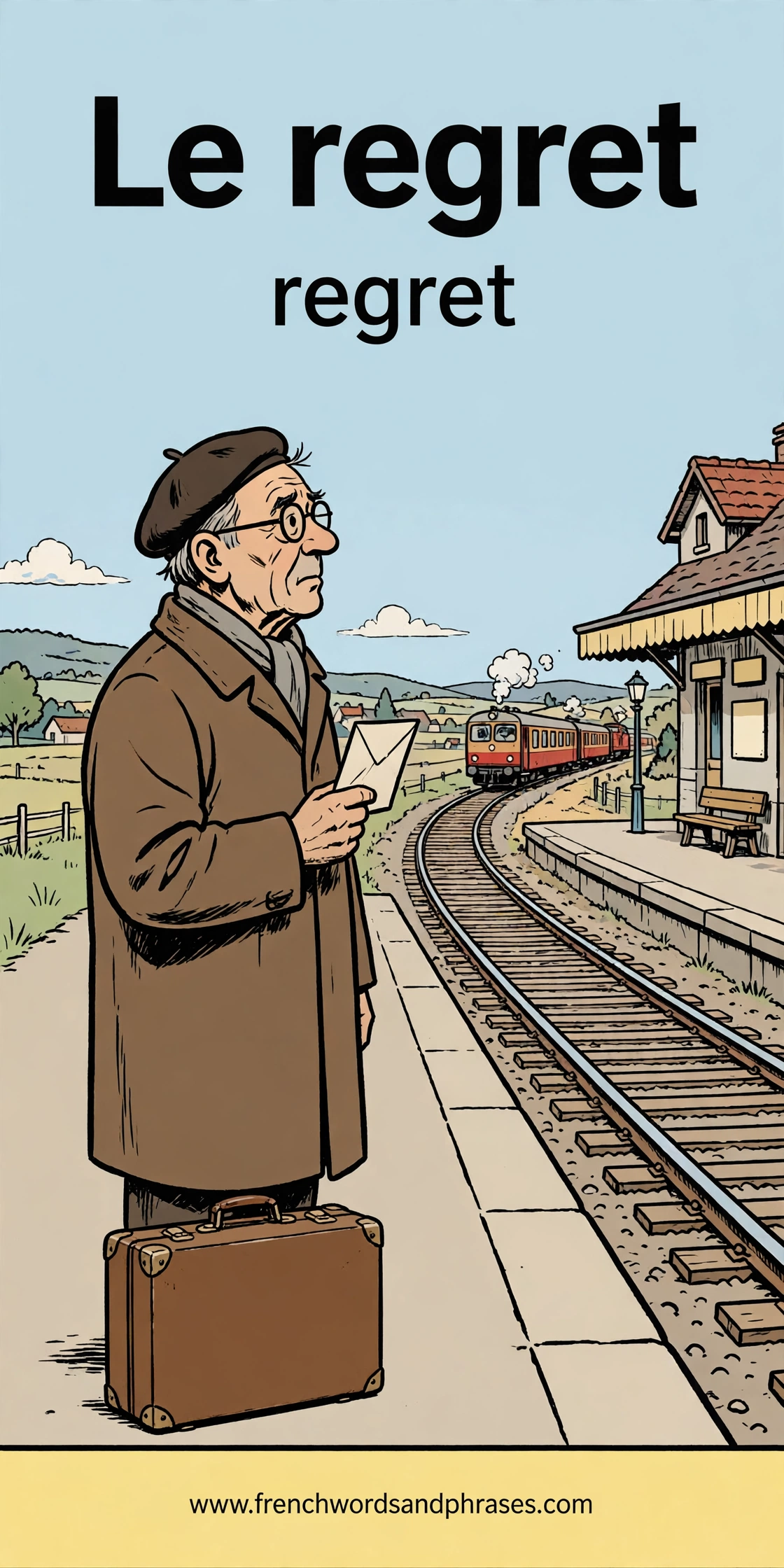
A French Word to Live By
Translate Regret to English
/ʁə.ɡʁɛ/
Le regret means regret.
The train doors close, and through the window you see your friend running down the platform, waving the umbrella you left behind. Too late. You sit down with a small, familiar weight in your chest — le regret.
In this guide, you’ll learn what regret means in English, how to use it with its articles, how to form its plural, and how it appears in everyday French. Explore French examples, English translations, and practice quizzes.
Understanding the French Noun Regret
Regret is a masculine French noun. It is learned together with its article: le regret, un regret. It belongs to the family of feelings French talks about constantly — the backward glance at what might have been.
It means regret — the sadness you feel about something done, or not done: un regret sincère (a sincere regret), des regrets éternels (eternal regrets). In the plural it has a second, formal life: présenter ses regrets is to offer your apologies, to send your regrets when you cannot attend.
Gender: Masculine
Definite article: le — le regret (regret)
Indefinite article: un — un regret (a regret)
Plural: les regrets
English equivalents: Regret; in the plural, regrets — and, formally, apologies: présenter ses regrets, to send one’s regrets.
One important usage detail: French does something generous with this word — à regret, literally ‘with regret’, means reluctantly, unwillingly: il a accepté à regret, he accepted reluctantly. And the verb regretter does double duty: it means to regret, and also to miss something lost — je regrette les étés de mon enfance, I miss the summers of my childhood.
Experience the Word
Regret is more than a mistake remembered. It is the quiet arithmetic of a life — the doors not opened, the words not said, weighed gently in the evening.
Imagine an old sailor in a café in Brittany, watching the fishing boats leave without him for the first time in fifty years. He smiles, but slowly: some regrets are simply the price of having lived fully.
You have not just made an error. You have looked back — and looking back is regret.
How to Use Regret in French: Complete Guide
Let’s explore how regret works in French, beginning with its articles.
Regret with the Definite Article (Le, Les)
Used for the regret everyone in the conversation knows — the one that has been mentioned, the one that stays.
| Number | French |
|---|---|
| Singular | le regret |
| Plural | les regrets |
Example
Le regret de ce départ le suit partout.
The regret of that departure follows him everywhere.
Regret with the Indefinite Article (Un, Des)
Used for a regret in general — one among others, named for the first time.
| Number | French |
|---|---|
| Singular | un regret |
| Plural | des regrets |
Example
Elle garde un regret de ses années à Paris.
She keeps one regret from her years in Paris.
Regret in Everyday Frames
Regret rarely travels alone — these are the frames it lives in, from the apology to the reluctant yes.
| French | In English |
|---|---|
| avoir des regrets | to have regrets |
| à regret | reluctantly, with regret |
| sans regret | without regret |
| exprimer ses regrets | to express one’s regrets |
| présenter ses regrets | to send one’s regrets (formal apologies) |
| un regret éternel | an eternal regret |
Example
Il a vendu sa vieille maison à regret.
He sold his old house reluctantly.
Quick Quiz 1
What does à regret mean in: « Elle a quitté le village à regret »?
Reveal the answer
Reluctantly — she left the village with regret, unwillingly.
Elle a quitté le village à regret, en regardant en arrière.
She left the village reluctantly, looking back.
The Plural of Regret
Regret adds an -s in the plural — les regrets, the many backward glances of a long life.
| Number | French |
|---|---|
| Singular | le regret |
| Plural | les regrets |
Example
À quatre-vingts ans, il dit n’avoir que deux regrets.
At eighty, he says he has only two regrets.
Regret with Possessive Adjectives (Mon, Ton, Son…)
Possessives agree with the noun, not with the owner — and regret is masculine, so it takes mon, ton, son.
| Owner | French |
|---|---|
| my | mon regret |
| your (tu) | ton regret |
| his / her | son regret |
| our | notre regret |
| your (vous) | votre regret |
| their | leur regret |
Example
Mon plus grand regret est de ne pas avoir voyagé jeune.
My greatest regret is not having travelled when I was young.
Quick Quiz 2
Complete the sentence:
______ regrets sont sincères, je vous assure. (My)
Reveal the answer
Mes — regrets is plural here, so my becomes mes.
Mes regrets sont sincères, je vous assure.
My regrets are sincere, I assure you.
Regret with Demonstrative Adjectives (Ce, Ces)
Used to point: this regret here, those regrets there.
| Number | French |
|---|---|
| Singular | ce regret |
| Plural | ces regrets |
Example
Ce regret-là ne la quittera jamais.
That regret will never leave her.
Regret with Adjectives
Adjectives agree with regret, masculine — profond, sincère, éternel.
| Adjective | With Regret |
|---|---|
| profond (deep) | un regret profond |
| sincère (sincere) | un regret sincère |
| éternel (eternal) | un regret éternel |
| léger (slight) | un léger regret |
| grand (great) | un grand regret |
Example
Il garde un regret profond de cette décision.
He keeps a deep regret about that decision.
Quick Quiz 3
Complete the sentence:
Elle éprouve un regret ______ pour ses paroles dures. (sincere)
Reveal the answer
sincère
Elle éprouve un regret sincère pour ses paroles dures.
She feels a sincere regret for her harsh words.
Everyday Expressions with Regret
Apologies, refusals and backward glances — the regret phrases of daily life.
| Expression | In English |
|---|---|
| avoir des regrets | to have regrets |
| ne rien regretter | to regret nothing |
| à regret | reluctantly |
| présenter ses regrets | to send one’s regrets |
| le regret de sa vie | the regret of one’s life |
| mourir sans regrets | to die without regrets |
Example
Elle a tout essayé et ne regrette rien.
She tried everything and regrets nothing.
Words from the Same Family as Regret
Verbs, adjectives and apologies — the words that travel with regret.
| French | In English |
|---|---|
| regretter | to regret; to miss |
| regrettable | regrettable, unfortunate |
| à regret | reluctantly |
| les regrets | regrets; formal apologies |
| s’excuser | to apologise |
| le remords | remorse (heavier than regret) |
Example
C’est regrettable, mais le concert est annulé.
It is regrettable, but the concert is cancelled.
Quick Quiz 4
Your friend translates « Je regrette les dimanches chez ma grand-mère » as ‘I regret the Sundays at my grandmother’s’. What has gone wrong?
Reveal the answer
Regretter also means to miss — she misses those Sundays; she does not feel guilty about them.
Je regrette les dimanches chez ma grand-mère, ils me manquent.
I miss the Sundays at my grandmother’s, I long for them.
Regret in Everyday French: Real-Life Examples
Now that you know the word, let’s see how regret appears in everyday French.
Example 1 — At the station
Il regarde le train partir avec un léger regret.
He watches the train leave with a slight regret.
Example 2 — Looking back
Mon seul regret est de ne pas avoir appris le piano.
My only regret is not having learned the piano.
Example 3 — A formal apology
Elle présente ses regrets de ne pas pouvoir venir.
She sends her regrets at not being able to come.
Example 4 — Reluctantly
Ils ont fermé le café à regret, après trente ans.
They closed the café reluctantly, after thirty years.
Example 5 — No regrets
Il a quitté son travail sans aucun regret.
He left his job without any regret.
Example 6 — An old photograph
En voyant la photo, un regret doux l’envahit.
Seeing the photo, a gentle regret washes over him.
Beyond Translation: The Meaning of Regret
Regret comes from an old Germanic word for weeping — to regret was first to lament, to cry over what is gone. French keeps that softness: le regret is rarely bitter. It is the feeling of the platform after the train, of the letter never sent, carried lightly for years.
To say regret is to look back without anger.
It evokes Edith Piaf’s famous defiance — « Non, je ne regrette rien » — and the quieter truth beneath it: a life examined always keeps a few regrets, and French has a gentle word ready for every one of them.
How to Remember the French Noun Regret
Remember it this way: Regret is masculine — le regret, un regret — the gentle backward glance, lighter than remorse and often just a way of missing something.
- You look back — mon regret, mes regrets, never with anger.
- You act unwillingly — tu le fais à regret, reluctantly.
- You miss the past — je regrette les étés d’autrefois, I miss them.
The key idea is le regret looks back gently — à regret means reluctantly.
Test Your Knowledge of Regret
Let’s see how much you’ve learned. Try answering these questions before revealing the answers.
Question 1
Is regret masculine or feminine?
Reveal the answer
Masculine — le regret, un regret.
Question 2
How do you say ‘reluctantly’ using regret?
Reveal the answer
À regret — il a accepté à regret, he accepted reluctantly.
Question 3
Translate: She has no regrets.
Reveal the answer
Elle n’a aucun regret.
Question 4
What are les regrets in a formal letter?
Reveal the answer
Apologies — présenter ses regrets is to send your regrets, to apologise for an absence.
Question 5
Complete the sentence:
Il garde ______ regret profond de ce jour-là. (a)
Reveal the answer
un
Il garde un regret profond de ce jour-là.
He keeps a deep regret from that day.
Your Final Challenge
Can You Use It?
How would you say this in French?
“He left the town without any regret.”
Reveal the answer
Il a quitté la ville sans aucun regret.
He left the town without any regret.
A little French. A little curiosity. A richer everyday life.
LEARN FRENCH ONE WORD AT A TIME