A French Word to Live By
Translate Envie to English
/ɑ̃.vi/
L’envie means envy.
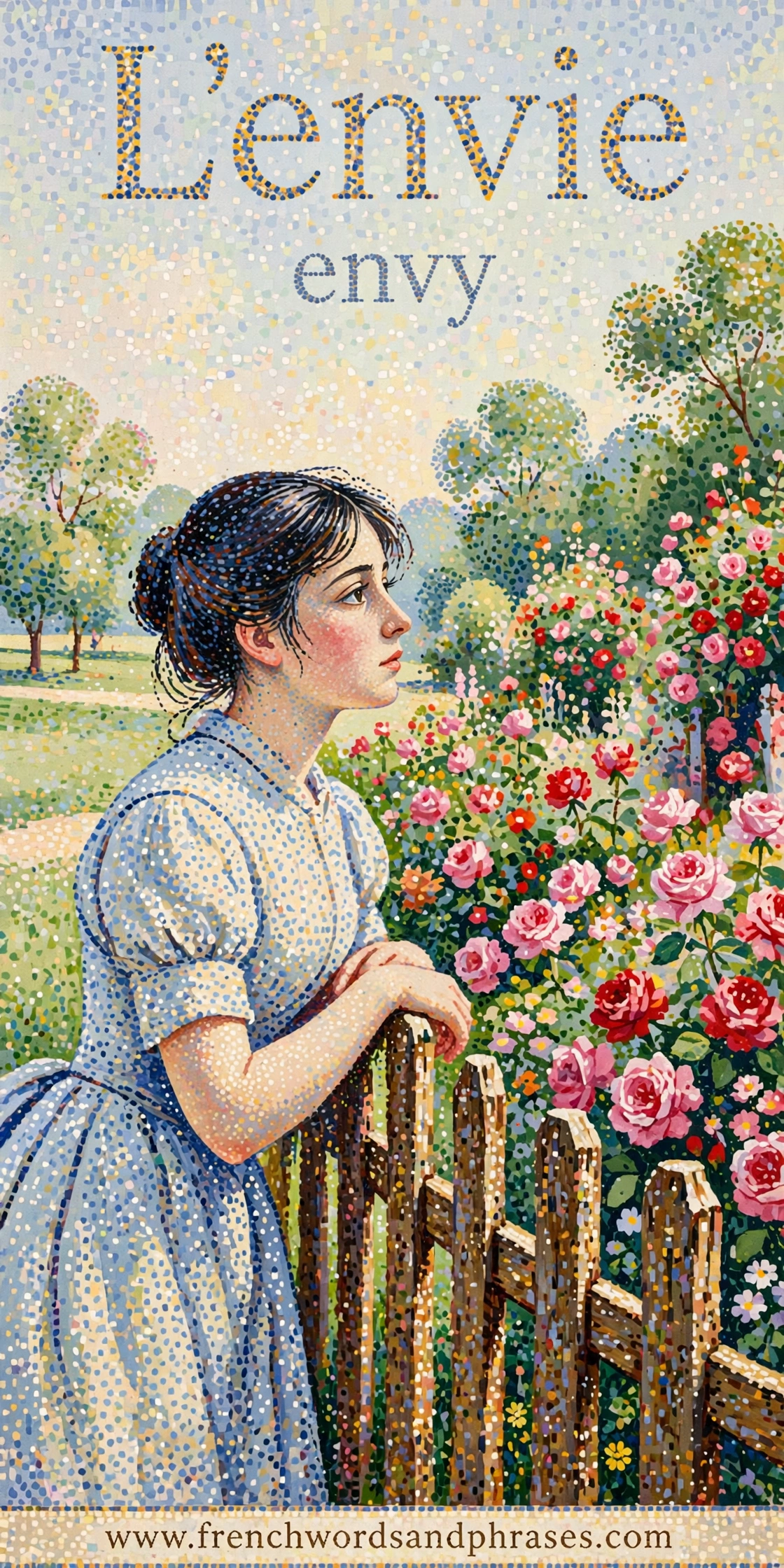
Her neighbour’s new car gleams on the drive, bought the very week her own failed its inspection. She is happy for him — she says so twice — but something small and green is chewing at the edge of her smile. French has a word for it, and it is a word with two faces: l’envie.
In this guide, you’ll learn what envie means in English, how to use it with its articles, how to form its plural, and how it appears in everyday French. Explore French examples, English translations, and practice quizzes.
Understanding the French Noun Envie
Envie is a feminine French noun. It is learned together with its article: l’envie, une envie. Because it begins with a vowel, the definite article shrinks to l’. The word leads a double life, and this page will be honest about both: first, envy — wanting what another person has; second, a wish or an urge — the envie de partir, the feeling-like of leaving. You will meet the second sense everywhere, so learn to tell the twins apart.
It means envy first: the wistful, stinging desire for what someone else possesses — their car, their house, their easy talent: être vert d’envie (to be green with envy), regarder avec envie (to look on with envy). But French also uses envie for any urge or wish: avoir envie de dormir is to feel like sleeping, and une envie de fraises is a sudden craving for strawberries. Same word, two very different temperatures.
Gender: Feminine
Definite article: l’ — l’envie (the envy)
Indefinite article: une — une envie (an envy; also, a craving)
Plural: les envies
English equivalents: Envy; also a wish, an urge, a craving (avoir envie de = to feel like).
One important usage detail: the two senses are told apart by their company. Envy arrives with people and possessions — l’envie devant la réussite des autres — while desire arrives with de plus a verb or a food: avoir envie de voyager (to feel like travelling), une envie de chocolat (a craving for chocolate). And note the possessive trap: envie is feminine but begins with a vowel, so it takes mon envie, never « ma envie ».
Experience the Word
Envie is more than wanting. In its first sense it is wanting with a witness — the neighbour’s car is only enviable because it is his, parked where you must pass it every morning.
Imagine the school reunion: the old classmate with the publishing deal, the house by the sea, the effortless stories. You applaud, you embrace him — and on the drive home the applause echoes a little hollow.
You have not just desired something. You have felt l’envie — desire that has looked sideways.
How to Use Envie in French: Complete Guide
Let’s explore how envie works in French, beginning with its articles.
Envie with the Definite Article (L’, Les)
Envie begins with a vowel, so le and la both shrink to l’ — l’envie — while the plural is les envies.
| Number | French |
|---|---|
| Singular | l’envie |
| Plural | les envies |
Example
L’envie se lisait dans son regard.
The envy could be read in her look.
Envie with the Indefinite Article (Une, Des)
Used for an envie in general — a bout of envy, or one of the day’s little urges.
| Number | French |
|---|---|
| Singular | une envie |
| Plural | des envies |
Example
Une envie soudaine de partir l’a prise au milieu du dîner.
A sudden urge to leave came over her in the middle of dinner.
The Two Faces of Envie: Envy and Desire
The essential table of the word — one face looks sideways at others, the other simply wants. Learn to read which face is turned towards you.
| French | In English |
|---|---|
| être vert d’envie | to be green with envy |
| regarder avec envie | to look on with envy |
| mourir d’envie de faire quelque chose | to be dying to do something |
| avoir envie de dormir | to feel like sleeping |
| une envie de chocolat | a craving for chocolate |
| faire envie | to be tempting, to look appealing |
Example
Il est vert d’envie devant la moto de son frère.
He is green with envy at his brother’s motorbike.
Quick Quiz 1
« J’ai envie de partir » — is this envy, or a wish?
Reveal the answer
A wish — avoir envie de plus a verb means to feel like doing something; envy needs a person or a possession to aim at.
J’ai envie de partir, ce travail m’épuise.
I feel like leaving, this job is wearing me out.
The Plural of Envie
Envie adds an -s in the plural — les envies, all the day’s urges and cravings, or a lifetime’s envies.
| Number | French |
|---|---|
| Singular | l’envie |
| Plural | les envies |
Example
Les envies de chocolat reviennent toujours le soir.
The cravings for chocolate always come back in the evening.
Envie with Possessive Adjectives (Mon, Ton, Son…)
A famous exception: envie is feminine, but because it begins with a vowel it takes mon, ton, son — mon envie, never « ma envie ».
| Owner | French |
|---|---|
| my | mon envie |
| your (tu) | ton envie |
| his / her | son envie |
| our | notre envie |
| your (vous) | votre envie |
| their | leur envie |
Example
Mon envie de voyager grandit chaque année.
My desire to travel grows every year.
Quick Quiz 2
Complete the sentence:
Elle suit ______ envie et réserve le billet. (her)
Reveal the answer
son
Elle suit son envie et réserve le billet.
She follows her urge and books the ticket — son, not sa, because envie begins with a vowel.
Envie with Demonstrative Adjectives (Cette, Ces)
Used to point: this urge here, those cravings there.
| Number | French |
|---|---|
| Singular | cette envie |
| Plural | ces envies |
Example
Cette envie de tout quitter lui passe chaque hiver.
This urge to leave everything comes over him every winter.
Envie with Adjectives
Adjectives agree with envie, feminine — folle, soudaine, irrésistible.
| Adjective | With Envie |
|---|---|
| folle (mad, wild) | une envie folle |
| soudaine (sudden) | une envie soudaine |
| irrésistible (irresistible) | une envie irrésistible |
| petite (small) | une petite envie |
| constante (constant) | une envie constante |
Example
Une envie folle de danser l’a saisie à minuit.
A wild urge to dance seized her at midnight.
Quick Quiz 3
Complete the sentence:
Une envie ______ de glace m’a pris après le repas. (sudden)
Reveal the answer
soudaine
Une envie soudaine de glace m’a pris après le repas.
A sudden craving for ice cream came over me after the meal.
Everyday Expressions with Envie
From green envy to midnight cravings — the envie phrases of daily life, in both its senses.
| Expression | In English |
|---|---|
| avoir envie de | to feel like, to want to |
| être vert d’envie | to be green with envy |
| mourir d’envie | to be dying to, to be dying of envy |
| donner envie | to make someone feel like, to tempt |
| passer son envie | to get over a craving, to satisfy it |
| une envie de fraises | a craving for strawberries (famously, in pregnancy) |
Example
Ce gâteau au chocolat donne vraiment envie.
That chocolate cake really looks tempting.
Words from the Same Family as Envie
Envy, desire and their neighbours — the words that travel with envie.
| French | In English |
|---|---|
| envier | to envy |
| envieux, envieuse | envious |
| enviable | enviable |
| le désir | desire |
| souhaiter | to wish |
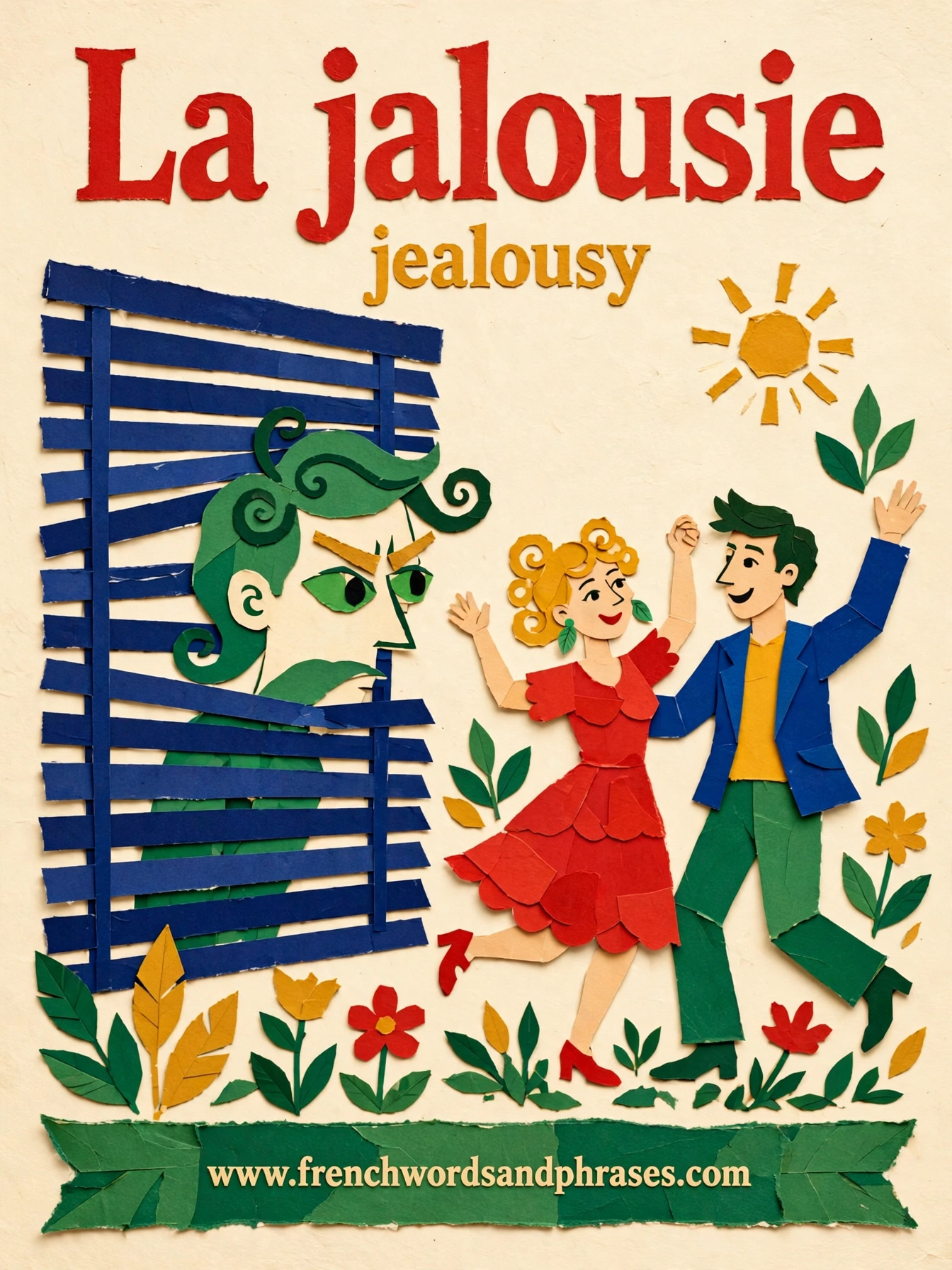
| la jalousie | jealousy — the cousin that fears losing |
Example
Envieux de son succès, il a cessé de l’appeler.
Envious of his success, he stopped calling him.
Quick Quiz 4
What is the difference between l’envie and la jalousie?
Reveal the answer
L’envie wants what another has; la jalousie fears losing what it already has — above all, a loved person’s heart.
L’envie convoite, la jalousie surveille.
Envy covets, jealousy watches.
Envie in Everyday French: Real-Life Examples
Now that you know the word, let’s see how envie appears in everyday French.
Example 1 — The neighbour’s car
Il regarde la voiture neuve du voisin avec envie.
He looks at the neighbour’s new car with envy.
Example 2 — Green with envy
Elle est verte d’envie devant leur maison au bord de la mer.
She is green with envy at their house by the sea.
Example 3 — Feeling like it
Ce soir, j’ai envie de rester à la maison.
Tonight, I feel like staying at home.
Example 4 — A craving
Une envie de fraises l’a réveillée à minuit.
A craving for strawberries woke her at midnight.
Example 5 — Dying to go
Les enfants meurent d’envie d’aller à la piscine.
The children are dying to go to the swimming pool.
Example 6 — Tempting
Cette robe dans la vitrine me donne envie.
That dress in the window is tempting me.
Beyond Translation: The Meaning of Envie
Envie is one of the seven deadly sins in the old French catechism — l’envie, the sin of the sideways look — yet the same word innocently orders your evening: j’ai envie d’un café. Few French words travel so far between confession and café. The language forgives the second sense because it knows the first so well: every urge is a little envy of the person you would be, doing the thing.
To say envie is to admit that wanting has two faces.
It evokes the neighbour’s gleaming car and the midnight craving, the classmate’s success and the simple wish for a swim — one word for the whole geography of wanting, from the sin to the strawberry.
How to Remember the French Noun Envie
Remember it this way: Envie is envy — feminine with l’, and a word with two faces: it wants what others have, and it simply feels like doing things.
- You spot the envy — vert d’envie, regarder avec envie.
- You spot the wish — avoir envie de plus a verb: to feel like doing it.
- You dodge the exception — mon envie, pas ma envie, because of the vowel.
The key idea is l’envie covets — avoir envie de simply wants.
Test Your Knowledge of Envie
Let’s see how much you’ve learned. Try answering these questions before revealing the answers.
Question 1
Is envie masculine or feminine?
Reveal the answer
Feminine — but with l’: l’envie, une envie.
Question 2
Why do we say mon envie and not ma envie?
Reveal the answer
Because envie begins with a vowel sound — feminine nouns starting with a vowel take mon, ton, son.
Question 3
Translate: She is green with envy.
Reveal the answer
Elle est verte d’envie.
Question 4
What does j’ai envie de dormir mean?
Reveal the answer
I feel like sleeping — the desire sense of envie, not envy.
Question 5
Complete the sentence:
Les enfants meurent ______ envie d’aller à la mer.
Reveal the answer
d’
Les enfants meurent d’envie d’aller à la mer.
The children are dying to go to the seaside.
Your Final Challenge
Can You Use It?
How would you say this in French?
“He looks at the neighbour’s new car with envy.”
Reveal the answer
Il regarde la voiture neuve du voisin avec envie.
He looks at the neighbour’s new car with envy.
A little French. A little curiosity. A richer everyday life.
LEARN FRENCH ONE WORD AT A TIME