A French Word to Live By
Translate Parents to English
/pa.ʁɑ̃/
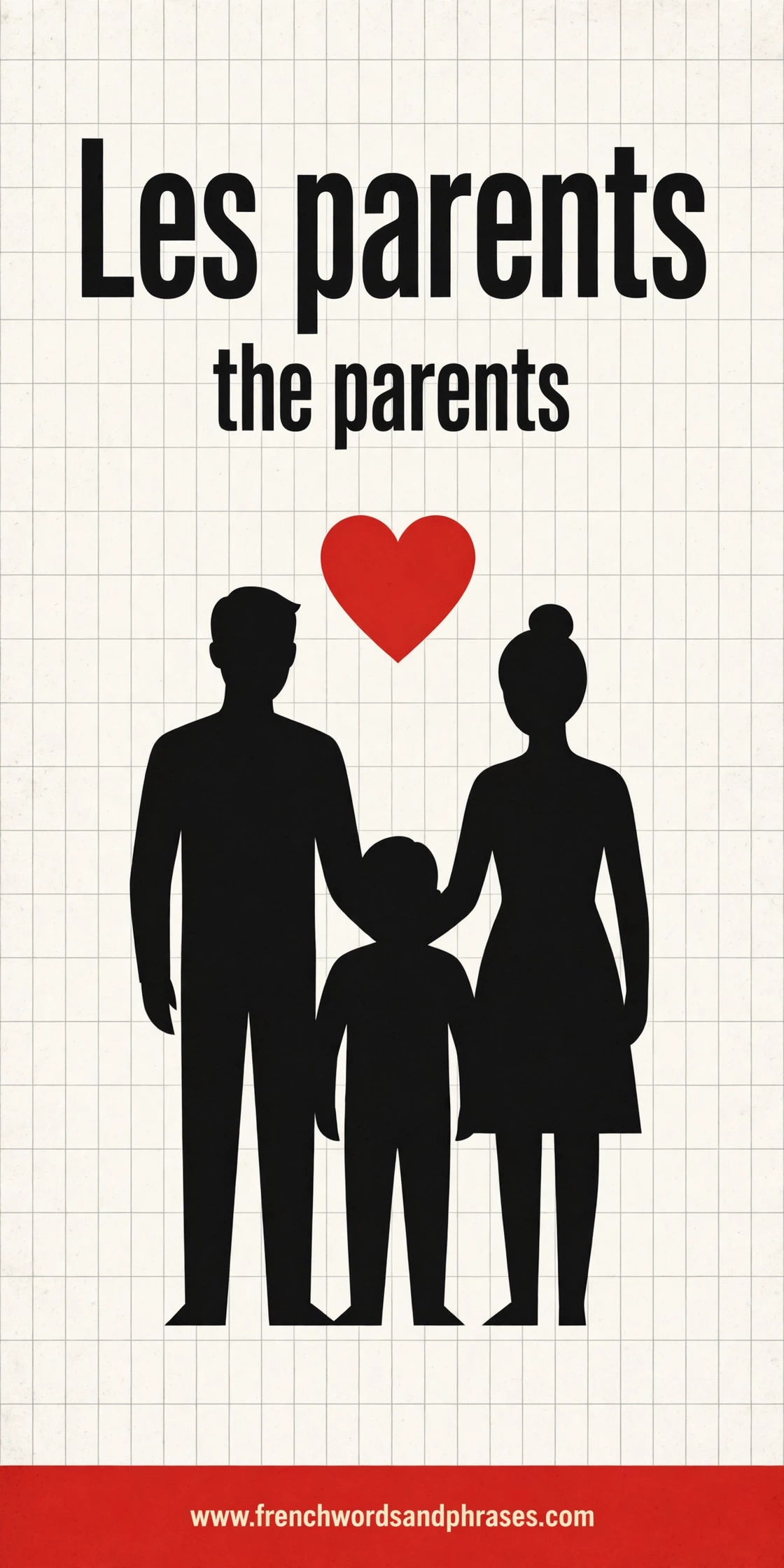
Les parents means the parents.
Two figures wait at the school gate in the rain, one with an umbrella, one with a forgotten lunchbox: les parents, the parents — the pair who made you, raised you, and still, decades later, keep a spare key to your life. In French the word lives in the plural, because parents, like shoes and scissors, come as a pair.
In this guide, you’ll learn what parents means in English, how to use it with its articles, how to form its plural, and how it appears in everyday French. Explore French examples, English translations, and practice quizzes.
Understanding the French Noun Parents
Parents is a masculine French noun that lives in the plural: les parents, the parents — father and mother together. Beware the trap inside it: the singular exists but changes meaning — un parent is a relative, any member of the family, and une parente is a female relative. The two people who raised you are never one parent in everyday French; they are les parents, plural, a team.
It means the parents — one’s father and mother: mes parents habitent à Lyon, my parents live in Lyon; les parents d’élèves, the pupils’ parents, the school-gate crowd. The wider family sense flows from the singular: un parent éloigné, a distant relative; ils sont parents, they are related. And the in-laws have their own compound: les beaux-parents, the parents-in-law.
Gender: Masculine plural — les parents
Definite article: les — les parents (the parents)
Indefinite article: des — des parents (parents, some parents)
Plural: the word lives in the plural — the singular un parent means a relative
Spelling note: the final -ts is silent: parents sounds exactly like parent
Close neighbour: les grands-parents — the grandparents; les beaux-parents — the in-laws
English equivalents: The parents.
The great trap: do not translate « my parent » word for word when you mean your father or mother — French says mon père or ma mère for one of them, and mes parents for the pair. Un parent on its own sends a French ear to the wider family: cousins, uncles, relations. And the verb agrees plural, always: les parents sont…, never est.
Experience the Word
Parents is childhood’s government in one word — the authority, the refuge and the audience of every early triumph.
Imagine the little theatre of the school play: a forest of phones rises above the seats, filming a shepherd with three lines — les parents, an army of love armed with cameras, seeing not the wobbly shepherd but the star.
You have not just named two people. You have named the first home a person ever has — les parents, the pair at the gate.
How to Use Parents in French: Complete Guide
Let’s explore how parents works in French, beginning with its articles — les parents, des parents, mes parents.
Parents with the Definite Article (Les)
Parents lives with les — the pair, known and specific.
| Form | French |
|---|---|
| Plural | les parents |
| The parents of… | les parents de Léa |
Example
Les parents de Léa arrivent à six heures.
Léa’s parents are arriving at six.
Parents with the Indefinite Article (Des)
Des parents — parents in general, pairs among pairs.
| Form | French |
|---|---|
| Plural | des parents |
| Good parents | de bons parents |
Example
Ce sont de bons parents, patients et drôles.
They are good parents, patient and funny.
Parents with Quantities (Tous, Beaucoup de…)
Parents are counted in crowds — at gates, meetings and weddings.
| Quantity | French |
|---|---|
| all the parents | tous les parents |
| many parents | beaucoup de parents |
| both my parents | mes deux parents |
| the other parents | les autres parents |
| some parents | certains parents |
Example
Tous les parents attendent devant l’école.
All the parents are waiting in front of the school.
Quick Quiz 1
Complete the sentence:
______ parents de Hugo sont médecins. (the)
Reveal the answer
Les
Les parents de Hugo sont médecins.
Hugo’s parents are doctors — parents lives in the plural, so les.
The Singular Trap: Un parent Is a Relative
Parents has a singular, but it changes the meaning — handle with care.
| Number | French |
|---|---|
| Singular | un parent — a relative |
| Plural | les parents — the parents (father and mother) |
Example
Un parent éloigné habite au Canada.
A distant relative lives in Canada.
Parents with Possessive Adjectives (Mes, Tes, Ses…)
Possessives for a plural noun: mes, tes, ses, nos, vos, leurs.
| Owner | French |
|---|---|
| my | mes parents |
| your (tu) | tes parents |
| his / her | ses parents |
| our | nos parents |
| your (vous) | vos parents |
| their | leurs parents |
Example
Mes parents habitent près de la mer.
My parents live near the sea.
Quick Quiz 2
Complete the sentence:
Elle téléphone à ______ parents tous les dimanches. (her)
Reveal the answer
ses
Elle téléphone à ses parents tous les dimanches.
She phones her parents every Sunday — ses, the plural possessive.
Parents with Demonstrative Adjectives (Ces)
Used to point: ces parents, these parents — that couple by the gate.
| Form | French |
|---|---|
| Plural | ces parents |
| These parents here | ces parents-ci |
Example
Ces parents attendent depuis une heure.
These parents have been waiting for an hour.
Parents with Adjectives
Adjectives agree with parents — masculine plural: des parents heureux, de jeunes parents.
| Adjective | With Parents |
|---|---|
| jeunes (young) | de jeunes parents |
| heureux (happy) | des parents heureux |
| âgés (elderly) | des parents âgés |
| fiers (proud) | des parents fiers |
| inquiets (worried) | des parents inquiets |
Example
De jeunes parents promènent leur bébé au parc.
Young parents are walking their baby in the park.
Quick Quiz 3
Complete the sentence:
Ce sont des parents très ______. (proud)
Reveal the answer
fiers
Ce sont des parents très fiers.
They are very proud parents — fiers, masculine plural, to agree with parents.
Everyday Expressions with Parents
School gates, family Sundays and weddings — the parents phrases of daily life.
| Expression | In English |
|---|---|
| les parents d’élèves | the pupils’ parents (as a body) |
| chez mes parents | at my parents’ (house) |
| les beaux-parents | the parents-in-law |
| parents et enfants | parents and children |
| devenir parents | to become parents |
Example
Nous passons dimanche chez mes parents.
We’re spending Sunday at my parents’.
Words from the Same Family as Parents
The family circle — the words that travel with parents.
| French | In English |
|---|---|
| le père | the father |
| la mère | the mother |
| un parent | a relative — the singular with its other meaning |
| les grands-parents | the grandparents |
| la famille | the family |
Example
Toute la famille vient dimanche, parents et grands-parents.
The whole family is coming on Sunday, parents and grandparents.
Quick Quiz 4
What do les beaux-parents mean?
Reveal the answer
The parents-in-law — your partner’s parents, the beaux-parents.
Il dîne chez ses beaux-parents.
He’s having dinner at his in-laws’.
Parents in Everyday French: Real-Life Examples
Now that you know the word, let’s see how parents appears in everyday French.
Example 1 — At the school gate
Les parents attendent les enfants à la sortie.
The parents are waiting for the children at the exit.
Example 2 — At home
Mes parents regardent le journal à la télé.
My parents are watching the news on TV.
Example 3 — A phone call
Je téléphone à mes parents tous les dimanches.
I phone my parents every Sunday.
Example 4 — Becoming parents
Ils vont devenir parents en juin.
They are going to become parents in June.
Example 5 — The in-laws
Nous dînons chez les beaux-parents ce soir.
We’re having dinner at the in-laws’ this evening.
Example 6 — A relative
Un parent de ma mère habite au Canada.
A relative of my mother’s lives in Canada.
Beyond Translation: The Meaning of Parents
Parents tells a quiet truth about French family thinking: the pair is the unit. Where English happily singularises — a parent, each parent — everyday French keeps father and mother fused in a plural that has no ordinary singular, because in the child’s world they arrive together, decide together, wait at the gate together. The singular was left to the wider clan: un parent is anybody the blood connects you to, near or far — a word for weddings and funerals, where the whole parentèle gathers.
To say les parents is to name the original team — two people, one word, no singular.
It evokes the school gate in the rain, the Sunday table, and the spare key that still, after forty years, hangs by your parents’ door.
How to Remember the French Noun Parents
Remember it this way: Parents is the plural-only pair — les parents, mes parents — while the singular un parent slips away to mean a relative.
- Always plural for the pair — les parents sont…, jamais « le parent est » pour papa et maman.
- One of them has a name — mon père, ma mère ; les deux ensemble, mes parents.
- The singular emigrates — un parent, c’est un membre de la famille, pas forcément le père.
The key idea is les parents — the parents, plural only; un parent = a relative.
Test Your Knowledge of Parents
Let’s see how much you’ve learned. Try answering these questions before revealing the answers.
Question 1
How do you say the parents?
Reveal the answer
Les parents — the word lives in the plural.
Question 2
What does un parent mean?
Reveal the answer
A relative — the singular changes meaning; father-and-mother together are always les parents.
Question 3
Translate: My parents live in Lyon.
Reveal the answer
Mes parents habitent à Lyon.
Question 4
Complete the sentence:
______ parents sont très fiers de toi. (my)
Reveal the answer
Mes
Mes parents sont très fiers de toi.
My parents are very proud of you.
Question 5
How do you say the parents-in-law?
Reveal the answer
Les beaux-parents.
Your Final Challenge
Can You Use It?
How would you say this in French?
“My parents are waiting in front of the school.”
Reveal the answer
Mes parents attendent devant l’école.
My parents are waiting in front of the school.
A little French. A little curiosity. A richer everyday life.
LEARN FRENCH ONE WORD AT A TIME