A French Word to Live By
Translate Mépris to English
/me.pʁi/
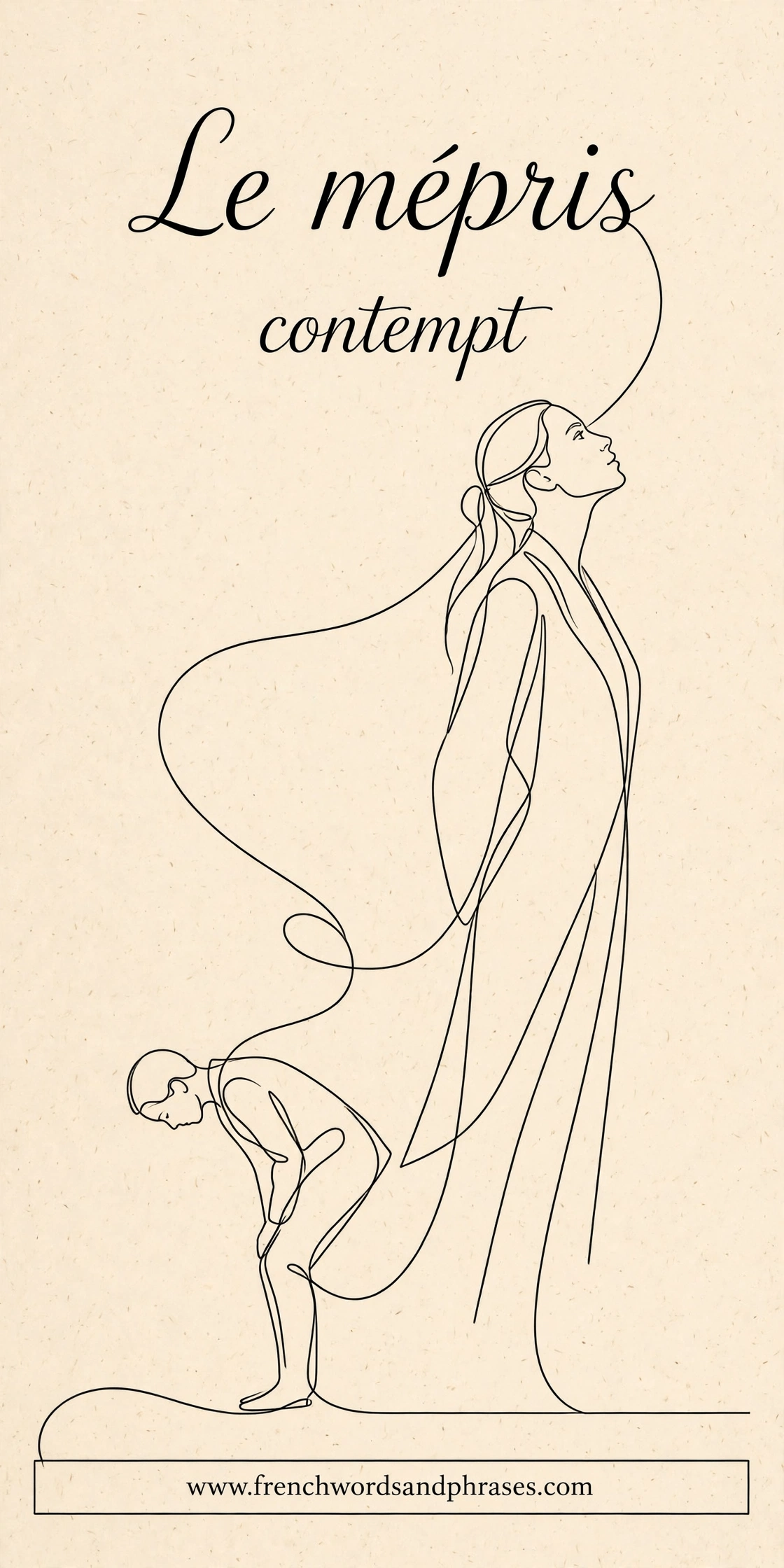
Le mépris means contempt.
The young waiter brings the bill to the grand table, and the gentleman does not even look at him — he takes the paper with two fingers, the way you pick up something dirty. No insult is spoken, and none is needed: le mépris has just entered the room.
In this guide, you’ll learn what mépris means in English, how to use it with its articles, how to form its plural, and how it appears in everyday French. Explore French examples, English translations, and practice quizzes.
Understanding the French Noun Mépris
Mépris is a masculine French noun. It is learned together with its article: le mépris, un mépris. It is the noun of the verb mépriser, to despise — from an old idea of pricing something below its worth: to hold something cheap. The final -s is part of the word and is never pronounced, singular or plural.
It means contempt — the cold, looking-down feeling that judges someone or something as beneath notice: un profond mépris (a deep contempt), le mépris des règles (contempt for the rules), regarder quelqu’un avec mépris (to look at someone with contempt). It is colder than la colère and quieter than la haine: contempt does not even raise its voice.
Gender: Masculine
Definite article: le — le mépris (the contempt)
Indefinite article: un — un mépris (a contempt)
Plural: les mépris — the word itself never changes
English equivalents: Contempt, scorn, disdain.
One important usage detail: mépris has a famous preposition phrase — au mépris de, in defiance of, with contempt for: au mépris des règles (in defiance of the rules), au mépris du danger (scorning the danger). Journalists love it, and it lifts any sentence into formal French. The word’s spelling never changes: singular and plural are both mépris.
Experience the Word
Mépris is more than disapproval. It is a verdict delivered from above — the raised eyebrow, the turned shoulder, the silence that says: you are not worth an answer.
Imagine the old professor receiving a sloppy essay: he does not mark it, he does not scold. He places it back on the desk, face down, very gently, and moves on to the next student as if the page were empty.
You have not just witnessed rudeness. You have felt the temperature of le mépris.
How to Use Mépris in French: Complete Guide
Let’s explore how mépris works in French, beginning with its articles.
Mépris with the Definite Article (Le, Les)
Used for the contempt everyone in the room can feel — the one in his voice, in her look.
| Number | French |
|---|---|
| Singular | le mépris |
| Plural | les mépris |
Example
Le mépris se lisait dans son regard.
The contempt could be read in his look.
Mépris with the Indefinite Article (Un, Des)
Used for a contempt in general — one contempt, qualified and weighed.
| Number | French |
|---|---|
| Singular | un mépris |
| Plural | des mépris |
Example
Il parlait de ses adversaires avec un mépris total.
He spoke of his opponents with total contempt.
Au mépris de: Contempt at Work
The great phrase of the word — au mépris de turns contempt into action: rules ignored, dangers scorned.
| French | In English |
|---|---|
| au mépris des règles | in defiance of the rules |
| au mépris du danger | scorning the danger |
| au mépris de la loi | in contempt of the law |
| le mépris des autres | contempt for others |
| le mépris de l’argent | contempt for money |
| un sourire de mépris | a smile of contempt, a sneer |
Example
Il a traversé la rivière au mépris du danger.
He crossed the river scorning the danger.
Quick Quiz 1
What does « au mépris de la loi » mean?
Reveal the answer
In contempt of the law — defying it, treating it as beneath obedience.
Ils ont construit au mépris de la loi.
They built in contempt of the law.
The Plural of Mépris
Mépris is invariable — the word ends in -s already and never changes: le mépris, les mépris, spelled exactly the same.
| Number | French |
|---|---|
| Singular | le mépris |
| Plural | les mépris |
Example
Les petits mépris du quotidien blessent autant que les grands.
The little everyday contempts hurt as much as the great ones.
Mépris with Possessive Adjectives (Mon, Ton, Son…)
Possessives agree with the noun, not with the owner — and mépris is masculine, so it takes mon, ton, son.
| Owner | French |
|---|---|
| my | mon mépris |
| your (tu) | ton mépris |
| his / her | son mépris |
| our | notre mépris |
| your (vous) | votre mépris |
| their | leur mépris |
Example
Son mépris pour les faibles le rendait détestable.
His contempt for the weak made him detestable.
Quick Quiz 2
Complete the sentence:
Elle ne cache pas ______ mépris pour les menteurs. (her)
Reveal the answer
son
Elle ne cache pas son mépris pour les menteurs.
She does not hide her contempt for liars.
Mépris with Demonstrative Adjectives (Ce, Ces)
Used to point: this contempt here, those contempts there.
| Number | French |
|---|---|
| Singular | ce mépris |
| Plural | ces mépris |
Example
Ce mépris affiché finira par se retourner contre lui.
This displayed contempt will end up turning against him.
Mépris with Adjectives
Adjectives agree with mépris, masculine — profond, total, affiché.
| Adjective | With Mépris |
|---|---|
| profond (deep) | un profond mépris |
| total (total) | un mépris total |
| affiché (openly shown) | un mépris affiché |
| souverain (supreme) | un souverain mépris |
| à peine caché (barely hidden) | un mépris à peine caché |
Example
Il répondit par un souverain mépris.
He answered with supreme contempt.
Quick Quiz 3
Complete the sentence:
Un ______ mépris se lisait sur son visage. (deep)
Reveal the answer
profond
Un profond mépris se lisait sur son visage.
A deep contempt could be read on his face.
Everyday Expressions with Mépris
Showing it, hiding it, defying with it — the mépris phrases of French.
| Expression | In English |
|---|---|
| avec mépris | with contempt, contemptuously |
| regarder avec mépris | to look at with contempt |
| au mépris de | in defiance of, scorning |
| le mépris de soi | self-contempt |
| traiter avec mépris | to treat with contempt |
| un ton de mépris | a tone of contempt |
Example
Elle a repoussé l’offre avec mépris.
She pushed the offer away with contempt.
Words from the Same Family as Mépris
Contempt and its neighbours — the words that travel with mépris.
| French | In English |
|---|---|
| mépriser | to despise, to scorn |
| méprisant | contemptuous, scornful |
| le dédain | disdain |
| méprisable | despicable, contemptible |
| dédaigner | to disdain, to scorn |
| le respect | respect — the opposite |
Example
Le dédain est un mépris qui se donne des airs.
Disdain is a contempt that puts on airs.
Quick Quiz 4
Does the spelling of mépris change in the plural?
Reveal the answer
No — mépris is invariable: le mépris, les mépris, written exactly the same.
Un mépris, des mépris — le mot ne bouge pas.
A contempt, some contempts — the word does not move.
Mépris in Everyday French: Real-Life Examples
Now that you know the word, let’s see how mépris appears in everyday French.
Example 1 — At work
Son chef le traite avec mépris depuis des mois.
His boss has been treating him with contempt for months.
Example 2 — In the press
Le maire a agi au mépris des règles de sécurité.
The mayor acted in defiance of the safety rules.
Example 3 — A look
Elle l’a regardé avec un mépris glacial.
She looked at him with icy contempt.
Example 4 — Money
Son mépris de l’argent étonnait toute sa famille.
His contempt for money astonished his whole family.
Example 5 — An answer
À ses insultes, elle a répondu par le mépris.
To his insults, she answered with contempt.
Example 6 — Self-contempt
Le mépris de soi l’empêchait d’avancer.
Self-contempt was stopping him from moving forward.
Beyond Translation: The Meaning of Mépris
French philosophy has long kept mépris in a strange double place: it is the ugliest of social feelings, the one democracies are built to abolish — and yet the language honours it when it is aimed upward, at danger, at money, at death itself: le mépris du danger is a compliment.
To say mépris is to look down — and French asks, every time, at what.
It evokes the sneer across the grand table, the rule scorned by the powerful, the hero’s calm before the storm — contempt as cruelty between people, and as courage before fate.
How to Remember the French Noun Mépris
Remember it this way: Mépris is contempt — masculine, invariable (le mépris, les mépris), and famous for its phrase au mépris de, in defiance of.
- You never change the word — le mépris, les mépris, toujours pareil.
- You defy with it — au mépris des règles, au mépris du danger.
- You aim it carefully — le mépris blesse les gens, mais le mépris du danger fait les héros.
The key idea is le mépris — invariable, and au mépris de defies.
Test Your Knowledge of Mépris
Let’s see how much you’ve learned. Try answering these questions before revealing the answers.
Question 1
Is mépris masculine or feminine?
Reveal the answer
Masculine — le mépris, un mépris.
Question 2
How is the plural of mépris written?
Reveal the answer
Les mépris — the word is invariable and never changes its spelling.
Question 3
Translate: He crossed the river scorning the danger.
Reveal the answer
Il a traversé la rivière au mépris du danger.
Question 4
What is le dédain?
Reveal the answer
Disdain — mépris’s close cousin, contempt with airs and graces.
Question 5
Complete the sentence:
Elle ne cache pas ______ mépris pour les menteurs.
Reveal the answer
son
Elle ne cache pas son mépris pour les menteurs.
She does not hide her contempt for liars.
Your Final Challenge
Can You Use It?
How would you say this in French?
“She looked at him with icy contempt.”
Reveal the answer
Elle l’a regardé avec un mépris glacial.
She looked at him with icy contempt.
A little French. A little curiosity. A richer everyday life.
LEARN FRENCH ONE WORD AT A TIME