A French Word to Live By
Translate Pitié to English
/pi.tje/
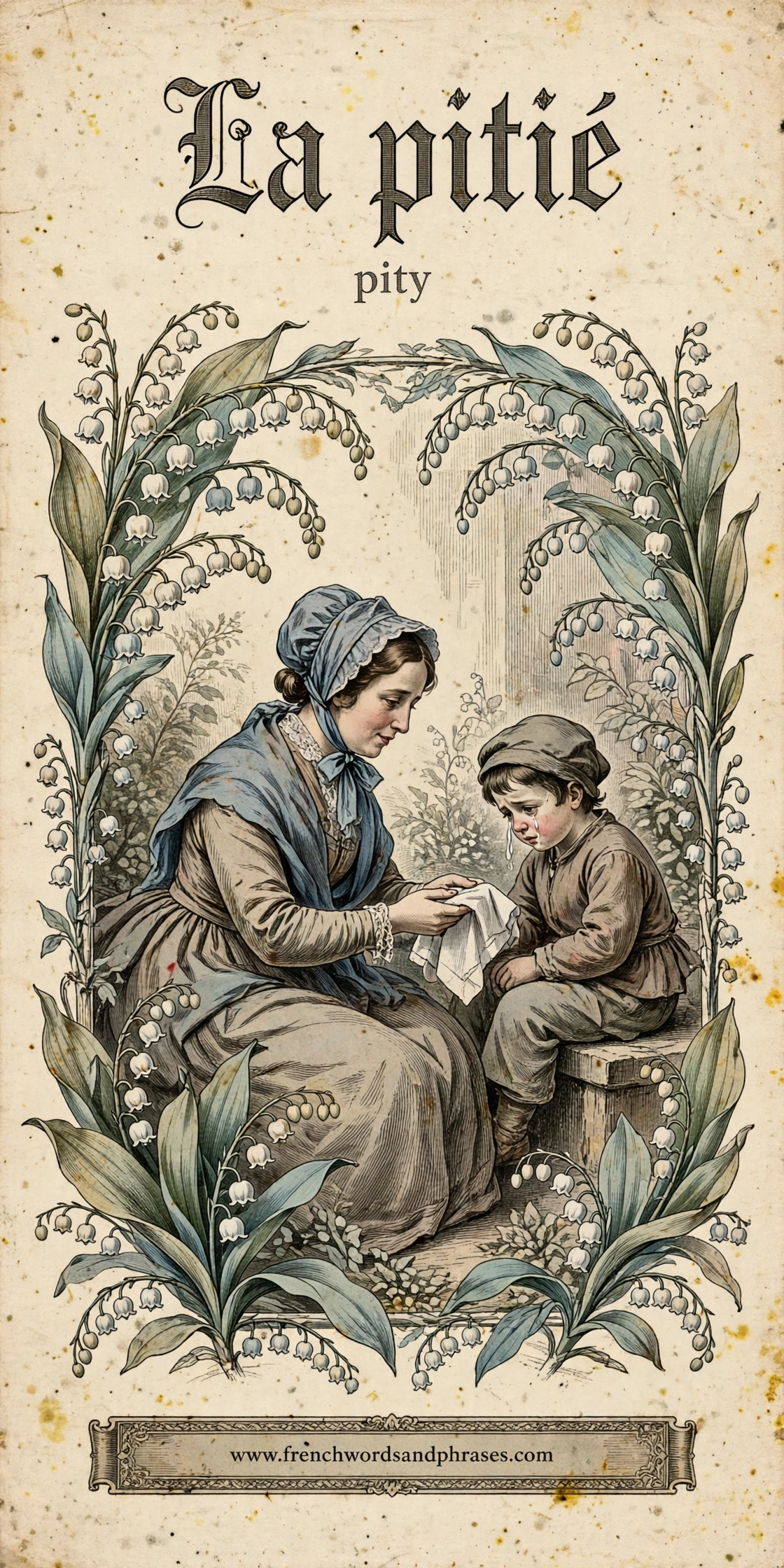
La pitié means pity.
At the corner of the square, an old man sits with his cap at his feet, in the rain that everyone else is hurrying through. A schoolgirl stops, opens her umbrella over him for a moment, and empties her pockets into the cap — moved by the feeling French calls la pitié.
In this guide, you’ll learn what pitié means in English, how to use it with its articles, how to form its plural, and how it appears in everyday French. Explore French examples, English translations, and practice quizzes.
Understanding the French Noun Pitié
Pitié is a feminine French noun. It is learned together with its article: la pitié, une pitié. It shares its root with pieux, pious, and once carried a religious weight — pity as a duty of the soul. Today it is the everyday word for the ache you feel at someone else’s misfortune, the feeling that makes you stop, help, or spare.
It means pity — the pained, tender feeling provoked by another’s suffering: avoir pitié de quelqu’un (to take pity on someone), par pitié (out of pity), sans pitié (without pity, pitiless). It sits close to la compassion, which suffers with the other person; la pitié looks at the suffering from the doorstep — moved, but standing outside it.
Gender: Feminine
Definite article: la — la pitié (the pity)
Indefinite article: une — une pitié (a pity)
Plural: les pitiés — rare; the word is usually uncountable
English equivalents: Pity, mercy; faire pitié — to look pitiful, pathetic.
One important usage detail: pity splits into two famous phrases that learners confuse — avoir pitié de means to feel pity for someone, but faire pitié means to look pitiful, to be a sorry sight: ce jardin fait pitié, this garden is a sorry sight. And beware the English « what a pity! »: for a shame or a disappointment, French says quel dommage ! — never « quelle pitié ».
Experience the Word
Pitié is more than feeling sorry. It is the moment another person’s misfortune stops being news and becomes a weight in your own chest — the moment the hand goes into the pocket.
Imagine the hospital corridor: a stranger is crying quietly into her hands, and without a word the woman beside her moves one chair closer and offers a paper handkerchief. Nothing is fixed; everything is shared.
You have not just sympathised. You have been seized by la pitié — and it has moved your hands.
How to Use Pitié in French: Complete Guide
Let’s explore how pitié works in French, beginning with its articles.
Pitié with the Definite Article (La, Les)
Used for the pity everyone in the scene can feel — the one that stops the passer-by.
| Number | French |
|---|---|
| Singular | la pitié |
| Plural | les pitiés |
Example
La pitié l’a poussée à s’arrêter.
Pity pushed her to stop.
Pitié with the Indefinite Article (Une, Des)
Used for a pity in general — rare, since pity is usually named with la or with the partitive de la.
| Number | French |
|---|---|
| Singular | une pitié |
| Plural | des pitiés |
Example
Une pitié sincère se lisait dans son geste.
A sincere pity could be read in her gesture.
The Two Faces of Pitié: Avoir and Faire
The essential table of the word — avoir pitié feels it, faire pitié causes it, and the two must never be swapped.
| French | In English |
|---|---|
| avoir pitié de quelqu’un | to take pity on someone |
| faire pitié | to look pitiful, to be a sorry sight |
| par pitié | out of pity |
| sans pitié | without pity, pitiless |
| prendre quelqu’un en pitié | to take pity on someone |
| pitié ! | mercy! (a cry for mercy) |
Example
Le vieux chien faisait pitié, seul sous la pluie.
The old dog was a sorry sight, alone in the rain.
Quick Quiz 1
« Ce manteau fait pitié » — is the coat feeling sorry, or looking sorry?
Reveal the answer
Looking sorry — faire pitié means to be a pitiful sight; it is avoir pitié that feels the pity.
Ce manteau fait pitié, il faut le remplacer.
This coat is a sorry sight, it needs replacing.
The Plural of Pitié
Pitié adds an -s in the plural — les pitiés — but the plural is rare: pity is normally a single, uncountable feeling.
| Number | French |
|---|---|
| Singular | la pitié |
| Plural | les pitiés |
Example
On parle rarement des pitiés au pluriel : le sentiment est un.
People rarely speak of pities in the plural: the feeling is one.
Pitié with Possessive Adjectives (Ma, Ta, Sa…)
Possessives agree with the noun, not with the owner — and pitié is feminine, so it takes ma, ta, sa.
| Owner | French |
|---|---|
| my | ma pitié |
| your (tu) | ta pitié |
| his / her | sa pitié |
| our | notre pitié |
| your (vous) | votre pitié |
| their | leur pitié |
Example
Sa pitié pour les animaux abandonnés le pousse à agir.
His pity for abandoned animals pushes him to act.
Quick Quiz 2
Complete the sentence:
Elle a éveillé ______ pitié dès le premier regard. (my)
Reveal the answer
ma
Elle a éveillé ma pitié dès le premier regard.
She aroused my pity from the first look.
Pitié with Demonstrative Adjectives (Cette, Ces)
Used to point: this pity here, those pities there.
| Number | French |
|---|---|
| Singular | cette pitié |
| Plural | ces pitiés |
Example
Cette pitié soudaine l’a surprise elle-même.
This sudden pity surprised even herself.
Pitié with Adjectives
Adjectives agree with pitié, feminine — grande, sincère, profonde.
| Adjective | With Pitié |
|---|---|
| grande (great) | une grande pitié |
| sincère (sincere) | une pitié sincère |
| profonde (deep) | une profonde pitié |
| tardive (late-coming) | une pitié tardive |
| sans bornes (boundless) | une pitié sans bornes |
Example
Une grande pitié l’envahit devant tant de malheurs.
A great pity came over him before so much misfortune.
Quick Quiz 3
Complete the sentence:
Une pitié ______ se lisait dans ses yeux. (sincere)
Reveal the answer
sincère
Une pitié sincère se lisait dans ses yeux.
A sincere pity could be read in her eyes.
Everyday Expressions with Pitié
Feeling it, begging for it, refusing it — the pitié phrases of daily life.
| Expression | In English |
|---|---|
| avoir pitié de | to take pity on |
| par pitié | out of pity, for pity’s sake |
| sans pitié | pitiless, merciless |
| faire pitié | to be a sorry sight |
| prendre en pitié | to take pity on |
| éveiller la pitié | to arouse pity |
Example
Par pitié, ne lui raconte pas cette histoire.
For pity’s sake, don’t tell him that story.
Words from the Same Family as Pitié
Pity and its neighbours — the words that travel with pitié.
| French | In English |
|---|---|
| pitoyable | pitiful, pathetic |
| impitoyable | pitiless, merciless |
| la compassion | compassion |
| compatir | to sympathise, to feel for |
| la miséricorde | mercy (solemn, religious) |
| plaindre | to pity, to feel sorry for |
Example
Un juge impitoyable n’écoute aucune excuse.
A pitiless judge listens to no excuse.
Quick Quiz 4
A friend drops his ice cream and cries « Quelle pitié ! » Is that good French for « what a pity »?
Reveal the answer
No — for a shame or a disappointment, French says quel dommage ! Pitié is for suffering, not for dropped ice creams.
Quel dommage, ta glace est tombée !
What a shame, your ice cream fell!
Pitié in Everyday French: Real-Life Examples
Now that you know the word, let’s see how pitié appears in everyday French.
Example 1 — In the street
La vieille dame a eu pitié du chat errant.
The old lady took pity on the stray cat.
Example 2 — A sorry sight
Après l’orage, le jardin fait pitié.
After the storm, the garden is a sorry sight.
Example 3 — Begging
Pitié, monsieur, quelques pièces pour manger.
Mercy, sir, a few coins for food.
Example 4 — No mercy
Le correcteur a été sans pitié pour les fautes.
The marker was merciless about the mistakes.
Example 5 — Out of pity
Par pitié, elle lui a prêté sa voiture.
Out of pity, she lent him her car.
Example 6 — In a story
Le roi, pris de pitié, a gracié le prisonnier.
The king, seized with pity, pardoned the prisoner.
Beyond Translation: The Meaning of Pitié
Pitié has a proud literary history in French: it is the word of Victor Hugo, who built novels on it — the pity of the crowd for the condemned man, of the bishop for the thief. Philosophers have argued over it ever since: is pity a virtue that helps, or a luxury that looks down? French keeps the argument alive inside one short word.
To say pitié is to stop walking — and look at suffering properly.
It evokes the coin in the cap, the handkerchief in the hospital corridor, the pardon at the scaffold — the small, ancient moment where another’s pain becomes, briefly, your own business.
How to Remember the French Noun Pitié
Remember it this way: Pitié is pity — feminine, and split in two: avoir pitié feels it, faire pitié looks it.
- You feel it — tu as pitié de quelqu’un, tu prends en pitié.
- You look it — ce jardin fait pitié, c’est un triste spectacle.
- You dodge the trap — « what a pity » se dit quel dommage, jamais quelle pitié.
The key idea is avoir pitié feels it — faire pitié looks it.
Test Your Knowledge of Pitié
Let’s see how much you’ve learned. Try answering these questions before revealing the answers.
Question 1
Is pitié masculine or feminine?
Reveal the answer
Feminine — la pitié, une pitié.
Question 2
What does faire pitié mean?
Reveal the answer
To look pitiful, to be a sorry sight — not to feel pity; that is avoir pitié.
Question 3
Translate: The old lady took pity on the stray cat.
Reveal the answer
La vieille dame a eu pitié du chat errant.
Question 4
How does French say « what a pity! » for a disappointment?
Reveal the answer
Quel dommage ! — pitié belongs to suffering, dommage to mishaps.
Question 5
Complete the sentence:
Par ______, ne lui dis rien.
Reveal the answer
pitié
Par pitié, ne lui dis rien.
For pity’s sake, don’t tell him anything.
Your Final Challenge
Can You Use It?
How would you say this in French?
“Out of pity, she lent him her car.”
Reveal the answer
Par pitié, elle lui a prêté sa voiture.
Out of pity, she lent him her car.
A little French. A little curiosity. A richer everyday life.
LEARN FRENCH ONE WORD AT A TIME