A French Word to Live By
Translate Joie to English
/ʒwa/
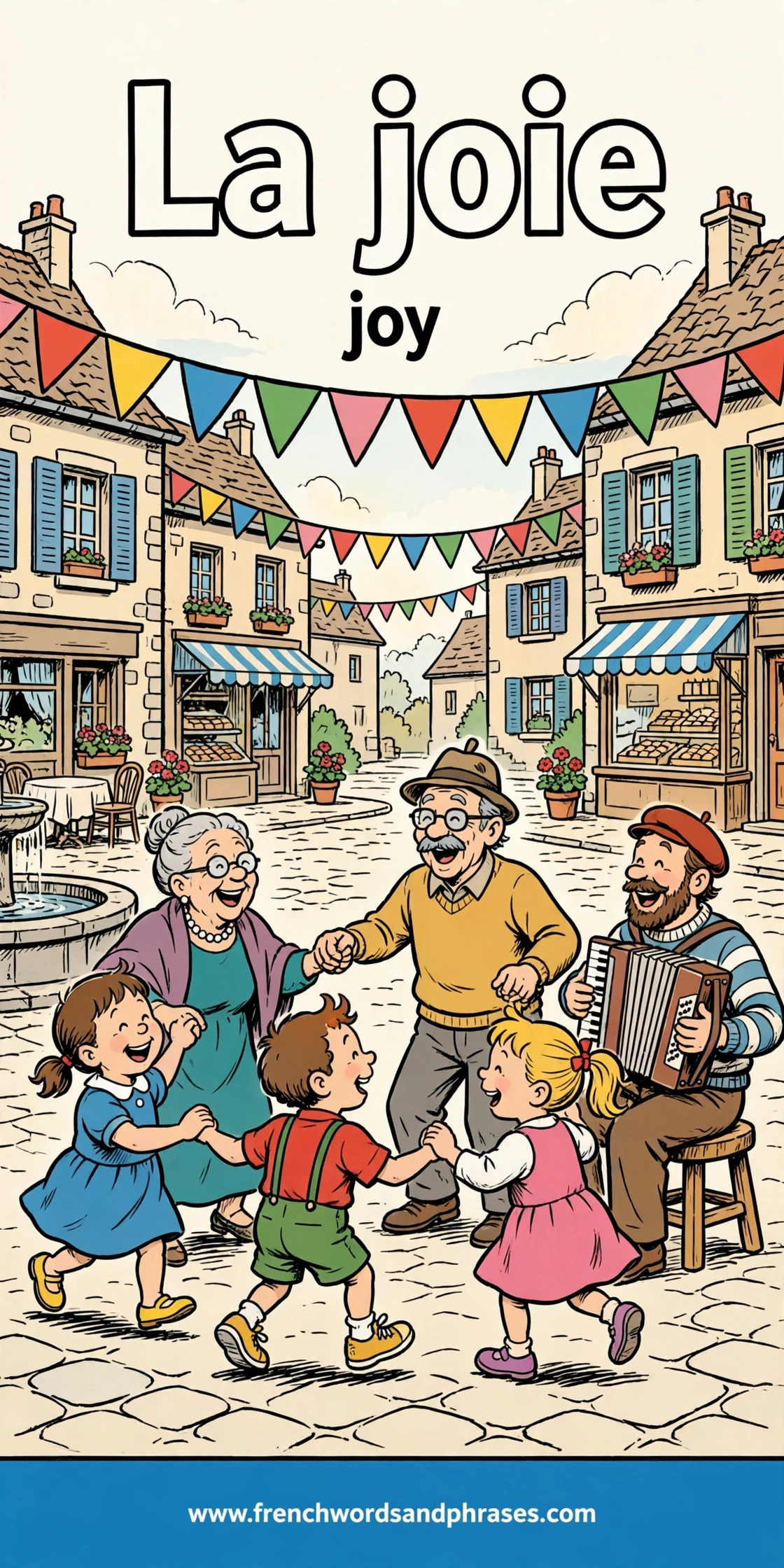
La joie means joy.
The envelope is torn open on the kitchen table, the letter is read once, twice — and then the whole room erupts. She has passed, she has the job, the baby is born: whatever the news, the feeling that fills the room is la joie.
In this guide, you’ll learn what joie means in English, how to use it with its articles, how to form its plural, and how it appears in everyday French. Explore French examples, English translations, and practice quizzes.
Understanding the French Noun Joie
Joie is a feminine French noun. It is learned together with its article: la joie, une joie. Short, round and bright, it is one of the oldest emotion words in French, and one of the warmest: where le bonheur is happiness as a lasting state, la joie is happiness in motion — felt, shown and shared.
It means joy — the bright, bubbling feeling of good news, reunions and summer mornings: une joie immense (an immense joy), la joie de vivre (the joy of living), pleurer de joie (to cry with joy). French also uses it in the plural for life’s pleasures: les joies de la famille, the joys of family life.
Gender: Feminine
Definite article: la — la joie (the joy)
Indefinite article: une — une joie (a joy)
Plural: les joies
English equivalents: Joy, delight; in the plural, the pleasures of something.
One important usage detail: joie loves the preposition de — sauter de joie (to jump for joy), pleurer de joie (to cry with joy), fou de joie (mad with joy), un cri de joie (a cry of joy). And the famous fixed phrase la joie de vivre is used in English too — French simply kept the original.
Experience the Word
Joie is more than being happy. It is happiness that cannot sit still — the laugh that escapes, the arms that go up, the phone call that has to be made at once to share the news.
Imagine the results board at the school gates in June: a crowd of teenagers, a scream, two friends hugging and jumping on the pavement while their bags fall where they fall.
You have not just felt pleased. You have been carried away by la joie.
How to Use Joie in French: Complete Guide
Let’s explore how joie works in French, beginning with its articles.
Joie with the Definite Article (La, Les)
Used for the joy everyone can see — the one on her face, the one in this room.
| Number | French |
|---|---|
| Singular | la joie |
| Plural | les joies |
Example
La joie se lisait sur son visage.
The joy could be read on her face.
Joie with the Indefinite Article (Une, Des)
Used for a joy in general — one delight among the many a life can hold.
| Number | French |
|---|---|
| Singular | une joie |
| Plural | des joies |
Example
C’est une joie de te revoir après tant d’années.
It is a joy to see you again after so many years.
Joie in Motion: the De Phrases
Joy in French is always doing something — jumping, crying, shouting. These de phrases are the ones to learn by heart.
| French | In English |
|---|---|
| sauter de joie | to jump for joy |
| pleurer de joie | to cry with joy |
| fou de joie | mad with joy |
| un cri de joie | a cry of joy |
| rayonner de joie | to beam with joy |
| la joie de vivre | the joy of living |
Example
Les enfants sautent de joie en voyant la neige.
The children jump for joy when they see the snow.
Quick Quiz 1
What does « fou de joie » mean?
Reveal the answer
Mad with joy — beside yourself with happiness.
Il était fou de joie à la naissance de sa fille.
He was mad with joy at the birth of his daughter.
The Plural of Joie
Joie adds an -s in the plural — les joies, the pleasures and delights of a life or a season.
| Number | French |
|---|---|
| Singular | la joie |
| Plural | les joies |
Example
Les joies de l’été commencent avec les premiers bains de mer.
The joys of summer begin with the first swims in the sea.
Joie with Possessive Adjectives (Ma, Ta, Sa…)
Possessives agree with the noun, not with the owner — and joie is feminine, so it takes ma, ta, sa.
| Owner | French |
|---|---|
| my | ma joie |
| your (tu) | ta joie |
| his / her | sa joie |
| our | notre joie |
| your (vous) | votre joie |
| their | leur joie |
Example
Elle ne cache pas sa joie.
She does not hide her joy.
Quick Quiz 2
Complete the sentence:
Nous partageons ______ joie avec toute la famille. (our)
Reveal the answer
notre
Nous partageons notre joie avec toute la famille.
We share our joy with the whole family.
Joie with Demonstrative Adjectives (Cette, Ces)
Used to point: this joy here, those joys there.
| Number | French |
|---|---|
| Singular | cette joie |
| Plural | ces joies |
Example
Cette joie-là, je ne l’oublierai jamais.
That joy, I will never forget it.
Joie with Adjectives
Adjectives agree with joie, feminine — grande, immense, pure.
| Adjective | With Joie |
|---|---|
| grande (great) | une grande joie |
| immense (immense) | une joie immense |
| pure (pure) | une joie pure |
| sincère (sincere) | une joie sincère |
| partagée (shared) | une joie partagée |
Example
Une joie partagée est une joie doublée.
A joy shared is a joy doubled.
Quick Quiz 3
Complete the sentence:
Ce fut une joie ______ pour toute l’équipe. (immense)
Reveal the answer
immense
Ce fut une joie immense pour toute l’équipe.
It was an immense joy for the whole team.
Everyday Expressions with Joie
Sharing it, showing it, living it — the joie phrases of daily life.
| Expression | In English |
|---|---|
| avec joie | with pleasure, gladly |
| faire la joie de quelqu’un | to be someone’s delight |
| la joie de vivre | the joy of living |
| remplir de joie | to fill with joy |
| partager sa joie | to share your joy |
| un moment de joie | a moment of joy |
Example
C’est avec joie que nous acceptons votre invitation.
It is with joy that we accept your invitation.
Words from the Same Family as Joie
Joy and its neighbours — the words that travel with joie.
| French | In English |
|---|---|
| joyeux | joyful, merry |
| se réjouir | to rejoice, to be delighted |
| le bonheur | happiness |
| gai | cheerful, merry |
| le sourire | the smile |
| rire | to laugh |
Example
Un joyeux anniversaire se fête en famille.
A joyful birthday is celebrated with family.
Quick Quiz 4
What is the difference between la joie and le bonheur?
Reveal the answer
Le bonheur is a lasting state — happiness as a condition of life; la joie is the bright moment that erupts inside it.
Le bonheur se construit, la joie éclate.
Happiness is built, joy bursts out.
Joie in Everyday French: Real-Life Examples
Now that you know the word, let’s see how joie appears in everyday French.
Example 1 — Good news
À l’annonce des résultats, ce fut une explosion de joie.
When the results were announced, it was an explosion of joy.
Example 2 — A reunion
Quelle joie de vous revoir tous !
What a joy to see you all again!
Example 3 — Children in the snow
Les enfants sautent de joie devant la fenêtre.
The children jump for joy in front of the window.
Example 4 — Accepting gladly
Je vous aiderai avec joie.
I will help you with joy — gladly.
Example 5 — A birth
La naissance du bébé a rempli la maison de joie.
The baby’s birth filled the house with joy.
Example 6 — Everyday pleasures
Les petites joies du matin : le café, le soleil, le journal.
The little joys of the morning: coffee, sun, the newspaper.
Beyond Translation: The Meaning of Joie
Of all the words English has borrowed from French, la joie de vivre may be the happiest — proof that the language is felt to own a special lease on delight. Inside French, joie is the emotion of the feast day and the family photo, the word sung at weddings and shouted at football matches.
To say joie is to let happiness make a noise.
It evokes the scream at the results board, the tears at the wedding, the grandfather dancing at the village fête — joy not kept, but spent, shared and doubled in the spending.
How to Remember the French Noun Joie
Remember it this way: Joie is joy — feminine, short and bright, and happiest inside its de phrases: sauter de joie, pleurer de joie.
- You move with it — on saute de joie, on pleure de joie.
- You share it — une joie partagée est une joie doublée.
- You live it — la joie de vivre, the phrase English borrowed whole.
The key idea is la joie bursts out — le bonheur lasts.
Test Your Knowledge of Joie
Let’s see how much you’ve learned. Try answering these questions before revealing the answers.
Question 1
Is joie masculine or feminine?
Reveal the answer
Feminine — la joie, une joie.
Question 2
How do you say to jump for joy in French?
Reveal the answer
Sauter de joie — joie follows de in all its motion phrases.
Question 3
Translate: She does not hide her joy.
Reveal the answer
Elle ne cache pas sa joie.
Question 4
What does la joie de vivre mean?
Reveal the answer
The joy of living — delight in simply being alive; English borrowed the phrase unchanged.
Question 5
Complete the sentence:
Les enfants pleurent ______ joie.
Reveal the answer
de
Les enfants pleurent de joie.
The children cry with joy.
Your Final Challenge
Can You Use It?
How would you say this in French?
“The children jump for joy when they see the snow.”
Reveal the answer
Les enfants sautent de joie en voyant la neige.
The children jump for joy when they see the snow.
A little French. A little curiosity. A richer everyday life.
LEARN FRENCH ONE WORD AT A TIME