A French Word to Live By
Translate Courage to English
/ku.ʁaʒ/
Le courage means courage.
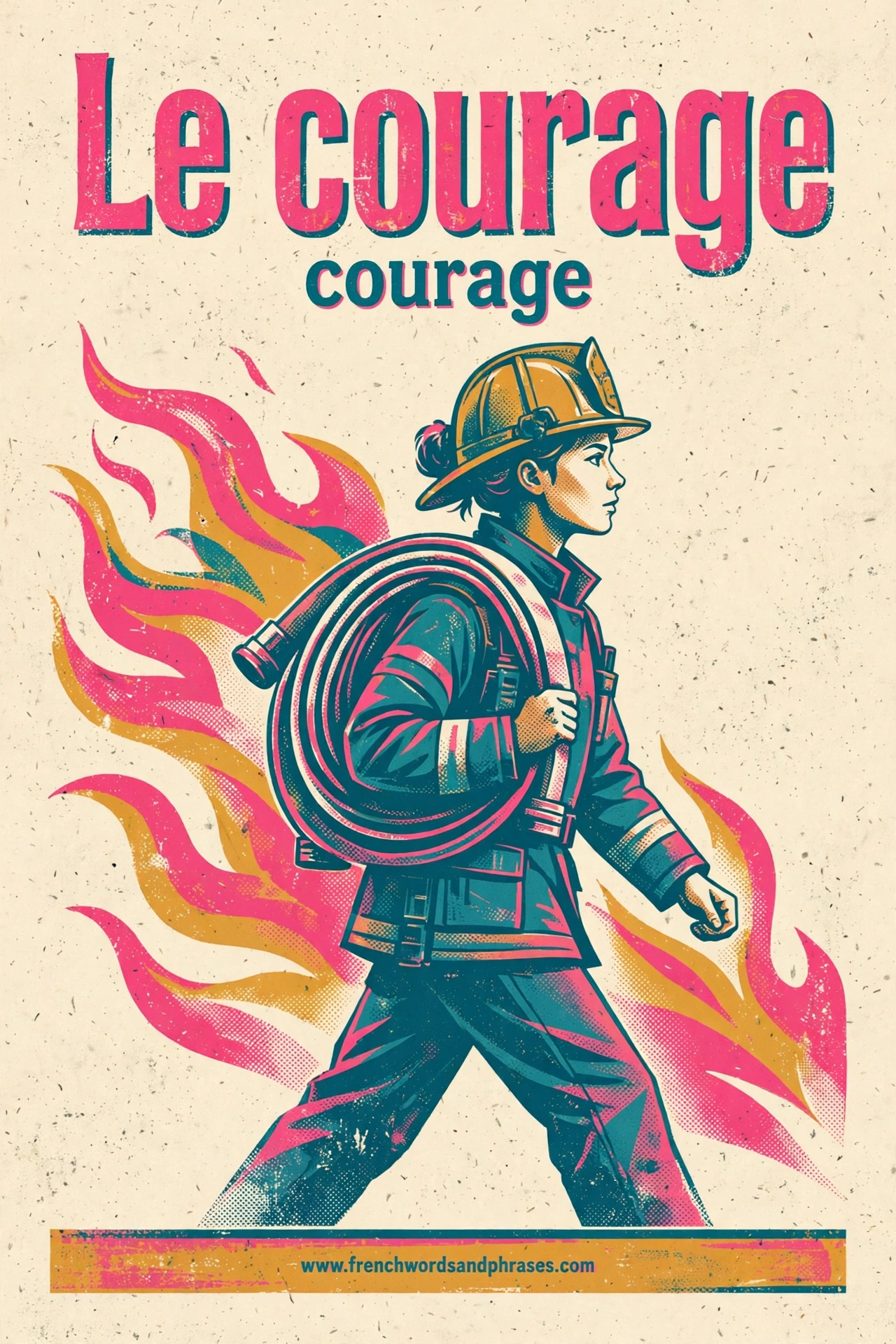
The firefighter stands before the burning building, checks his mask one last time, and goes in. Later, the neighbours will use one word for what carried him through that door: le courage.
In this guide, you’ll learn what courage means in English, how to use it with its articles, how to form its plural, and how it appears in everyday French. Explore French examples, English translations, and practice quizzes.
Understanding the French Noun Courage
Courage is a masculine French noun. It is learned together with its article: le courage, and it is an abstract noun that almost never needs an indefinite article — courage is a quality, not an object. The word carries its origin in its first syllable: cœur, the heart. Courage, in French, is having heart.
It means courage — the strength to act while afraid: le courage de parler (the courage to speak), le courage de continuer (the courage to go on). French also uses it far beyond battlefields: avoir le courage de dire la vérité, to have the courage to tell the truth, and the everyday encouragement Bon courage !, said to anyone facing a hard day, a long shift or a difficult task.
Gender: Masculine
Definite article: le — le courage (the courage)
Indefinite article: rarely used — courage is a quality, not a thing
Plural: no plural in normal use
English equivalents: Courage, bravery; Bon courage ! — good luck, hang in there!
One important usage detail: Bon courage ! is not quite ‘good luck’. French says it where English says ‘hang in there’ or ‘you can do it’ — to a nurse starting a night shift, a student entering an exam, a friend facing a move. It wishes strength, not luck: luck is bonne chance, and courage is the part that depends on you.
Experience the Word
Courage is more than the heroism of films. In French daily life it is mostly quiet: the courage to apologise, to start again at fifty, to tell the truth when lying would be easier.
Imagine a young doctor telling a patient a hard diagnosis. Her voice does not shake; she stays, she answers every question, she does not look away. No cameras, no medals — just le courage, doing its ordinary work.
You have not just been brave. You have shown le courage — the heart in action.
How to Use Courage in French: Complete Guide
Let’s explore how courage works in French, beginning with its articles.
Courage with the Definite Article (Le)
Courage almost always appears with le — the courage shown, the courage needed.
| Number | French |
|---|---|
| Singular | le courage |
| Plural | — (no plural in normal use) |
Example
Le courage de ces sauveteurs a impressionné tout le pays.
The courage of these rescuers impressed the whole country.
Courage with the Indefinite Article
Un is rare with courage; when it appears, it singles out one remarkable act of bravery.
| Number | French |
|---|---|
| Singular | un courage (rare, emphatic) |
| Plural | — |
Example
Il a montré un courage que personne n’oubliera.
He showed a courage that nobody will forget.
Courage with the Partitive Article (Du)
Courage is measured with the partitive: du courage, some courage — exactly what we wish each other.
| Quantity | French |
|---|---|
| some | du courage |
| a lot of | beaucoup de courage |
| so much | tant de courage |
| a little | un peu de courage |
| no, none | pas de courage |
Example
Il faut du courage pour recommencer à zéro.
It takes courage to start again from zero.
Quick Quiz 1
How do you say ‘some courage’ in French?
Reveal the answer
Du courage — the partitive du, as in il faut du courage, it takes courage.
Il faut du courage pour dire la vérité.
It takes courage to tell the truth.
The Plural of Courage
Courage has no working plural: it names a quality, and qualities are not counted. The singular carries every act.
| Number | French |
|---|---|
| Singular | le courage |
| Plural | — (qualities are not counted) |
Example
Le courage ne se compte pas, il se prouve.
Courage is not counted, it is proven.
Courage with Possessive Adjectives (Mon, Ton, Son…)
Possessives agree with the noun, not with the owner — and courage is masculine, so it takes mon, ton, son.
| Owner | French |
|---|---|
| my | mon courage |
| your (tu) | ton courage |
| his / her | son courage |
| our | notre courage |
| your (vous) | votre courage |
| their | leur courage |
Example
Elle a rassemblé tout son courage avant d’entrer.
She gathered all her courage before going in.
Quick Quiz 2
Complete the sentence:
Il a perdu ______ courage après le premier échec. (his)
Reveal the answer
son
Il a perdu son courage après le premier échec.
He lost his courage after the first failure.
Courage with Demonstrative Adjectives (Ce)
Used to point at the courage in front of us: ce courage, this courage.
| Number | French |
|---|---|
| Singular | ce courage |
| Plural | — |
Example
Ce courage silencieux mérite le respect de tous.
This silent courage deserves everyone’s respect.
Courage with Adjectives
Adjectives agree with courage, masculine — grand, immense, tranquille.
| Adjective | With Courage |
|---|---|
| grand (great) | un grand courage |
| immense (immense) | un courage immense |
| tranquille (quiet) | un courage tranquille |
| exemplaire (exemplary) | un courage exemplaire |
| quotidien (everyday) | le courage quotidien |
Example
Soigner les autres demande un courage tranquille.
Caring for others requires a quiet courage.
Quick Quiz 3
Complete the sentence:
Elle a fait preuve d’un courage ______. (immense)
Reveal the answer
immense
Elle a fait preuve d’un courage immense.
She showed immense courage.
Everyday Expressions with Courage
Wishing strength and finding it — the courage phrases of daily life.
| Expression | In English |
|---|---|
| Bon courage ! | Hang in there! You can do it! |
| avoir le courage de | to have the courage to |
| prendre son courage à deux mains | to pluck up one’s courage |
| perdre courage | to lose heart |
| faire preuve de courage | to show courage |
| manquer de courage | to lack courage |
Example
Avant l’opération, toute la famille lui a dit : bon courage !
Before the operation, the whole family said to her: hang in there!
Words from the Same Family as Courage
Hearts and bravery — the words that travel with courage.
| French | In English |
|---|---|
| le cœur | the heart — the root of courage |
| courageux / courageuse | brave, courageous |
| encourager | to encourage |
| la bravoure | bravery (heroic) |
| la peur | fear — courage’s opponent |
| décourager | to discourage |
Example
Une infirmière courageuse encourage les malades chaque matin.
A courageous nurse encourages the patients every morning.
Quick Quiz 4
Your colleague faces a double shift tonight. What do you say: « Bonne chance » or « Bon courage »?
Reveal the answer
Bon courage ! — the shift depends on her strength, not on luck. Bonne chance is for lotteries and exams decided by fate.
Bon courage pour cette nuit, on pense à toi !
Hang in there tonight, we’re thinking of you!
Courage in Everyday French: Real-Life Examples
Now that you know the word, let’s see how courage appears in everyday French.
Example 1 — Before a shift
Bon courage pour ta journée, elle va être longue.
Good luck today — hang in there, it’s going to be a long day.
Example 2 — Telling the truth
Il a eu le courage de dire la vérité à son chef.
He had the courage to tell his boss the truth.
Example 3 — Starting again
Après la faillite, elle a trouvé le courage de recommencer.
After the bankruptcy, she found the courage to start again.
Example 4 — At the hospital
Les soignants font preuve de courage chaque jour.
The carers show courage every day.
Example 5 — A hard phone call
Il a pris son courage à deux mains et il a téléphoné.
He plucked up his courage and made the call.
Example 6 — Encouragement
Ne perds pas courage, tu es presque au bout.
Don’t lose heart, you’re nearly there.
Beyond Translation: The Meaning of Courage
The word courage is built on cœur, the heart — and French has never forgotten it. Where English bravery suggests the battlefield, French courage lives in the chest: it is the heart holding firm. That is why the language uses it for nurses and night shifts as naturally as for soldiers, and why Bon courage ! may be the most-said encouragement in the country.
To say courage is to point at the heart and ask it to hold.
It evokes the firefighter at the door, the doctor who stays to answer questions, and every ordinary morning when someone gathers their courage — rassemble son courage — and goes in anyway.
How to Remember the French Noun Courage
Remember it this way: Courage is courage — masculine, built on cœur, the heart, and measured with du like a strength you can gather.
- You hear the heart — cœur beats inside courage.
- You measure it — du courage, un peu de courage, tout son courage.
- You wish it — Bon courage ! for strength, bonne chance for luck.
The key idea is le courage — the heart, holding firm.
Test Your Knowledge of Courage
Let’s see how much you’ve learned. Try answering these questions before revealing the answers.
Question 1
Is courage masculine or feminine?
Reveal the answer
Masculine — le courage.
Question 2
What word hides inside courage?
Reveal the answer
Cœur — the heart. Courage is having heart.
Question 3
Translate: It takes courage to start again.
Reveal the answer
Il faut du courage pour recommencer.
Question 4
What does ‘prendre son courage à deux mains’ mean?
Reveal the answer
To pluck up one’s courage — to gather all your bravery with both hands before acting.
Question 5
Complete the sentence:
Elle a rassemblé tout ______ courage avant de parler.
Reveal the answer
son
Elle a rassemblé tout son courage avant de parler.
She gathered all her courage before speaking.
Your Final Challenge
Can You Use It?
How would you say this in French?
“It takes courage to tell the truth.”
Reveal the answer
Il faut du courage pour dire la vérité.
It takes courage to tell the truth.
A little French. A little curiosity. A richer everyday life.
LEARN FRENCH ONE WORD AT A TIME