A French Word to Live By
Translate Faire gaffe to English
/fɛʁ ɡaf/
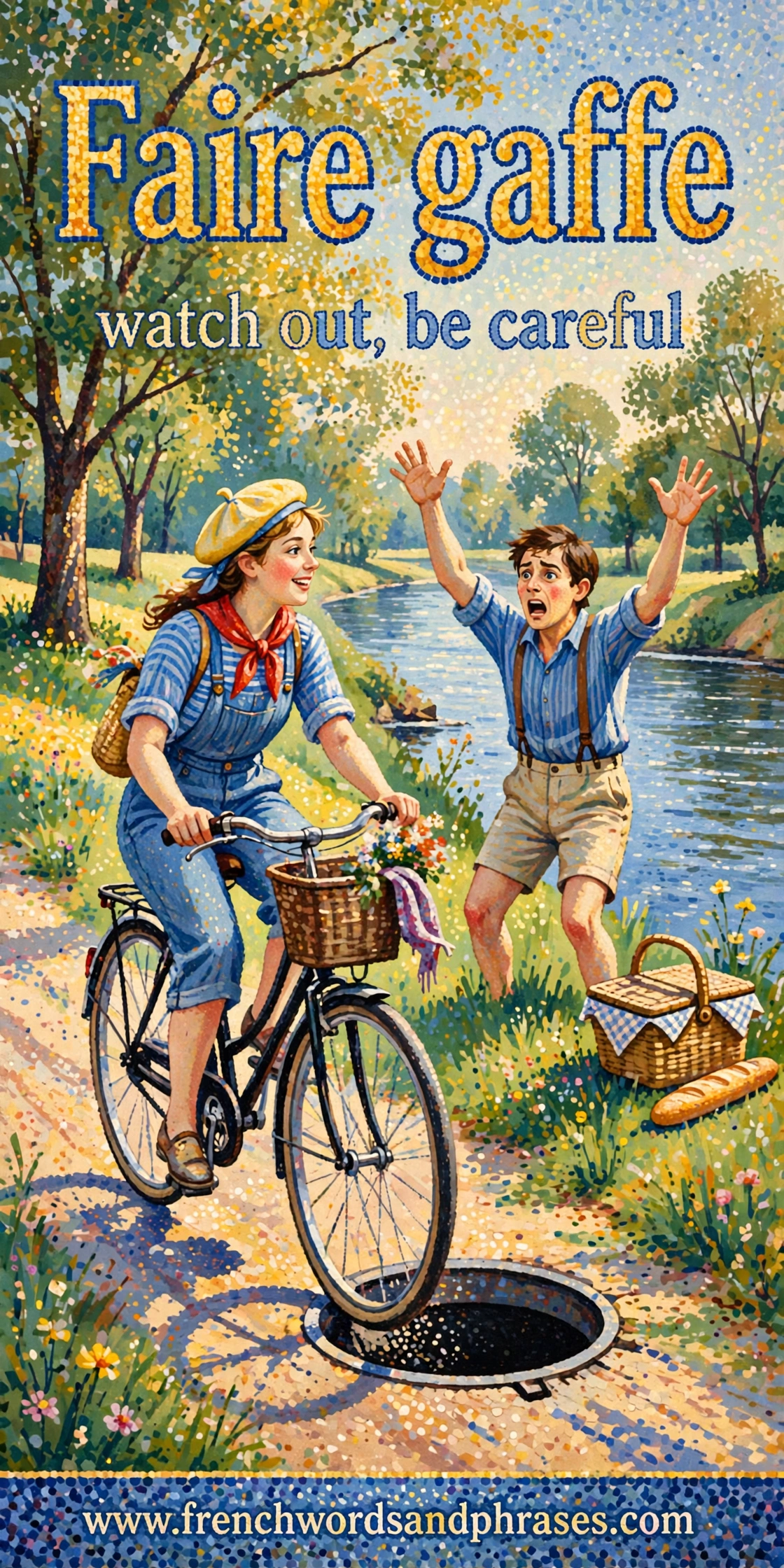
Faire gaffe means to watch out, to be careful.
You are cycling down a narrow street in Nantes when your friend, riding just behind you, shouts two words over the noise of the traffic: « Fais gaffe ! » You squeeze the brakes a second before the car door swings open in front of you. Two informal words, one accident avoided — that is faire gaffe at work.
Let’s explore how faire gaffe works in French, beginning with the whole phrase on one card.
Understanding the French Phrase Faire gaffe
Faire gaffe is an informal French idiom built from faire (to do) and gaffe — an old argot word for a lookout, a sentry posted to watch for danger. To faire gaffe is therefore to keep lookout: to watch out, to pay attention, to be careful.
It means to watch out, to be careful. The picture is the sentry on his post: eyes open, attention forward. English says ‘watch out’ and ‘keep an eye out’ — the same lookout spirit, in the same informal, urgent tone between friends.
Type: Idiom — verb phrase built on an old argot word (the lookout)
Answers the need: Warning someone, or promising to pay attention
Register: Informal (familier) — for friends, family and colleagues you know well
Strength: Urgent and vivid — sharper than the neutral faire attention
One important usage detail: keep the register in view. Faire gaffe is what you shout to a friend on a bicycle; in a formal letter or to a stranger you are being careful with, French switches to the neutral faire attention. The warning is the same — the company decides the words.
Experience the Word
Faire gaffe is the shout across the street, the tug on the sleeve, the text message that arrives just in time — fais gaffe, il y a un contrôle, watch out, there’s a check ahead.
Imagine the lookout posted at the gate in the old argot of Paris, paid to watch the street and whistle at the first sign of trouble. Every fais gaffe ! since then carries a little of that whistle.
French keeps two temperatures of careful: the cool, correct faire attention, and this one — warm, urgent, and always between people who look out for each other.
How to Use Faire gaffe in French: Complete Guide
Let’s explore how faire gaffe works in French, beginning with the whole phrase on one card.
Faire gaffe at a Glance
The Whole Phrase on One Card
Real meaning, literal building blocks, English twin and register — the idiom in five lines.
| Point | Faire gaffe |
|---|---|
| What it really means | to watch out, to be careful, to pay attention |
| Word for word | to do the lookout — gaffe was old argot for a sentry |
| English equivalent | watch out! / be careful! / keep an eye out |
| Register | informal (familier) — the neutral twin is faire attention |
| Use it for | warnings between friends: roads, doors, bosses, exams |
Example
Fais gaffe, la marche est glissante.
Watch out, the step is slippery.
Word by Word: Posting the Lookout
Two pieces — the all-purpose verb and a word that once stood guard.
| Word | Literal meaning | Its job in the phrase |
|---|---|---|
| faire | to do, to make | the verb of the idiom — je fais gaffe, tu fais gaffe |
| gaffe | the lookout, the sentry (old argot) | the posted watchman — to faire gaffe is to take his place and keep your eyes open |
Example
Je fais gaffe quand je traverse cette rue.
I pay attention when I cross this street.
Quick Quiz 1
What did gaffe mean in old argot?
Reveal the answer
A lookout, a sentry — the man posted to watch for danger. Faire gaffe is to take his post.
Fais gaffe, un camion arrive !
Watch out, a lorry is coming!
When You Say It: The Warning Moments
The idiom lives in the half-second before trouble — on roads, on stairs, and in whispered office warnings.
| Situation | Example |
|---|---|
| On the road | fais gaffe, il y a un vélo ! — watch out, there’s a bike! |
| At home | fais gaffe à la casserole, elle est chaude — careful with the pan, it’s hot |
| At work | fais gaffe, le patron est de mauvaise humeur — watch out, the boss is in a bad mood |
| About money | fais gaffe à tes affaires dans le métro — keep an eye on your things in the metro |
| Promising care | je ferai gaffe, promis — I’ll be careful, promise |
Example
Faites gaffe les enfants, la route est dangereuse ici.
Be careful, children, the road is dangerous here.
Make It Yours: Warning Anyone
The idiom lives mostly in the imperative — fais gaffe ! — but it conjugates through every person, and takes à before the danger.
| Form | French | In English |
|---|---|---|
| The warning (tu) | fais gaffe ! | watch out! |
| The warning (vous) | faites gaffe ! | be careful! — still informal in tone |
| I pay attention | je fais gaffe | I watch out, I’m careful |
| Naming the danger | fais gaffe à la marche | mind the step |
| In the past | je n’ai pas fait gaffe | I wasn’t paying attention |
| In the future | tu feras gaffe demain | you’ll be careful tomorrow |
Example
Il fait toujours gaffe quand il conduit la nuit.
He always takes care when he drives at night.
Quick Quiz 2
Your friend steps towards a wet floor. What do you shout?
Reveal the answer
Fais gaffe ! — the tu imperative, quick and warm.
Fais gaffe, le sol est mouillé !
Watch out, the floor is wet!
Everyday Expressions: Frames of the Warning
The idiom slots into these everyday frames — each one ready to use as it stands.
| Frame | In English |
|---|---|
| fais gaffe à toi | take care of yourself — the affectionate goodbye warning |
| fais gaffe à ne pas tomber | be careful not to fall |
| il faut faire gaffe | you have to watch out — the general rule |
| faire gaffe à son argent | to watch your money, to be careful with spending |
| gaffe à la marche ! | mind the step! — the warning shortened to its bones |
Example
Il faut faire gaffe sur cette route en hiver.
You have to be careful on this road in winter.
Close Cousins: The Other Ways to Be Careful
French grades its warnings by register — faire gaffe is the friendly shout; its cousins dress more formally.
| Expression | The difference |
|---|---|
| faire gaffe | the informal standard — urgent, warm, between friends |
| faire attention | the neutral twin — safe everywhere, the one for strangers and letters |
| prendre garde | to take care, to beware — more formal, a little literary |
| être prudent | to be careful by character — a quality, not a shouted warning |
| se méfier | to be wary, to distrust — careful because someone may not be honest |
Example
Faites attention, enfants — ou, entre nous, faites gaffe.
Be careful, children — or, between ourselves, watch out.
Quick Quiz 3
You are writing a formal email to a client about a dangerous step. Faire gaffe or faire attention?
Reveal the answer
Faire attention — faire gaffe is familier, for friends. Formal writing takes the neutral twin.
Nous vous demandons de faire attention à la marche.
We ask you to be careful of the step.
Faire gaffe and Its Neighbours
The warning shelf around the idiom — danger, attention and the famous blunder next door.
| French | In English |
|---|---|
| attention ! | watch out! — the universal one-word warning |
| au secours ! | help! — the warning after the accident, not before |
| un danger | a danger — what the lookout is watching for |
| vigilant | watchful — the lookout’s professional quality |
| faire une gaffe | to make a blunder — the neighbour that sounds the same and means something else entirely |
Example
Attention, le train arrive — restez vigilants.
Watch out, the train is coming — stay alert.
Watch Out: The Traps Around Faire gaffe
The traps: above all, the famous false friend inside the idiom itself — gaffe the lookout against gaffe the blunder.
| Trap | The truth |
|---|---|
| thinking gaffe means a blunder here | in faire gaffe, the gaffe is the old argot lookout — but faire UNE gaffe really does mean to make a blunder; the article changes everything |
| using it formally | faire gaffe is familier — with strangers, officials and in writing, say faire attention |
| dropping the à | before the danger you need à: fais gaffe à la marche — without it the warning floats unfinished |
| translating as ‘make a gaffe’ | English ‘gaffe’ is only the blunder — the idiom is watch out, never a mistake |
Example
Il n’a pas fait gaffe et il a fait une gaffe énorme.
He wasn’t paying attention and he made an enormous blunder.
Quick Quiz 4
True or false: faire gaffe and faire une gaffe mean the same thing.
Reveal the answer
False — faire gaffe is to watch out (the lookout); faire une gaffe is to make a blunder. One little word, une, changes everything.
Fais gaffe à ne pas faire de gaffe ce soir.
Be careful not to put your foot in it tonight.
Faire gaffe in Everyday French: Real-Life Examples
Now that you know the word, let’s see how faire gaffe appears in everyday French.
Example 1 — The bicycle
Fais gaffe, une portière s’ouvre !
Watch out, a car door is opening!
Example 2 — The hot dish
Fais gaffe au plat, il sort du four.
Careful with the dish, it’s just out of the oven.
Example 3 — The pickpockets
Dans ce quartier, fais gaffe à ton sac.
In this area, keep an eye on your bag.
Example 4 — The promise
Je ferai gaffe sur la route, ne t’inquiète pas.
I’ll be careful on the road, don’t worry.
Example 5 — The confession
Je n’ai pas fait gaffe et j’ai raté la sortie.
I wasn’t paying attention and I missed the exit.
Example 6 — The boss
Fais gaffe aujourd’hui, le directeur inspecte les bureaux.
Watch out today, the director is inspecting the offices.
Beyond Translation: The Meaning of Faire gaffe
The word gaffe lives a double life in French, and the idiom keeps the older one. Before gaffe meant a blunder, it meant — in the argot of the streets — the lookout, the man whose whole job was attention. Faire gaffe is to borrow his eyes for a moment.
Every fais gaffe ! is a small act of friendship: my attention, lent to you, for the half-second you need it.
And the language enjoys the joke the two meanings make together — fais gaffe à ne pas faire de gaffe, be careful not to blunder, is a sentence French speakers genuinely say, with a grin.
How to Remember the French Phrase Faire gaffe
Remember it this way: picture the old street lookout on his corner, eyes open for trouble — faire gaffe is taking his post for a moment.
- You hear gaffe and think lookout — the sentry of old argot, not the blunder.
- You watch the article — faire gaffe warns, faire une gaffe blunders.
- You check the company — friends get fais gaffe, formal letters get faire attention.
The key idea is faire gaffe means to watch out — gaffe was old argot for the lookout, and the idiom is informal.
Test Your Knowledge of Faire gaffe
Let’s see how much you’ve learned. Try answering these questions before revealing the answers.
Question 1
What does faire gaffe mean?
Reveal the answer
To watch out, to be careful — the informal warning between friends.
Question 2
What is the neutral, formal-safe twin of faire gaffe?
Reveal the answer
Faire attention — the same warning, dressed for strangers and letters.
Question 3
What is the difference between faire gaffe and faire une gaffe?
Reveal the answer
Faire gaffe is to watch out; faire une gaffe is to make a blunder. The gaffe of the idiom is the old lookout; the une gaffe is the famous mistake.
Question 4
Translate: Watch out, the step is slippery!
Reveal the answer
Fais gaffe, la marche est glissante !
Question 5
Complete the sentence:
Je n’ai pas ______ gaffe et j’ai manqué le train. (I wasn’t paying attention and I missed the train.)
Reveal the answer
fait
Je n’ai pas fait gaffe et j’ai manqué le train.
I wasn’t paying attention and I missed the train.
Your Final Challenge
Can You Use It?
How would you say this in French?
“Watch out — the floor is wet!”
Reveal the answer
Fais gaffe — le sol est mouillé !
Watch out — the floor is wet!
A little French. A little curiosity. A richer everyday life.
LEARN FRENCH ONE WORD AT A TIME