A French Word to Live By
How to Conjugate Vamper in French
/vɑ̃.pe/
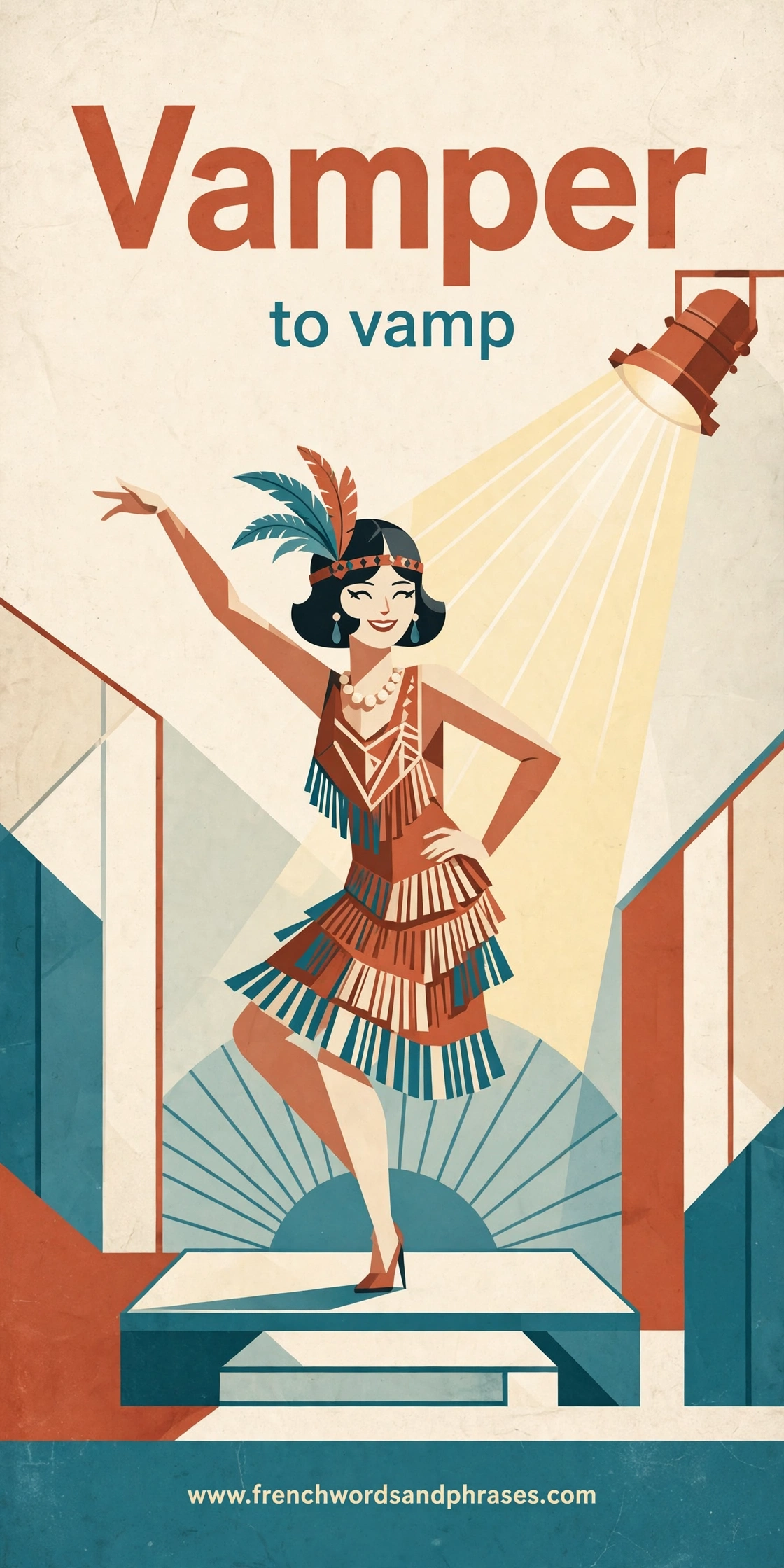
Vamper means to vamp — to charm and seduce someone with deliberate, theatrical allure, like the vamps of silent cinema.
A darkened cinema in 1915, a woman in black silk turning her head very slowly towards the hero — and the whole audience understanding that he is lost: vamper is the verb of the vamp, seduction practised as an art form, half theatre, half trap.
In this guide, you’ll learn how to conjugate vamper in all the major French tenses and moods. Explore complete conjugation tables, French examples, English translations, and practice quizzes.
Understanding the French Verb Vamper
Vamper is a regular French verb belonging to the first group of verbs, those ending in -er.
It means to vamp. It is commonly used with humour for flirtation and calculated charm — in love, in sales, on stage — anywhere someone deploys allure as a deliberate technique and everyone can see the strings.
Verb classification: First group (-er)
Auxiliary verb: Avoir
Past participle: vampé
Present participle: vampant
English equivalents: To vamp, to seduce by charm, to wrap someone round your finger; une vamp — a vamp, a femme fatale; vamper un public — to win an audience over completely.
One important detail: vamper is a borrowing — English vamp, short for vampire, crossed the Channel with silent films and stars like Theda Bara — but it conjugates as a perfectly regular French -er verb: je vampe, nous vampons, past participle vampé. The noun une vamp keeps its English look, and the verb always keeps its playful, slightly ironic flavour: nobody vamps by accident, and the victim usually knows exactly what is happening.
Experience the Word
Vamper is the verb of seduction with the stage lights on — charm as a performance, enjoyed by performer and audience alike.
Imagine a charity gala. The auctioneer is good, but the lots are dull — until the actress takes the microphone, smiles her slowest smile, and begins: elle vampe la salle entière, playing the bidders like an orchestra, and every lot doubles its price before dessert.
Nobody was fooled and everybody was delighted. That is vamper — the trap you walk into smiling.
How to Conjugate Vamper: Complete French Conjugation Guide
Let’s explore every major conjugation of vamper, beginning with the indicative mood.
How to Conjugate Vamper in the Indicative Mood
The indicative mood is used to express facts, observations, actions, and events.
How to Conjugate Vamper in the Present Tense (Présent)
Used for actions happening now, habitual actions, and general truths.
| Subject | Conjugation |
|---|---|
| je | vampe |
| tu | vampes |
| il / elle | vampe |
| nous | vampons |
| vous | vampez |
| ils / elles | vampent |
Example
Elle vampe tous ses admirateurs avec un art consommé.
She vamps all her admirers with consummate art.
Quick Quiz 1
Complete the sentence:
Nous ______ le jury avec notre présentation.
Reveal the answer
vampons
Nous vampons le jury avec notre présentation.
We are winning the jury over with our presentation.
How to Conjugate Vamper in the Passé Composé
Used for completed actions in the past. Vamper takes the auxiliary verb avoir.
| Subject | Conjugation |
|---|---|
| j’ | ai vampé |
| tu | as vampé |
| il / elle | a vampé |
| nous | avons vampé |
| vous | avez vampé |
| ils / elles | ont vampé |
Example
L’actrice a vampé le public dès son entrée en scène.
The actress won the audience over from the moment she came on stage.
How to Conjugate Vamper in the Imparfait (Imperfect Tense)
Used for habitual past actions, descriptions, and ongoing situations in the past.
| Subject | Conjugation |
|---|---|
| je | vampais |
| tu | vampais |
| il / elle | vampait |
| nous | vampions |
| vous | vampiez |
| ils / elles | vampaient |
Example
Dans les films muets, l’héroïne vampait le héros en dix minutes.
In silent films, the heroine used to vamp the hero within ten minutes.
Quick Quiz 2
Choose the correct form:
She vamped the banker.
Elle ______ le banquier. (a vampé / est vampée)
Reveal the answer
a vampé
Elle a vampé le banquier.
Vamper takes avoir.
How to Conjugate Vamper in the Plus-que-parfait
Used to describe an action that had already been completed before another past event.
| Subject | Conjugation |
|---|---|
| j’ | avais vampé |
| tu | avais vampé |
| il / elle | avait vampé |
| nous | avions vampé |
| vous | aviez vampé |
| ils / elles | avaient vampé |
Example
Il avait vampé toute l’assistance avant le dessert.
He had charmed the whole gathering before dessert.
How to Conjugate Vamper in the Passé Simple
Primarily used in formal writing, literature, and historical narratives. It is rarely used in everyday conversation.
| Subject | Conjugation |
|---|---|
| je | vampai |
| tu | vampas |
| il / elle | vampa |
| nous | vampâmes |
| vous | vampâtes |
| ils / elles | vampèrent |
Example
Elle vampa le banquier d’un seul regard.
She vamped the banker with a single look.
How to Conjugate Vamper in the Passé Antérieur
A literary tense used to express an action completed immediately before another past action, generally in the passé simple.
| Subject | Conjugation |
|---|---|
| j’ | eus vampé |
| tu | eus vampé |
| il / elle | eut vampé |
| nous | eûmes vampé |
| vous | eûtes vampé |
| ils / elles | eurent vampé |
Example
Quand elle eut vampé le jury, le prix était à elle.
When she had won the jury over, the prize was hers.
How to Conjugate Vamper in the Future Tense (Futur Simple)
Used to describe actions that will take place in the future.
| Subject | Conjugation |
|---|---|
| je | vamperai |
| tu | vamperas |
| il / elle | vampera |
| nous | vamperons |
| vous | vamperez |
| ils / elles | vamperont |
Example
Ce soir, elle vampera les invités du gala.
Tonight, she will vamp the guests at the gala.
How to Conjugate Vamper in the Futur Antérieur (Future Perfect)
Used for an action that will have been completed before a particular point in the future.
| Subject | Conjugation |
|---|---|
| j’ | aurai vampé |
| tu | auras vampé |
| il / elle | aura vampé |
| nous | aurons vampé |
| vous | aurez vampé |
| ils / elles | auront vampé |
Example
À la fin de la soirée, il aura vampé tous les clients du bar.
By the end of the evening, he will have charmed every customer in the bar.
How to Conjugate Vamper in the Near Future (Futur Proche)
Used to describe something that is going to happen soon. Formed with aller + infinitive.
| Subject | Conjugation |
|---|---|
| je | vais vamper |
| tu | vas vamper |
| il / elle | va vamper |
| nous | allons vamper |
| vous | allez vamper |
| ils / elles | vont vamper |
Example
Je vais vamper le vendeur pour obtenir une remise.
I am going to charm the salesman to get a discount.
How to Conjugate Vamper in the Conditional Mood
The conditional mood expresses what would happen under certain circumstances. It is also frequently used to make polite requests or express wishes.
How to Conjugate Vamper in the Present Conditional
| Subject | Conjugation |
|---|---|
| je | vamperais |
| tu | vamperais |
| il / elle | vamperait |
| nous | vamperions |
| vous | vamperiez |
| ils / elles | vamperaient |
Example
Avec ce sourire, tu vamperais n’importe qui.
With that smile, you would vamp anyone.
How to Conjugate Vamper in the Past Conditional
| Subject | Conjugation |
|---|---|
| j’ | aurais vampé |
| tu | aurais vampé |
| il / elle | aurait vampé |
| nous | aurions vampé |
| vous | auriez vampé |
| ils / elles | auraient vampé |
Example
Elle aurait vampé le directeur si elle l’avait voulu.
She would have vamped the manager if she had wanted to.
Vamper in the Literary Past Conditional Form
This less common literary form uses the imperfect subjunctive of avoir.
| Subject | Conjugation |
|---|---|
| j’ | eusse vampé |
| tu | eusses vampé |
| il / elle | eût vampé |
| nous | eussions vampé |
| vous | eussiez vampé |
| ils / elles | eussent vampé |
Example
La courtisane eût vampé la cour entière.
The courtesan would have vamped the entire court.
How to Conjugate Vamper in the Subjunctive Mood
The subjunctive is used to express wishes, emotions, doubts, necessity, and uncertainty. It frequently follows expressions such as il faut que (it is necessary that) or bien que (although).
How to Conjugate Vamper in the Present Subjunctive
| Subject | Conjugation |
|---|---|
| que je | vampe |
| que tu | vampes |
| qu’il / qu’elle | vampe |
| que nous | vampions |
| que vous | vampiez |
| qu’ils / qu’elles | vampent |
Example
Il faut qu’elle vampe le public dès la première scène.
She must win the audience over from the very first scene.
Quick Quiz 3
Complete the sentence using the subjunctive:
Il faut que vous ______ les clients dès l’accueil.
Reveal the answer
vampiez
Il faut que vous vampiez les clients dès l’accueil.
You must charm the customers from the welcome onwards.
How to Conjugate Vamper in the Imperfect Subjunctive
A literary tense, rarely encountered in modern spoken French.
| Subject | Conjugation |
|---|---|
| que je | vampasse |
| que tu | vampasses |
| qu’il / qu’elle | vampât |
| que nous | vampassions |
| que vous | vampassiez |
| qu’ils / qu’elles | vampassent |
Example
Tout le monde attendait qu’elle vampât le héros.
Everyone waited for her to vamp the hero.
How to Conjugate Vamper in the Pluperfect Subjunctive
A literary construction used to express an action completed before another past action.
| Subject | Conjugation |
|---|---|
| que j’ | eusse vampé |
| que tu | eusses vampé |
| qu’il / qu’elle | eût vampé |
| que nous | eussions vampé |
| que vous | eussiez vampé |
| qu’ils / qu’elles | eussent vampé |
Example
On racontait qu’elle eût vampé trois ministres.
People told how she had vamped three ministers.
How to Conjugate Vamper in the Past Subjunctive
| Subject | Conjugation |
|---|---|
| que j’ | aie vampé |
| que tu | aies vampé |
| qu’il / qu’elle | ait vampé |
| que nous | ayons vampé |
| que vous | ayez vampé |
| qu’ils / qu’elles | aient vampé |
Example
Je suis amusé qu’elle ait vampé tout le bureau.
I am amused that she vamped the whole office.
How to Conjugate Vamper in the Imperative
The imperative is used to give commands, instructions, invitations, or suggestions. Subject pronouns are omitted.
How to Conjugate Vamper in the Present Imperative
| Person | Conjugation |
|---|---|
| (tu) | vampe |
| (nous) | vampons |
| (vous) | vampez |
Example
Vampe-les un peu, ils n’attendent que ça !
Charm them a little, they are only waiting for it!
Quick Quiz 4
How would you say Charm them a little (tu form)?
Reveal the answer
Vampe-les un peu !
French Participles of Vamper
Participles are verb forms that can be used in compound tenses and other grammatical constructions.
Present Participle of Vamper
vampant
En vampant le vendeur, elle a obtenu vingt pour cent de remise.
By charming the salesman, she got twenty per cent off.
Past Participle of Vamper
vampé
Vampé par la vendeuse, il a acheté trois costumes.
Vamped by the saleswoman, he bought three suits.
Vamper in Everyday French: Real-Life Examples
Now that you know the conjugations, let’s see how vamper appears in everyday French.
Example 1 — Present
Elle vampe tous ses admirateurs.
She vamps all her admirers.
Example 2 — Passé composé
L’actrice a vampé le public dès son entrée.
The actress won the audience over from her entrance.
Example 3 — Imparfait
Les vamps du cinéma muet vampaient en noir et blanc.
The vamps of silent cinema used to vamp in black and white.
Example 4 — Future
Ce soir, elle vampera les invités du gala.
Tonight, she will vamp the guests at the gala.
Example 5 — Conditional
Avec ce sourire, tu vamperais n’importe qui.
With that smile, you would vamp anyone.
Example 6 — Imperative
Vampe-les un peu, ils adorent ça !
Charm them a little, they love it!
Beyond Translation: The Meaning of Vamper
English gave French the word, and French gave it back with interest: vamper is never quite serious.
It is seduction with a wink.
To séduire is the plain word; to vamper is to do it theatrically, in black silk, with the whole room watching and applauding the technique.
How to Remember the French Verb Vamper
Remember it this way: Vamper is about the silent-film vamp — seduction as theatre, with a wink.
- Vamper comes from vamp — short for vampire — via the femmes fatales of silent film.
- Always deliberate and a little ironic: nobody vamps by accident.
- Regular -er despite its English look: je vampe, nous vampons, past participle vampé.
The key idea is the silent-film vamp — seduction as theatre, with a wink.
Test Your Knowledge of Vamper
Let’s see how much you’ve learned. Try answering these questions before revealing the answers.
Question 1
How do you say a vamp, a femme fatale, in French?
Reveal the answer
Une vamp.
Question 2
How do you say She vamps all her admirers in French?
Reveal the answer
Elle vampe tous ses admirateurs.
Question 3
Translate: The actress won the audience over from her entrance.
Reveal the answer
L’actrice a vampé le public dès son entrée.
Question 4
What is the past participle of vamper?
Reveal the answer
Vampé.
Question 5
Complete the sentence:
Il faut qu’elle ______ le public dès la première scène.
Reveal the answer
vampe
Il faut qu’elle vampe le public dès la première scène.
She must win the audience over from the first scene.
Your Final Challenge
Can You Use It?
How would you say this in French?
She vamps the whole room with one smile, and the evening is hers.
Reveal the answer
Elle vampe la salle entière d’un sourire, et la soirée lui appartient.
She vamps the whole room with one smile, and the evening is hers.
A little French. A little curiosity. A richer everyday life.
LEARN FRENCH ONE WORD AT A TIME