A French Word to Live By
How to Conjugate Vanner in French
/va.ne/
Vanner means to winnow — to toss grain into the air so the wind fans the chaff away; and in familiar French, être vanné is to be utterly exhausted.
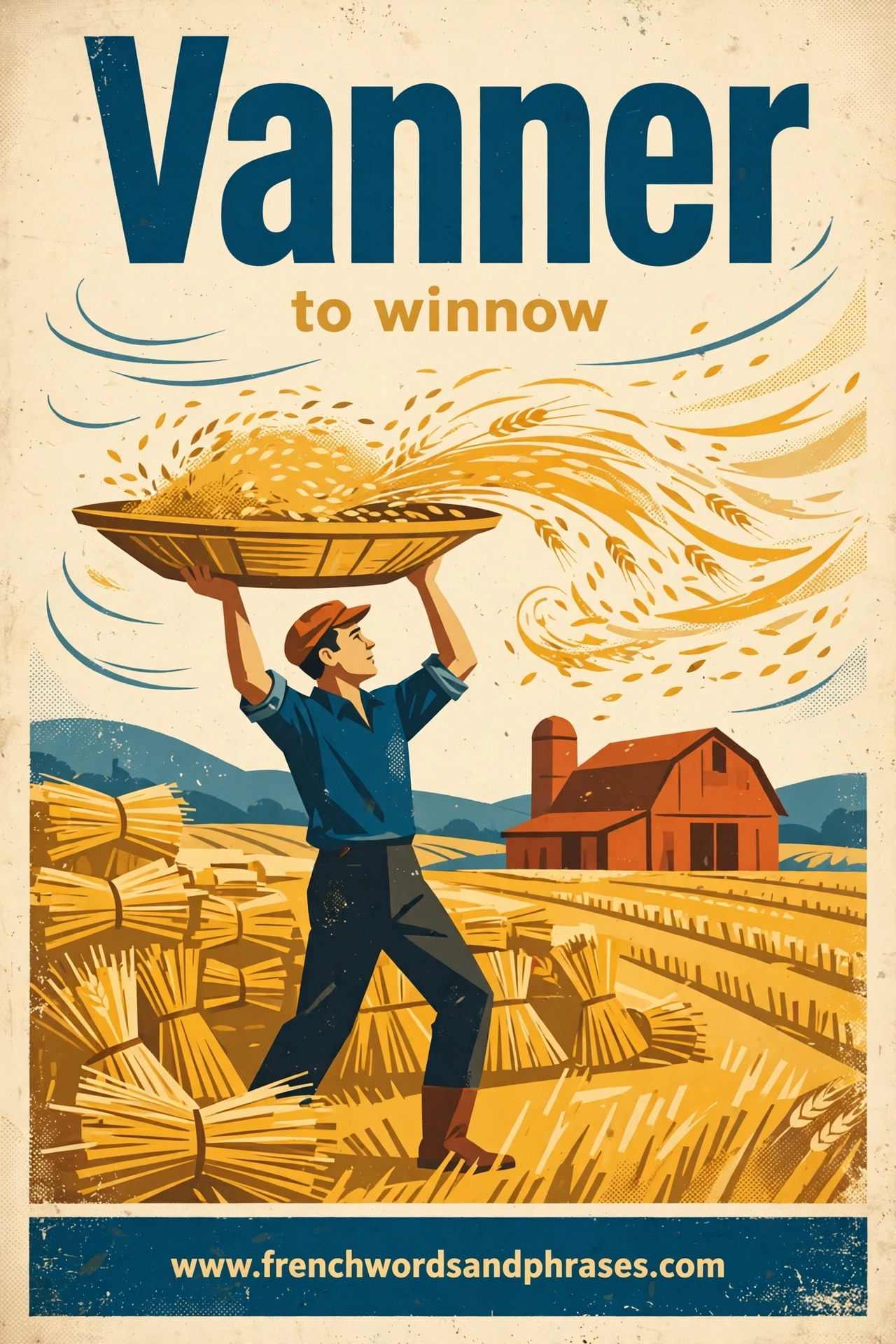
A harvest evening, a wide shallow basket, grain tossed again and again into the wind while the light chaff blows away and the good seed falls back heavy — vanner is the verb of winnowing, one of the oldest gestures in farming; and French, loving the image of a person emptied like a basket, made it mean exhaustion too.
In this guide, you’ll learn how to conjugate vanner in all the major French tenses and moods. Explore complete conjugation tables, French examples, English translations, and practice quizzes.
Understanding the French Verb Vanner
Vanner is a regular French verb belonging to the first group of verbs, those ending in -er.
It means to winnow. It is commonly used in farming and harvest descriptions for winnowing grain with a basket and the wind, and everywhere in familiar speech for exhaustion after sport, work or a long day — je suis vanné is the modern, everyday sense.
Verb classification: First group (-er)
Auxiliary verb: Avoir
Past participle: vanné
Present participle: vannant
English equivalents: To winnow, to fan (grain); un van — a winnowing basket; être vanné — to be shattered, dead tired (fam.); ça me vanne — that wears me out; vanner le grain — to winnow the grain.
One important detail: vanner is a regular -er verb with two lives that share one picture — a basket shaken until only the heavy grain remains. In the fields it is literal: vanner le blé, vanner l’orge, with the big flat basket called un van. In familiar modern French the participle does the talking: être vanné, je suis vanné — I am shattered, worn out, good for nothing — and ça me vanne means that wears me out. The farmer’s basket emptied the chaff; the day empties you.
Experience the Word
Vanner is the verb of the shaken basket — the wind takes the light stuff, the heavy grain stays; and a vanné person feels exactly like the grain at the end of the day.
Imagine the last evening of the harvest a century ago. The farmer stands in the yard with his van, tossing the wheat in rhythm, the chaff drifting gold in the low sun. Tonight, his great-grandson comes home from a marathon, drops his bag in the hall and announces the same verdict in the same word: « Je suis vanné. »
A hundred years apart, one image. The basket has been shaken, the day has been shaken — vanné, and nothing light is left.
How to Conjugate Vanner: Complete French Conjugation Guide
Let’s explore every major conjugation of vanner, beginning with the indicative mood.
How to Conjugate Vanner in the Indicative Mood
The indicative mood is used to express facts, observations, actions, and events.
How to Conjugate Vanner in the Present Tense (Présent)
Used for actions happening now, habitual actions, and general truths.
| Subject | Conjugation |
|---|---|
| je | vanne |
| tu | vannes |
| il / elle | vanne |
| nous | vannons |
| vous | vannez |
| ils / elles | vannent |
Example
Le paysan vanne le blé dans la cour de la ferme.
The farmer winnows the wheat in the farmyard.
Quick Quiz 1
Complete the sentence:
Nous ______ le grain dans la cour.
Reveal the answer
vannons
Nous vannons le grain dans la cour.
We winnow the grain in the yard.
How to Conjugate Vanner in the Passé Composé
Used for completed actions in the past. Vanner takes the auxiliary verb avoir.
| Subject | Conjugation |
|---|---|
| j’ | ai vanné |
| tu | as vanné |
| il / elle | a vanné |
| nous | avons vanné |
| vous | avez vanné |
| ils / elles | ont vanné |
Example
Nous avons vanné le seigle hier soir.
We winnowed the rye yesterday evening.
How to Conjugate Vanner in the Imparfait (Imperfect Tense)
Used for habitual past actions, descriptions, and ongoing situations in the past.
| Subject | Conjugation |
|---|---|
| je | vannais |
| tu | vannais |
| il / elle | vannait |
| nous | vannions |
| vous | vanniez |
| ils / elles | vannaient |
Example
Autrefois, on vannait le grain à la main, le soir venu.
In the old days, people used to winnow the grain by hand in the evening.
Quick Quiz 2
Choose the correct form:
She winnowed the barley.
Elle ______ l’orge. (a vanné / est vannée)
Reveal the answer
a vanné
Elle a vanné l’orge.
Vanner takes avoir.
How to Conjugate Vanner in the Plus-que-parfait
Used to describe an action that had already been completed before another past event.
| Subject | Conjugation |
|---|---|
| j’ | avais vanné |
| tu | avais vanné |
| il / elle | avait vanné |
| nous | avions vanné |
| vous | aviez vanné |
| ils / elles | avaient vanné |
Example
Elle avait vanné tout l’orge avant la pluie.
She had winnowed all the barley before the rain.
How to Conjugate Vanner in the Passé Simple
Primarily used in formal writing, literature, and historical narratives. It is rarely used in everyday conversation.
| Subject | Conjugation |
|---|---|
| je | vannai |
| tu | vannas |
| il / elle | vanna |
| nous | vannâmes |
| vous | vannâtes |
| ils / elles | vannèrent |
Example
Il vanna le seigle comme son père le lui avait appris.
He winnowed the rye as his father had taught him.
How to Conjugate Vanner in the Passé Antérieur
A literary tense used to express an action completed immediately before another past action, generally in the passé simple.
| Subject | Conjugation |
|---|---|
| j’ | eus vanné |
| tu | eus vanné |
| il / elle | eut vanné |
| nous | eûmes vanné |
| vous | eûtes vanné |
| ils / elles | eurent vanné |
Example
Quand ils eurent vanné le blé, ils le rentrèrent à la grange.
When they had winnowed the wheat, they brought it into the barn.
How to Conjugate Vanner in the Future Tense (Futur Simple)
Used to describe actions that will take place in the future.
| Subject | Conjugation |
|---|---|
| je | vannerai |
| tu | vanneras |
| il / elle | vannera |
| nous | vannerons |
| vous | vannerez |
| ils / elles | vanneront |
Example
Demain, nous vannerons le grain dès le lever du vent.
Tomorrow, we will winnow the grain as soon as the wind rises.
How to Conjugate Vanner in the Futur Antérieur (Future Perfect)
Used for an action that will have been completed before a particular point in the future.
| Subject | Conjugation |
|---|---|
| j’ | aurai vanné |
| tu | auras vanné |
| il / elle | aura vanné |
| nous | aurons vanné |
| vous | aurez vanné |
| ils / elles | auront vanné |
Example
À la nuit tombée, ils auront vanné toute la récolte.
By nightfall, they will have winnowed the whole harvest.
How to Conjugate Vanner in the Near Future (Futur Proche)
Used to describe something that is going to happen soon. Formed with aller + infinitive.
| Subject | Conjugation |
|---|---|
| je | vais vanner |
| tu | vas vanner |
| il / elle | va vanner |
| nous | allons vanner |
| vous | allez vanner |
| ils / elles | vont vanner |
Example
Ce trajet va me vanner, je le sens déjà.
This journey is going to wear me out, I can feel it already.
How to Conjugate Vanner in the Conditional Mood
The conditional mood expresses what would happen under certain circumstances. It is also frequently used to make polite requests or express wishes.
How to Conjugate Vanner in the Present Conditional
| Subject | Conjugation |
|---|---|
| je | vannerais |
| tu | vannerais |
| il / elle | vannerait |
| nous | vannerions |
| vous | vanneriez |
| ils / elles | vanneraient |
Example
Avec une machine, vous vanneriez dix fois plus vite.
With a machine, you would winnow ten times faster.
How to Conjugate Vanner in the Past Conditional
| Subject | Conjugation |
|---|---|
| j’ | aurais vanné |
| tu | aurais vanné |
| il / elle | aurait vanné |
| nous | aurions vanné |
| vous | auriez vanné |
| ils / elles | auraient vanné |
Example
Ce travail l’aurait vanné en une semaine.
That job would have worn him out in a week.
Vanner in the Literary Past Conditional Form
This less common literary form uses the imperfect subjunctive of avoir.
| Subject | Conjugation |
|---|---|
| j’ | eusse vanné |
| tu | eusses vanné |
| il / elle | eût vanné |
| nous | eussions vanné |
| vous | eussiez vanné |
| ils / elles | eussent vanné |
Example
Le moissonneur eût vanné son grain avant l’orage.
The harvester would have winnowed his grain before the storm.
How to Conjugate Vanner in the Subjunctive Mood
The subjunctive is used to express wishes, emotions, doubts, necessity, and uncertainty. It frequently follows expressions such as il faut que (it is necessary that) or bien que (although).
How to Conjugate Vanner in the Present Subjunctive
| Subject | Conjugation |
|---|---|
| que je | vanne |
| que tu | vannes |
| qu’il / qu’elle | vanne |
| que nous | vannions |
| que vous | vanniez |
| qu’ils / qu’elles | vannent |
Example
Il faut que le vent se lève pour qu’on vanne le blé.
The wind must rise for us to winnow the wheat.
Quick Quiz 3
Complete the sentence using the subjunctive:
Il faut que vous ______ le blé avant la pluie.
Reveal the answer
vanniez
Il faut que vous vanniez le blé avant la pluie.
You must winnow the wheat before the rain.
How to Conjugate Vanner in the Imperfect Subjunctive
A literary tense, rarely encountered in modern spoken French.
| Subject | Conjugation |
|---|---|
| que je | vannasse |
| que tu | vannasses |
| qu’il / qu’elle | vannât |
| que nous | vannassions |
| que vous | vannassiez |
| qu’ils / qu’elles | vannassent |
Example
On attendait que le paysan vannât son orge.
People waited for the farmer to winnow his barley.
How to Conjugate Vanner in the Pluperfect Subjunctive
A literary construction used to express an action completed before another past action.
| Subject | Conjugation |
|---|---|
| que j’ | eusse vanné |
| que tu | eusses vanné |
| qu’il / qu’elle | eût vanné |
| que nous | eussions vanné |
| que vous | eussiez vanné |
| qu’ils / qu’elles | eussent vanné |
Example
On disait qu’ils eussent vanné toute la grange avant midi.
People said they had winnowed the whole barn’s worth before noon.
How to Conjugate Vanner in the Past Subjunctive
| Subject | Conjugation |
|---|---|
| que j’ | aie vanné |
| que tu | aies vanné |
| qu’il / qu’elle | ait vanné |
| que nous | ayons vanné |
| que vous | ayez vanné |
| qu’ils / qu’elles | aient vanné |
Example
Je suis content que tu aies vanné le grain à temps.
I am glad you winnowed the grain in time.
How to Conjugate Vanner in the Imperative
The imperative is used to give commands, instructions, invitations, or suggestions. Subject pronouns are omitted.
How to Conjugate Vanner in the Present Imperative
| Person | Conjugation |
|---|---|
| (tu) | vanne |
| (nous) | vannons |
| (vous) | vannez |
Example
Vannez le blé pendant que le vent souffle !
Winnow the wheat while the wind is blowing!
Quick Quiz 4
How would you say I am shattered (fam., tu-style self-report)?
Reveal the answer
Je suis vanné !
French Participles of Vanner
Participles are verb forms that can be used in compound tenses and other grammatical constructions.
Present Participle of Vanner
vannant
En vannant le seigle, il chantait une vieille chanson.
While winnowing the rye, he sang an old song.
Past Participle of Vanner
vanné
Vanné par le vent du soir, le grain est prêt pour le moulin.
Winnowed by the evening wind, the grain is ready for the mill.
Vanner in Everyday French: Real-Life Examples
Now that you know the conjugations, let’s see how vanner appears in everyday French.
Example 1 — Present
Le paysan vanne le blé dans la cour.
The farmer winnows the wheat in the yard.
Example 2 — Passé composé
Ce travail m’a vanné en une semaine.
That job wore me out in a week.
Example 3 — Imparfait
On vannait le grain à la main autrefois.
People used to winnow grain by hand in the old days.
Example 4 — Future
Nous vannerons l’orge demain matin.
We will winnow the barley tomorrow morning.
Example 5 — Conditional
Cette randonnée te vannerait en une journée.
That hike would wear you out in one day.
Example 6 — Imperative
Vanne le blé avant la pluie !
Winnow the wheat before the rain!
Beyond Translation: The Meaning of Vanner
English winnow stayed in the farmyard and in metaphors about separating truth from lies; French vanner walked into everyday speech and lay down, exhausted.
Je suis vanné — the harvest word for shattered.
French loves giving farm words a second life in the body: a day of work shakes you like a basket until only the heavy part of you is left, and that part wants its bed.
How to Remember the French Verb Vanner
Remember it this way: Vanner is about the shaken basket of the harvest — and the runner shaken by his day.
- Un van is the winnowing basket; vanner is to toss grain in it so the wind takes the chaff.
- Familiar gold: être vanné — to be shattered, worn out; ça me vanne — that wears me out.
- Regular -er: je vanne, nous vannons, past participle vanné.
The key idea is the shaken basket of the harvest — and the runner shaken by his day.
Test Your Knowledge of Vanner
Let’s see how much you’ve learned. Try answering these questions before revealing the answers.
Question 1
How do you say I am shattered, worn out, in familiar French?
Reveal the answer
Je suis vanné.
Question 2
How do you say The farmer winnows the wheat in French?
Reveal the answer
Le paysan vanne le blé.
Question 3
Translate: People used to winnow grain by hand in the old days.
Reveal the answer
On vannait le grain à la main autrefois.
Question 4
What is the past participle of vanner?
Reveal the answer
Vanné.
Question 5
Complete the sentence:
Il faut que le vent se lève pour qu’on ______ le blé.
Reveal the answer
vanne
Il faut que le vent se lève pour qu’on vanne le blé.
The wind must rise for us to winnow the wheat.
Your Final Challenge
Can You Use It?
How would you say this in French?
The farmer winnows his wheat in the evening wind, and the good grain falls back, heavy and pure.
Reveal the answer
Le paysan vanne son blé au vent du soir, et le bon grain retombe, lourd et pur.
The farmer winnows his wheat in the evening wind, and the good grain falls back, heavy and pure.
A little French. A little curiosity. A richer everyday life.
LEARN FRENCH ONE WORD AT A TIME