
A French Word to Live By
How to Conjugate Trôner in French
/tʁo.ne/
Trôner means to sit enthroned — to sit in state like a king on his throne, and, figuratively, to sit proudly on top of everything, or to lord it over a room.
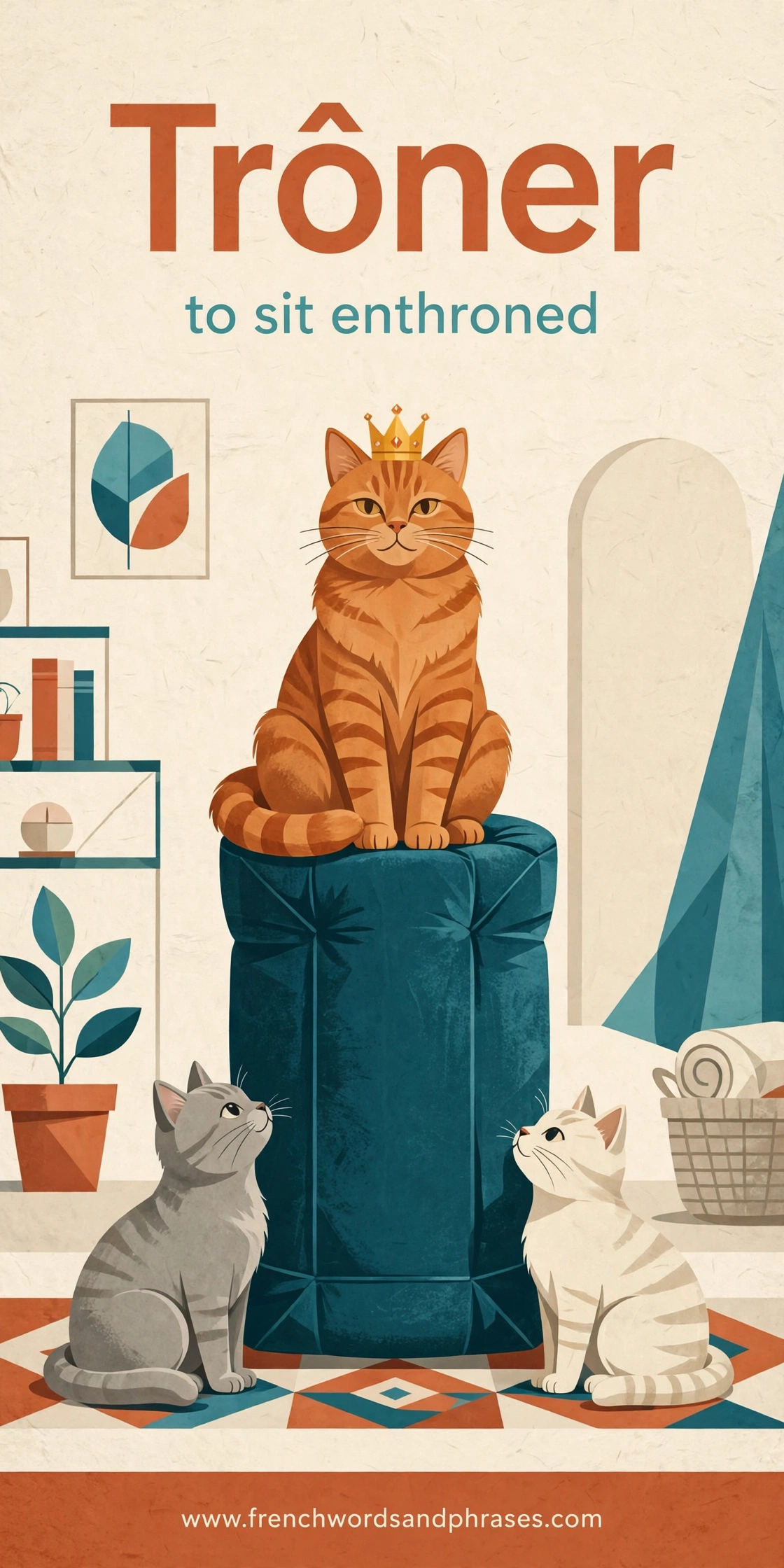
On top of the highest wardrobe, motionless, tail curled around her paws, the cat looks down on the whole household: she trône. Trôner is the verb of the throne — of kings in state, of castles above villages, and of anything, from a trophy to a tabby, that sits on high and knows it.
In this guide, you’ll learn how to conjugate trôner in all the major French tenses and moods. Explore complete conjugation tables, French examples, English translations, and practice quizzes.
Understanding the French Verb Trôner
Trôner is a regular French verb belonging to the first group of verbs, those ending in -er.
It means to sit enthroned. It is commonly used of castles, churches and statues dominating a landscape, of prized objects given the place of honour on a mantelpiece or table, and humorously of pets and people who install themselves above everyone else and survey the room.
Verb classification: First group (-er)
Auxiliary verb: Avoir
Past participle: trôné
Present participle: trônant
English equivalents: To sit enthroned, to sit in state; (figurative) to sit proudly on top — le château trône sur la colline, the castle sits enthroned on the hill; (of a person) to lord it, to hold court — il trône au milieu du salon, he holds court in the middle of the drawing room.
One important detail: the circumflex is part of the word’s identity — trôner comes from le trône, the throne, and the ô stays through every form: je trône, nous trônons, je trônais, past participle trôné. Nothing else changes; it is a perfectly regular -er verb. Its subjects are often things, not people: a castle, a statue, a vase or a cat can trôner, as long as it sits high and looks down on the world.
Experience the Word
Trôner is the verb of height plus dignity — to be on top, and to look as if you belong there.
Imagine driving into a Provençal village at dusk. Above the tiled roofs, floodlit against the darkening sky, the old castle keeps watch over the valley exactly as it has for eight hundred years. The guidebook does not say it sits there — it trône.
Everything below comes and goes. It remains above it all — trônant — surveying its kingdom in silence.
How to Conjugate Trôner: Complete French Conjugation Guide
Let’s explore every major conjugation of trôner, beginning with the indicative mood.
How to Conjugate Trôner in the Indicative Mood
The indicative mood is used to express facts, observations, actions, and events.
How to Conjugate Trôner in the Present Tense (Présent)
Used for actions happening now, habitual actions, and general truths.
| Subject | Conjugation |
|---|---|
| je | trône |
| tu | trônes |
| il / elle | trône |
| nous | trônons |
| vous | trônez |
| ils / elles | trônent |
Example
Le château trône sur la colline depuis huit siècles.
The castle has sat enthroned on the hill for eight centuries.
Quick Quiz 1
Complete the sentence:
Le château ______ au-dessus du village.
Reveal the answer
trône
Le château trône au-dessus du village.
The castle sits enthroned above the village.
How to Conjugate Trôner in the Passé Composé
Used for completed actions in the past. Trôner takes the auxiliary verb avoir.
| Subject | Conjugation |
|---|---|
| j’ | ai trôné |
| tu | as trôné |
| il / elle | a trôné |
| nous | avons trôné |
| vous | avez trôné |
| ils / elles | ont trôné |
Example
Le chat a trôné toute la journée sur le haut de l’armoire.
The cat sat enthroned all day on top of the wardrobe.
How to Conjugate Trôner in the Imparfait (Imperfect Tense)
Used for habitual past actions, descriptions, and ongoing situations in the past.
| Subject | Conjugation |
|---|---|
| je | trônais |
| tu | trônais |
| il / elle | trônait |
| nous | trônions |
| vous | trôniez |
| ils / elles | trônaient |
Example
Le vieux roi trônait au milieu de sa cour en silence.
The old king used to sit enthroned in silence in the midst of his court.
Quick Quiz 2
Choose the correct form:
The cat sat enthroned on the wardrobe.
Le chat ______ sur l’armoire. (a trôné / est trôné)
Reveal the answer
a trôné
Le chat a trôné sur l’armoire.
Trôner takes avoir.
How to Conjugate Trôner in the Plus-que-parfait
Used to describe an action that had already been completed before another past event.
| Subject | Conjugation |
|---|---|
| j’ | avais trôné |
| tu | avais trôné |
| il / elle | avait trôné |
| nous | avions trôné |
| vous | aviez trôné |
| ils / elles | avaient trôné |
Example
La statue avait trôné sur la place avant la Révolution.
The statue had sat enthroned on the square before the Revolution.
How to Conjugate Trôner in the Passé Simple
Primarily used in formal writing, literature, and historical narratives. It is rarely used in everyday conversation.
| Subject | Conjugation |
|---|---|
| je | trônai |
| tu | trônas |
| il / elle | trôna |
| nous | trônâmes |
| vous | trônâtes |
| ils / elles | trônèrent |
Example
Le roi trôna pendant cinquante ans sur le trône de France.
The king sat enthroned for fifty years on the throne of France.
How to Conjugate Trôner in the Passé Antérieur
A literary tense used to express an action completed immediately before another past action, generally in the passé simple.
| Subject | Conjugation |
|---|---|
| j’ | eus trôné |
| tu | eus trôné |
| il / elle | eut trôné |
| nous | eûmes trôné |
| vous | eûtes trôné |
| ils / elles | eurent trôné |
Example
Quand le tableau eut trôné un siècle dans le salon, on le vendit aux enchères.
When the painting had sat enthroned in the drawing room for a century, it was sold at auction.
How to Conjugate Trôner in the Future Tense (Futur Simple)
Used to describe actions that will take place in the future.
| Subject | Conjugation |
|---|---|
| je | trônerai |
| tu | trôneras |
| il / elle | trônera |
| nous | trônerons |
| vous | trônerez |
| ils / elles | trôneront |
Example
Ce trophée trônera sur la cheminée, à la vue de tous.
This trophy will sit enthroned on the mantelpiece, in full view of everyone.
How to Conjugate Trôner in the Futur Antérieur (Future Perfect)
Used for an action that will have been completed before a particular point in the future.
| Subject | Conjugation |
|---|---|
| j’ | aurai trôné |
| tu | auras trôné |
| il / elle | aura trôné |
| nous | aurons trôné |
| vous | aurez trôné |
| ils / elles | auront trôné |
Example
À Noël, le sapin aura trôné trois semaines dans le salon.
By Christmas, the tree will have sat enthroned in the living room for three weeks.
How to Conjugate Trôner in the Near Future (Futur Proche)
Used to describe something that is going to happen soon. Formed with aller + infinitive.
| Subject | Conjugation |
|---|---|
| je | vais trôner |
| tu | vas trôner |
| il / elle | va trôner |
| nous | allons trôner |
| vous | allez trôner |
| ils / elles | vont trôner |
Example
Regarde, le chat va trôner sur tes dossiers !
Look, the cat is going to sit enthroned on your files!
How to Conjugate Trôner in the Conditional Mood
The conditional mood expresses what would happen under certain circumstances. It is also frequently used to make polite requests or express wishes.
How to Conjugate Trôner in the Present Conditional
| Subject | Conjugation |
|---|---|
| je | trônerais |
| tu | trônerais |
| il / elle | trônerait |
| nous | trônerions |
| vous | trôneriez |
| ils / elles | trôneraient |
Example
Sans ce brouillard, le château trônerait fièrement au-dessus du village.
Without this fog, the castle would sit proudly enthroned above the village.
How to Conjugate Trôner in the Past Conditional
| Subject | Conjugation |
|---|---|
| j’ | aurais trôné |
| tu | aurais trôné |
| il / elle | aurait trôné |
| nous | aurions trôné |
| vous | auriez trôné |
| ils / elles | auraient trôné |
Example
La vieille armoire aurait trôné dans l’entrée si elle avait été moins large.
The old wardrobe would have sat enthroned in the hall if it had been less wide.
Trôner in the Literary Past Conditional Form
This less common literary form uses the imperfect subjunctive of avoir.
| Subject | Conjugation |
|---|---|
| j’ | eusse trôné |
| tu | eusses trôné |
| il / elle | eût trôné |
| nous | eussions trôné |
| vous | eussiez trôné |
| ils / elles | eussent trôné |
Example
Le roi eût trôné au milieu de ses barons assemblés.
The king would have sat enthroned among his assembled barons.
How to Conjugate Trôner in the Subjunctive Mood
The subjunctive is used to express wishes, emotions, doubts, necessity, and uncertainty. It frequently follows expressions such as il faut que (it is necessary that) or bien que (although).
How to Conjugate Trôner in the Present Subjunctive
| Subject | Conjugation |
|---|---|
| que je | trône |
| que tu | trônes |
| qu’il / qu’elle | trône |
| que nous | trônions |
| que vous | trôniez |
| qu’ils / qu’elles | trônent |
Example
Il faut que la mariée trône au centre de la photo de famille.
The bride must sit enthroned at the centre of the family photograph.
Quick Quiz 3
Complete the sentence using the subjunctive:
Il faut que la mariée ______ au centre de la photo.
Reveal the answer
trône
Il faut que la mariée trône au centre de la photo.
The bride must sit enthroned at the centre of the photograph.
How to Conjugate Trôner in the Imperfect Subjunctive
A literary tense, rarely encountered in modern spoken French.
| Subject | Conjugation |
|---|---|
| que je | trônasse |
| que tu | trônasses |
| qu’il / qu’elle | trônât |
| que nous | trônassions |
| que vous | trônassiez |
| qu’ils / qu’elles | trônassent |
Example
Le photographe voulait que le trophée trônât au milieu de la table.
The photographer wanted the trophy to sit enthroned in the middle of the table.
How to Conjugate Trôner in the Pluperfect Subjunctive
A literary construction used to express an action completed before another past action.
| Subject | Conjugation |
|---|---|
| que j’ | eusse trôné |
| que tu | eusses trôné |
| qu’il / qu’elle | eût trôné |
| que nous | eussions trôné |
| que vous | eussiez trôné |
| qu’ils / qu’elles | eussent trôné |
Example
On racontait que le tableau eût trôné jadis dans un palais.
People told how the painting had once sat enthroned in a palace.
How to Conjugate Trôner in the Past Subjunctive
| Subject | Conjugation |
|---|---|
| que j’ | aie trôné |
| que tu | aies trôné |
| qu’il / qu’elle | ait trôné |
| que nous | ayons trôné |
| que vous | ayez trôné |
| qu’ils / qu’elles | aient trôné |
Example
Je suis ravi que ton tableau ait trôné à l’exposition tout l’été.
I am delighted that your painting sat enthroned at the exhibition all summer.
How to Conjugate Trôner in the Imperative
The imperative is used to give commands, instructions, invitations, or suggestions. Subject pronouns are omitted.
How to Conjugate Trôner in the Present Imperative
| Person | Conjugation |
|---|---|
| (tu) | trône |
| (nous) | trônons |
| (vous) | trônez |
Example
Trônez au premier rang, Majesté, la cérémonie va commencer !
Sit enthroned in the front row, Your Majesty, the ceremony is about to begin!
Quick Quiz 4
How would you say Sit enthroned in the front row, Your Majesty (vous form)?
Reveal the answer
Trônez au premier rang, Majesté !
French Participles of Trôner
Participles are verb forms that can be used in compound tenses and other grammatical constructions.
Present Participle of Trôner
trônant
Trônant sur la colline, le château domine toute la vallée.
Sitting enthroned on the hill, the castle dominates the whole valley.
Past Participle of Trôner
trôné
Après avoir trôné un siècle sur la place, la statue a été déplacée au musée.
After sitting enthroned on the square for a century, the statue was moved to the museum.
Trôner in Everyday French: Real-Life Examples
Now that you know the conjugations, let’s see how trôner appears in everyday French.
Example 1 — Present
Le château trône au-dessus du village.
The castle sits enthroned above the village.
Example 2 — Passé composé
Le chat a trôné sur l’armoire toute la journée.
The cat sat enthroned on the wardrobe all day.
Example 3 — Imparfait
Le roi trônait en silence au milieu de la cour.
The king used to sit enthroned in silence in the midst of the court.
Example 4 — Future
Le trophée trônera sur la cheminée.
The trophy will sit enthroned on the mantelpiece.
Example 5 — Conditional
Le sapin trônerait mieux près de la fenêtre.
The Christmas tree would sit enthroned better near the window.
Example 6 — Imperative
Trônez au premier rang, Majesté !
Sit enthroned in the front row, Your Majesty!
Beyond Translation: The Meaning of Trôner
English keeps enthroned for coronations; French trôner has escaped the palace.
Anything given the high place can trôner.
A wedding cake trône on its stand, a television trône in the corner of the room, and the family cat trône wherever the family cat pleases. The verb always carries a smile: height, pride, and just a little pomposity.
How to Remember the French Verb Trôner
Remember it this way: Trôner is about the cat on top of the wardrobe and the castle above the village — high up, motionless, surveying everything.
- Le trône is the throne; trôner is to sit on it — in state, on high, on top of everything.
- The ô never changes: je trône, nous trônons, trôné — a perfectly regular -er verb.
- Things trônent as happily as kings: le château trône sur la colline — the castle sits enthroned on the hill.
The key idea is the cat on top of the wardrobe and the castle above the village — high up, motionless, surveying everything.
Test Your Knowledge of Trôner
Let’s see how much you’ve learned. Try answering these questions before revealing the answers.
Question 1
How do you say the castle sits enthroned on the hill in French?
Reveal the answer
Le château trône sur la colline.
Question 2
How do you say The cat sat enthroned on the wardrobe in French?
Reveal the answer
Le chat a trôné sur l’armoire.
Question 3
Translate: The trophy will sit enthroned on the mantelpiece.
Reveal the answer
Le trophée trônera sur la cheminée.
Question 4
What is the past participle of trôner?
Reveal the answer
Trôné.
Question 5
Complete the sentence:
Trônant sur la colline, le château ______ toute la vallée.
Reveal the answer
domine
Trônant sur la colline, le château domine toute la vallée.
Sitting enthroned on the hill, the castle dominates the whole valley.
Your Final Challenge
Can You Use It?
How would you say this in French?
On the hill, the old castle still sits enthroned above the sleeping village.
Reveal the answer
Sur la colline, le vieux château trône toujours au-dessus du village endormi.
On the hill, the old castle still sits enthroned above the sleeping village.
A little French. A little curiosity. A richer everyday life.
LEARN FRENCH ONE WORD AT A TIME




