
A French Word to Live By
How to Conjugate Tronquer in French
/tʁɔ̃.ke/
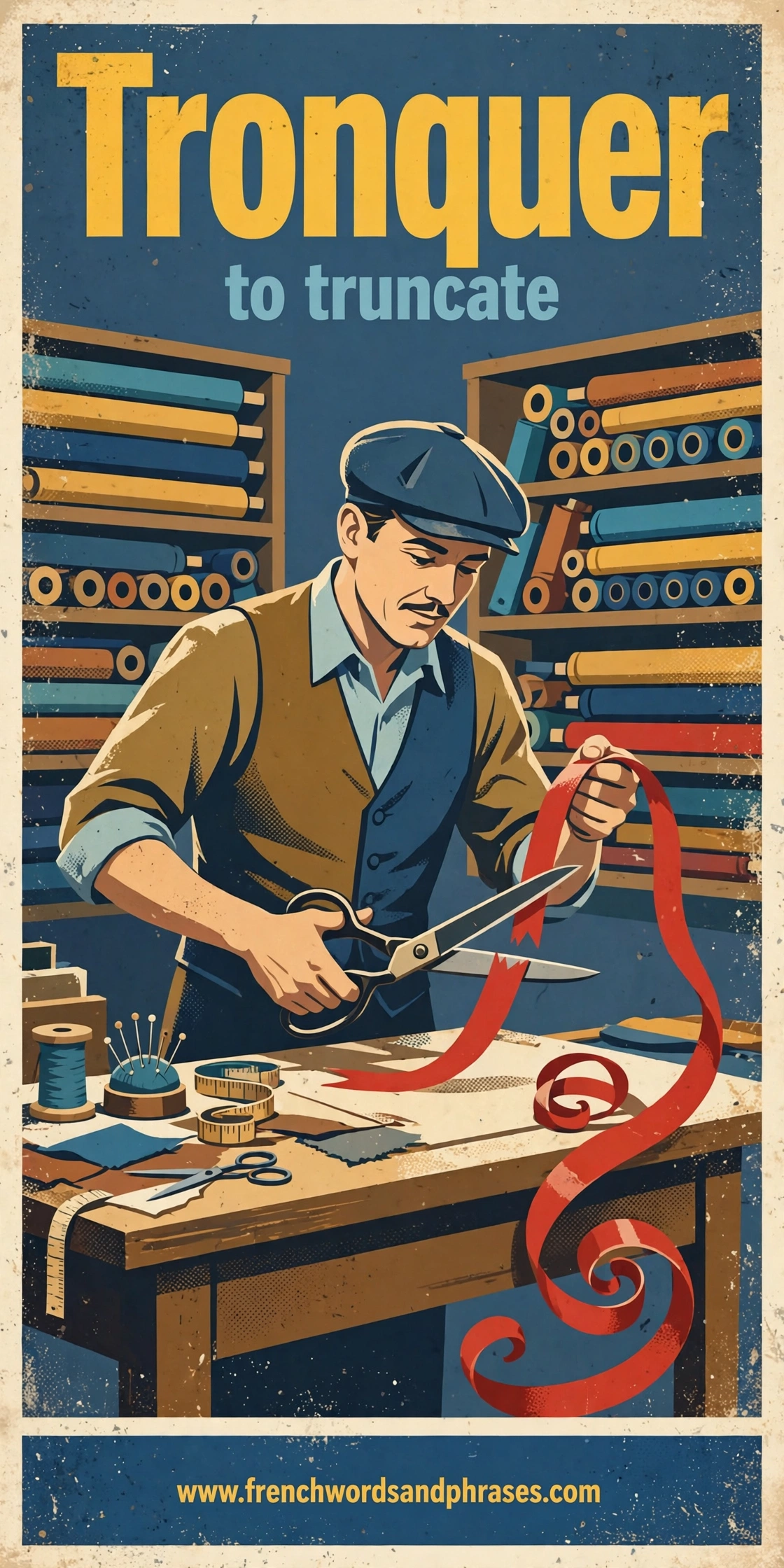
Tronquer means to truncate — to cut something short by chopping off a part of it, whether it is a text, a quotation or a number.
The editor stares at the article: two hundred words too long. Out comes the pencil, and the final paragraph falls away — tronquer is the verb of the cut that shortens, of quotations trimmed to fit and numbers docked of their decimals.
In this guide, you’ll learn how to conjugate tronquer in all the major French tenses and moods. Explore complete conjugation tables, French examples, English translations, and practice quizzes.
Understanding the French Verb Tronquer
Tronquer is a regular French verb belonging to the first group of verbs, those ending in -er.
It means to truncate. It is commonly used in publishing and journalism for texts and quotations cut to fit a space, in mathematics for numbers shortened by dropping decimals, and in computing for data and file names cut off at a fixed length.
Verb classification: First group (-er)
Auxiliary verb: Avoir
Past participle: tronqué
Present participle: tronquant
English equivalents: To truncate, to cut short; tronquer un texte — to cut a text down; une citation tronquée — a quotation cut short (and often distorted); tronquer un nombre — to truncate a number, dropping the decimals without rounding.
One important detail: tronquer is an -quer verb, and the qu is kept before e and i so the hard k sound survives: je tronque, nous tronquons, je tronquais, que je tronque. It comes from le tronc, a trunk: to truncate is to cut a thing down to a stump. Watch for its favourite partners — un texte tronqué, a cut-down text; une citation tronquée, a quote trimmed until it may mean something else entirely.
Experience the Word
Tronquer is the verb of the shortened thing — what remains still works, but something has been chopped away.
Imagine a politician reading the morning paper in fury. The newspaper has printed only half his sentence, and the half that remains says the opposite of what he meant. His spokesman has one word for the interview: tronquée — cut short, and cut unfairly.
The words are all his, yet the meaning is gone. It has been truncated — tronqué — and the stump says something new.
How to Conjugate Tronquer: Complete French Conjugation Guide
Let’s explore every major conjugation of tronquer, beginning with the indicative mood.
How to Conjugate Tronquer in the Indicative Mood
The indicative mood is used to express facts, observations, actions, and events.
How to Conjugate Tronquer in the Present Tense (Présent)
Used for actions happening now, habitual actions, and general truths.
| Subject | Conjugation |
|---|---|
| je | tronque |
| tu | tronques |
| il / elle | tronque |
| nous | tronquons |
| vous | tronquez |
| ils / elles | tronquent |
Example
Le journaliste tronque la citation pour la faire tenir dans son article.
The journalist truncates the quotation to make it fit in his article.
Quick Quiz 1
Complete the sentence:
Nous ______ les textes trop longs.
Reveal the answer
tronquons
Nous tronquons les textes trop longs.
We truncate texts that are too long.
How to Conjugate Tronquer in the Passé Composé
Used for completed actions in the past. Tronquer takes the auxiliary verb avoir.
| Subject | Conjugation |
|---|---|
| j’ | ai tronqué |
| tu | as tronqué |
| il / elle | a tronqué |
| nous | avons tronqué |
| vous | avez tronqué |
| ils / elles | ont tronqué |
Example
Ils ont tronqué mon interview, mes propos n’ont plus aucun sens.
They truncated my interview, my words no longer make any sense.
How to Conjugate Tronquer in the Imparfait (Imperfect Tense)
Used for habitual past actions, descriptions, and ongoing situations in the past.
| Subject | Conjugation |
|---|---|
| je | tronquais |
| tu | tronquais |
| il / elle | tronquait |
| nous | tronquions |
| vous | tronquiez |
| ils / elles | tronquaient |
Example
Autrefois, les censeurs tronquaient les livres qui les gênaient.
In the old days, the censors used to truncate the books that embarrassed them.
Quick Quiz 2
Choose the correct form:
She truncated the report.
Elle ______ le rapport. (a tronqué / est tronquée)
Reveal the answer
a tronqué
Elle a tronqué le rapport.
Tronquer takes avoir.
How to Conjugate Tronquer in the Plus-que-parfait
Used to describe an action that had already been completed before another past event.
| Subject | Conjugation |
|---|---|
| j’ | avais tronqué |
| tu | avais tronqué |
| il / elle | avait tronqué |
| nous | avions tronqué |
| vous | aviez tronqué |
| ils / elles | avaient tronqué |
Example
Elle avait tronqué le rapport avant de l’envoyer à la direction.
She had truncated the report before sending it to management.
How to Conjugate Tronquer in the Passé Simple
Primarily used in formal writing, literature, and historical narratives. It is rarely used in everyday conversation.
| Subject | Conjugation |
|---|---|
| je | tronquai |
| tu | tronquas |
| il / elle | tronqua |
| nous | tronquâmes |
| vous | tronquâtes |
| ils / elles | tronquèrent |
Example
L’éditeur tronqua le chapitre final sans prévenir l’auteur.
The editor truncated the final chapter without warning the author.
How to Conjugate Tronquer in the Passé Antérieur
A literary tense used to express an action completed immediately before another past action, generally in the passé simple.
| Subject | Conjugation |
|---|---|
| j’ | eus tronqué |
| tu | eus tronqué |
| il / elle | eut tronqué |
| nous | eûmes tronqué |
| vous | eûtes tronqué |
| ils / elles | eurent tronqué |
Example
Quand il eut tronqué le texte, il le relut avec regret.
When he had truncated the text, he reread it with regret.
How to Conjugate Tronquer in the Future Tense (Futur Simple)
Used to describe actions that will take place in the future.
| Subject | Conjugation |
|---|---|
| je | tronquerai |
| tu | tronqueras |
| il / elle | tronquera |
| nous | tronquerons |
| vous | tronquerez |
| ils / elles | tronqueront |
Example
Je tronquerai ce nombre à deux décimales pour le tableau.
I will truncate this number to two decimal places for the table.
How to Conjugate Tronquer in the Futur Antérieur (Future Perfect)
Used for an action that will have been completed before a particular point in the future.
| Subject | Conjugation |
|---|---|
| j’ | aurai tronqué |
| tu | auras tronqué |
| il / elle | aura tronqué |
| nous | aurons tronqué |
| vous | aurez tronqué |
| ils / elles | auront tronqué |
Example
À la fin de la journée, ils auront tronqué tous les fichiers trop longs.
By the end of the day, they will have truncated all the files that are too long.
How to Conjugate Tronquer in the Near Future (Futur Proche)
Used to describe something that is going to happen soon. Formed with aller + infinitive.
| Subject | Conjugation |
|---|---|
| je | vais tronquer |
| tu | vas tronquer |
| il / elle | va tronquer |
| nous | allons tronquer |
| vous | allez tronquer |
| ils / elles | vont tronquer |
Example
Tu vas tronquer la fin de la phrase, attention à ne pas changer le sens !
You are going to truncate the end of the sentence, be careful not to change the meaning!
How to Conjugate Tronquer in the Conditional Mood
The conditional mood expresses what would happen under certain circumstances. It is also frequently used to make polite requests or express wishes.
How to Conjugate Tronquer in the Present Conditional
| Subject | Conjugation |
|---|---|
| je | tronquerais |
| tu | tronquerais |
| il / elle | tronquerait |
| nous | tronquerions |
| vous | tronqueriez |
| ils / elles | tronqueraient |
Example
Sans limite de place, je ne tronquerais jamais cette citation.
Without a space limit, I would never truncate this quotation.
How to Conjugate Tronquer in the Past Conditional
| Subject | Conjugation |
|---|---|
| j’ | aurais tronqué |
| tu | aurais tronqué |
| il / elle | aurait tronqué |
| nous | aurions tronqué |
| vous | auriez tronqué |
| ils / elles | auraient tronqué |
Example
Il aurait tronqué le discours si le président le lui avait demandé.
He would have truncated the speech if the president had asked him to.
Tronquer in the Literary Past Conditional Form
This less common literary form uses the imperfect subjunctive of avoir.
| Subject | Conjugation |
|---|---|
| j’ | eusse tronqué |
| tu | eusses tronqué |
| il / elle | eût tronqué |
| nous | eussions tronqué |
| vous | eussiez tronqué |
| ils / elles | eussent tronqué |
Example
Le censeur eût tronqué le passage sans hésiter une seconde.
The censor would have truncated the passage without a second’s hesitation.
How to Conjugate Tronquer in the Subjunctive Mood
The subjunctive is used to express wishes, emotions, doubts, necessity, and uncertainty. It frequently follows expressions such as il faut que (it is necessary that) or bien que (although).
How to Conjugate Tronquer in the Present Subjunctive
| Subject | Conjugation |
|---|---|
| que je | tronque |
| que tu | tronques |
| qu’il / qu’elle | tronque |
| que nous | tronquions |
| que vous | tronquiez |
| qu’ils / qu’elles | tronquent |
Example
Il faut que tu tronques ce paragraphe, il est beaucoup trop long.
You must truncate this paragraph, it is far too long.
Quick Quiz 3
Complete the sentence using the subjunctive:
Il faut que vous ______ ce nombre à deux décimales.
Reveal the answer
tronquiez
Il faut que vous tronquiez ce nombre à deux décimales.
You must truncate this number to two decimal places.
How to Conjugate Tronquer in the Imperfect Subjunctive
A literary tense, rarely encountered in modern spoken French.
| Subject | Conjugation |
|---|---|
| que je | tronquasse |
| que tu | tronquasses |
| qu’il / qu’elle | tronquât |
| que nous | tronquassions |
| que vous | tronquassiez |
| qu’ils / qu’elles | tronquassent |
Example
L’auteur refusait que l’on tronquât son roman pour l’adapter.
The author refused to let anyone truncate his novel for the adaptation.
How to Conjugate Tronquer in the Pluperfect Subjunctive
A literary construction used to express an action completed before another past action.
| Subject | Conjugation |
|---|---|
| que j’ | eusse tronqué |
| que tu | eusses tronqué |
| qu’il / qu’elle | eût tronqué |
| que nous | eussions tronqué |
| que vous | eussiez tronqué |
| qu’ils / qu’elles | eussent tronqué |
Example
On lui reprochait qu’il eût tronqué la déclaration du témoin.
He was accused of having truncated the witness’s statement.
How to Conjugate Tronquer in the Past Subjunctive
| Subject | Conjugation |
|---|---|
| que j’ | aie tronqué |
| que tu | aies tronqué |
| qu’il / qu’elle | ait tronqué |
| que nous | ayons tronqué |
| que vous | ayez tronqué |
| qu’ils / qu’elles | aient tronqué |
Example
Je regrette que vous ayez tronqué ma réponse dans l’article.
I regret that you truncated my answer in the article.
How to Conjugate Tronquer in the Imperative
The imperative is used to give commands, instructions, invitations, or suggestions. Subject pronouns are omitted.
How to Conjugate Tronquer in the Present Imperative
| Person | Conjugation |
|---|---|
| (tu) | tronque |
| (nous) | tronquons |
| (vous) | tronquez |
Example
Tronque ce nombre à l’unité, ne l’arrondis surtout pas !
Truncate this number to the whole unit, whatever you do, don’t round it!
Quick Quiz 4
How would you say Truncate this number (tu form)?
Reveal the answer
Tronque ce nombre !
French Participles of Tronquer
Participles are verb forms that can be used in compound tenses and other grammatical constructions.
Present Participle of Tronquer
tronquant
En tronquant la citation, le journaliste en a changé le sens.
By truncating the quotation, the journalist changed its meaning.
Past Participle of Tronquer
tronqué
Tronquée par la censure, la lettre a perdu sa dernière page.
Truncated by the censor, the letter lost its last page.
Tronquer in Everyday French: Real-Life Examples
Now that you know the conjugations, let’s see how tronquer appears in everyday French.
Example 1 — Present
L’éditeur tronque les textes trop longs.
The editor truncates texts that are too long.
Example 2 — Passé composé
Ils ont tronqué ma citation dans l’article.
They truncated my quotation in the article.
Example 3 — Imparfait
Les censeurs tronquaient les livres interdits.
The censors used to truncate banned books.
Example 4 — Future
Je tronquerai le nombre à deux décimales.
I will truncate the number to two decimal places.
Example 5 — Conditional
Tu tronquerais ce texte si tu manquais de place.
You would truncate this text if you were short of space.
Example 6 — Imperative
Tronquez la phrase, elle dépasse la limite !
Truncate the sentence, it goes over the limit!
Beyond Translation: The Meaning of Tronquer
English truncate sounds technical; French tronquer grows straight out of the forest — le tronc, the trunk of a tree.
To truncate is to leave a stump.
That is why a citation tronquée is such an accusation in French public life: not merely shortened, but cut in a way that changes what grows from it. And in mathematics the stump rule is precise — tronquer drops the decimals, where arrondir would round them.
How to Remember the French Verb Tronquer
Remember it this way: Tronquer is about the editor’s pencil and the tree stump — whatever is cut short and left standing.
- From le tronc, a trunk — tronquer cuts a thing down to a stump: texts, quotes and numbers.
- An -quer verb: the qu stays before e and i — je tronque, nous tronquons.
- Une citation tronquée — a quotation cut short; in maths, tronquer drops decimals without rounding.
The key idea is the editor’s pencil and the tree stump — whatever is cut short and left standing.
Test Your Knowledge of Tronquer
Let’s see how much you’ve learned. Try answering these questions before revealing the answers.
Question 1
How do you say to truncate a quotation in French?
Reveal the answer
Tronquer une citation.
Question 2
How do you say The editor truncates the text in French?
Reveal the answer
L’éditeur tronque le texte.
Question 3
Translate: They truncated my interview.
Reveal the answer
Ils ont tronqué mon interview.
Question 4
What is the past participle of tronquer?
Reveal the answer
Tronqué.
Question 5
Complete the sentence:
Il faut que tu ______ ce paragraphe, il est trop long.
Reveal the answer
tronques
Il faut que tu tronques ce paragraphe, il est trop long.
You must truncate this paragraph, it is too long.
Your Final Challenge
Can You Use It?
How would you say this in French?
By truncating the quotation, the journalist unfortunately changed its meaning.
Reveal the answer
En tronquant la citation, le journaliste en a malheureusement changé le sens.
By truncating the quotation, the journalist unfortunately changed its meaning.
A little French. A little curiosity. A richer everyday life.
LEARN FRENCH ONE WORD AT A TIME




