A French Word to Live By
How to Conjugate Avoir in French
/avwaʁ/
Avoir means to have. It is one of the most important and frequently used verbs in the French language.
We use avoir to talk about what we own, what we possess, our age, and even how we feel. From saying J’ai un livre (I have a book) to J’ai faim (I am hungry), avoir is essential to everyday French communication.
In this guide, you’ll learn how to conjugate avoir in all the major French tenses and moods. Explore complete conjugation tables, French examples, English translations, pronunciation links, and practice quizzes.
Understanding the French Verb Avoir
Avoir is an irregular French verb belonging to the third group of verbs. Its conjugations do not follow a regular pattern, so the different forms must be learned through practice.
Its primary meaning is to have, but avoir also appears in many everyday French expressions. It is additionally one of the two main auxiliary verbs used to form compound tenses.
Verb classification: Third group (irregular verb)
Auxiliary verb: Avoir
Past participle: eu
Present participle: ayant
English equivalent: To have.
Avoir is especially important because it serves as the auxiliary verb for most French verbs when forming compound tenses. It also serves as its own auxiliary, as in j’ai eu (I had).
Experience the Word
Avoir is much more than a verb used to describe ownership. It appears in countless everyday expressions and is an essential part of speaking natural French.
Imagine telling someone what you own: J’ai une voiture (I have a car). You might explain your age: J’ai vingt ans (I am twenty years old). Or tell a friend how you feel: J’ai faim (I am hungry).
Notice something interesting? In French, many expressions that use the English verb “to be” actually use avoir.
Master avoir, and you will unlock an enormous part of everyday French conversation.
How to Conjugate Avoir: Complete French Conjugation Guide
Let’s explore every major conjugation of avoir, beginning with the indicative mood.
How to Conjugate Avoir in the Indicative Mood
The indicative mood is used to express facts, observations, situations, and events.
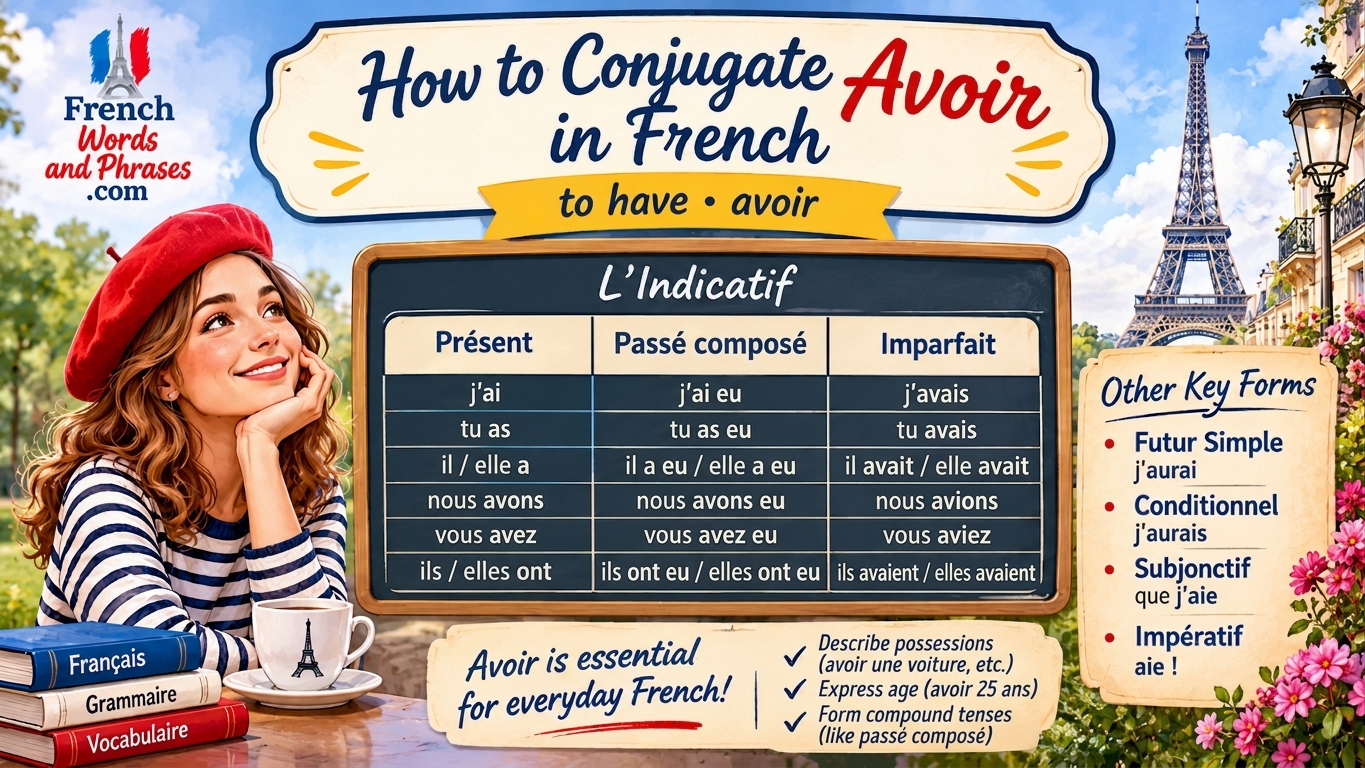
How to Conjugate Avoir in the Present Tense (Présent)
Used to describe what someone has, owns, or possesses. It is also used in many common French expressions.
| Subject | Conjugation |
|---|---|
| j’ | ai |
| tu | as |
| il / elle | a |
| nous | avons |
| vous | avez |
| ils / elles | ont |
Example
J’ai un petit appartement à Paris.
I have a small apartment in Paris.
Quick Quiz 1
Complete the sentence:
Nous ______ une grande maison.
Reveal the answer
avons
Nous avons une grande maison.
We have a large house.
How to Conjugate Avoir in the Passé Composé
Used for completed actions or situations in the past. Avoir takes the auxiliary verb avoir when forming its own passé composé.
| Subject | Conjugation |
|---|---|
| j’ | ai eu |
| tu | as eu |
| il / elle | a eu |
| nous | avons eu |
| vous | avez eu |
| ils / elles | ont eu |
Example
J’ai eu beaucoup de chance hier.
I was very lucky yesterday.
How to Conjugate Avoir in the Imparfait (Imperfect Tense)
Used to describe habitual past situations, ongoing conditions, and things someone used to have.
| Subject | Conjugation |
|---|---|
| je | avais |
| tu | avais |
| il / elle | avait |
| nous | avions |
| vous | aviez |
| ils / elles | avaient |
Example
Quand j’étais enfant, j’avais un chien.
When I was a child, I had a dog.
Quick Quiz 2
Choose the correct form:
When we were young, we had a lot of friends.
Quand nous étions jeunes, nous ______ beaucoup d’amis.
Reveal the answer
avions
Quand nous étions jeunes, nous avions beaucoup d’amis.
How to Conjugate Avoir in the Plus-que-parfait
Used to describe something someone had already possessed or experienced before another past event.
| Subject | Conjugation |
|---|---|
| j’ | avais eu |
| tu | avais eu |
| il / elle | avait eu |
| nous | avions eu |
| vous | aviez eu |
| ils / elles | avaient eu |
Example
J’avais déjà eu cette idée avant notre conversation.
I had already had that idea before our conversation.
How to Conjugate Avoir in the Passé Simple
Primarily used in formal writing, literature, and historical narratives. It is rarely used in everyday conversation.
| Subject | Conjugation |
|---|---|
| j’ | eus |
| tu | eus |
| il / elle | eut |
| nous | eûmes |
| vous | eûtes |
| ils / elles | eurent |
Example
Il eut une grande influence sur son époque.
He had a great influence on his era.
How to Conjugate Avoir in the Passé Antérieur
A literary tense used to express an action completed before another past action, generally in the passé simple.
| Subject | Conjugation |
|---|---|
| j’ | eus eu |
| tu | eus eu |
| il / elle | eut eu |
| nous | eûmes eu |
| vous | eûtes eu |
| ils / elles | eurent eu |
Example
Dès qu’il eut eu la réponse, il partit.
As soon as he had received the answer, he left.
How to Conjugate Avoir in the Future Tense (Futur Simple)
Used to describe what someone will have or possess in the future.
| Subject | Conjugation |
|---|---|
| j’ | aurai |
| tu | auras |
| il / elle | aura |
| nous | aurons |
| vous | aurez |
| ils / elles | auront |
Example
Demain, j’aurai plus de temps libre.
Tomorrow, I will have more free time.
How to Conjugate Avoir in the Futur Antérieur (Future Perfect)
Used to describe something that will have been obtained, possessed, or experienced before a particular point in the future.
| Subject | Conjugation |
|---|---|
| j’ | aurai eu |
| tu | auras eu |
| il / elle | aura eu |
| nous | aurons eu |
| vous | aurez eu |
| ils / elles | auront eu |
Example
À la fin de l’année, j’aurai eu beaucoup de nouvelles expériences.
By the end of the year, I will have had many new experiences.
How to Conjugate Avoir in the Near Future (Futur Proche)
Used to describe something that is going to happen soon. Formed with aller + infinitive.
| Subject | Conjugation |
|---|---|
| je | vais avoir |
| tu | vas avoir |
| il / elle | va avoir |
| nous | allons avoir |
| vous | allez avoir |
| ils / elles | vont avoir |
Example
Nous allons avoir des invités ce soir.
We are going to have guests tonight.
How to Conjugate Avoir in the Conditional Mood
The conditional mood expresses what would happen under certain circumstances. It is also frequently used to make polite requests, express wishes, or describe hypothetical situations.
How to Conjugate Avoir in the Present Conditional
| Subject | Conjugation |
|---|---|
| j’ | aurais |
| tu | aurais |
| il / elle | aurait |
| nous | aurions |
| vous | auriez |
| ils / elles | auraient |
Example
J’aurais besoin de votre aide.
I would need your help.
How to Conjugate Avoir in the Past Conditional
| Subject | Conjugation |
|---|---|
| j’ | aurais eu |
| tu | aurais eu |
| il / elle | aurait eu |
| nous | aurions eu |
| vous | auriez eu |
| ils / elles | auraient eu |
Example
J’aurais eu plus de temps si j’avais terminé plus tôt.
I would have had more time if I had finished earlier.
Avoir in the Literary Past Conditional Form
This less common literary form uses the imperfect subjunctive of avoir. It is also known as the second form of the past conditional.
| Subject | Conjugation |
|---|---|
| j’ | eusse eu |
| tu | eusses eu |
| il / elle | eût eu |
| nous | eussions eu |
| vous | eussiez eu |
| ils / elles | eussent eu |
Example
Il eût eu davantage de succès avec plus de patience.
He would have had more success with more patience.
How to Conjugate Avoir in the Subjunctive Mood
The subjunctive is used to express wishes, emotions, doubts, necessity, and uncertainty. It frequently follows expressions such as il faut que (it is necessary that) or bien que (although).
How to Conjugate Avoir in the Present Subjunctive
| Subject | Conjugation |
|---|---|
| que j’ | aie |
| que tu | aies |
| qu’il / qu’elle | ait |
| que nous | ayons |
| que vous | ayez |
| qu’ils / qu’elles | aient |
Example
Il faut que j’aie plus de patience.
I need to have more patience.
Quick Quiz 3
Complete the sentence using the subjunctive:
Il faut que nous ______ confiance.
Reveal the answer
ayons
Il faut que nous ayons confiance.
We must have confidence.
How to Conjugate Avoir in the Imperfect Subjunctive
A literary tense, rarely encountered in modern spoken French.
| Subject | Conjugation |
|---|---|
| que j’ | eusse |
| que tu | eusses |
| qu’il / qu’elle | eût |
| que nous | eussions |
| que vous | eussiez |
| qu’ils / qu’elles | eussent |
Example
Il souhaitait que j’eusse davantage de courage.
He wished that I had more courage.
How to Conjugate Avoir in the Pluperfect Subjunctive
A literary construction used to express an action or situation completed before another past action.
| Subject | Conjugation |
|---|---|
| que j’ | eusse eu |
| que tu | eusses eu |
| qu’il / qu’elle | eût eu |
| que nous | eussions eu |
| que vous | eussiez eu |
| qu’ils / qu’elles | eussent eu |
Example
Il regrettait que nous eussions eu si peu de temps.
He regretted that we had had so little time.
How to Conjugate Avoir in the Past Subjunctive
Used to express a completed past action or situation following an expression that requires the subjunctive.
| Subject | Conjugation |
|---|---|
| que j’ | aie eu |
| que tu | aies eu |
| qu’il / qu’elle | ait eu |
| que nous | ayons eu |
| que vous | ayez eu |
| qu’ils / qu’elles | aient eu |
Example
Je suis heureux que tu aies eu cette occasion.
I am happy that you had this opportunity.
How to Conjugate Avoir in the Imperative
The imperative is used to give commands, instructions, invitations, or suggestions. Subject pronouns are omitted.
How to Conjugate Avoir in the Present Imperative
| Person | Conjugation |
|---|---|
| (tu) | aie |
| (nous) | ayons |
| (vous) | ayez |
Example
Ayez confiance en vous !
Have confidence in yourself!
Quick Quiz 4
How would you say “Have patience” when speaking to one person informally?
Reveal the answer
Aie patience !
French Participles of Avoir
Participles are verb forms that can be used in compound tenses and other grammatical constructions.
Present Participle of Avoir
ayant
Ayant beaucoup de travail, elle est restée au bureau.
Having a lot of work, she stayed at the office.
Past Participle of Avoir
eu
The standard past participle is eu. Depending on the grammatical context, it can also take different agreement forms:
- eu — masculine singular
- eus — masculine plural
- eue — feminine singular
- eues — feminine plural
Example
J’ai eu une excellente idée.
I had an excellent idea.
Avoir in Everyday French: Real-Life Examples
Now that you know the conjugations, let’s see how avoir appears in everyday French.
Example 1 — Present
J’ai deux frères et une sœur.
I have two brothers and one sister.
Example 2 — Passé composé
Nous avons eu une belle journée.
We had a lovely day.
Example 3 — Imparfait
Elle avait beaucoup d’amis à l’école.
She had many friends at school.
Example 4 — Future
Ils auront bientôt une nouvelle maison.
They will soon have a new house.
Example 5 — Conditional
J’aurais besoin d’un peu plus de temps.
I would need a little more time.
Example 6 — Subjunctive
Bien qu’il ait de l’expérience, il continue d’apprendre.
Although he has experience, he continues to learn.
Beyond Translation: The Many Uses of Avoir
The English verb to have and the French verb avoir share many similarities, but French uses avoir in some expressions where English uses the verb “to be.”
These expressions are particularly important because translating them word for word can lead to mistakes.
Here are some of the most common examples:
- Avoir faim — To be hungry (literally, to have hunger).
- Avoir soif — To be thirsty (literally, to have thirst).
- Avoir chaud — To be hot.
- Avoir froid — To be cold.
- Avoir peur — To be afraid.
- Avoir sommeil — To be sleepy.
- Avoir raison — To be right.
- Avoir tort — To be wrong.
- Avoir besoin de — To need.
- Avoir envie de — To feel like or want something.
For example:
J’ai faim et j’ai soif.
I am hungry and thirsty.
Understanding these expressions will help you sound more natural and communicate more confidently in French.
Avoir: One of the Two Essential Auxiliary Verbs
Avoir also plays a central role in French grammar because it is used to form the passé composé and other compound tenses of most French verbs.
For example:
- J’ai mangé. — I ate / I have eaten.
- Elle a choisi. — She chose / She has chosen.
- Nous avons parlé. — We spoke / We have spoken.
These examples show why avoir is so important. Learning this verb helps you understand not only everyday expressions but also how to form the past tenses of a large number of French verbs.
How to Remember the French Verb Avoir
Remember it this way: Avoir is the verb you use when talking about what you have, what you need, and many things you experience.
- J’ai un livre. — I have a book.
- Tu as faim. — You are hungry.
- Elle a vingt ans. — She is twenty years old.
- Nous avons du temps. — We have time.
- Vous avez raison. — You are right.
- Ils ont peur. — They are afraid.
The key to mastering avoir is repetition. Its conjugations are irregular, so practice them regularly. Pay particular attention to the present tense, the future forms, and the subjunctive.
Test Your Knowledge of Avoir
Let’s see how much you’ve learned. Try answering these questions before revealing the answers.
Question 1
What is the past participle of avoir?
Reveal the answer
Eu.
Question 2
How do you say “I will have” in French?
Reveal the answer
J’aurai.
Question 3
Translate: “We have had a good day.”
Reveal the answer
Nous avons eu une bonne journée.
Question 4
What is the present participle of avoir?
Reveal the answer
Ayant.
Question 5
Complete the sentence:
Si j’avais plus d’argent, j’______ une nouvelle voiture.
Reveal the answer
aurais
Si j’avais plus d’argent, j’aurais une nouvelle voiture.
If I had more money, I would have a new car.
Your Final Challenge
Can You Use It?
How would you say this in French?
“Tomorrow, I will have enough time to visit the museum.”
Reveal the answer
Demain, j’aurai assez de temps pour visiter le musée.
Tomorrow, I will have enough time to visit the museum.
A little French. A little curiosity. A richer everyday life.
LEARN FRENCH ONE WORD AT A TIME