A French Word to Live By
How to Conjugate Être in French
/ɛtʁ/
Être means to be. It is one of the most important and frequently used verbs in the French language.
Who are you? Where are you? How are you feeling? From describing people and places to expressing emotions and identifying things, être is at the heart of everyday French communication.
In this guide, you’ll learn how to conjugate être in all the major French tenses and moods. Explore complete conjugation tables, French examples, English translations, pronunciation links, and practice quizzes.
Understanding the French Verb Être
Être is an irregular French verb belonging to the third group of verbs. Unlike regular verbs, it does not follow a predictable conjugation pattern and must be learned through practice.
It means to be and is used to describe identity, characteristics, location, feelings, and conditions. It also serves as an auxiliary verb in certain compound constructions.
Verb classification: Third group (irregular -re verb)
Auxiliary verb: Avoir
Past participle: été
Present participle: étant
English equivalent: To be.
One important detail: although être is itself a verb, it uses avoir as its auxiliary when forming compound tenses. For example, j’ai été means “I have been.”
Experience the Word
Être is one of the first French verbs students learn, and for good reason. It helps us describe who we are, how we feel, and the world around us.
Imagine introducing yourself: Je suis étudiant (I am a student). You might describe a friend: Elle est gentille (She is kind). Or explain where you are: Nous sommes à Paris (We are in Paris).
These simple sentences demonstrate just how essential être is to communicating in French.
Master être, and you have taken an important step toward speaking French with confidence.
How to Conjugate Être: Complete French Conjugation Guide
Let’s explore every major conjugation of être, beginning with the indicative mood.
How to Conjugate Être in the Indicative Mood
The indicative mood is used to express facts, observations, descriptions, and events.
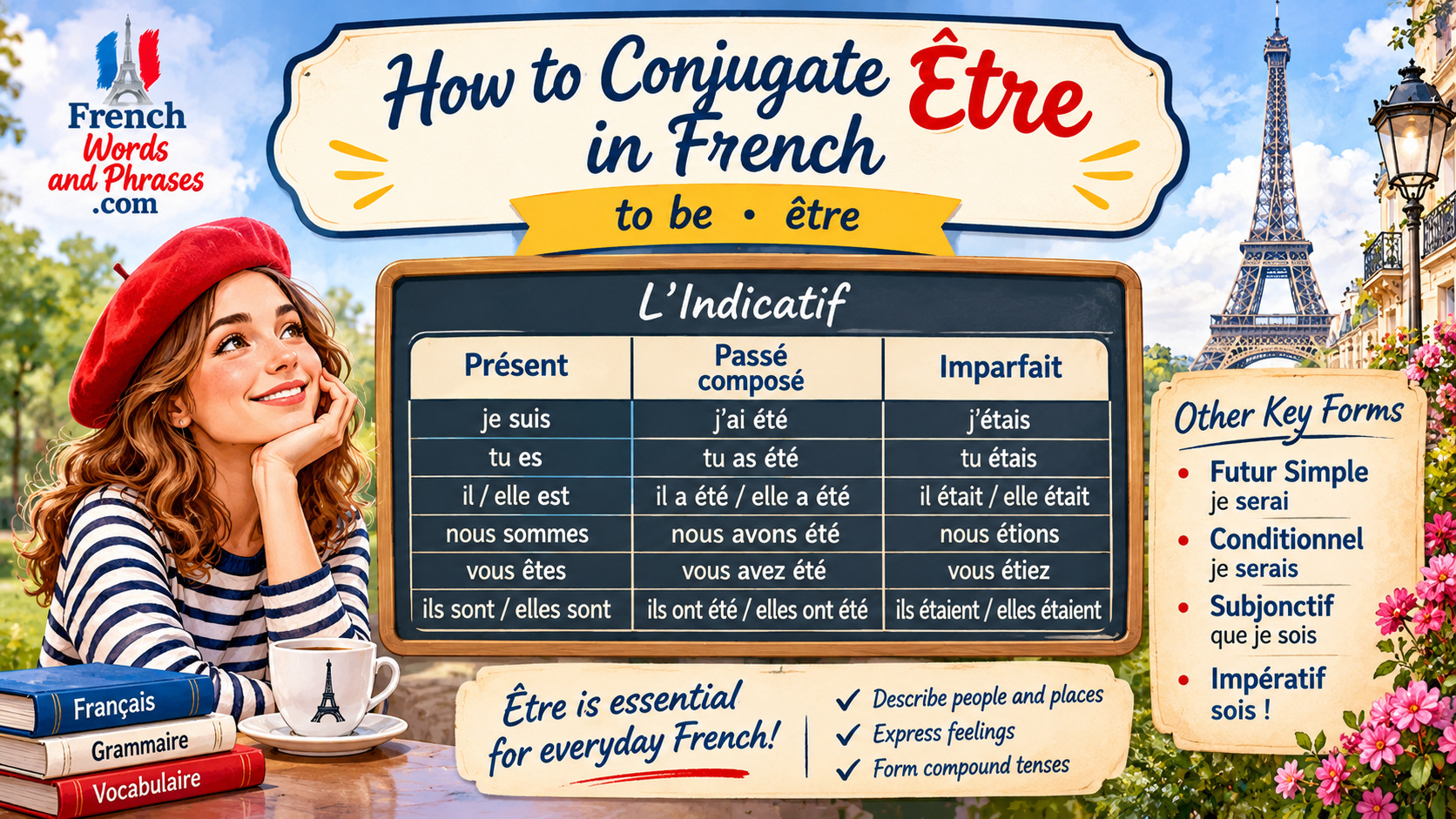
How to Conjugate Être in the Present Tense (Présent)
Used to describe current states, identities, characteristics, locations, and general truths.
| Subject | Conjugation |
|---|---|
| je | suis |
| tu | es |
| il / elle | est |
| nous | sommes |
| vous | êtes |
| ils / elles | sont |
Example
Je suis heureux d’apprendre le français.
I am happy to learn French.
Quick Quiz 1
Complete the sentence:
Nous ______ étudiants.
Reveal the answer
sommes
Nous sommes étudiants.
We are students.
How to Conjugate Être in the Passé Composé
Used for completed actions or states in the past. Être takes the auxiliary verb avoir when forming its own passé composé.
| Subject | Conjugation |
|---|---|
| j’ | ai été |
| tu | as été |
| il / elle | a été |
| nous | avons été |
| vous | avez été |
| ils / elles | ont été |
Example
J’ai été très occupé hier.
I was very busy yesterday.
How to Conjugate Être in the Imparfait (Imperfect Tense)
Used to describe ongoing past states, habitual situations, and background descriptions.
| Subject | Conjugation |
|---|---|
| je | étais |
| tu | étais |
| il / elle | était |
| nous | étions |
| vous | étiez |
| ils / elles | étaient |
Example
Quand j’étais petit, j’étais très timide.
When I was little, I was very shy.
Quick Quiz 2
Choose the correct form:
When we were young, we were very happy.
Quand nous étions jeunes, nous ______ très heureux.
Reveal the answer
étions
Quand nous étions jeunes, nous étions très heureux.
How to Conjugate Être in the Plus-que-parfait
Used to describe a state or situation that had already occurred before another past event.
| Subject | Conjugation |
|---|---|
| j’ | avais été |
| tu | avais été |
| il / elle | avait été |
| nous | avions été |
| vous | aviez été |
| ils / elles | avaient été |
Example
J’avais déjà été à Paris avant ce voyage.
I had already been to Paris before this trip.
How to Conjugate Être in the Passé Simple
Primarily used in formal writing, literature, and historical narratives. It is rarely used in everyday conversation.
| Subject | Conjugation |
|---|---|
| je | fus |
| tu | fus |
| il / elle | fut |
| nous | fûmes |
| vous | fûtes |
| ils / elles | furent |
Example
Il fut un grand roi.
He was a great king.
How to Conjugate Être in the Passé Antérieur
A literary tense used to express a state or condition completed before another past action, generally in the passé simple.
| Subject | Conjugation |
|---|---|
| j’ | eus été |
| tu | eus été |
| il / elle | eut été |
| nous | eûmes été |
| vous | eûtes été |
| ils / elles | eurent été |
Example
Dès qu’il eut été informé, il prit une décision.
As soon as he had been informed, he made a decision.
How to Conjugate Être in the Future Tense (Futur Simple)
Used to describe states, conditions, and situations that will exist in the future.
| Subject | Conjugation |
|---|---|
| je | serai |
| tu | seras |
| il / elle | sera |
| nous | serons |
| vous | serez |
| ils / elles | seront |
Example
Demain, je serai à la maison.
Tomorrow, I will be at home.
How to Conjugate Être in the Futur Antérieur (Future Perfect)
Used for a state or situation that will have been completed before a particular point in the future.
| Subject | Conjugation |
|---|---|
| j’ | aurai été |
| tu | auras été |
| il / elle | aura été |
| nous | aurons été |
| vous | aurez été |
| ils / elles | auront été |
Example
À la fin de l’année, j’aurai été ici pendant cinq ans.
By the end of the year, I will have been here for five years.
How to Conjugate Être in the Near Future (Futur Proche)
Used to describe something that is going to happen soon. Formed with aller + infinitive.
| Subject | Conjugation |
|---|---|
| je | vais être |
| tu | vas être |
| il / elle | va être |
| nous | allons être |
| vous | allez être |
| ils / elles | vont être |
Example
Nous allons être en retard.
We are going to be late.
How to Conjugate Être in the Conditional Mood
The conditional mood expresses what would happen under certain circumstances. It is also frequently used to make polite requests, express wishes, or describe hypothetical situations.
How to Conjugate Être in the Present Conditional
| Subject | Conjugation |
|---|---|
| je | serais |
| tu | serais |
| il / elle | serait |
| nous | serions |
| vous | seriez |
| ils / elles | seraient |
Example
Je serais heureux de vous aider.
I would be happy to help you.
How to Conjugate Être in the Past Conditional
| Subject | Conjugation |
|---|---|
| j’ | aurais été |
| tu | aurais été |
| il / elle | aurait été |
| nous | aurions été |
| vous | auriez été |
| ils / elles | auraient été |
Example
J’aurais été plus prudent si j’avais su.
I would have been more careful if I had known.
Être in the Literary Past Conditional Form
This less common literary form uses the imperfect subjunctive of avoir. It is also known as the second form of the past conditional.
| Subject | Conjugation |
|---|---|
| j’ | eusse été |
| tu | eusses été |
| il / elle | eût été |
| nous | eussions été |
| vous | eussiez été |
| ils / elles | eussent été |
Example
Il eût été préférable de partir plus tôt.
It would have been preferable to leave earlier.
How to Conjugate Être in the Subjunctive Mood
The subjunctive is used to express wishes, emotions, doubts, necessity, and uncertainty. It frequently follows expressions such as il faut que (it is necessary that) or bien que (although).
How to Conjugate Être in the Present Subjunctive
| Subject | Conjugation |
|---|---|
| que je | sois |
| que tu | sois |
| qu’il / qu’elle | soit |
| que nous | soyons |
| que vous | soyez |
| qu’ils / qu’elles | soient |
Example
Il faut que je sois à l’heure.
I must be on time.
Quick Quiz 3
Complete the sentence using the subjunctive:
Il faut que nous ______ prêts.
Reveal the answer
soyons
Il faut que nous soyons prêts.
We must be ready.
How to Conjugate Être in the Imperfect Subjunctive
A literary tense, rarely encountered in modern spoken French.
| Subject | Conjugation |
|---|---|
| que je | fusse |
| que tu | fusses |
| qu’il / qu’elle | fût |
| que nous | fussions |
| que vous | fussiez |
| qu’ils / qu’elles | fussent |
Example
Il souhaitait que je fusse présent.
He wished that I were present.
How to Conjugate Être in the Pluperfect Subjunctive
A literary construction used to express a state or condition completed before another past action.
| Subject | Conjugation |
|---|---|
| que j’ | eusse été |
| que tu | eusses été |
| qu’il / qu’elle | eût été |
| que nous | eussions été |
| que vous | eussiez été |
| qu’ils / qu’elles | eussent été |
Example
Il regrettait que nous eussions été absents.
He regretted that we had been absent.
How to Conjugate Être in the Past Subjunctive
Used to express a completed past state or condition following an expression that requires the subjunctive.
| Subject | Conjugation |
|---|---|
| que j’ | aie été |
| que tu | aies été |
| qu’il / qu’elle | ait été |
| que nous | ayons été |
| que vous | ayez été |
| qu’ils / qu’elles | aient été |
Example
Je suis heureux que tu aies été là.
I am happy that you were there.
How to Conjugate Être in the Imperative
The imperative is used to give commands, instructions, invitations, or suggestions. Subject pronouns are omitted.
How to Conjugate Être in the Present Imperative
| Person | Conjugation |
|---|---|
| (tu) | sois |
| (nous) | soyons |
| (vous) | soyez |
Example
Sois patient !
Be patient!
Quick Quiz 4
How would you say “Let’s be careful”?
Reveal the answer
Soyons prudents !
French Participles of Être
Participles are verb forms that can be used in compound tenses and other grammatical constructions.
Present Participle of Être
étant
Étant malade, elle est restée chez elle.
Being ill, she stayed at home.
Past Participle of Être
été
J’ai été très heureux de vous rencontrer.
I was very happy to meet you.
Être in Everyday French: Real-Life Examples
Now that you know the conjugations, let’s see how être appears in everyday French.
Example 1 — Present
Je suis étudiant en français.
I am a French student.
Example 2 — Passé composé
Elle a été très gentille avec moi.
She was very kind to me.
Example 3 — Imparfait
Nous étions fatigués après le voyage.
We were tired after the trip.
Example 4 — Future
Ils seront bientôt à la maison.
They will be home soon.
Example 5 — Conditional
Je serais ravi de vous aider.
I would be delighted to help you.
Example 6 — Subjunctive
Bien qu’il soit jeune, il est très sérieux.
Although he is young, he is very serious.
Beyond Translation: The Importance of Être
The English verb to be and the French verb être serve many of the same essential purposes. They allow us to identify people, describe things, express feelings, and explain where someone or something is located.
But être has another important role in French grammar.
Être is also used as an auxiliary verb to form compound tenses of many other French verbs.
For example:
- Je suis allé. — I went / I have gone.
- Elle est arrivée. — She arrived / She has arrived.
- Nous sommes partis. — We left / We have left.
These examples show why learning être is so important. It is not only a verb you use frequently on its own; it also helps you form the past tenses of many other verbs.
One more important distinction: when être is used as an auxiliary, the past participle generally agrees in gender and number with the subject. When être is the main verb, as in j’ai été, it takes avoir and the past participle remains été.
How to Remember the French Verb Être
Remember it this way: Être is the verb you use whenever you want to say what someone or something is, how they are, or where they are.
- Je suis heureux. — I am happy.
- Tu es gentil. — You are kind.
- Elle est française. — She is French.
- Nous sommes prêts. — We are ready.
- Vous êtes ici. — You are here.
- Ils sont amis. — They are friends.
The key to mastering être is repetition. Its conjugations are irregular, so practice them regularly and pay particular attention to the present tense, imperfect, and future forms.
Test Your Knowledge of Être
Let’s see how much you’ve learned. Try answering these questions before revealing the answers.
Question 1
What auxiliary verb is used with être in its own compound tenses?
Reveal the answer
Avoir
Question 2
How do you say “I will be” in French?
Reveal the answer
Je serai.
Question 3
Translate: “We have been happy.”
Reveal the answer
Nous avons été heureux.
Question 4
What is the present participle of être?
Reveal the answer
Étant.
Question 5
Complete the sentence:
Si j’avais plus de temps, je ______ plus souvent à Paris.
Reveal the answer
serais
Si j’avais plus de temps, je serais plus souvent à Paris.
If I had more time, I would be in Paris more often.
Your Final Challenge
Can You Use It?
How would you say this in French?
“Tomorrow, we will be in the beautiful city of Paris.”
Reveal the answer
Demain, nous serons dans la belle ville de Paris.
Tomorrow, we will be in the beautiful city of Paris.
A little French. A little curiosity. A richer everyday life.
LEARN FRENCH ONE WORD AT A TIME