
A French Word to Live By
Translate Gourde to English
/ɡuʁd/
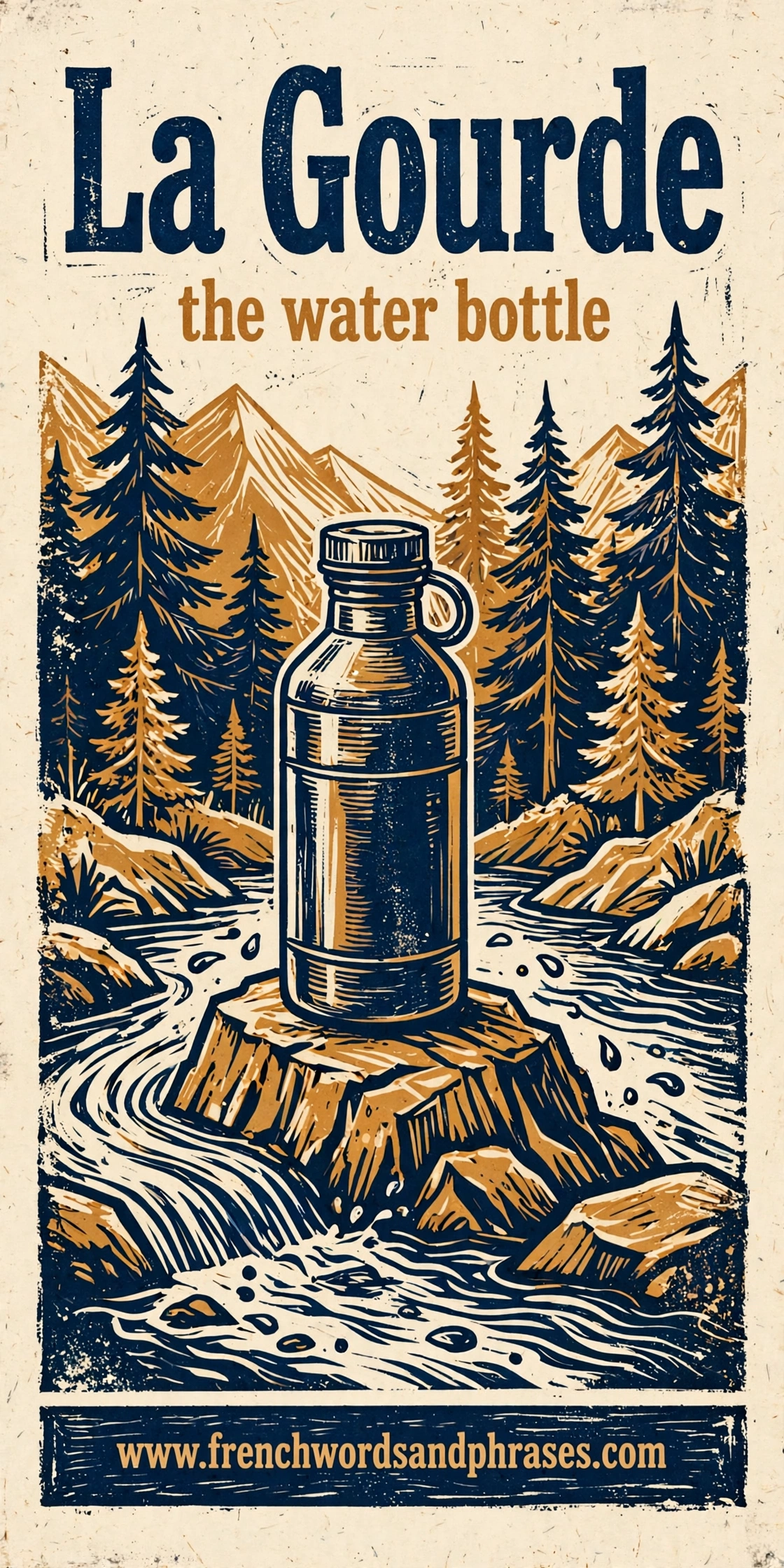
La gourde means the water bottle.
The path climbs away from the village in the midday heat, the cicadas are roaring, and at the first patch of shade everyone reaches for the same thing in their bag — la gourde, the water bottle, the hiker’s best friend.
In this guide, you’ll learn what gourde means in English, how to use it with its articles, how to form its plural, and how it appears in everyday French. Explore French examples, English translations, and practice quizzes.
Understanding the French Noun Gourde
Gourde is a feminine French noun. It is learned together with its article: la gourde, une gourde. Long before plastic, the gourde was the flask travellers carried — its name comes from the gourd, the hard-skinned fruit hollowed out to carry water. The modern bottle, metal or plastic, kept the old traveller’s name.
It means the water bottle — the reusable bottle you fill at the fountain, clip to your bag and drink from all day: at school, on the hike, at the gym, on the beach. In a country of village fountains and mountain refuges, la gourde is serious equipment: filled in the morning, emptied by the summit, refilled at every source.
Gender: Feminine
Definite article: la — la gourde (the water bottle)
Indefinite article: une — une gourde (a water bottle)
Plural: les gourdes
English equivalents: The water bottle, the flask.
One important usage detail: between friends, une gourde is also a playful word for a silly, clumsy person — quelle gourde ! is what you say, laughing, when someone locks the keys in the car. It is teasing, never truly cruel, and it only ever describes people, never bottles. Context and tone tell you which gourde you are holding.
Experience the Word
Gourde is more than a bottle. It is the sound of a hot day survived — the glug at the fountain, the first cold mouthful at the top of the climb.
Imagine the fountain in the village square: the gourde held under the spout, the water splashing over your hands, the bottle beaded with cold before it goes back in the bag, twice as heavy and ten times as precious.
You have not just filled a bottle. You have laid in supplies for the whole afternoon.
How to Use Gourde in French: Complete Guide
Let’s explore how gourde works in French, beginning with its articles.
Gourde with the Definite Article (La, Les)
Used for the water bottle everyone in the conversation knows — yours, hanging from your bag.
| Number | French |
|---|---|
| Singular | la gourde |
| Plural | les gourdes |
Example
La gourde est accrochée au sac à dos.
The water bottle is clipped to the backpack.
Gourde with the Indefinite Article (Une, Des)
Used for a water bottle in general — the one you buy at the sports shop, the one you lend to a thirsty friend.
| Number | French |
|---|---|
| Singular | une gourde |
| Plural | des gourdes |
Example
Elle achète une gourde pour la randonnée.
She buys a water bottle for the hike.
Gourde and the Partitive (De l’eau, Des)
Here the partitive belongs to what goes inside: de l’eau, some water, the gourde’s whole purpose. The plural des gourdes is for the bottles themselves.
| Form | French |
|---|---|
| Some water (the contents) | de l’eau |
| Some bottles | des gourdes |
Example
Il reste de l’eau dans ma gourde, bois si tu as soif.
There is some water left in my bottle, drink if you are thirsty.
Quick Quiz 1
A hiker asks at the fountain: « Je peux remplir ma gourde ? » What does he want to do?
Reveal the answer
Fill his water bottle — remplir sa gourde, the first ritual of every walk.
La fontaine est là-bas, remplis ta gourde.
The fountain is over there, fill your bottle.
The Plural of Gourde
Gourde adds an -s in the plural — les gourdes, one per hiker, lined up by the fountain.
| Number | French |
|---|---|
| Singular | la gourde |
| Plural | les gourdes |
Example
Les gourdes des enfants sont toutes de couleurs différentes.
The children’s water bottles are all different colours.
Gourde with Possessive Adjectives (Ma, Ta, Sa…)
Possessives agree with the noun, not with the owner — and gourde is feminine, so it takes ma, ta, sa.
| Owner | French |
|---|---|
| my | ma gourde |
| your (tu) | ta gourde |
| his / her | sa gourde |
| our | notre gourde |
| your (vous) | votre gourde |
| their | leur gourde |
Example
J’ai oublié ma gourde à la maison, je vais mourir de soif.
I forgot my water bottle at home, I am going to die of thirst.
Quick Quiz 2
Complete the sentence:
______ gourde est vide, je la remplis à la fontaine. (My)
Reveal the answer
Ma
Ma gourde est vide, je la remplis à la fontaine.
My water bottle is empty, I am filling it at the fountain.
Gourde with Demonstrative Adjectives (Cette, Ces)
Used to point: this water bottle here, those water bottles there.
| Number | French |
|---|---|
| Singular | cette gourde |
| Plural | ces gourdes |
Example
Cette gourde garde l’eau fraîche toute la journée.
This water bottle keeps water cool all day.
Gourde with Adjectives
Adjectives agree with gourde, feminine — pleine, vide, isotherme.
| Adjective | With Gourde |
|---|---|
| pleine (full) | une gourde pleine |
| vide (empty) | une gourde vide |
| isotherme (insulated) | une gourde isotherme |
| légère (light) | une gourde légère |
| en métal (metal) | une gourde en métal |
Example
Une gourde isotherme bien pleine, et la randonnée peut commencer.
A well-filled insulated bottle, and the hike can begin.
Quick Quiz 3
Complete the sentence:
Je cherche une gourde ______. (insulated)
Reveal the answer
isotherme
Je cherche une gourde isotherme.
I am looking for an insulated water bottle.
Everyday Expressions with Gourde
Filling, drinking and the playful insult — the gourde phrases of daily life.
| Expression | In English |
|---|---|
| remplir sa gourde | to fill your water bottle |
| boire à la gourde | to drink from the bottle |
| une gourde isotherme | an insulated water bottle |
| une gourde d’un litre | a one-litre bottle |
| accrocher sa gourde au sac | to clip your bottle to your bag |
| quelle gourde ! | what a silly thing to do! (playful, about a person) |
Example
Remplis ta gourde avant de partir, il n’y a pas d’eau sur le chemin.
Fill your bottle before leaving, there is no water on the way.
Words from the Same Family as Gourde
Water, thirst and fountains — the words that travel with gourde.
| French | In English |
|---|---|
| l’eau | water |
| boire | to drink |
| remplir | to fill |
| la soif | thirst |
| le bouchon | the cap, the stopper |
| la fontaine | the fountain |
Example
Après deux heures de marche, nous avons tous soif.
After two hours of walking, we are all thirsty.
Quick Quiz 4
Your friend locks the car keys inside the car, and everyone laughs: « Quelle gourde ! » Are they talking about a bottle?
Reveal the answer
No — it is the playful insult: une gourde, between friends, is a silly, clumsy person. Said with a laugh, it stings no more than a splash of water.
Ne t’inquiète pas, ça arrive à tout le monde, ma gourde.
Do not worry, it happens to everyone, you silly thing.
Gourde in Everyday French: Real-Life Examples
Now that you know the word, let’s see how gourde appears in everyday French.
Example 1 — At the fountain
Je remplis ma gourde à la fontaine du village.
I fill my water bottle at the village fountain.
Example 2 — Before the hike
Chacun prend sa gourde et son chapeau.
Everyone takes their water bottle and their hat.
Example 3 — On the path
Bois un peu d’eau de ta gourde, il fait très chaud.
Drink some water from your bottle, it is very hot.
Example 4 — At school
Les enfants posent leurs gourdes près de la porte.
The children put their water bottles by the door.
Example 5 — Forgotten
J’ai oublié ma gourde dans le train, quel dommage.
I forgot my water bottle on the train, what a shame.
Example 6 — The playful tease
Tu as mis ton passeport dans la valise fermée ? Quelle gourde !
You put your passport in the locked suitcase? What a silly thing to do!
See la gourde in a story: Holiday Objects: French Vocabulary (Les Objets de Vacances) — packing for a beach and camping holiday.
Beyond Translation: The Meaning of Gourde
La gourde is one of the oldest objects in travel: Roman soldiers carried one, pilgrims carried one, and the French word still smells of leather, cork and spring water. The modern sports bottle — steel, insulated, clipped to every schoolbag in the country — is the same object in new clothes, and French schoolchildren would no more leave theirs behind than their shoes.
To say la gourde is to hear the fountain splash.
It evokes hot paths, cold water, and the friend who forgot theirs, drinking from yours all the way home.
How to Remember the French Noun Gourde
Remember it this way: Gourde is the water bottle — feminine, with la and une, filled at fountains and teased about between friends.
- You fill it at the fountain — remplir sa gourde, feminine with la.
- You drink from it — boire à la gourde on the hot path.
- You laugh at the other one — quelle gourde !, the playful insult for a silly friend.
The key idea is la gourde you fill — la gourde you tease.
Test Your Knowledge of Gourde
Let’s see how much you’ve learned. Try answering these questions before revealing the answers.
Question 1
Is gourde masculine or feminine?
Reveal the answer
Feminine — la gourde, une gourde.
Question 2
What does remplir sa gourde mean?
Reveal the answer
To fill your water bottle — the first ritual of every hike.
Question 3
Translate: I fill my water bottle at the fountain.
Reveal the answer
Je remplis ma gourde à la fontaine.
Question 4
What does « Quelle gourde ! » mean between friends?
Reveal the answer
What a silly thing to do! — a playful tease for a clumsy friend, never a real insult.
Question 5
Complete the sentence:
Il reste de l’eau dans ______ gourde. (my)
Reveal the answer
ma
Il reste de l’eau dans ma gourde.
There is some water left in my bottle.
Your Final Challenge
Can You Use It?
How would you say this in French?
“Fill your water bottle before leaving, there is no water on the way.”
Reveal the answer
Remplis ta gourde avant de partir, il n’y a pas d’eau sur le chemin.
Fill your water bottle before leaving, there is no water on the way.
A little French. A little curiosity. A richer everyday life.
LEARN FRENCH ONE WORD AT A TIME




