A French Word to Live By
Translate Carte to English
/kaʁt/
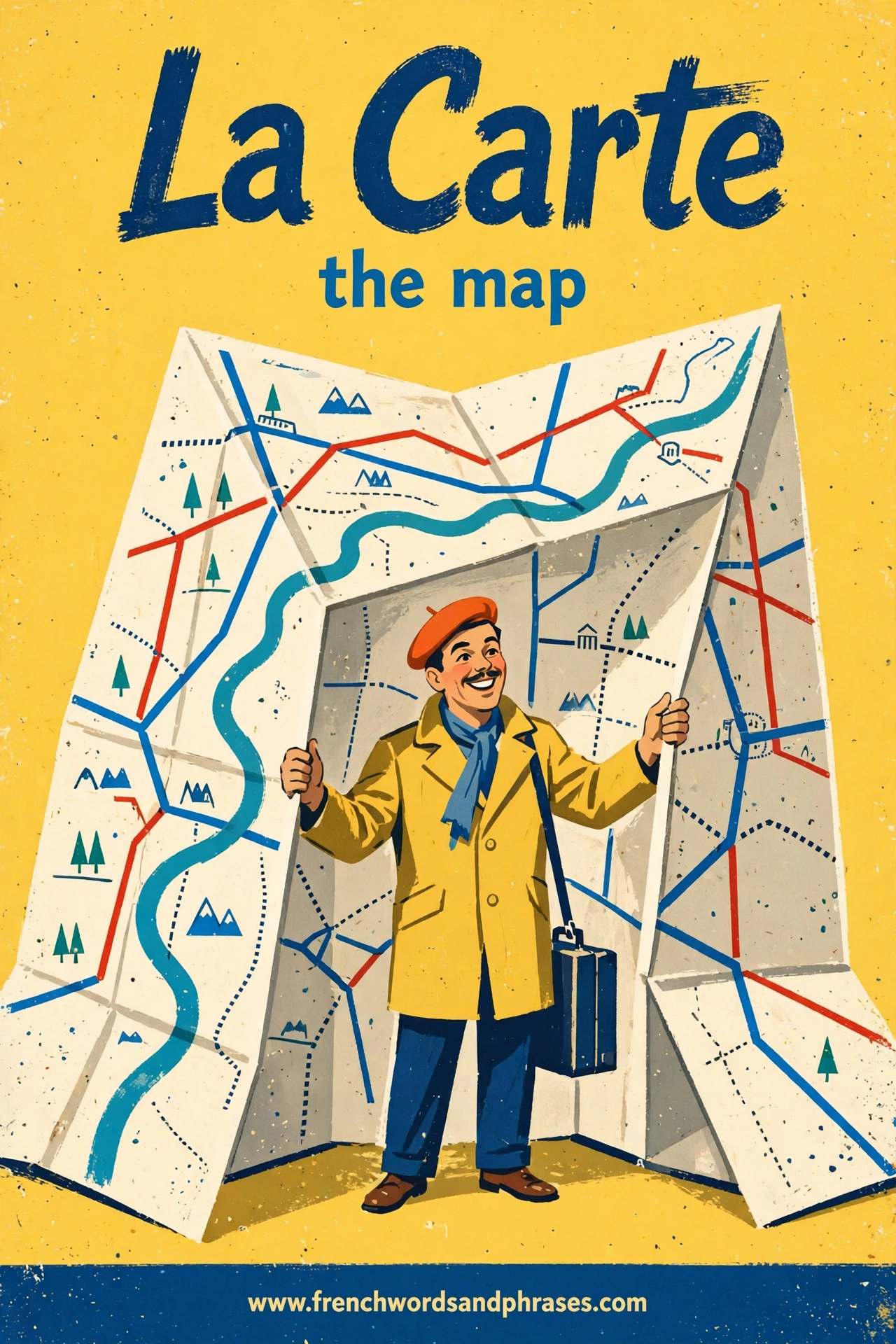
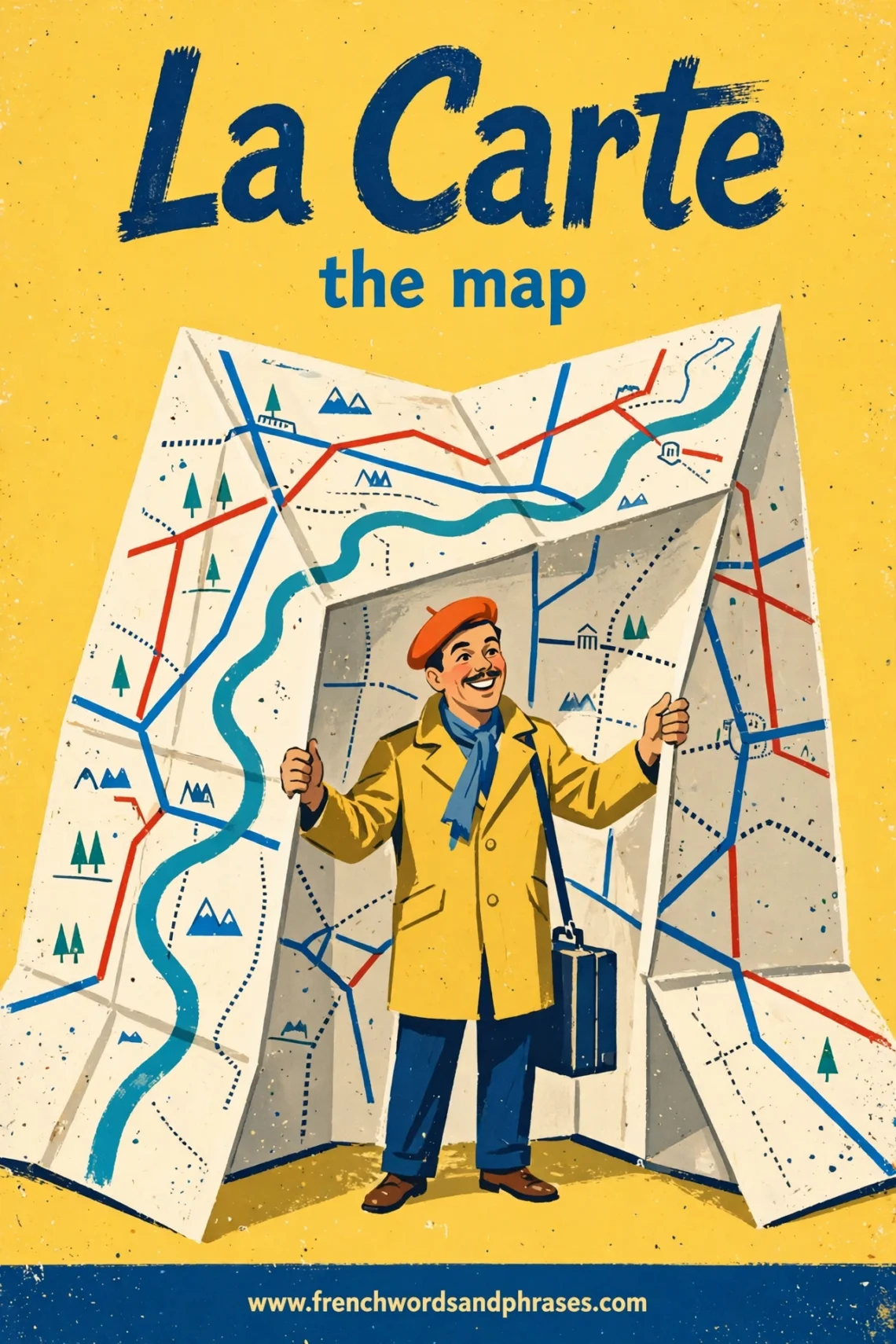
La carte means the map.
The car is parked at the side of a country road, the bonnet is warm, and a great paper sheet is unfolded across it, flapping in the wind while two people bend over it — la carte, the map, spread out to answer the oldest holiday question: where are we, and which way now?
In this guide, you’ll learn what carte means in English, how to use it with its articles, how to form its plural, and how it appears in everyday French. Explore French examples, English translations, and practice quizzes.
Understanding the French Noun Carte
Carte is a feminine French noun. It is learned together with its article: la carte, une carte. This page teaches one sense only — la carte the map: the folded paper sheet, the road atlas, the drawing of a place that lets you find your way. (The same word has other lives, as a card or a menu; those live on their own page.)
It means the map — the sheet you unfold on the car bonnet, the page of the road atlas, the plan of a town pinned up at the tourist office. On holiday, la carte is the traveller’s oldest tool: it shows the roads, the rivers and the little villages no motorway sign will ever name, and it never runs out of battery.
Gender: Feminine
Definite article: la — la carte (the map)
Indefinite article: une — une carte (a map)
Plural: les cartes
English equivalents: The map — on this page, only the map: road maps, folding maps, town plans.
One important usage detail: this page is about la carte the map only. The same word also means a card and the menu in a restaurant, and those senses have their own page on this site. Here, keep to the traveller’s carte: une carte routière is a road map, and lire une carte — to read a map — is the skill this page is built around.
Experience the Word
Carte is more than a sheet of paper. It is the whole journey visible at once — every road you might take, spread out in front of you like a promise.
Imagine the folding ritual at the kitchen table the night before departure: the map opened to its full, glorious size, the route traced with a finger, the stops circled in pencil — and then the eternal struggle to fold it back along its original creases.
You have not just found the road. You have seen the whole country at a glance.
How to Use Carte in French: Complete Guide
Let’s explore how carte works in French — the map, and only the map — beginning with its articles.
Carte with the Definite Article (La, Les)
Used for the map everyone in the conversation knows — the one unfolded on the bonnet, the one in the glove box.
| Number | French |
|---|---|
| Singular | la carte |
| Plural | les cartes |
Example
La carte est dans la boîte à gants.
The map is in the glove box.
Carte with the Indefinite Article (Une, Des)
Used for a map in general — the one you buy at the service station, the one the tourist office gives you.
| Number | French |
|---|---|
| Singular | une carte |
| Plural | des cartes |
Example
Elle achète une carte de la région à la station-service.
She buys a map of the region at the service station.
Carte with the Partitive Article (De la, Des)
The partitive means some or any. With a countable traveller’s tool like the map, you will mostly meet its plural form, des — maps of everywhere, in every drawer of the holiday house.
| Number | French |
|---|---|
| Singular | de la carte |
| Plural | des cartes |
Example
Nous avons des cartes de toute la région dans le tiroir.
We have maps of the whole region in the drawer.
Quick Quiz 1
What is une carte routière?
Reveal the answer
A road map — la carte of the roads, the driver’s map, from la route, the road.
La carte routière montre toutes les petites routes du pays.
The road map shows all the little roads of the country.
The Plural of Carte
Carte adds an -s in the plural — les cartes, a drawer full of journeys past and future.
| Number | French |
|---|---|
| Singular | la carte |
| Plural | les cartes |
Example
Les cartes des anciennes vacances remplissent un tiroir.
The maps from past holidays fill a drawer.
Carte with Possessive Adjectives (Ma, Ta, Sa…)
Possessives agree with the noun, not with the owner — and carte is feminine, so it takes ma, ta, sa.
| Owner | French |
|---|---|
| my | ma carte |
| your (tu) | ta carte |
| his / her | sa carte |
| our | notre carte |
| your (vous) | votre carte |
| their | leur carte |
Example
Je garde toujours ma carte dans la portière.
I always keep my map in the door pocket.
Quick Quiz 2
Complete the sentence:
______ carte est déchirée au niveau du pli. (My)
Reveal the answer
Ma
Ma carte est déchirée au niveau du pli.
My map is torn along the fold.
Carte with Demonstrative Adjectives (Cette, Ces)
Used to point: this map here, those maps there.
| Number | French |
|---|---|
| Singular | cette carte |
| Plural | ces cartes |
Example
Cette carte est trop vieille, les routes ont changé.
This map is too old, the roads have changed.
Carte with Adjectives
Adjectives agree with carte, feminine — détaillée, ancienne, pliée.
| Adjective | With Carte |
|---|---|
| détaillée (detailed) | une carte détaillée |
| ancienne (old) | une carte ancienne |
| pliée (folded) | une carte pliée |
| routière (road) | une carte routière |
| grande (large) | une grande carte |
Example
Une carte détaillée vaut mieux qu’un téléphone sans batterie.
A detailed map is worth more than a phone with no battery.
Quick Quiz 3
Complete the sentence:
Je cherche une carte bien ______. (detailed)
Reveal the answer
détaillée
Je cherche une carte bien détaillée.
I am looking for a really detailed map.
Everyday Expressions with Carte
Unfolding, reading and getting your bearings — the map phrases of daily travel life.
| Expression | In English |
|---|---|
| lire une carte | to read a map |
| déplier une carte | to unfold a map |
| une carte routière | a road map |
| se repérer sur la carte | to get your bearings on the map |
| suivre un itinéraire | to follow a route |
| replier une carte | to fold a map back up |
Example
Déplie la carte, je veux voir où nous sommes.
Unfold the map, I want to see where we are.
Words from the Same Family as Carte
Roads, routes and compass points — the words that travel with carte the map.
| French | In English |
|---|---|
| l’itinéraire | the route, the itinerary |
| la route | the road |
| le nord | north |
| l’échelle | the scale (of a map) |
| se repérer | to get your bearings |
| le chemin | the way, the path |
Example
Sur la carte, le nord est presque toujours en haut.
On the map, north is almost always at the top.
Quick Quiz 4
The driver pulls over and says: « Je ne sais plus où nous sommes, passe-moi la carte. » What does he want?
Reveal the answer
The map — la carte the traveller’s sheet, to read the roads and get his bearings. On this page, la carte is always the map.
Tiens, la carte est dépliée sur la bonne page.
Here, the map is open at the right page.
Carte in Everyday French: Real-Life Examples
Now that you know the word, let’s see how carte appears in everyday French.
Example 1 — On the road
Déplie la carte, nous cherchons la prochaine sortie.
Unfold the map, we are looking for the next exit.
Example 2 — At the tourist office
La dame nous donne une carte de la ville.
The lady gives us a map of the town.
Example 3 — Planning
Le soir, nous traçons l’itinéraire sur la carte.
In the evening, we trace the route on the map.
Example 4 — Getting bearings
Je me repère sur la carte grâce à la rivière.
I get my bearings on the map thanks to the river.
Example 5 — The folding struggle
Impossible de replier cette carte comme avant !
Impossible to fold this map back the way it was!
Example 6 — No battery
Le téléphone est mort, heureusement nous avons la carte.
The phone is dead, luckily we have the map.
See la carte in a story: Holiday Objects: French Vocabulary (Les Objets de Vacances) — packing for a beach and camping holiday.
Beyond Translation: The Meaning of Carte
Before screens, la carte was the journey. French families kept the great folded road maps of the national publisher in every glove box, and reading one — following the thin red roads, judging distances by l’échelle, finding the village between two rivers — was a skill passed from parent to child in the passenger seat. The screens won the dashboard, but the paper map keeps one crown: it shows you not just the route, but everything around it.
To say la carte is to unfold the whole country.
It evokes pencil circles round villages, arguments at crossroads, and the map refolded wrong, gloriously wrong, for the hundredth time.
How to Remember the French Noun Carte
Remember it this way: Carte on this page is the map — feminine, with la and une, the folded sheet that finds the road when the phone gives up.
- You unfold it on the bonnet — la carte, feminine with une.
- You read it — lire une carte, the passenger’s great skill.
- You keep to this page’s sense — the map; the card and the menu live elsewhere.
The key idea is la carte you unfold — la route you find.
Test Your Knowledge of Carte
Let’s see how much you’ve learned. Try answering these questions before revealing the answers.
Question 1
Is carte masculine or feminine?
Reveal the answer
Feminine — la carte, une carte.
Question 2
What is une carte routière?
Reveal the answer
A road map — the map of the roads, for drivers.
Question 3
Translate: Unfold the map, I want to see where we are.
Reveal the answer
Déplie la carte, je veux voir où nous sommes.
Question 4
What does se repérer sur la carte mean?
Reveal the answer
To get your bearings on the map — to work out where you are.
Question 5
Complete the sentence:
La carte est dans ______ boîte à gants. (the)
Reveal the answer
la
La carte est dans la boîte à gants.
The map is in the glove box.
Your Final Challenge
Can You Use It?
How would you say this in French?
“The phone is dead, luckily we have the map.”
Reveal the answer
Le téléphone est mort, heureusement nous avons la carte.
The phone is dead, luckily we have the map.
A little French. A little curiosity. A richer everyday life.
LEARN FRENCH ONE WORD AT A TIME