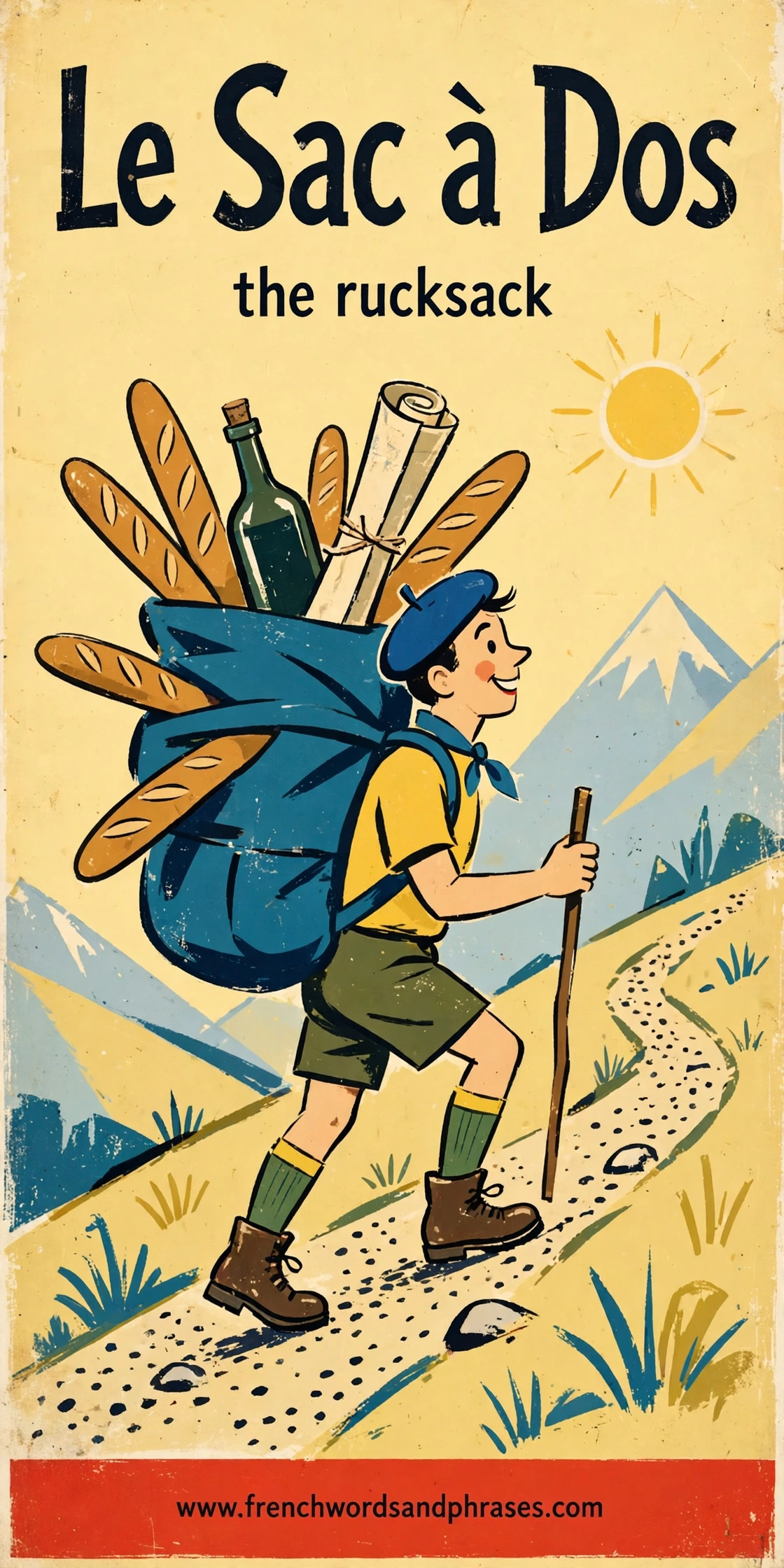
A French Word to Live By
Translate Sac à dos to English
/sa.ka.do/
Le sac à dos means the rucksack.
Seven in the morning at the foot of the mountain path: straps adjusted, water bottle in the side pocket, the day carried on two shoulders — le sac à dos, the rucksack, the bag that goes where wheels cannot.
In this guide, you’ll learn what sac à dos means in English, how to use it with its articles, how to form its plural, and how it appears in everyday French. Explore French examples, English translations, and practice quizzes.
Understanding the French Noun Sac à dos
Sac à dos is a masculine French noun phrase. It is learned together with its article: le sac à dos, un sac à dos. The head word is sac, a bag, and à dos says where it rides: on the back. Schoolchildren, hikers and travellers all live out of one.
It means the rucksack, the backpack — the two-strapped bag carried on the back. In France it is the schoolbag of every écolier, the hiker’s house on the mountain paths, and the young traveller’s whole wardrobe on a summer of trains. Its straps are les bretelles, a word it shares with braces and shoulder straps everywhere.
Gender: Masculine
Definite article: le — le sac à dos (the rucksack)
Indefinite article: un — un sac à dos (a rucksack)
Plural: les sacs à dos
English equivalents: The rucksack, the backpack.
One important usage detail: only sac takes the plural — les sacs à dos, never « les sacs à doss ». The à dos part is fixed. The same pattern runs through French: des sacs de couchage, sleeping bags, plural on the first word only.
Experience the Word
Sac à dos is more than a bag. It is freedom measured in litres — everything you own for the journey, riding between your shoulder blades.
Imagine the school gate in September: a hundred small backs bent cheerfully under new sacs à dos, each one heavier than its owner would admit.
You have not just carried a bag. You have carried your day on your back, hands free for the world.
How to Use Sac à dos in French: Complete Guide
Let’s explore how sac à dos works in French, beginning with its articles.
Sac à dos with the Definite Article (Le, Les)
Used for the rucksack everyone in the conversation knows — the one by the door, the one on your back.
| Number | French |
|---|---|
| Singular | le sac à dos |
| Plural | les sacs à dos |
Example
Le sac à dos est contre le mur, prêt pour la randonnée.
The rucksack is against the wall, ready for the hike.
Sac à dos with the Indefinite Article (Un, Des)
Used for a rucksack in general — the one you buy for school, the one you borrow for the mountains.
| Number | French |
|---|---|
| Singular | un sac à dos |
| Plural | des sacs à dos |
Example
Il achète un sac à dos pour la rentrée.
He is buying a rucksack for the new school term.
Sac à dos and the Partitive (Du, De, Des)
A rucksack is counted, not scooped — so the partitive steps aside for un and des, and plain de appears after a negation.
| Form | French |
|---|---|
| One | un sac à dos |
| Some (plural) | des sacs à dos |
| None — after ne… pas | pas de sac à dos |
| After a number | deux sacs à dos |
Example
Je n’ai pas de sac à dos assez grand pour la montagne.
I don’t have a rucksack big enough for the mountains.
Quick Quiz 1
What is wrong with « les sacs à doss »?
Reveal the answer
The -s goes on sac only — à dos never changes: les sacs à dos.
Les sacs à dos des élèves sont dans le couloir.
The pupils’ rucksacks are in the corridor.
The Plural of Sac à dos
Only sac takes the -s — les sacs à dos, a whole class of them hanging on their hooks.
| Number | French |
|---|---|
| Singular | le sac à dos |
| Plural | les sacs à dos |
Example
Les sacs à dos des randonneurs sont alignés devant le refuge.
The hikers’ rucksacks are lined up in front of the refuge.
Sac à dos with Possessive Adjectives (Mon, Ton, Son…)
Possessives agree with the noun, not with the owner — and sac is masculine, so it takes mon, ton, son.
| Owner | French |
|---|---|
| my | mon sac à dos |
| your (tu) | ton sac à dos |
| his / her | son sac à dos |
| our | notre sac à dos |
| your (vous) | votre sac à dos |
| their | leur sac à dos |
Example
Mon sac à dos contient tout pour trois jours.
My rucksack holds everything for three days.
Quick Quiz 2
Complete the sentence:
______ sac à dos est plus lourd que le mien. (Your — tu)
Reveal the answer
Ton
Ton sac à dos est plus lourd que le mien.
Your rucksack is heavier than mine.
Sac à dos with Demonstrative Adjectives (Ce, Ces)
Used to point: this rucksack here, those rucksacks there.
| Number | French |
|---|---|
| Singular | ce sac à dos |
| Plural | ces sacs à dos |
Example
Ce sac à dos a traversé trois pays avec moi.
This rucksack has crossed three countries with me.
Sac à dos with Adjectives
Adjectives agree with sac, masculine — lourd, léger, plein.
| Adjective | With Sac à dos |
|---|---|
| lourd (heavy) | un sac à dos lourd |
| léger (light) | un sac à dos léger |
| plein (full) | un sac à dos plein |
| confortable (comfortable) | un sac à dos confortable |
| étanche (waterproof) | un sac à dos étanche |
Example
Un sac à dos léger rend la marche plus douce.
A light rucksack makes the walking gentler.
Quick Quiz 3
Complete the sentence:
Je cherche un sac à dos ______ pour la pluie. (waterproof)
Reveal the answer
étanche
Je cherche un sac à dos étanche pour la pluie.
I’m looking for a waterproof rucksack for the rain.
Everyday Expressions with Sac à dos
School gates, mountain paths and open roads — the sac à dos phrases of daily life.
| Expression | In English |
|---|---|
| porter un sac à dos | to carry a rucksack |
| partir sac au dos | to set off with your pack on |
| le sac à dos d’écolier | the schoolchild’s satchel-rucksack |
| charger son sac à dos | to load up your rucksack |
| un sac à dos de randonnée | a hiking rucksack |
| les bretelles du sac | the straps of the bag |
Example
Ils sont partis sac au dos pour un mois de voyage.
They set off with their packs on for a month of travelling.
Words from the Same Family as Sac à dos
Backs, straps and footpaths — the words that travel with sac à dos.
| French | In English |
|---|---|
| le dos | the back |
| le sac | the bag |
| la randonnée | the hike |
| la bretelle | the strap |
| marcher | to walk |
| le sac de couchage | the sleeping bag |
Example
La randonnée commence, les sacs à dos sont prêts.
The hike is starting, the rucksacks are ready.
Quick Quiz 4
Friends announce: « On part sac au dos ! » What are they doing?
Reveal the answer
Setting off backpacking — sac au dos, pack on back, is the classic French picture of travelling light and free.
On part sac au dos, sans plan et sans hôtel.
We’re off backpacking, with no plan and no hotel.
Sac à dos in Everyday French: Real-Life Examples
Now that you know the word, let’s see how sac à dos appears in everyday French.
Example 1 — School morning
Les enfants prennent leurs sacs à dos et courent à l’école.
The children grab their rucksacks and run to school.
Example 2 — In the mountains
Son sac à dos contient de l’eau, du pain et une carte.
His rucksack holds water, bread and a map.
Example 3 — Travelling light
Nous voyageons avec un seul sac à dos chacun.
We travel with just one rucksack each.
Example 4 — Too heavy
Ton sac à dos est trop lourd pour un enfant.
Your rucksack is too heavy for a child.
Example 5 — Setting off
Ils partent sac au dos pour traverser les Pyrénées.
They set off with their packs on to cross the Pyrenees.
Example 6 — At the refuge
Pose ton sac à dos près de la porte du refuge.
Put your rucksack down near the refuge door.
See le sac à dos in a story: Holiday Objects: French Vocabulary (Les Objets de Vacances) — packing for a beach and camping holiday.
Beyond Translation: The Meaning of Sac à dos
The sac à dos is the bag of French beginnings: the first day of school, the first mountain, the first summer of trains with a pass and no plan. Partir sac au dos is a small philosophy in four words — own little, carry it yourself, and let the road decide.
To say sac à dos is to travel the French way: on foot, hands free, everything on your back.
It evokes the school gate at eight in the morning, the refuge at dusk, and the straps that have outlasted three summers of roads.
How to Remember the French Noun Sac à dos
Remember it this way: Sac à dos is the rucksack — masculine, with le and un, plural on sac only, the bag of schoolchildren, hikers and free travellers.
- You carry it on your back — le sac à dos, masculine with un.
- You pluralise carefully — les sacs à dos, the -s on sac alone.
- You set off with it — partir sac au dos, the backpacker’s motto.
The key idea is le sac à dos on your back — les sacs à dos on the road.
Test Your Knowledge of Sac à dos
Let’s see how much you’ve learned. Try answering these questions before revealing the answers.
Question 1
Is sac à dos masculine or feminine?
Reveal the answer
Masculine — le sac à dos, un sac à dos.
Question 2
What is the plural of le sac à dos?
Reveal the answer
Les sacs à dos — only sac takes the -s; à dos never changes.
Question 3
Translate: He leaves at dawn with his rucksack.
Reveal the answer
Il part à l’aube avec son sac à dos.
Question 4
What are les bretelles?
Reveal the answer
The straps — the shoulder straps of the rucksack.
Question 5
Complete the sentence:
______ sac à dos est étanche. (My)
Reveal the answer
Mon
Mon sac à dos est étanche.
My rucksack is waterproof.
Your Final Challenge
Can You Use It?
How would you say this in French?
“He leaves at dawn with his rucksack on his back.”
Reveal the answer
Il part à l’aube, son sac à dos sur le dos.
He leaves at dawn with his rucksack on his back.
A little French. A little curiosity. A richer everyday life.
LEARN FRENCH ONE WORD AT A TIME