A French Word to Live By
Translate Valise to English
/va.liz/
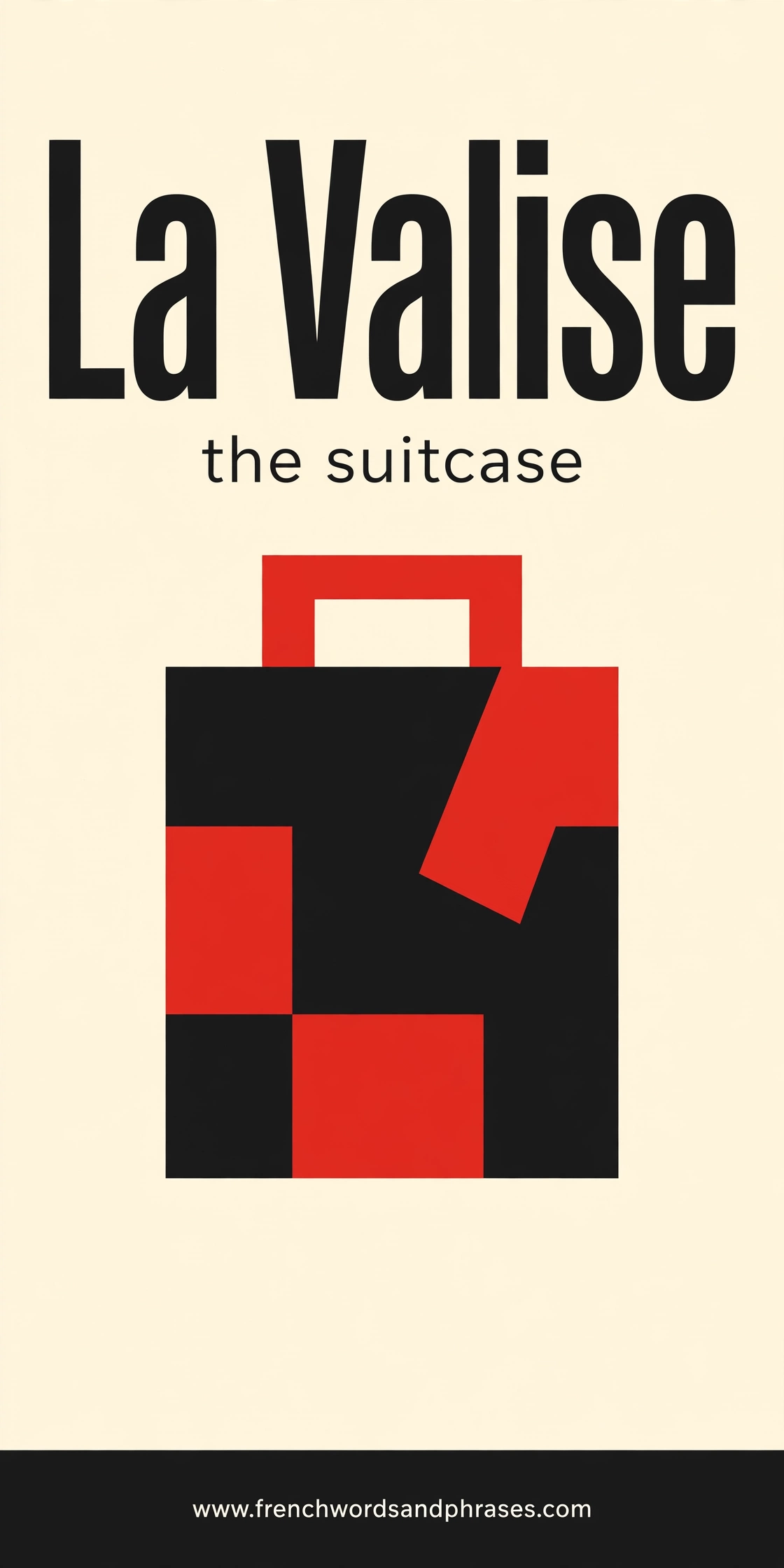
La valise means the suitcase.
The night before departure: the case lies open on the bed, clothes folded into careful towers, and one sweater still being argued over — la valise, the suitcase, the box every holiday must fit inside.
In this guide, you’ll learn what valise means in English, how to use it with its articles, how to form its plural, and how it appears in everyday French. Explore French examples, English translations, and practice quizzes.
Understanding the French Noun Valise
Valise is a feminine French noun. It is learned together with its article: la valise, une valise. It names the traveller’s case — and in French it leads a double life, because the verb that goes with it, faire sa valise, simply means to pack.
It means the suitcase — hard or soft, carried or wheeled, stuffed the night before and sat on to close. French distinguishes la grande valise for the hold from la valise cabine, the cabin case. And when the journey ends, défaire sa valise, to unpack, is the small sad ceremony of coming home.
Gender: Feminine
Definite article: la — la valise (the suitcase)
Indefinite article: une — une valise (a suitcase)
Plural: les valises
English equivalents: The suitcase; faire sa valise — to pack.
One important usage detail: the suitcase generates two everyday idioms. Poser ses valises — to put your suitcases down — means to settle somewhere for good. And avoir des valises sous les yeux — to have suitcases under your eyes — is the vivid French way of saying someone has bags under their eyes after a short night.
Experience the Word
Valise is more than luggage. It is the measure of a trip — everything you need, reduced to what one person can carry.
Imagine the platform at the end of the line: the case heavier than when you left, its corners scuffed, a sticker from somewhere sunny still holding on.
You have not just carried a case. You have carried home proof that you went.
How to Use Valise in French: Complete Guide
Let’s explore how valise works in French, beginning with its articles.
Valise with the Definite Article (La, Les)
Used for the suitcase everyone in the conversation knows — the one by the door, the one on the bed.
| Number | French |
|---|---|
| Singular | la valise |
| Plural | les valises |
Example
La valise est près de la porte, prête à partir.
The suitcase is by the door, ready to go.
Valise with the Indefinite Article (Une, Des)
Used for a suitcase in general — the one you buy, the one you borrow.
| Number | French |
|---|---|
| Singular | une valise |
| Plural | des valises |
Example
Elle achète une valise à roulettes pour le voyage.
She is buying a wheeled suitcase for the trip.
Valise and the Partitive (Du, De, Des)
A suitcase is counted, not scooped — so the partitive steps aside for une and des, and plain de appears after a negation.
| Form | French |
|---|---|
| One | une valise |
| Some (plural) | des valises |
| None — after ne… pas | pas de valise |
| After a number | deux valises |
Example
Je n’ai pas de valise assez grande pour ce voyage.
I don’t have a suitcase big enough for this trip.
Quick Quiz 1
What does faire sa valise mean?
Reveal the answer
To pack — literally, to do your suitcase. Its mirror, défaire sa valise, is to unpack.
Je fais ma valise ce soir, je pars demain.
I’m packing tonight, I leave tomorrow.
The Plural of Valise
Valise adds an -s in the plural — les valises, the whole family’s cases lined up in the hall.
| Number | French |
|---|---|
| Singular | la valise |
| Plural | les valises |
Example
Les valises des enfants sont déjà dans la voiture.
The children’s suitcases are already in the car.
Valise with Possessive Adjectives (Ma, Ta, Sa…)
Possessives agree with the noun, not with the owner — and valise is feminine, so it takes ma, ta, sa.
| Owner | French |
|---|---|
| my | ma valise |
| your (tu) | ta valise |
| his / her | sa valise |
| our | notre valise |
| your (vous) | votre valise |
| their | leur valise |
Example
Ma valise est trop lourde, je dois enlever des affaires.
My suitcase is too heavy, I have to take some things out.
Quick Quiz 2
Complete the sentence:
______ valise ne ferme plus, elle est trop pleine. (His)
Reveal the answer
Sa
Sa valise ne ferme plus, elle est trop pleine.
His suitcase won’t close any more, it is too full — sa agrees with valise, feminine.
Valise with Demonstrative Adjectives (Cette, Ces)
Used to point: this suitcase here, those suitcases there.
| Number | French |
|---|---|
| Singular | cette valise |
| Plural | ces valises |
Example
Cette valise est la mienne, la rouge.
This suitcase is mine, the red one.
Valise with Adjectives
Adjectives agree with valise, feminine — lourde, légère, pleine.
| Adjective | With Valise |
|---|---|
| lourde (heavy) | une valise lourde |
| légère (light) | une valise légère |
| pleine (full) | une valise pleine |
| grande (big) | une grande valise |
| rouge (red) | une valise rouge |
Example
Une valise légère au départ revient toujours lourde.
A light suitcase on the way out always comes back heavy.
Quick Quiz 3
Complete the sentence:
Elle porte une valise très ______. (heavy)
Reveal the answer
lourde
Elle porte une valise très lourde.
She is carrying a very heavy suitcase — lourde, feminine, to agree with valise.
Everyday Expressions with Valise
Packing, settling and short nights — the valise phrases of daily life.
| Expression | In English |
|---|---|
| faire sa valise | to pack (your suitcase) |
| défaire sa valise | to unpack |
| poser ses valises | to settle down somewhere |
| avoir des valises sous les yeux | to have bags under your eyes |
| une valise à roulettes | a wheeled suitcase |
| boucler sa valise | to finish packing, to close up your case |
Example
Après le déménagement, ils ont enfin posé leurs valises.
After the move, they finally settled in.
Words from the Same Family as Valise
Bags, wheels and journeys — the words that travel with valise.
| French | In English |
|---|---|
| le bagage | luggage, baggage |
| la poignée | the handle |
| la roulette | the little wheel |
| le voyage | the journey, the trip |
| la valise cabine | the cabin case |
| voyager | to travel |
Example
La poignée de ma valise est cassée depuis le dernier voyage.
The handle of my suitcase has been broken since the last trip.
Quick Quiz 4
A colleague arrives exhausted and someone jokes: « Tu as des valises sous les yeux ! » What do they mean?
Reveal the answer
She has bags under her eyes — the suitcases are the dark luggage of a short night, not real cases.
Dors un peu, tu as des valises sous les yeux.
Get some sleep, you have bags under your eyes.
Valise in Everyday French: Real-Life Examples
Now that you know the word, let’s see how valise appears in everyday French.
Example 1 — The night before
Je fais ma valise la veille du départ.
I pack my suitcase the night before departure.
Example 2 — At the station
Elle traîne sa valise à roulettes sur le quai.
She drags her wheeled suitcase along the platform.
Example 3 — Too full
Sa valise est si pleine qu’elle doit s’asseoir dessus.
Her suitcase is so full she has to sit on it.
Example 4 — Coming home
En rentrant, je défais ma valise tout de suite.
When I get home, I unpack my suitcase straight away.
Example 5 — Settling down
Ils ont posé leurs valises dans un petit village du sud.
They settled down in a little village in the south.
Example 6 — A short night
Après le vol de nuit, nous avions des valises sous les yeux.
After the night flight, we had bags under our eyes.
See la valise in a story: Holiday Objects: French Vocabulary (Les Objets de Vacances) — packing for a beach and camping holiday.
Beyond Translation: The Meaning of Valise
The valise measures a French life in journeys: the schoolchild’s first trip, the student’s move to a new city, the family’s August departure. French even packs its tiredness into the word — the valises under your eyes are the luggage you never chose to carry.
To say valise is to stand in the hall the night before, deciding what a life needs for two weeks.
It evokes the folded towers of clothes, the zip that barely closes, and the small ceremony of défaire sa valise when the world comes home again.
How to Remember the French Noun Valise
Remember it this way: Valise is the suitcase — feminine, with la and une, packed with faire, unpacked with défaire, and worn under the eyes after a short night.
- You pack it — faire sa valise, feminine with la.
- You settle with it — poser ses valises, to put down roots.
- You wear it tired — des valises sous les yeux, bags under the eyes.
The key idea is la valise you pack — les valises you settle with.
Test Your Knowledge of Valise
Let’s see how much you’ve learned. Try answering these questions before revealing the answers.
Question 1
Is valise masculine or feminine?
Reveal the answer
Feminine — la valise, une valise.
Question 2
What does défaire sa valise mean?
Reveal the answer
To unpack — défaire undoes what faire sa valise did.
Question 3
Translate: She is packing her suitcase tonight.
Reveal the answer
Elle fait sa valise ce soir.
Question 4
What is une valise à roulettes?
Reveal the answer
A wheeled suitcase — roulettes are the little wheels underneath.
Question 5
Complete the sentence:
______ valise est trop lourde. (My)
Reveal the answer
Ma
Ma valise est trop lourde.
My suitcase is too heavy.
Your Final Challenge
Can You Use It?
How would you say this in French?
“She is packing her suitcase the night before the trip.”
Reveal the answer
Elle fait sa valise la veille du départ.
She is packing her suitcase the night before the trip.
A little French. A little curiosity. A richer everyday life.
LEARN FRENCH ONE WORD AT A TIME