A French Word to Live By
Translate Moteur to English
/mɔ.tœʁ/
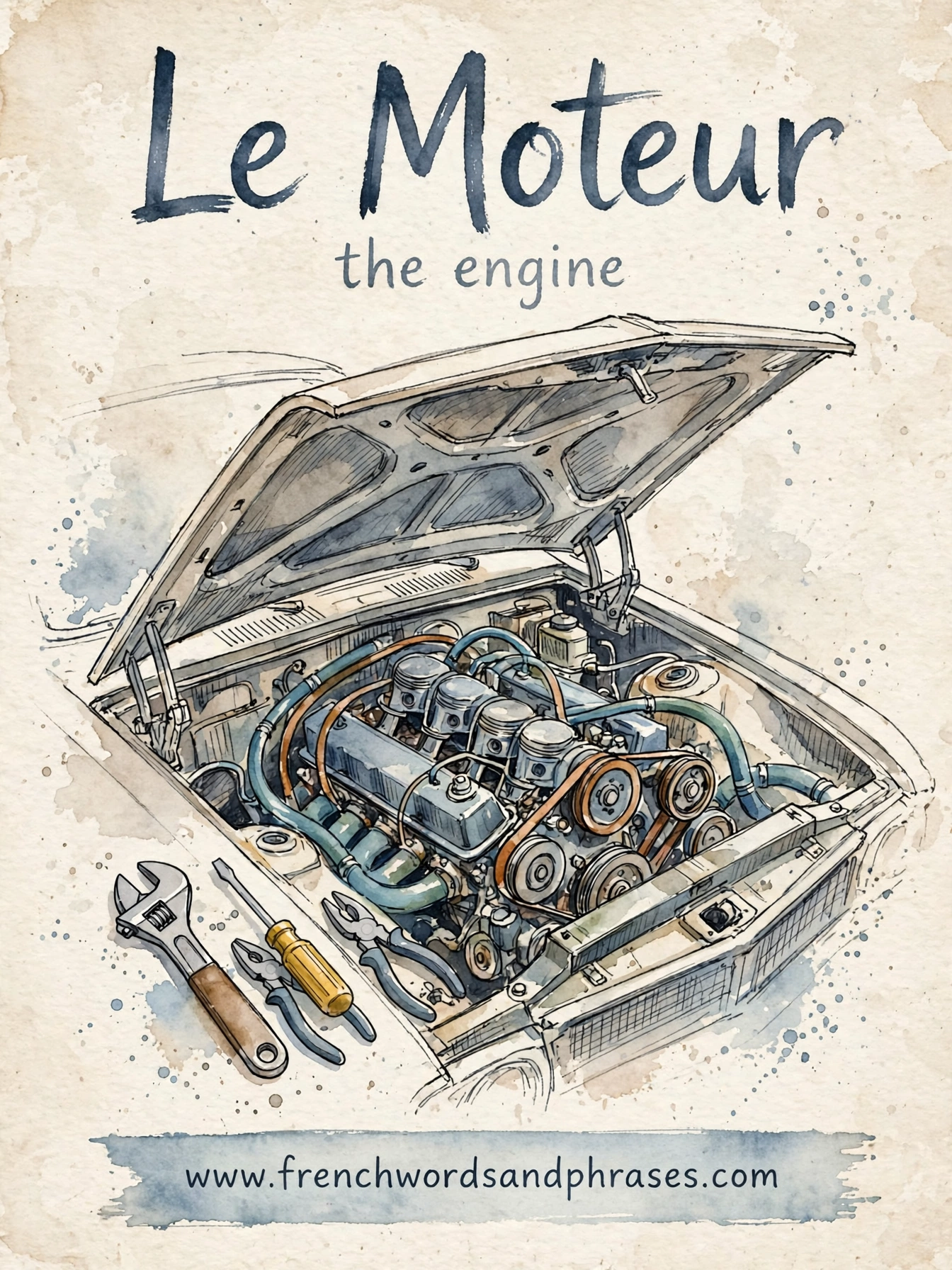
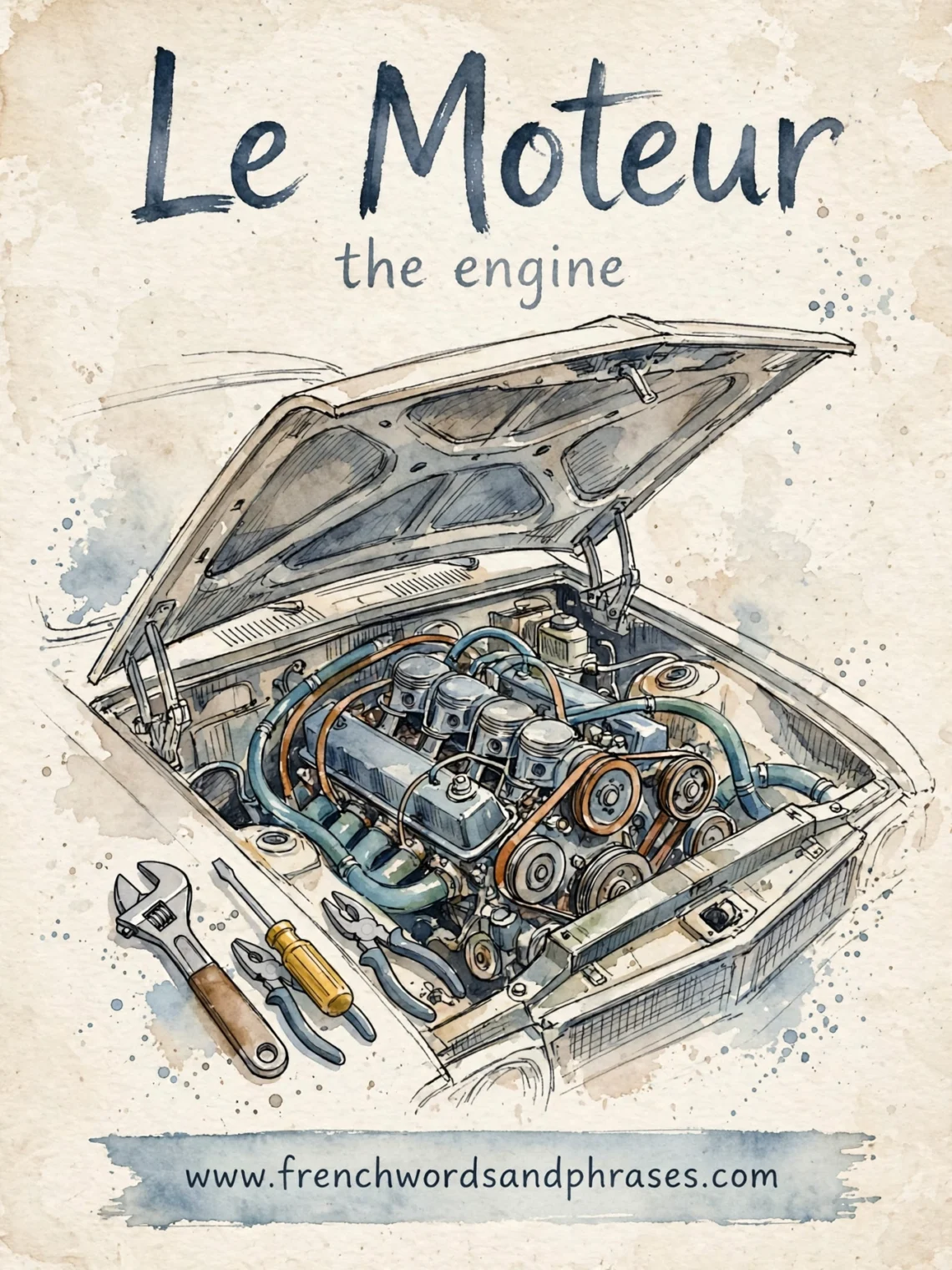
Le moteur means the engine.
A cold morning, a quiet street, one deep breath — then the key turns, something under the bonnet coughs, catches, and settles into a steady hum: le moteur, the engine, the heart of the car, awake for another day.
In this guide, you’ll learn what moteur means in English, how to use it with its articles, how to form its plural, and how it appears in everyday French. Explore French examples, English translations, and practice quizzes.
Understanding the French Noun Moteur
Moteur is a masculine French noun. It is learned together with its article: le moteur, un moteur. It comes from the same family as the Latin motor, the thing that moves — and French uses it for car engines, boat engines, search engines, and anything else that drives a system from inside.
It means the engine — the machine under the bonnet that burns fuel or draws on a battery to turn the wheels. A moteur can be essence (petrol), diesel, électrique or hybride, and its whole life is told in three verbs: démarrer, to start it, tourner, to run, and couper, to switch it off. When it refuses all three, it is en panne — broken down.
Gender: Masculine
Definite article: le — le moteur (the engine)
Indefinite article: un — un moteur (an engine)
Plural: les moteurs
English equivalents: The engine, the motor; figuratively, the driving force of something.
One important usage detail: the moteur has a second, figurative life — le moteur de l’économie, the engine of the economy, le moteur du changement, the driving force of change. On the screen, un moteur de recherche is a search engine. But in the car, keep the verbs straight: démarrer le moteur to start it, le moteur tourne while it runs, couper le moteur to switch it off.
Experience the Word
Moteur is more than a machine. It is the car’s heartbeat — the sound a driver reads like a language, healthy hum or worrying rattle.
Imagine the first start after the garage has finished: the key turns, the moteur catches on the first try and settles into that smooth, even note it had when the car was new.
You have not just started an engine. You have heard the car say it is well again.
How to Use Moteur in French: Complete Guide
Let’s explore how moteur works in French, beginning with its articles.
Moteur with the Definite Article (Le, Les)
Used for the engine everyone in the conversation knows — the one under this bonnet, in this car.
| Number | French |
|---|---|
| Singular | le moteur |
| Plural | les moteurs |
Example
Le moteur de cette voiture est très silencieux.
This car’s engine is very quiet.
Moteur with the Indefinite Article (Un, Des)
Used for an engine in general — the one a model offers, the one an advert boasts about.
| Number | French |
|---|---|
| Singular | un moteur |
| Plural | des moteurs |
Example
Ce modèle a un moteur électrique puissant.
This model has a powerful electric engine.
Moteur with the Partitive Article (Des, De — Some and None)
Count nouns meet the partitive family through des in the plural, de after a negative, and du for a part of the whole machine.
| Situation | French |
|---|---|
| Some (in the plural) | des moteurs |
| None (after a negative) | pas de moteur |
| A lot of them | beaucoup de moteurs |
| Part of the engine | une partie du moteur |
Example
Sans électricité, ce n’est pas un moteur, c’est une sculpture.
Without electricity, it is not an engine, it is a sculpture.
Quick Quiz 1
The driver says: « Le moteur tourne. » Is the car moving?
Reveal the answer
Not necessarily — the engine is running. Tourner is what a healthy moteur does at rest: it idles, it hums, it waits.
Laisse le moteur tourner une minute avant de partir.
Let the engine run for a minute before setting off.
The Plural of Moteur
Moteur adds an -s in the plural — les moteurs, from lawnmowers to locomotives.
| Number | French |
|---|---|
| Singular | le moteur |
| Plural | les moteurs |
Example
Les moteurs électriques sont de plus en plus courants.
Electric engines are becoming more and more common.
Moteur with Possessive Adjectives (Mon, Ton, Son…)
Possessives agree with the noun, not with the owner — and moteur is masculine, so it takes mon, ton, son.
| Owner | French |
|---|---|
| my | mon moteur |
| your (tu) | ton moteur |
| his / her | son moteur |
| our | notre moteur |
| your (vous) | votre moteur |
| their | leur moteur |
Example
Son moteur fait un bruit bizarre depuis hier.
His engine has been making a strange noise since yesterday.
Quick Quiz 2
Complete the sentence:
Coupe ______ moteur, nous sommes arrivés. (your, tu form)
Reveal the answer
ton
Coupe ton moteur, nous sommes arrivés.
Switch your engine off, we have arrived.
Moteur with Demonstrative Adjectives (Ce, Ces)
Used to point: this engine here, those engines there.
| Number | French |
|---|---|
| Singular | ce moteur |
| Plural | ces moteurs |
Example
Ce moteur diesel consomme très peu.
This diesel engine uses very little fuel.
Moteur with Adjectives
Adjectives agree with moteur, masculine — puissant, silencieux, électrique.
| Adjective | With Moteur |
|---|---|
| puissant (powerful) | un moteur puissant |
| électrique (electric) | un moteur électrique |
| diesel (diesel) | un moteur diesel |
| silencieux (quiet) | un moteur silencieux |
| en panne (broken down) | un moteur en panne |
Example
Un moteur silencieux rend les longs voyages reposants.
A quiet engine makes long journeys restful.
Quick Quiz 3
Complete the sentence:
Elle a acheté une voiture avec un moteur ______ et économique. (powerful)
Reveal the answer
puissant
Elle a acheté une voiture avec un moteur puissant et économique.
She bought a car with a powerful, economical engine.
Everyday Expressions with Moteur
Starting, running and switching off — the moteur phrases of daily driving.
| Expression | In English |
|---|---|
| démarrer le moteur | to start the engine |
| couper le moteur | to switch the engine off |
| le moteur tourne | the engine is running |
| un moteur en panne | a broken-down engine |
| chauffer le moteur | to warm the engine up |
| un moteur de recherche | a search engine |
Example
Démarre le moteur, nous partons dans cinq minutes.
Start the engine, we are leaving in five minutes.
Words from the Same Family as Moteur
Fuel, breakdowns and starting up — the words that travel with moteur.
| French | In English |
|---|---|
| démarrer | to start (an engine, a journey) |
| l’essence (f.) | petrol, gasoline |
| le carburant | fuel |
| la panne | the breakdown |
| le garagiste | the mechanic |
| tourner | to turn, to run (engine) |
Example
En cas de panne du moteur, appelle le garagiste.
If the engine breaks down, call the mechanic.
Quick Quiz 4
A headline reads: « Le tourisme, moteur de l’économie. » Is it about car engines?
Reveal the answer
No — moteur is figurative here: the driving force. Tourism drives the economy the way an engine drives a car.
Le tourisme est le moteur de l’économie de la région.
Tourism is the driving force of the region’s economy.
Moteur in Everyday French: Real-Life Examples
Now that you know the word, let’s see how moteur appears in everyday French.
Example 1 — The cold start
Le matin, le moteur démarre au premier essai.
In the morning, the engine starts first try.
Example 2 — The strange noise
Écoute, le moteur fait un drôle de bruit.
Listen, the engine is making a funny noise.
Example 3 — Arriving
Il coupe le moteur devant la maison.
He switches the engine off in front of the house.
Example 4 — The breakdown
Sur l’autoroute, son moteur est tombé en panne.
On the motorway, his engine broke down.
Example 5 — The new car
Son nouveau moteur électrique ne fait aucun bruit.
His new electric engine makes no noise at all.
Example 6 — On the internet
Je cherche un hôtel avec un moteur de recherche.
I am looking for a hotel with a search engine.
See le moteur in a story: The Car: French Vocabulary (La Voiture) — a family road trip.
Beyond Translation: The Meaning of Moteur
For a century the moteur defined the car: its size, its sound, its appetite for fuel. Now the electric moteur is quietly rewriting all three — no roar, no petrol station, just instant, silent push. French keeps the same old word for the new machine, and for everything else that makes a system go: an economy, a change, a story.
To say moteur is to name the force inside the machine.
It evokes the cough of a cold morning, the hum of a healthy idle, and the headline-writer’s favourite metaphor for anything that drives the world forward.
How to Remember the French Noun Moteur
Remember it this way: Moteur is the engine — masculine, with le and un, started with démarrer, left running with tourner, and stopped with couper.
- You start it — démarrer le moteur, masculine with le, first thing in the morning.
- You listen to it — le moteur tourne, the engine runs, and a driver reads its mood.
- You borrow it — le moteur de l’économie, the driving force, engine of everything.
The key idea is le moteur under the bonnet — le moteur behind the economy.
Test Your Knowledge of Moteur
Let’s see how much you’ve learned. Try answering these questions before revealing the answers.
Question 1
Is moteur masculine or feminine?
Reveal the answer
Masculine — le moteur, un moteur.
Question 2
What does couper le moteur mean?
Reveal the answer
To switch the engine off — démarrer is its opposite, to start it.
Question 3
Translate: The engine starts first try this morning.
Reveal the answer
Le moteur démarre du premier coup ce matin.
Question 4
What is un moteur de recherche?
Reveal the answer
A search engine — the moteur that drives the internet’s questions.
Question 5
Complete the sentence:
Son ______ fait un bruit bizarre. (engine)
Reveal the answer
moteur
Son moteur fait un bruit bizarre.
His engine is making a strange noise.
Your Final Challenge
Can You Use It?
How would you say this in French?
“The engine starts first try this morning.”
Reveal the answer
Le moteur démarre du premier coup ce matin.
The engine starts first try this morning.
A little French. A little curiosity. A richer everyday life.
LEARN FRENCH ONE WORD AT A TIME