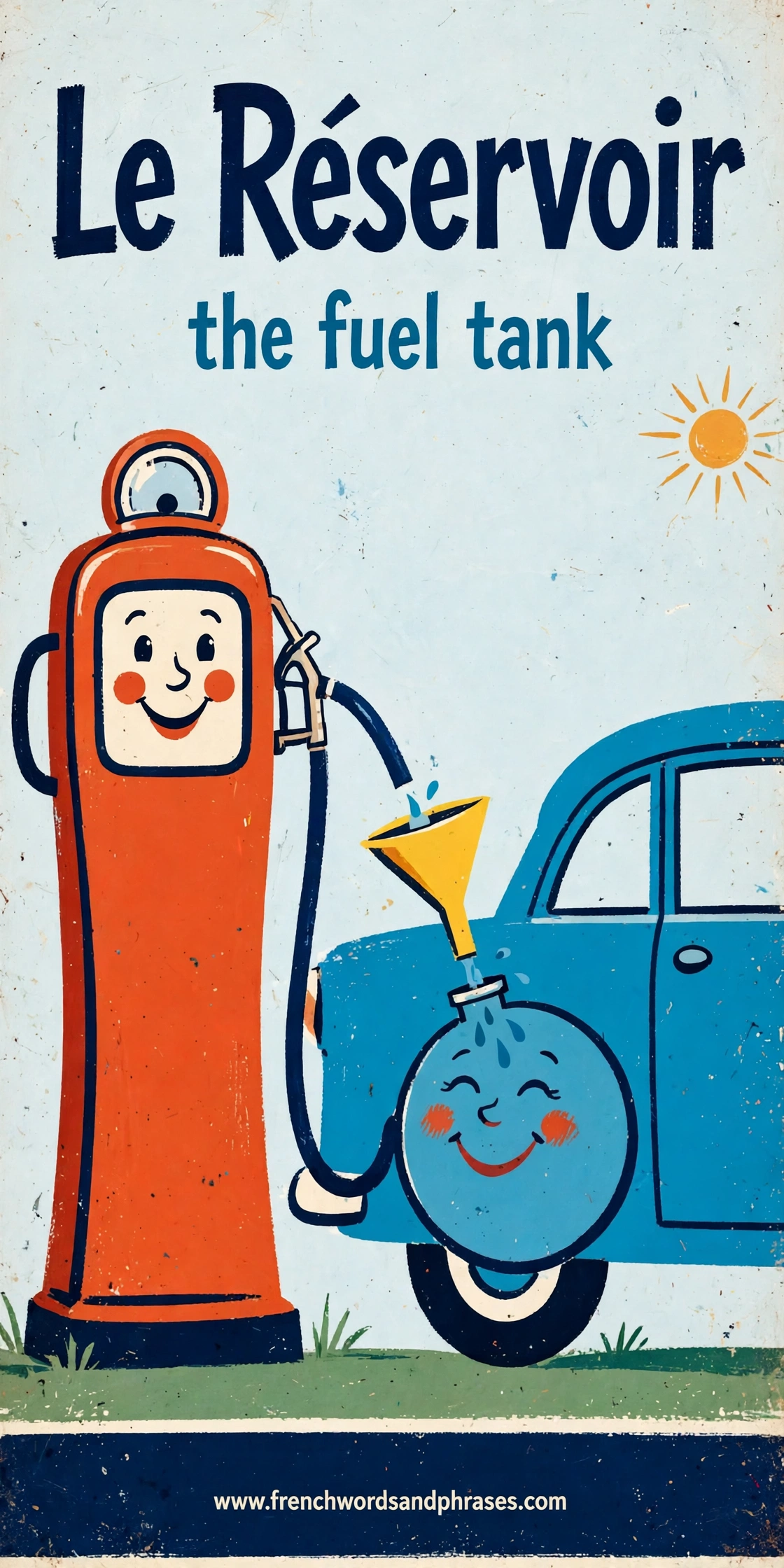
Translate Réservoir to English
/ʁe.zɛʁ.vwaʁ/
Le réservoir means the fuel tank.
The little orange light has just appeared on the dashboard, the next village is twenty kilometres away, and everyone in the car is suddenly thinking about the same thing — le réservoir, the fuel tank, and how much is left in it.
In this guide, you’ll learn what réservoir means in English, how to use it with its articles, how to form its plural, and how it appears in everyday French. Explore French examples, English translations, and practice quizzes.
Understanding the French Noun Réservoir
Réservoir is a masculine French noun. It is learned together with its article: le réservoir, un réservoir. It is built on réserver, to keep back: a réservoir is where something is kept in reserve. On the car it holds the fuel; elsewhere it holds water for a whole town.
It means the fuel tank — the hidden reserve under the car that decides how far the journey goes. When it is empty, French has the phrase every driver dreads: tomber en panne d’essence, to break down for want of fuel. Filling it is faire le plein, to fill right up.
Gender: Masculine
Definite article: le — le réservoir (the fuel tank)
Indefinite article: un — un réservoir (a fuel tank)
Plural: les réservoirs
English equivalents: The fuel tank; also a reservoir — un réservoir d’eau is a water tank or reservoir.
One important usage detail: the driver does not « remplir le réservoir » in everyday French — the set phrase at the petrol station is faire le plein, to do the full one. Je fais le plein means I am filling the tank right up. And the little cap you unscrew first is le bouchon du réservoir.
Experience the Word
Réservoir is more than a metal box. It is the car’s promise of distance — full, it means freedom; empty, it means a long walk with a jerrycan.
Imagine the motorway at dusk: the gauge sinking, the services still thirty kilometres away, and the whole car driving more gently, as if lightness could save fuel.
You have not just run low. You have learned exactly how far a reserve can stretch.
How to Use Réservoir in French: Complete Guide
Let’s explore how réservoir works in French, beginning with its articles.
Réservoir with the Definite Article (Le, Les)
Used for the tank everyone in the conversation knows — the one under your car, the one nearly empty.
| Number | French |
|---|---|
| Singular | le réservoir |
| Plural | les réservoirs |
Le réservoir est presque vide, arrêtons-nous.
The tank is almost empty, let’s stop.
Réservoir with the Indefinite Article (Un, Des)
Used for a tank in general — the big one advertised, the extra one on a boat.
| Number | French |
|---|---|
| Singular | un réservoir |
| Plural | des réservoirs |
Ce modèle a un réservoir de soixante litres.
This model has a sixty-litre tank.
At the Petrol Station
Caps, gauges and filling up — the words that travel with réservoir.
| French | In English |
|---|---|
| le bouchon du réservoir | the fuel cap |
| la jauge | the fuel gauge |
| faire le plein | to fill the tank up |
| l’essence | petrol |
| le carburant | fuel |
| la station-service | the petrol station |
N’oublie pas de refermer le bouchon du réservoir.
Do not forget to close the fuel cap again.
What does faire le plein mean?
Reveal the answer
To fill the tank right up — the everyday phrase at the petrol station, literally to do the full one.
Je fais le plein avant de prendre l’autoroute.
I fill up before taking the motorway.
The Plural of Réservoir
Réservoir adds an -s in the plural — les réservoirs, of cars, boats and water towers alike.
| Number | French |
|---|---|
| Singular | le réservoir |
| Plural | les réservoirs |
Les réservoirs du village sont remplis avant l’été.
The village water tanks are filled before the summer.
Réservoir with Possessive Adjectives (Mon, Ton, Son…)
Possessives agree with the noun, not with the owner — and réservoir is masculine, so it takes mon, ton, son.
| Owner | French |
|---|---|
| my | mon réservoir |
| your (tu) | ton réservoir |
| his / her | son réservoir |
| our | notre réservoir |
| your (vous) | votre réservoir |
| their | leur réservoir |
Son réservoir fuit, il y a une tache sous la voiture.
His tank is leaking, there is a stain under the car.
Complete the sentence:
______ réservoir est plein, nous pouvons partir. (Our)
Reveal the answer
Notre
Notre réservoir est plein, nous pouvons partir.
Our tank is full, we can leave.
Réservoir with Demonstrative Adjectives (Ce, Ces)
Used to point: this tank here, those tanks there.
| Number | French |
|---|---|
| Singular | ce réservoir |
| Plural | ces réservoirs |
Ce réservoir contient de quoi rouler six cents kilomètres.
This tank holds enough to drive six hundred kilometres.
Réservoir with Adjectives
Adjectives agree with réservoir, masculine — plein, vide, percé.
| Adjective | With Réservoir |
|---|---|
| plein (full) | un réservoir plein |
| vide (empty) | un réservoir vide |
| grand (big) | un grand réservoir |
| percé (holed, leaking) | un réservoir percé |
| rouillé (rusty) | un réservoir rouillé |
Un réservoir vide sur l’autoroute, c’est la panne assurée.
An empty tank on the motorway means a certain breakdown.
Complete the sentence:
Le réservoir est ______, il faut faire le plein. (empty)
Reveal the answer
vide
Le réservoir est vide, il faut faire le plein.
The tank is empty, we must fill up.
Everyday Expressions with Réservoir
Filling, leaking and running dry — the réservoir phrases of daily life.
| Expression | In English |
|---|---|
| faire le plein | to fill the tank up |
| le réservoir est vide | the tank is empty |
| tomber en panne d’essence | to run out of fuel |
| le bouchon du réservoir | the fuel cap |
| un réservoir d’eau | a water tank, a reservoir |
| la réserve | the reserve (the last of the fuel) |
Il est tombé en panne d’essence à deux kilomètres du village.
He ran out of fuel two kilometres from the village.
Words from the Same Family as Réservoir
Reserves, gauges and fuel — the words that travel with réservoir.
| French | In English |
|---|---|
| réserver | to reserve, to keep back |
| la réserve | the reserve |
| la jauge | the gauge |
| le carburant | fuel |
| la panne | the breakdown |
| rouler | to drive, to roll |
La jauge indique qu’il reste un quart du réservoir.
The gauge shows a quarter of the tank remaining.
A friend telephones: « Je suis tombé en panne d’essence ! » What has happened?
Reveal the answer
He has run out of fuel. His réservoir is empty — the panne d’essence is the breakdown every driver tries never to meet.
Elle est tombée en panne d’essence devant la station fermée.
She ran out of fuel in front of the closed petrol station.
Réservoir in Everyday French: Real-Life Examples
Now that you know the word, let’s see how réservoir appears in everyday French.
Je fais le plein, nous avons six cents kilomètres à faire.
I am filling up, we have six hundred kilometres to drive.
Le réservoir est vide, le voyant vient de s’allumer.
The tank is empty, the warning light has just come on.
Il est tombé en panne d’essence sur la départementale.
He ran out of fuel on the country road.
Son réservoir est plus grand, elle s’arrête moins souvent.
Her tank is bigger, she stops less often.
Le réservoir fuit, le garage doit le changer.
The tank is leaking, the garage must replace it.
Le réservoir d’eau du village est plein avant l’été.
The village water tank is full before the summer.
See le réservoir in a story: The Car: French Vocabulary (La Voiture) — a family road trip.
Beyond Translation: The Meaning of Réservoir
Every French driver knows the geography of the réservoir: which stations are cheap, which are dear, and the exact point on the motorway where the gauge starts to fall too fast. Faire le plein before the holiday is a ritual as fixed as the packing of the coffre.
To say réservoir is to talk about reserves — what you keep back for the road ahead.
It evokes the orange warning light, the relief of the services sign, and the small triumph of arriving with the needle just above empty.
How to Remember the French Noun Réservoir
Remember it this way: Réservoir is the fuel tank — masculine, with le and un, the car’s reserve, filled by faire le plein.
- You fill it — faire le plein, never a word-for-word remplir.
- You fear its opposite — tomber en panne d’essence, to run dry.
- You keep the family — réserver, to keep back; the tank keeps fuel back for you.
The key idea is le réservoir you fill — la panne you avoid.
Test Your Knowledge of Réservoir
Let’s see how much you’ve learned. Try answering these questions before revealing the answers.
Is réservoir masculine or feminine?
Reveal the answer
Masculine — le réservoir, un réservoir.
What does faire le plein mean?
Reveal the answer
To fill the tank right up — the set phrase at the petrol station.
Translate: The tank is empty, we must fill up.
Reveal the answer
Le réservoir est vide, il faut faire le plein.
What is le bouchon du réservoir?
Reveal the answer
The fuel cap — the little lid you unscrew before filling.
Complete the sentence:
Elle vérifie ______ réservoir avant le long trajet.
Reveal the answer
son
Elle vérifie son réservoir avant le long trajet.
She checks her tank before the long journey.
Can You Use It?
How would you say this in French?
“The tank is empty, we must fill up.”
Reveal the answer
Le réservoir est vide, il faut faire le plein.
The tank is empty, we must fill up.
LEARN FRENCH ONE WORD AT A TIME