A French Word to Live By
Translate Essuie-glace to English
/e.sɥi.ɡlas/
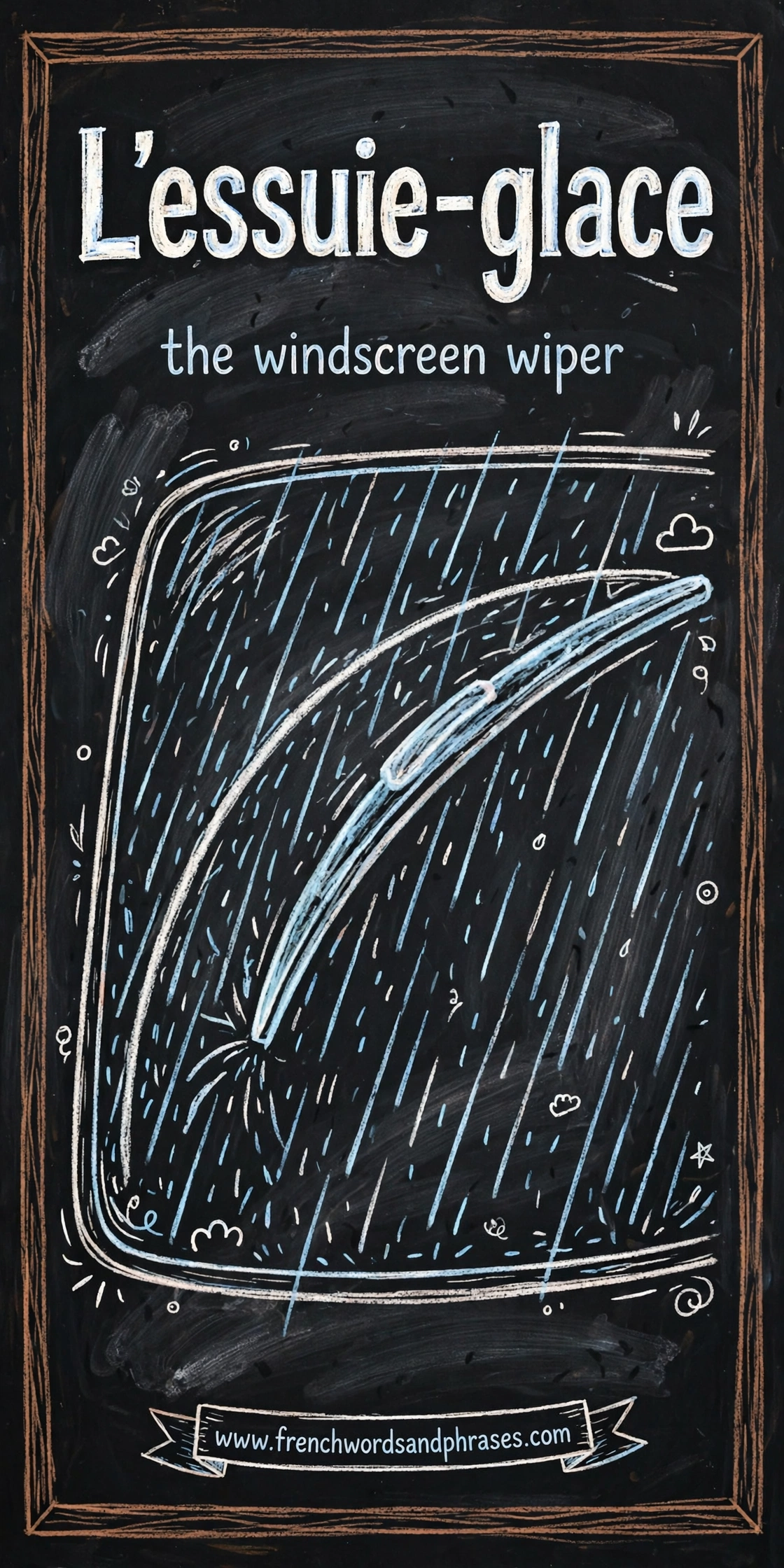
L’essuie-glace means the windscreen wiper.
The storm breaks over the motorway and the rain hammers the glass — then, sweep, sweep, the two black arms clear their bright arcs and the road comes back — l’essuie-glace, the windscreen wiper, the hardest-working arm on the car.
In this guide, you’ll learn what essuie-glace means in English, how to use it with its articles, how to form its plural, and how it appears in everyday French. Explore French examples, English translations, and practice quizzes.
Understanding the French Noun Essuie-glace
Essuie-glace is a masculine French noun. Because it begins with a vowel, its article shrinks: l’essuie-glace, un essuie-glace. The name is a small sentence: essuyer, to wipe, plus la glace — here not ice but the glass, the windscreen itself. And like pare-brise, it never changes in the plural: des essuie-glace, no final -s.
It means the windscreen wiper — the arm and blade, le balai d’essuie-glace, that sweep the rain from the windscreen. Cars have two at the front and often one at the back, l’essuie-glace arrière. Their rhythm is the soundtrack of wet driving: slow for drizzle, frantic for the storm, and their condition matters — a worn blade leaves the glass dirtier than it found it.
Gender: Masculine
Definite article: l’ — l’essuie-glace (the windscreen wiper)
Indefinite article: un — un essuie-glace (a windscreen wiper)
Plural: les essuie-glace (invariable — no -s)
English equivalents: The windscreen wiper (British), the windshield wiper (American).
One important usage detail: the blade itself is le balai d’essuie-glace — literally the wiper’s broom — and it is the balai you change when the wiping goes streaky, usually once a year. To switch the wipers on is mettre les essuie-glace; their speeds run from intermittent to rapide, with automatic settings on modern cars.
Experience the Word
Essuie-glace is more than a car part. It is the metronome of the rainy journey — the steady sweep that measures out the storm and hands the road back, arc by arc.
Imagine the night drive in heavy rain: the wipers at full speed, the world blurring and clearing, blurring and clearing, and the driver’s world reduced to the bright fan of glass they keep clean.
You have not just wiped a window. You have beaten time with les essuie-glace — and kept the road in sight.
How to Use Essuie-glace in French: Complete Guide
Let’s explore how essuie-glace works in French, beginning with its articles.
Essuie-glace with the Definite Article (L’, Les)
Essuie-glace begins with a vowel, so le shrinks to l’ — while the plural is les essuie-glace, the noun unchanged.
| Number | French |
|---|---|
| Singular | l’essuie-glace |
| Plural | les essuie-glace |
Example
L’essuie-glace du conducteur laisse des traces sur le pare-brise.
The driver’s wiper leaves streaks on the windscreen.
Essuie-glace with the Indefinite Article (Un, Des)
Used for a wiper in general — a worn one, a new one. The word itself does not change in the plural.
| Number | French |
|---|---|
| Singular | un essuie-glace |
| Plural | des essuie-glace |
Example
Il faut acheter un essuie-glace neuf pour l’arrière.
A new wiper must be bought for the rear window.
Essuie-glace with the Partitive Article (De l’, Des)
The partitive meets essuie-glace in phrases of movement and place — le mouvement de l’essuie-glace, the movement of the wiper — rather than for a quantity of wiper.
| Number | French |
|---|---|
| Singular | de l’essuie-glace |
| Plural | des essuie-glace |
Example
Le va-et-vient de l’essuie-glace rythme tout le voyage.
The to-and-fro of the wiper sets the rhythm for the whole journey.
Quick Quiz 1
What is le balai d’essuie-glace?
Reveal the answer
The wiper blade — the rubber blade itself, the part you replace when the wiping goes streaky.
Change les balais d’essuie-glace une fois par an.
Change the wiper blades once a year.
The Plural of Essuie-glace
Essuie-glace is invariable: the word never changes. Only the article shows the plural — les essuie-glace.
| Number | French |
|---|---|
| Singular | l’essuie-glace |
| Plural | les essuie-glace |
Example
Les essuie-glace battent de plus en plus vite sous l’orage.
The wipers beat faster and faster in the storm.
Essuie-glace with Possessive Adjectives (Mon, Ton, Son…)
Essuie-glace is masculine and begins with a vowel, so it takes mon, ton, son — mon essuie-glace, never « ma essuie-glace ».
| Owner | French |
|---|---|
| my | mon essuie-glace |
| your (tu) | ton essuie-glace |
| his / her | son essuie-glace |
| our | notre essuie-glace |
| your (vous) | votre essuie-glace |
| their | leur essuie-glace |
Example
Mets ton essuie-glace en automatique, la pluie commence.
Put your wiper on automatic, the rain is starting.
Quick Quiz 2
Complete the sentence:
Mets ______ essuie-glace, il pleut ! (your)
Reveal the answer
tes — here in the plural, les essuie-glace: Mets tes essuie-glace, il pleut !
Put your wipers on, it is raining!
Essuie-glace with Demonstrative Adjectives (Cet, Ces)
Before a vowel, ce becomes cet: cet essuie-glace. In the plural, ces essuie-glace.
| Number | French |
|---|---|
| Singular | cet essuie-glace |
| Plural | ces essuie-glace |
Example
Cet essuie-glace fait un bruit terrible à chaque passage.
This wiper makes a terrible noise with every sweep.
Essuie-glace with Adjectives
Adjectives agree with essuie-glace, masculine — arrière, usé, automatique.
| Adjective | With Essuie-glace |
|---|---|
| arrière (rear) | l’essuie-glace arrière |
| usé (worn) | un essuie-glace usé |
| neuf (new) | un essuie-glace neuf |
| automatique (automatic) | un essuie-glace automatique |
| bruyant (noisy) | un essuie-glace bruyant |
Example
Un essuie-glace usé nettoie moins bien qu’il ne salit.
A worn wiper cleans less well than it dirties.
Quick Quiz 3
Spot the trap: « des essuie-glaces neufs » — what is wrong?
Reveal the answer
Essuie-glace never takes an -s — it is invariable, like pare-brise. The adjective changes, the noun does not: des essuie-glace neufs.
Il a posé des essuie-glace neufs avant l’hiver.
He fitted new wipers before the winter.
Everyday Expressions with Essuie-glace
Switching on, sweeping and changing blades — the essuie-glace phrases of daily life.
| Expression | In English |
|---|---|
| mettre les essuie-glace | to switch the wipers on |
| le balai d’essuie-glace | the wiper blade |
| l’essuie-glace arrière | the rear wiper |
| changer les balais | to change the blades |
| en intermittent | on intermittent (setting) |
| le lave-glace | the windscreen washer fluid |
Example
Mets les essuie-glace en intermittent, il ne pleut presque plus.
Put the wipers on intermittent, it has nearly stopped raining.
Words from the Same Family as Essuie-glace
Wiping, glass and rain — the words that travel with essuie-glace.
| French | In English |
|---|---|
| essuyer | to wipe, to dry |
| la glace | the glass, the mirror (also ice) |
| la pluie | the rain |
| le pare-brise | the windscreen |
| le balai | the broom; the wiper blade |
| nettoyer | to clean |
Example
La pluie tombe, les essuie-glace nettoient, et la route reparaît.
The rain falls, the wipers clean, and the road reappears.
Quick Quiz 4
Essuie-glace is built from essuyer + glace. What does the name literally say?
Reveal the answer
It wipes the glass — essuyer, to wipe, plus la glace, the glass of the windscreen.
L’essuie-glace essuie la glace à chaque passage.
The wiper wipes the glass with every sweep.
Essuie-glace in Everyday French: Real-Life Examples
Now that you know the word, let’s see how essuie-glace appears in everyday French.
Example 1 — Rain starting
Il pleut, mets les essuie-glace !
It is raining, put the wipers on!
Example 2 — The storm
Sous l’orage, les essuie-glace battent à toute vitesse.
In the storm, the wipers beat at full speed.
Example 3 — Streaky glass
Tes balais d’essuie-glace sont usés, ils laissent des traces.
Your wiper blades are worn, they leave streaks.
Example 4 — The rear window
L’essuie-glace arrière est petit mais très utile.
The rear wiper is small but very useful.
Example 5 — Washer fluid
Il n’y a plus de lave-glace, les essuie-glace salissent le pare-brise.
There is no washer fluid left, the wipers are dirtying the windscreen.
Example 6 — The plural rule
On écrit des essuie-glace, sans s final.
You write des essuie-glace, with no final s.
See l’essuie-glace in a story: The Car: French Vocabulary (La Voiture) — a family road trip.
Beyond Translation: The Meaning of Essuie-glace
French built this word out of a whole action — essuyer la glace, to wipe the glass — and then froze it: no plural, no -s, whatever the number of arms sweeping the screen. Its partner word, pare-brise, froze the same way, and together they guard the front of every French car: one wards off the breeze, the other wipes the glass clear so the driver can watch the road through it.
To say essuie-glace is to hear the rhythm of the rain drive.
It evokes the sweep and the pause, the bright arc in the wet glass, and the storm beaten back, pass by pass.
How to Remember the French Noun Essuie-glace
Remember it this way: Essuie-glace is the windscreen wiper — masculine with l’, a verb and a noun frozen together, and invariable in the plural.
- You switch them on — mettre les essuie-glace when the rain starts, masculine with l’.
- You never add an -s — des essuie-glace, like des pare-brise.
- You change the blades — les balais d’essuie-glace, once a year.
The key idea is l’essuie-glace wipes — des essuie-glace, and not an -s more.
Test Your Knowledge of Essuie-glace
Let’s see how much you’ve learned. Try answering these questions before revealing the answers.
Question 1
Is essuie-glace masculine or feminine?
Reveal the answer
Masculine — but with l’: l’essuie-glace, un essuie-glace.
Question 2
What is the plural of essuie-glace?
Reveal the answer
Les essuie-glace — the word is invariable and never takes an -s.
Question 3
Translate: Put the wipers on, it is raining.
Reveal the answer
Mets les essuie-glace, il pleut.
Question 4
What is le balai d’essuie-glace?
Reveal the answer
The wiper blade — the rubber part you replace when it goes streaky.
Question 5
Complete the sentence:
______ essuie-glace fait un bruit terrible. (This)
Reveal the answer
Cet
Cet essuie-glace fait un bruit terrible.
This wiper makes a terrible noise — cet, because essuie-glace begins with a vowel.
Your Final Challenge
Can You Use It?
How would you say this in French?
“In the storm, the wipers beat at full speed.”
Reveal the answer
Sous l’orage, les essuie-glace battent à toute vitesse.
In the storm, the wipers beat at full speed.
A little French. A little curiosity. A richer everyday life.
LEARN FRENCH ONE WORD AT A TIME