A French Word to Live By
Translate Pare-brise to English
/paʁ.bʁiz/
Le pare-brise means the windscreen.
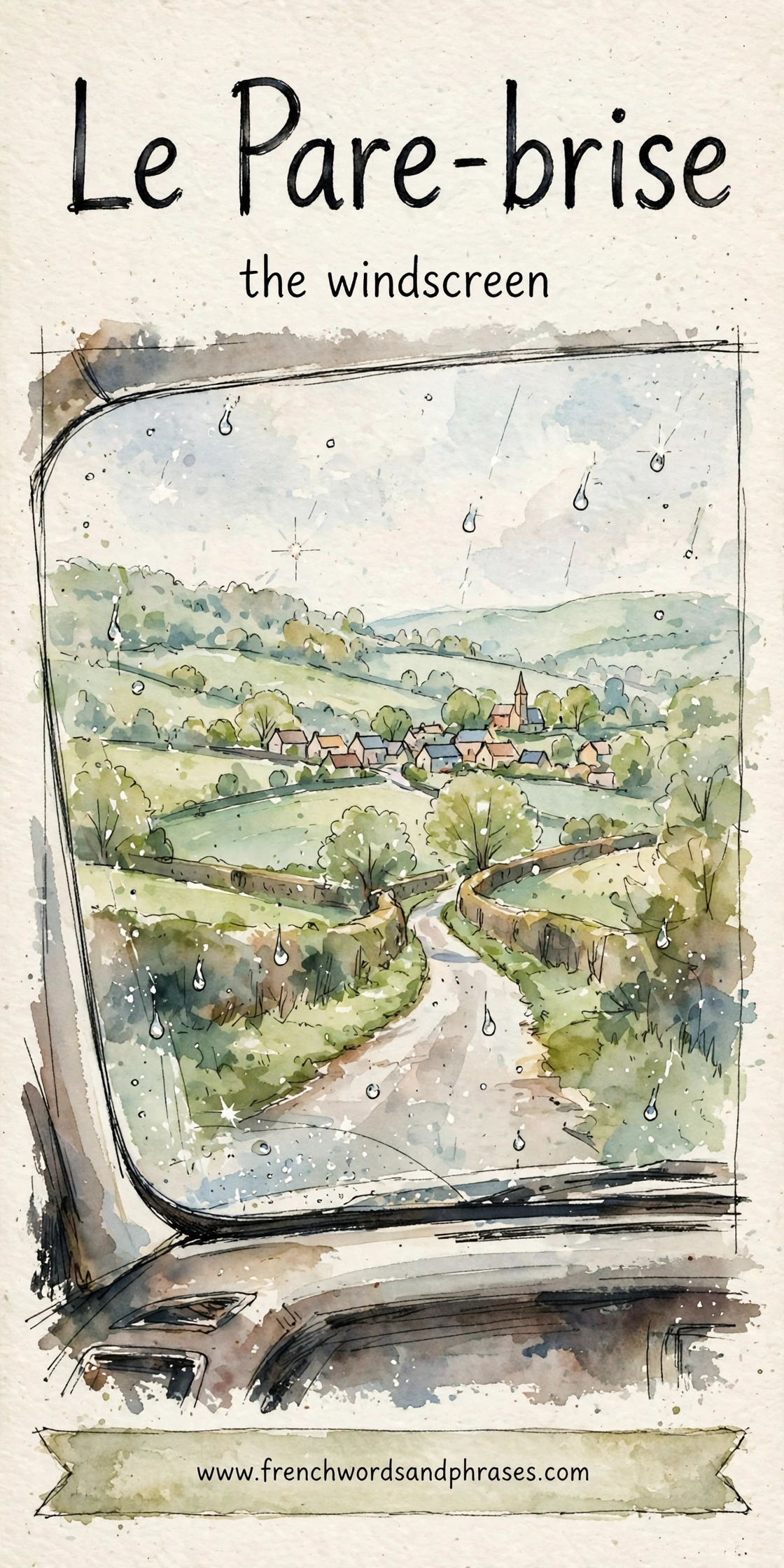
Autumn motorway, leaves and drizzle flying at the glass: the great curved window in front of the driver takes the wind, the rain and the road’s spray, and gives back nothing but the view — le pare-brise, the windscreen, the shield against the breeze.
In this guide, you’ll learn what pare-brise means in English, how to use it with its articles, how to form its plural, and how it appears in everyday French. Explore French examples, English translations, and practice quizzes.
Understanding the French Noun Pare-brise
Pare-brise is a masculine French noun. It is learned together with its article: le pare-brise, un pare-brise. The name tells its job: parer, to ward off, plus la brise, the breeze — the thing that wards off the breeze. Like many built-up French words, it never changes in the plural: des pare-brise, with no final -s.
It means the windscreen — the large front window of the car, through which the driver sees the road. It is stronger than it looks, part of the car’s safety structure, and the target of every stone on the motorway: un impact sur le pare-brise, a chip in the windscreen, is the small star-shaped crack every French driver knows, and dreads watching spread.
Gender: Masculine
Definite article: le — le pare-brise (the windscreen)
Indefinite article: un — un pare-brise (a windscreen)
Plural: les pare-brise (invariable — no -s)
English equivalents: The windscreen (British), the windshield (American).
One important usage detail: pare-brise is invariable — un pare-brise, des pare-brise, the word itself never takes an -s. Its everyday drama is un impact, a stone chip: garages will tell you a small impact can be repaired, but a crack — une fissure — means changer le pare-brise, replacing the whole windscreen.
Experience the Word
Pare-brise is more than a car part. It is the window onto the journey — the wide screen on which the road, the weather and the landscape play for the people inside.
Imagine the drive south in July: through the pare-brise, the motorway unrolls towards the mountains, the heat shimmers above the tarmac, and the first sign for the sea appears, huge and blue.
You have not just looked through glass. You have watched the whole journey through le pare-brise — the car’s own cinema screen.
How to Use Pare-brise in French: Complete Guide
Let’s explore how pare-brise works in French, beginning with its articles.
Pare-brise with the Definite Article (Le, Les)
Used for the windscreen everyone in the conversation knows — the one in front of you, covered in rain.
| Number | French |
|---|---|
| Singular | le pare-brise |
| Plural | les pare-brise |
Example
Le pare-brise est couvert de gouttes de pluie.
The windscreen is covered in raindrops.
Pare-brise with the Indefinite Article (Un, Des)
Used for a windscreen in general — a new one, a cracked one. Note that the plural form of the word does not change.
| Number | French |
|---|---|
| Singular | un pare-brise |
| Plural | des pare-brise |
Example
Il faut commander un pare-brise neuf pour cette voiture.
A new windscreen must be ordered for this car.
Pare-brise with the Partitive Article (Du, Des)
The partitive du meets pare-brise in phrases of surface and place — la surface du pare-brise, the surface of the windscreen — rather than for a quantity of glass.
| Number | French |
|---|---|
| Singular | du pare-brise |
| Plural | des pare-brise |
Example
Le bas du pare-brise est plein de feuilles mortes.
The bottom of the windscreen is full of dead leaves.
Quick Quiz 1
What is un impact sur le pare-brise?
Reveal the answer
A chip in the windscreen — the small star-shaped mark left by a flying stone, to be repaired before it becomes a crack.
Un gravillon a fait un impact sur le pare-brise.
A piece of gravel has chipped the windscreen.
The Plural of Pare-brise
Pare-brise is invariable: the word never changes. Only the article shows the plural — les pare-brise.
| Number | French |
|---|---|
| Singular | le pare-brise |
| Plural | les pare-brise |
Example
Le garage remplace les pare-brise toute la journée.
The garage replaces windscreens all day long.
Pare-brise with Possessive Adjectives (Mon, Ton, Son…)
Possessives agree with the noun, not with the owner — and pare-brise is masculine, so it takes mon, ton, son.
| Owner | French |
|---|---|
| my | mon pare-brise |
| your (tu) | ton pare-brise |
| his / her | son pare-brise |
| our | notre pare-brise |
| your (vous) | votre pare-brise |
| their | leur pare-brise |
Example
Ton pare-brise est sale, on ne voit presque rien.
Your windscreen is dirty, you can hardly see a thing.
Quick Quiz 2
Complete the sentence:
Nettoie ______ pare-brise avant de partir ! (your)
Reveal the answer
ton
Nettoie ton pare-brise avant de partir !
Clean your windscreen before leaving!
Pare-brise with Demonstrative Adjectives (Ce, Ces)
Used to point: this windscreen here, those windscreens there — the noun itself stays the same.
| Number | French |
|---|---|
| Singular | ce pare-brise |
| Plural | ces pare-brise |
Example
Ce pare-brise a un impact juste devant le conducteur.
This windscreen has a chip right in front of the driver.
Pare-brise with Adjectives
Adjectives agree with pare-brise, masculine — fêlé, chauffant, propre.
| Adjective | With Pare-brise |
|---|---|
| fêlé (cracked) | un pare-brise fêlé |
| chauffant (heated) | un pare-brise chauffant |
| propre (clean) | un pare-brise propre |
| sale (dirty) | un pare-brise sale |
| teinté (tinted) | un pare-brise teinté |
Example
Un pare-brise propre est une question de sécurité.
A clean windscreen is a matter of safety.
Quick Quiz 3
Spot the trap: « des pare-brises neufs » — what is wrong?
Reveal the answer
Pare-brise never takes an -s — it is invariable. The adjective changes, the noun does not: des pare-brise neufs.
Le garage pose des pare-brise neufs tous les jours.
The garage fits new windscreens every day.
Everyday Expressions with Pare-brise
Chips, cracks and winter ice — the pare-brise phrases of daily life.
| Expression | In English |
|---|---|
| un impact sur le pare-brise | a chip in the windscreen |
| une fissure | a crack |
| changer le pare-brise | to replace the windscreen |
| le pare-brise chauffant | the heated windscreen |
| gratter le pare-brise | to scrape the windscreen (ice) |
| le lave-glace | the windscreen washer fluid |
Example
En hiver, il gratte le pare-brise avant de partir travailler.
In winter, he scrapes the windscreen before leaving for work.
Words from the Same Family as Pare-brise
Glass, shields and wipers — the words that travel with pare-brise.
| French | In English |
|---|---|
| la vitre | the window pane, the car window |
| le verre | glass (the material) |
| l’essuie-glace | the windscreen wiper |
| le pare-chocs | the bumper |
| le pare-soleil | the sun visor |
| la brise | the breeze |
Example
Les essuie-glace nettoient le pare-brise à chaque passage.
The wipers clean the windscreen with every sweep.
Quick Quiz 4
Pare-brise is built from parer + brise. What does the name literally say?
Reveal the answer
It wards off the breeze — parer, to ward off, plus la brise, the breeze: the shield against the wind.
Le pare-brise nous protège du vent et de la pluie.
The windscreen protects us from the wind and the rain.
Pare-brise in Everyday French: Real-Life Examples
Now that you know the word, let’s see how pare-brise appears in everyday French.
Example 1 — Rainy day
La pluie couvre le pare-brise, mets les essuie-glace.
Rain covers the windscreen, put the wipers on.
Example 2 — A stone chip
Un gravillon a fait un impact sur mon pare-brise.
A piece of gravel has chipped my windscreen.
Example 3 — Winter morning
Le pare-brise est gelé, il faut le gratter.
The windscreen is frozen, it has to be scraped.
Example 4 — At the garage
Changer le pare-brise prend environ une heure.
Replacing the windscreen takes about an hour.
Example 5 — The view south
Par le pare-brise, on voit déjà les montagnes.
Through the windscreen, you can already see the mountains.
Example 6 — The plural rule
On écrit des pare-brise, sans s final.
You write des pare-brise, with no final s.
See le pare-brise in a story: The Car: French Vocabulary (La Voiture) — a family road trip.
Beyond Translation: The Meaning of Pare-brise
The pare-brise began as a name for protection — the shield that wards off the breeze — and it keeps the modesty of its origins: a word that never changes its shape, singular or plural, while everything around it takes its -s. Through it, the whole journey is watched: it is the screen of the road film every driver knows, rain-starred at night, ice-covered in January, and suddenly starred by a stone on the motorway.
To say pare-brise is to stand behind the great front window of the car.
It evokes the wiped arc in the rain, the dreaded impact, and the wide view of the road unfolding ahead.
How to Remember the French Noun Pare-brise
Remember it this way: Pare-brise is the windscreen — masculine, with le and un, the shield against the breeze, and invariable in the plural.
- You look through it — le pare-brise, the car’s front window, masculine with le.
- You never add an -s — des pare-brise, the word stands still.
- You decode it — parer la brise, to ward off the breeze.
The key idea is le pare-brise shields you — des pare-brise, and not an -s more.
Test Your Knowledge of Pare-brise
Let’s see how much you’ve learned. Try answering these questions before revealing the answers.
Question 1
Is pare-brise masculine or feminine?
Reveal the answer
Masculine — le pare-brise, un pare-brise.
Question 2
What is the plural of pare-brise?
Reveal the answer
Les pare-brise — the word is invariable and never takes an -s.
Question 3
Translate: A stone has chipped my windscreen.
Reveal the answer
Un gravillon a fait un impact sur mon pare-brise.
Question 4
What does the name pare-brise literally mean?
Reveal the answer
It wards off the breeze — parer (to ward off) + la brise (the breeze).
Question 5
Complete the sentence:
Le ______ est couvert de pluie. (windscreen)
Reveal the answer
pare-brise
Le pare-brise est couvert de pluie.
The windscreen is covered in rain.
Your Final Challenge
Can You Use It?
How would you say this in French?
“Through the windscreen, you can already see the mountains.”
Reveal the answer
Par le pare-brise, on voit déjà les montagnes.
Through the windscreen, you can already see the mountains.
A little French. A little curiosity. A richer everyday life.
LEARN FRENCH ONE WORD AT A TIME