A French Word to Live By
Translate Libellule to English
/li.bɛ.lyl/
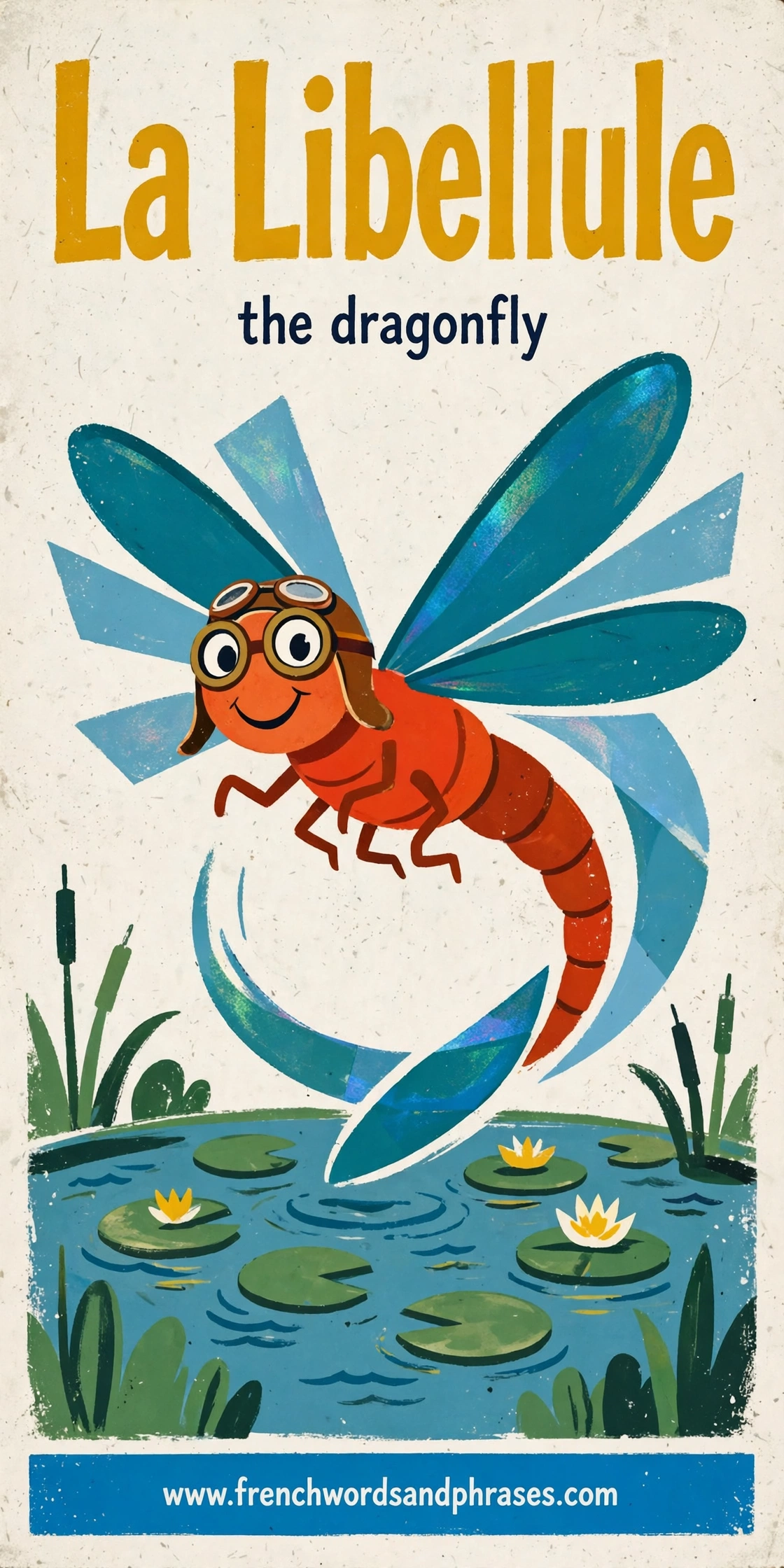
La libellule means the dragonfly.
Above the still pond, a flash of blue hangs in the air, darts sideways, and freezes again without a sound — la libellule, the dragonfly, the helicopter of the insect world.
In this guide, you’ll learn what libellule means in English, how to use it with its articles, how to form its plural, and how it appears in everyday French. Explore French examples, English translations, and practice quizzes.
Understanding the French Noun Libellule
Libellule is a feminine French noun. It is learned together with its article: la libellule, une libellule. It names the long-bodied, big-eyed insect of ponds and rivers, with two pairs of glassy wings — one of the oldest flying creatures on earth.
It means the dragonfly — the brilliant aerial hunter that skims ponds and slow rivers, hovering, darting and turning in mid-air like nothing else with wings. Dragonflies begin life underwater as nymphs, then climb a reed one summer morning and unfold into jewels. And despite the fierce English name, la libellule does not sting at all.
Gender: Feminine
Definite article: la — la libellule (the dragonfly)
Indefinite article: une — une libellule (a dragonfly)
Plural: les libellules
English equivalents: The dragonfly.
One important usage detail: the dragonfly’s slender cousin, the damselfly, is la demoiselle — the young lady — named for her delicate build and folded wings. Keep the pair straight: la libellule is the robust hunter holding her wings flat; la demoiselle is the slim one who closes hers like a fan.
Experience the Word
Libellule is more than an insect. It is a piece of flying jewellery — three hundred million years old and still the best pilot over the pond.
Imagine her hunting at noon: hanging motionless above the water, then gone in a blink, then back on the same reed, wings glittering like cut glass in the sun.
You have not just seen an insect fly. You have watched the oldest wings in the world at work.
How to Use Libellule in French: Complete Guide
Let’s explore how libellule works in French, beginning with its articles.
Libellule with the Definite Article (La, Les)
Used for the dragonfly everyone in the conversation knows — the one on the reed, the one over the pond.
| Number | French |
|---|---|
| Singular | la libellule |
| Plural | les libellules |
Example
La libellule se pose sur un roseau.
The dragonfly lands on a reed.
Libellule with the Indefinite Article (Une, Des)
Used for a dragonfly in general — the one flashing past, the ones hunting at noon.
| Number | French |
|---|---|
| Singular | une libellule |
| Plural | des libellules |
Example
Une libellule bleue survole l’étang.
A blue dragonfly flies over the pond.
Libellule with the Partitive Article (De — Quantities and Negatives)
Dragonflies are watched one by one, so the partitive appears as de after negatives and quantity words — no dragonflies on a cold morning, dozens on a hot one.
| Meaning | French |
|---|---|
| no dragonflies (after a negative) | pas de libellules |
| a lot of dragonflies | beaucoup de libellules |
| a few dragonflies | quelques libellules |
Example
Il y a beaucoup de libellules autour de l’étang en été.
There are a lot of dragonflies around the pond in summer.
Quick Quiz 1
Where will you find une libellule?
Reveal the answer
Near the water — over ponds, marshes and slow rivers, where she hunts and lays her eggs.
Cherche la libellule près de l’étang, pas dans le pré.
Look for the dragonfly near the pond, not in the meadow.
The Plural of Libellule
Libellule adds an -s in the plural — les libellules, patrolling the pond in squadrons on hot days.
| Number | French |
|---|---|
| Singular | la libellule |
| Plural | les libellules |
Example
Les libellules chassent au-dessus de l’eau.
The dragonflies hunt above the water.
Libellule with Possessive Adjectives (Ma, Ta, Sa…)
Possessives agree with the noun, not with the owner — and libellule is feminine, so it takes ma, ta, sa.
| Owner | French |
|---|---|
| my | ma libellule |
| your (tu) | ta libellule |
| his / her | sa libellule |
| our | notre libellule |
| your (vous) | votre libellule |
| their | leur libellule |
Example
Il photographie sa libellule préférée chaque été.
He photographs his favourite dragonfly every summer.
Quick Quiz 2
Complete the sentence:
______ libellule revient toujours au même roseau. (Our)
Reveal the answer
Notre
Notre libellule revient toujours au même roseau.
Our dragonfly always comes back to the same reed.
Libellule with Demonstrative Adjectives (Cette, Ces)
Used to point: this dragonfly here, those dragonflies there.
| Number | French |
|---|---|
| Singular | cette libellule |
| Plural | ces libellules |
Example
Cette libellule ne bouge pas, elle observe l’eau.
This dragonfly is not moving, it is watching the water.
Libellule with Adjectives
Adjectives agree with libellule, feminine — bleue, légère, rapide.
| Adjective | With Libellule |
|---|---|
| bleue (blue) | une libellule bleue |
| légère (light) | une libellule légère |
| rapide (fast) | une libellule rapide |
| irisée (iridescent) | une libellule irisée |
| élégante (elegant) | une libellule élégante |
Example
Une libellule bleue et irisée brille au soleil.
A blue, iridescent dragonfly shines in the sun.
Quick Quiz 3
Complete the sentence:
Je vois une libellule très ______. (fast)
Reveal the answer
rapide
Je vois une libellule très rapide.
I see a very fast dragonfly.
Everyday Expressions with Libellule
Ponds, reeds and mosquito patrols — the libellule phrases of daily life.
| Expression | In English |
|---|---|
| près de l’étang | by the pond |
| des ailes transparentes | transparent wings |
| se poser sur un roseau | to land on a reed |
| chasser les moustiques | to hunt mosquitoes |
| la demoiselle | the damselfly, her slender cousin |
| voler en zigzag | to zigzag through the air |
Example
La libellule chasse les moustiques au-dessus de l’étang.
The dragonfly hunts mosquitoes above the pond.
Words from the Same Family as Libellule
Ponds, reeds and still water — the words that travel with libellule.
| French | In English |
|---|---|
| un étang | a pond |
| un roseau | a reed |
| une aile | a wing |
| l’eau | water |
| un moustique | a mosquito (her favourite prey) |
| planer | to glide, to hover |
Example
La libellule plane au-dessus de l’eau calme.
The dragonfly glides above the calm water.
Quick Quiz 4
Your friend steps back: « Attention, elle va piquer ! » Will the dragonfly sting her?
Reveal the answer
No — dragonflies do not sting. La libellule hunts mosquitoes and flies; she has no sting at all, despite her fierce English name.
La libellule est belle et totalement inoffensive.
The dragonfly is beautiful and completely harmless.
Libellule in Everyday French: Real-Life Examples
Now that you know the word, let’s see how libellule appears in everyday French.
Example 1 — By the pond
Une libellule bleue survole l’étang.
A blue dragonfly flies over the pond.
Example 2 — On the reed
La libellule se pose sur un roseau et ne bouge plus.
The dragonfly lands on a reed and stops moving.
Example 3 — Mosquito patrol
Les libellules mangent des centaines de moustiques.
Dragonflies eat hundreds of mosquitoes.
Example 4 — Photography
Il passe l’après-midi à photographier les libellules.
He spends the afternoon photographing dragonflies.
Example 5 — The cousin
La demoiselle, plus fine, ferme ses ailes au repos.
The damselfly, slimmer, folds its wings at rest.
Example 6 — Summer heat
Plus il fait chaud, plus les libellules sont actives.
The hotter it is, the more active the dragonflies are.
See la libellule in a story: Insects: French Vocabulary (Les Insectes) — a summer day in a grandmother’s garden.
Beyond Translation: The Meaning of Libellule
Dragonflies were flying before the dinosaurs walked, and French naturalists have adored them ever since there were notebooks: la libellule is a favourite of pond-side photographers, watercolour painters and gardeners, who know that a pond with dragonflies is a pond with far fewer mosquitoes. Her name may come from the Latin libella, a little balance — the wings held level, like scales, as she hangs in the air.
To say libellule is to stand at the pond’s edge on the hottest day of the year.
It evokes the flash of blue, the frozen hover, and the oldest wings in the world still at work.
How to Remember the French Noun Libellule
Remember it this way: Libellule is the dragonfly — feminine, with la and une, the jewel of the pond that never stings.
- You find her by the water — la libellule de l’étang, feminine with la.
- You tell her from her cousin — la demoiselle folds her wings, la libellule holds hers flat.
- You relax — she hunts les moustiques, never you.
The key idea is la libellule over the pond — la demoiselle on the reed.
Test Your Knowledge of Libellule
Let’s see how much you’ve learned. Try answering these questions before revealing the answers.
Question 1
Is libellule masculine or feminine?
Reveal the answer
Feminine — la libellule, une libellule.
Question 2
Does a dragonfly sting?
Reveal the answer
No — la libellule has no sting; she hunts mosquitoes and flies.
Question 3
Translate: The dragonflies hunt above the water.
Reveal the answer
Les libellules chassent au-dessus de l’eau.
Question 4
What is la demoiselle, in the insect world?
Reveal the answer
The damselfly — the dragonfly’s slender cousin, which folds its wings at rest.
Question 5
Complete the sentence:
______ libellule se pose sur un roseau. (The)
Reveal the answer
La
La libellule se pose sur un roseau.
The dragonfly lands on a reed.
Your Final Challenge
Can You Use It?
How would you say this in French?
“Above the pond, the dragonfly glides in the sun.”
Reveal the answer
Au-dessus de l’étang, la libellule plane au soleil.
Above the pond, the dragonfly glides in the sun.
A little French. A little curiosity. A richer everyday life.
LEARN FRENCH ONE WORD AT A TIME