A French Word to Live By
How to Conjugate Écussonner in French
/e.ky.sɔ.ne/
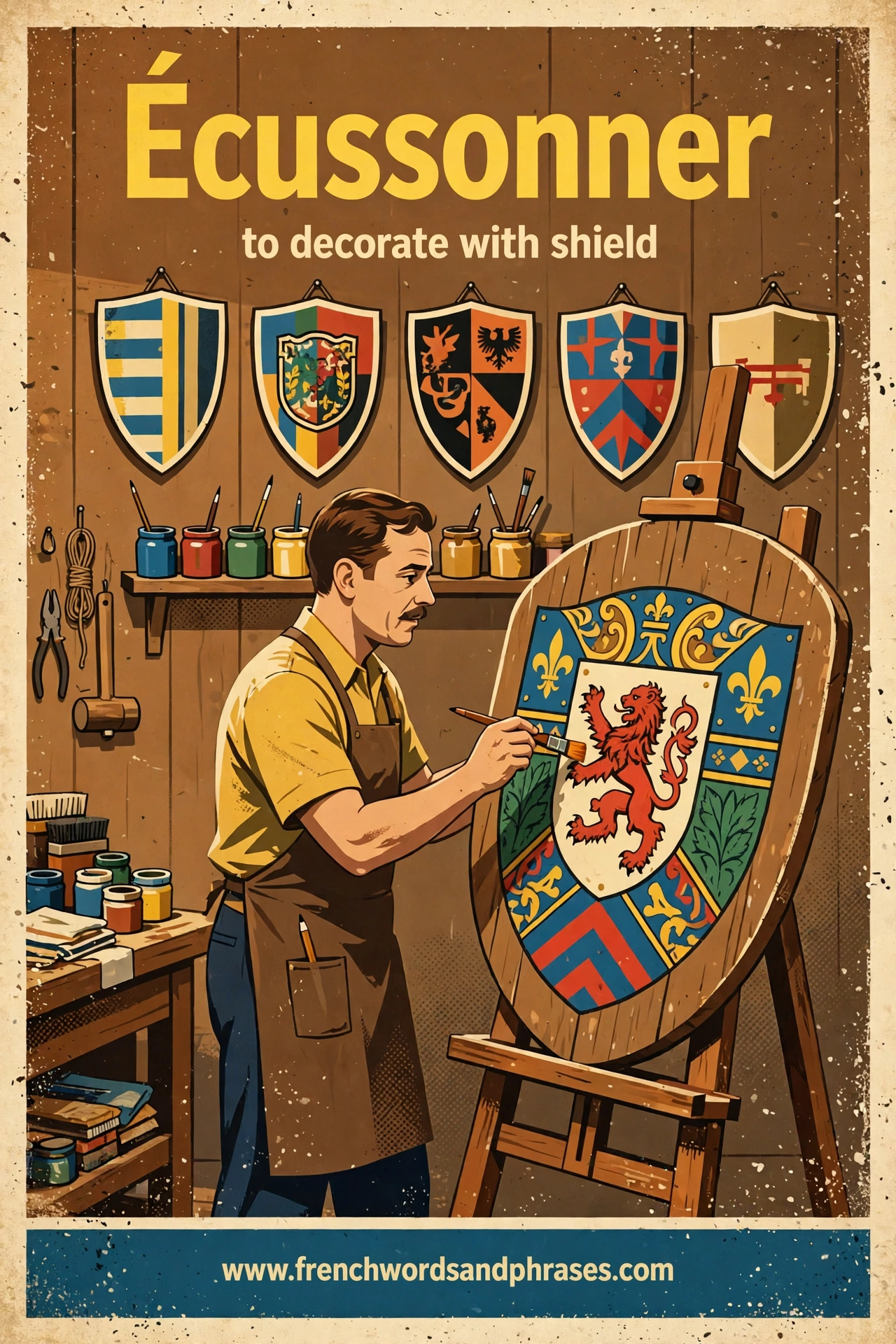
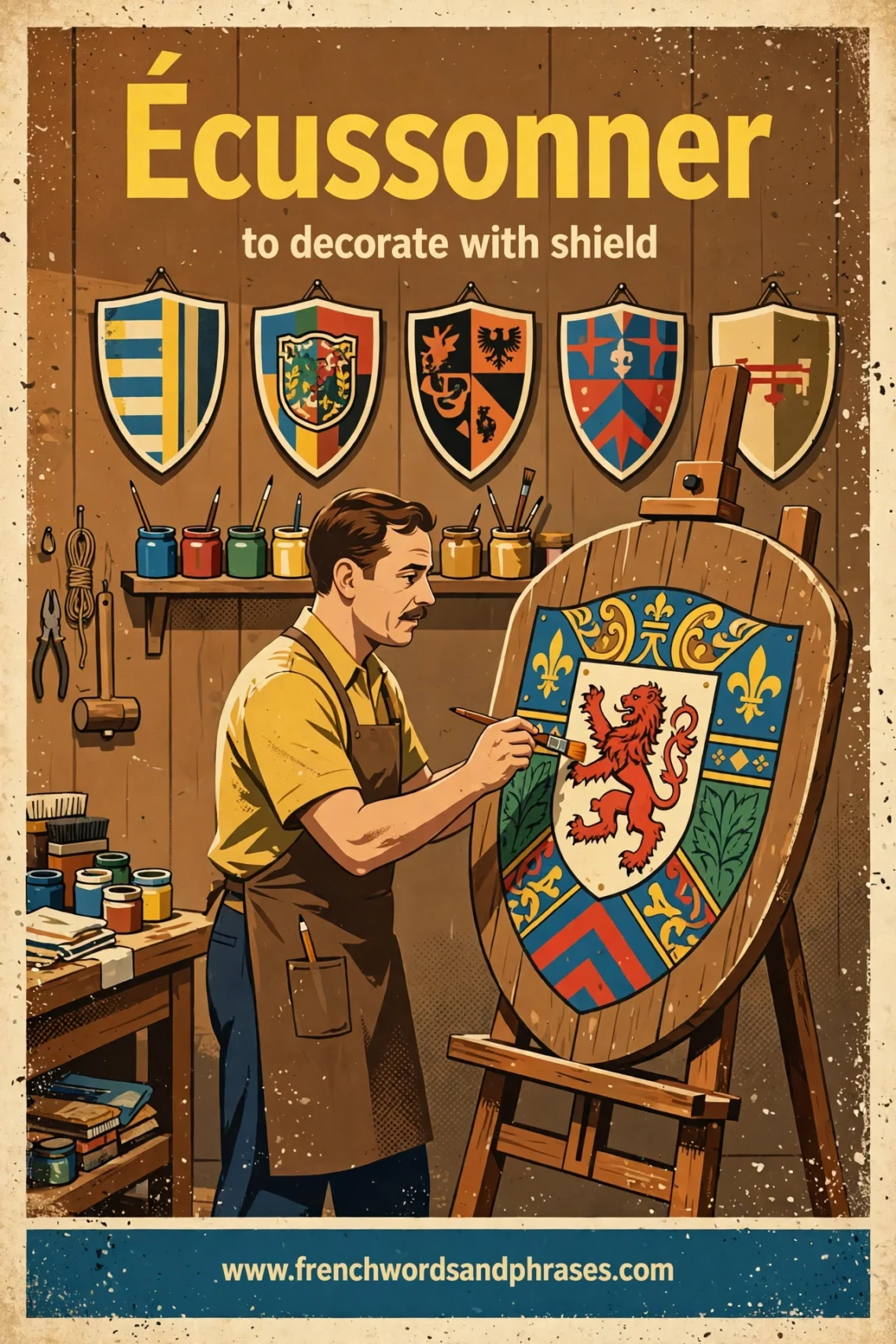
Écussonner means to decorate with a shield or coat of arms.
A great door blazoned with a city’s arms, a banner bright with shields, a scout’s sleeve covered in badges — écussonner is the heraldic verb of decorating a surface with shields, arms and emblems.
In this guide, you’ll learn how to conjugate écussonner in all the major French tenses and moods. Explore complete conjugation tables, French examples, English translations, and practice quizzes.
Understanding the French Verb Écussonner
Écussonner is a regular French verb belonging to the first group of verbs, those ending in -er.
It means to decorate with shield. It is commonly used for decorating gates, doors and carriages with coats of arms, for banners and flags at festivals and ceremonies, and for uniforms and blazers being fitted with their badges — anywhere a shield is added to say who something belongs to.
Verb classification: First group (-er)
Auxiliary verb: Avoir
Past participle: écussonné
Present participle: écussonnant
English equivalents: To decorate with a shield, coat of arms or badge; un écusson — a shield, an escutcheon, an embroidered badge.
One important detail: écussonner is built on un écusson, a word with two famous lives. In heraldry, un écusson is the shield that carries a coat of arms — les armes — painted on doors, seals and banners. In everyday life, it is the cloth badge sewn onto a blazer, a uniform or a scout’s sleeve. The verb covers both: to écussonner is to mark a thing with its shield, the way a knight’s shield once announced who he was before he said a word.
Experience the Word
Écussonner is the verb of proud belonging — a plain surface receives a shield, and suddenly it has a name, a house, a history.
Imagine the old gate of a town hall before a festival. Painters on ladders écussonnent its doors with the town’s arms — three golden towers on blue — and by evening the whole square seems to stand a little straighter.
The gate has not been rebuilt. It has been écussonné — given its shield, and with it, its identity.
How to Conjugate Écussonner: Complete French Conjugation Guide
Let’s explore every major conjugation of écussonner, beginning with the indicative mood.
How to Conjugate Écussonner in the Indicative Mood
The indicative mood is used to express facts, observations, actions, and events.
How to Conjugate Écussonner in the Present Tense (Présent)
Used for actions happening now, habitual actions, and general truths.
| Subject | Conjugation |
|---|---|
| je | écussonne |
| tu | écussonnes |
| il / elle | écussonne |
| nous | écussonnons |
| vous | écussonnez |
| ils / elles | écussonnent |
Example
Les artisans écussonnent la porte de la mairie.
The craftsmen decorate the town hall door with the coat of arms.
Quick Quiz 1
Complete the sentence:
Nous ______ les bannières pour la fête.
Reveal the answer
écussonnons
Nous écussonnons les bannières pour la fête.
We decorate the banners with shields for the festival.
How to Conjugate Écussonner in the Passé Composé
Used for completed actions in the past. Écussonner takes the auxiliary verb avoir.
| Subject | Conjugation |
|---|---|
| j’ | ai écussonné |
| tu | as écussonné |
| il / elle | a écussonné |
| nous | avons écussonné |
| vous | avez écussonné |
| ils / elles | ont écussonné |
Example
On a écussonné les bannières pour la fête du village.
The banners were decorated with shields for the village festival.
How to Conjugate Écussonner in the Imparfait (Imperfect Tense)
Used for habitual past actions, descriptions, and ongoing situations in the past.
| Subject | Conjugation |
|---|---|
| je | écussonnais |
| tu | écussonnais |
| il / elle | écussonnait |
| nous | écussonnions |
| vous | écussonniez |
| ils / elles | écussonnaient |
Example
Autrefois, on écussonnait les carrosses des grandes familles.
In the old days, the carriages of the great families were decorated with their arms.
Quick Quiz 2
Choose the correct form:
She decorated her blazer with badges.
Elle ______ son blazer. (a écussonné / est écussonnée)
Reveal the answer
a écussonné
Elle a écussonné son blazer.
Écussonner takes avoir.
How to Conjugate Écussonner in the Plus-que-parfait
Used to describe an action that had already been completed before another past event.
| Subject | Conjugation |
|---|---|
| j’ | avais écussonné |
| tu | avais écussonné |
| il / elle | avait écussonné |
| nous | avions écussonné |
| vous | aviez écussonné |
| ils / elles | avaient écussonné |
Example
Le peintre avait écussonné le portail avant l’arrivée du roi.
The painter had decorated the gate with the arms before the king’s arrival.
How to Conjugate Écussonner in the Passé Simple
Primarily used in formal writing, literature, and historical narratives. It is rarely used in everyday conversation.
| Subject | Conjugation |
|---|---|
| je | écussonnai |
| tu | écussonnas |
| il / elle | écussonna |
| nous | écussonnâmes |
| vous | écussonnâtes |
| ils / elles | écussonnèrent |
Example
L’héraldiste écussonna le bouclier du jeune chevalier.
The herald decorated the young knight’s shield with his arms.
How to Conjugate Écussonner in the Passé Antérieur
A literary tense used to express an action completed immediately before another past action, generally in the passé simple.
| Subject | Conjugation |
|---|---|
| j’ | eus écussonné |
| tu | eus écussonné |
| il / elle | eut écussonné |
| nous | eûmes écussonné |
| vous | eûtes écussonné |
| ils / elles | eurent écussonné |
Example
Quand ils eurent écussonné les portes, la cérémonie commença.
When they had decorated the doors with the arms, the ceremony began.
How to Conjugate Écussonner in the Future Tense (Futur Simple)
Used to describe actions that will take place in the future.
| Subject | Conjugation |
|---|---|
| je | écussonnerai |
| tu | écussonneras |
| il / elle | écussonnera |
| nous | écussonnerons |
| vous | écussonnerez |
| ils / elles | écussonneront |
Example
Nous écussonnerons les étendards pour le défilé.
We will decorate the standards with shields for the parade.
How to Conjugate Écussonner in the Futur Antérieur (Future Perfect)
Used for an action that will have been completed before a particular point in the future.
| Subject | Conjugation |
|---|---|
| j’ | aurai écussonné |
| tu | auras écussonné |
| il / elle | aura écussonné |
| nous | aurons écussonné |
| vous | aurez écussonné |
| ils / elles | auront écussonné |
Example
À la fin de la semaine, l’atelier aura écussonné tous les blasons.
By the end of the week, the workshop will have decorated all the blazers with badges.
How to Conjugate Écussonner in the Near Future (Futur Proche)
Used to describe something that is going to happen soon. Formed with aller + infinitive.
| Subject | Conjugation |
|---|---|
| je | vais écussonner |
| tu | vas écussonner |
| il / elle | va écussonner |
| nous | allons écussonner |
| vous | allez écussonner |
| ils / elles | vont écussonner |
Example
Je vais écussonner ce blazer avec l’écusson du club.
I am going to decorate this blazer with the club’s badge.
How to Conjugate Écussonner in the Conditional Mood
The conditional mood expresses what would happen under certain circumstances. It is also frequently used to make polite requests or express wishes.
How to Conjugate Écussonner in the Present Conditional
| Subject | Conjugation |
|---|---|
| je | écussonnerais |
| tu | écussonnerais |
| il / elle | écussonnerait |
| nous | écussonnerions |
| vous | écussonneriez |
| ils / elles | écussonneraient |
Example
Avec plus de temps, on écussonnerait aussi les fenêtres.
With more time, we would decorate the windows with shields too.
How to Conjugate Écussonner in the Past Conditional
| Subject | Conjugation |
|---|---|
| j’ | aurais écussonné |
| tu | aurais écussonné |
| il / elle | aurait écussonné |
| nous | aurions écussonné |
| vous | auriez écussonné |
| ils / elles | auraient écussonné |
Example
Ils auraient écussonné le portail si la peinture avait séché.
They would have decorated the gate with the arms if the paint had dried.
Écussonner in the Literary Past Conditional Form
This less common literary form uses the imperfect subjunctive of avoir.
| Subject | Conjugation |
|---|---|
| j’ | eusse écussonné |
| tu | eusses écussonné |
| il / elle | eût écussonné |
| nous | eussions écussonné |
| vous | eussiez écussonné |
| ils / elles | eussent écussonné |
Example
Le peintre eût écussonné les portes du palais pour le sacre.
The painter would have decorated the palace doors with arms for the coronation.
How to Conjugate Écussonner in the Subjunctive Mood
The subjunctive is used to express wishes, emotions, doubts, necessity, and uncertainty. It frequently follows expressions such as il faut que (it is necessary that) or bien que (although).
How to Conjugate Écussonner in the Present Subjunctive
| Subject | Conjugation |
|---|---|
| que je | écussonne |
| que tu | écussonnes |
| qu’il / qu’elle | écussonne |
| que nous | écussonnions |
| que vous | écussonniez |
| qu’ils / qu’elles | écussonnent |
Example
Il faut que vous écussonniez les bannières avant demain.
You must decorate the banners with shields before tomorrow.
Quick Quiz 3
Complete the sentence using the subjunctive:
Il faut que vous ______ les étendards.
Reveal the answer
écussonniez
Il faut que vous écussonniez les étendards.
You must decorate the standards with shields.
How to Conjugate Écussonner in the Imperfect Subjunctive
A literary tense, rarely encountered in modern spoken French.
| Subject | Conjugation |
|---|---|
| que je | écussonnasse |
| que tu | écussonnasses |
| qu’il / qu’elle | écussonnât |
| que nous | écussonnassions |
| que vous | écussonnassiez |
| qu’ils / qu’elles | écussonnassent |
Example
Le duc voulait que l’on écussonnât ses armes sur chaque porte.
The duke wanted his arms decorated on every door.
How to Conjugate Écussonner in the Pluperfect Subjunctive
A literary construction used to express an action completed before another past action.
| Subject | Conjugation |
|---|---|
| que j’ | eusse écussonné |
| que tu | eusses écussonné |
| qu’il / qu’elle | eût écussonné |
| que nous | eussions écussonné |
| que vous | eussiez écussonné |
| qu’ils / qu’elles | eussent écussonné |
Example
On admirait les portes qu’ils eussent écussonnées la veille.
People admired the doors they had decorated with arms the day before.
How to Conjugate Écussonner in the Past Subjunctive
| Subject | Conjugation |
|---|---|
| que j’ | aie écussonné |
| que tu | aies écussonné |
| qu’il / qu’elle | ait écussonné |
| que nous | ayons écussonné |
| que vous | ayez écussonné |
| qu’ils / qu’elles | aient écussonné |
Example
Je suis fier que nous ayons écussonné le portail à temps.
I am proud that we decorated the gate with the arms in time.
How to Conjugate Écussonner in the Imperative
The imperative is used to give commands, instructions, invitations, or suggestions. Subject pronouns are omitted.
How to Conjugate Écussonner in the Present Imperative
| Person | Conjugation |
|---|---|
| (tu) | écussonne |
| (nous) | écussonnons |
| (vous) | écussonnez |
Example
Écussonnez les étendards, la fête commence à midi !
Decorate the standards with shields, the festival starts at noon!
Quick Quiz 4
How would you say Decorate this shield (tu form)?
Reveal the answer
Écussonne ce bouclier !
French Participles of Écussonner
Participles are verb forms that can be used in compound tenses and other grammatical constructions.
Present Participle of Écussonner
écussonnant
En écussonnant la porte, il a raconté l’histoire de la ville.
While decorating the door with the arms, he told the history of the town.
Past Participle of Écussonner
écussonné
Écussonnée d’or et d’azur, la porte attirait tous les regards.
Decorated with shields in gold and azure, the door drew every eye.
Écussonner in Everyday French: Real-Life Examples
Now that you know the conjugations, let’s see how écussonner appears in everyday French.
Example 1 — Present
On écussonne les portes pour la fête nationale.
The doors are decorated with shields for the national holiday.
Example 2 — Passé composé
Elle a écussonné son blazer avec trois badges.
She decorated her blazer with three badges.
Example 3 — Imparfait
Les hérauts écussonnaient les boucliers avant le tournoi.
The heralds used to decorate the shields before the tournament.
Example 4 — Future
Nous écussonnerons les bannières ce week-end.
We will decorate the banners with shields this weekend.
Example 5 — Conditional
Tu écussonnerais ta veste avec l’écusson de l’équipe ?
Would you decorate your jacket with the team’s badge?
Example 6 — Imperative
Écussonne ce bouclier avec les armes de la famille !
Decorate this shield with the family arms!
Beyond Translation: The Meaning of Écussonner
English reaches for emblazon on the rare occasions it needs this idea; French écussonner grows straight out of the object itself — un écusson, the shield.
To écussonner is to give a surface its colours.
From a knight’s shield to a scout’s sleeve badge, the gesture has never changed: this is who I am, this is where I belong — worn where everyone can see it.
How to Remember the French Verb Écussonner
Remember it this way: Écussonner is about giving a surface its shield — arms, badges and belonging.
- Un écusson — a shield with arms, or a cloth badge; écussonner decorates with it.
- Écussonner une porte, une bannière, un blazer — a door, a banner, a blazer.
- Regular -er: j’écussonne, nous écussonnons, past participle écussonné.
The key idea is giving a surface its shield — arms, badges and belonging.
Test Your Knowledge of Écussonner
Let’s see how much you’ve learned. Try answering these questions before revealing the answers.
Question 1
What is un écusson?
Reveal the answer
A shield bearing a coat of arms — or the cloth badge sewn on a uniform.
Question 2
How do you say The craftsmen decorate the door with the coat of arms in French?
Reveal the answer
Les artisans écussonnent la porte.
Question 3
Translate: The banners were decorated with shields for the festival.
Reveal the answer
On a écussonné les bannières pour la fête.
Question 4
What is the past participle of écussonner?
Reveal the answer
Écussonné.
Question 5
Complete the sentence:
Il faut que vous ______ les bannières avant demain.
Reveal the answer
écussonniez
Il faut que vous écussonniez les bannières avant demain.
You must decorate the banners with shields before tomorrow.
Your Final Challenge
Can You Use It?
How would you say this in French?
They decorate the old gate with shields, and the whole town recognises itself in its arms.
Reveal the answer
Ils écussonnent le vieux portail, et la ville entière se reconnaît dans ses armes.
They decorate the old gate with shields, and the whole town recognises itself in its arms.
A little French. A little curiosity. A richer everyday life.
LEARN FRENCH ONE WORD AT A TIME