A French Word to Live By
How to Conjugate S’éczémater in French
/seɡ.ze.ma.te/
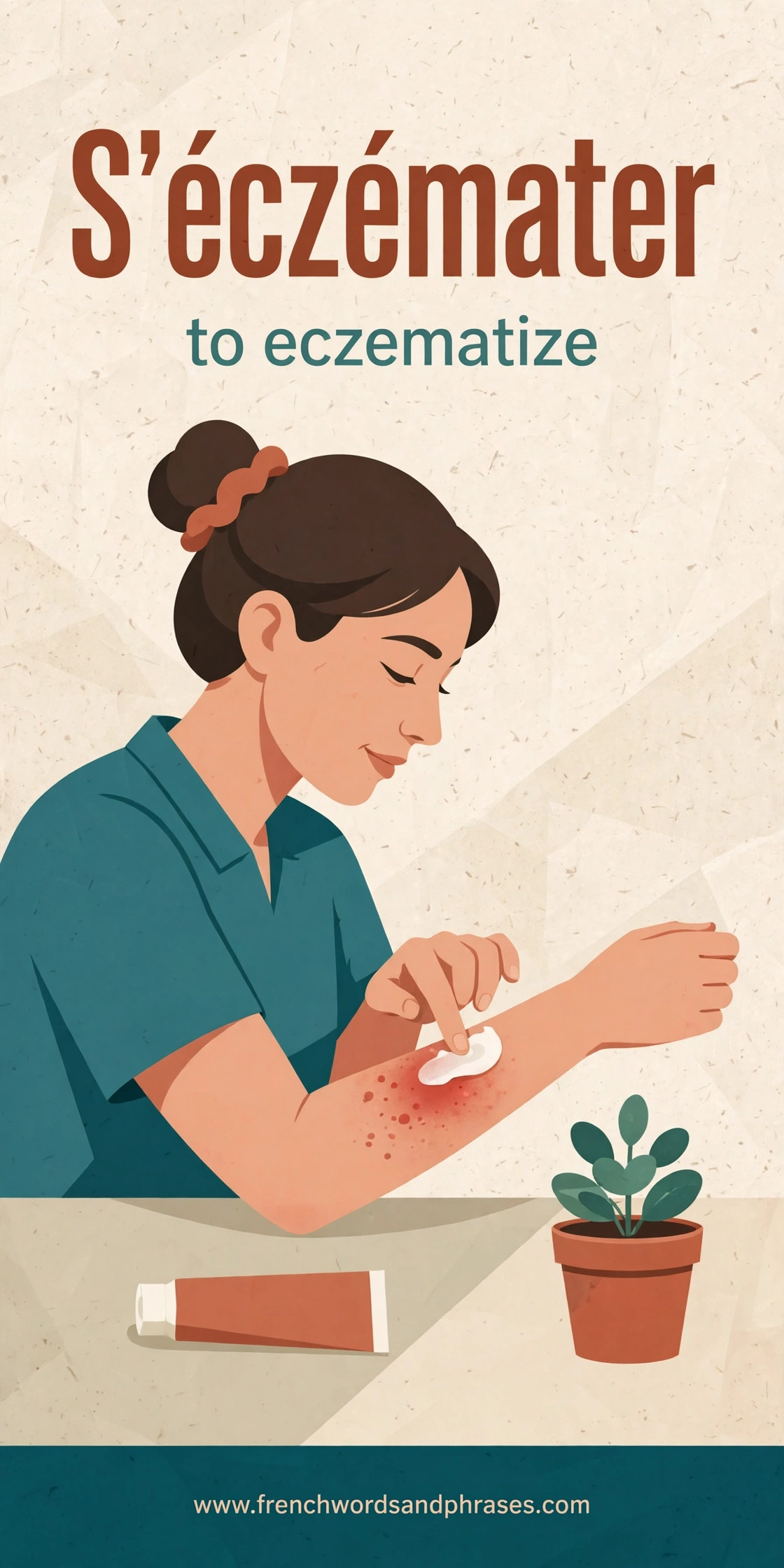
S’éczémater means to eczematize — for skin to break out in eczema.
Hands that crack and itch every winter, a child’s cheeks roughened by the cold — s’éczémater is the rare medical verb for skin that breaks out in eczema, turning itself into a map of red, dry patches.
In this guide, you’ll learn how to conjugate s’éczémater in all the major French tenses and moods. Explore complete conjugation tables, French examples, English translations, and practice quizzes.
Understanding the French Verb S’éczémater
S’éczémater is a regular French verb belonging to the first group of verbs, those ending in -er.
It means to eczematize. It is found in medical writing and older health books for skin — especially hands, face and the folds of elbows and knees — that becomes covered in eczema, and for the way cold weather, soaps and stress make sensitive skin flare into dry, itching patches.
Verb classification: First group (-er), reflexive
Auxiliary verb: Être
Past participle: éczématé
Present participle: éczématant
English equivalents: To break out in eczema, to become eczematous; l’eczéma — eczema; une peau eczémateuse — eczematous skin.
One important detail: s’éczémater is a rare, medical word — the verb doctors and old dictionaries keep for what skin does when eczema takes hold. Everyday French says it differently: avoir de l’eczéma, faire de l’eczéma, une poussée d’eczéma, a flare-up of eczema. Note the spelling with its unusual cz, straight from the Greek of l’eczéma. Being reflexive, it takes être, and the participle agrees with the skin it describes: ses mains se sont eczématées.
Experience the Word
S’éczémater is the verb of skin in revolt — the surface that should protect you becomes the very thing that itches, cracks and burns.
Imagine a baker’s apprentice in his first winter. The flour, the cold water, the hot oven air — by January his hands se sont eczématées, red and cracked, and the doctor shakes her head: the trade itself is written on his skin.
Nothing has attacked him from outside. His own skin has broken out — eczématée, in quiet rebellion.
How to Conjugate S’éczémater: Complete French Conjugation Guide
Let’s explore every major conjugation of s’éczémater, beginning with the indicative mood.
How to Conjugate S’éczémater in the Indicative Mood
The indicative mood is used to express facts, observations, actions, and events.
How to Conjugate S’éczémater in the Present Tense (Présent)
Used for actions happening now, habitual actions, and general truths.
| Subject | Conjugation |
|---|---|
| je | m’éczémate |
| tu | t’éczémates |
| il / elle | s’éczémate |
| nous | nous éczématons |
| vous | vous éczématez |
| ils / elles | s’éczématent |
Example
Sa peau s’éczémate dès que l’hiver arrive.
Her skin breaks out in eczema as soon as winter arrives.
Quick Quiz 1
Complete the sentence:
Avec ce froid, nos mains ______.
Reveal the answer
s’éczématent
Avec ce froid, nos mains s’éczématent.
In this cold, our hands break out in eczema.
How to Conjugate S’éczémater in the Passé Composé
Used for completed actions in the past. S’éczémater takes the auxiliary verb être.
| Subject | Conjugation |
|---|---|
| je | me suis éczématé / me suis éczématée |
| tu | t’es éczématé / t’es éczématée |
| il / elle | s’est éczématé / s’est éczématée |
| nous | nous sommes éczématés / nous sommes éczématées |
| vous | vous êtes éczématés / vous êtes éczématées / vous êtes éczématé / vous êtes éczématée |
| ils / elles | se sont éczématés / se sont éczématées |
Example
Ses mains se sont eczématées à force de produits chimiques.
His hands became covered in eczema from all the chemicals.
How to Conjugate S’éczémater in the Imparfait (Imperfect Tense)
Used for habitual past actions, descriptions, and ongoing situations in the past.
| Subject | Conjugation |
|---|---|
| je | m’éczématais |
| tu | t’éczématais |
| il / elle | s’éczématait |
| nous | nous éczémations |
| vous | vous éczématiez |
| ils / elles | s’éczémataient |
Example
Enfant, son visage s’éczématait chaque printemps.
As a child, his face used to break out in eczema every spring.
Quick Quiz 2
Choose the correct form:
Her skin broke out in eczema.
Sa peau ______ cet hiver. (s’est eczématée / a eczématé)
Reveal the answer
s’est eczématée
Sa peau s’est eczématée cet hiver.
S’éczémater is reflexive, takes être, and the participle agrees: eczématée.
How to Conjugate S’éczémater in the Plus-que-parfait
Used to describe an action that had already been completed before another past event.
| Subject | Conjugation |
|---|---|
| je | m’étais éczématé / m’étais éczématée |
| tu | t’étais éczématé / t’étais éczématée |
| il / elle | s’était éczématé / s’était éczématée |
| nous | nous étions éczématés / nous étions éczématées |
| vous | vous étiez éczématés / vous étiez éczématées / vous étiez éczématé / vous étiez éczématée |
| ils / elles | s’étaient éczématés / s’étaient éczématées |
Example
Sa peau s’était eczématée bien avant le diagnostic.
Her skin had broken out in eczema long before the diagnosis.
How to Conjugate S’éczémater in the Passé Simple
Primarily used in formal writing, literature, and historical narratives. It is rarely used in everyday conversation.
| Subject | Conjugation |
|---|---|
| je | m’éczématai |
| tu | t’éczématas |
| il / elle | s’éczémata |
| nous | nous éczématâmes |
| vous | vous éczématâtes |
| ils / elles | s’éczématèrent |
Example
Après ce savon nouveau, ses bras s’éczématèrent en une nuit.
After that new soap, her arms broke out in eczema in one night.
How to Conjugate S’éczémater in the Passé Antérieur
A literary tense used to express an action completed immediately before another past action, generally in the passé simple.
| Subject | Conjugation |
|---|---|
| je | me fus éczématé / me fus éczématée |
| tu | te fus éczématé / te fus éczématée |
| il / elle | se fut éczématé / se fut éczématée |
| nous | nous fûmes éczématés / nous fûmes éczématées |
| vous | vous fûtes éczématés / vous fûtes éczématées / vous fûtes éczématé / vous fûtes éczématée |
| ils / elles | se furent éczématés / se furent éczématées |
Example
Dès que sa peau se fut eczématée, il consulta un dermatologue.
As soon as his skin had broken out in eczema, he saw a dermatologist.
How to Conjugate S’éczémater in the Future Tense (Futur Simple)
Used to describe actions that will take place in the future.
| Subject | Conjugation |
|---|---|
| je | m’éczématerai |
| tu | t’éczémateras |
| il / elle | s’éczématera |
| nous | nous éczématerons |
| vous | vous éczématerez |
| ils / elles | s’éczémateront |
Example
Si tu continues, tes mains s’éczémateront complètement.
If you go on, your hands will become completely covered in eczema.
How to Conjugate S’éczémater in the Futur Antérieur (Future Perfect)
Used for an action that will have been completed before a particular point in the future.
| Subject | Conjugation |
|---|---|
| je | me serai éczématé / me serai éczématée |
| tu | te seras éczématé / te seras éczématée |
| il / elle | se sera éczématé / se sera éczématée |
| nous | nous serons éczématés / nous serons éczématées |
| vous | vous serez éczématés / vous serez éczématées / vous serez éczématé / vous serez éczématée |
| ils / elles | se seront éczématés / se seront éczématées |
Example
À la fin de l’hiver, sa peau se sera eczématée trois fois.
By the end of winter, her skin will have broken out in eczema three times.
How to Conjugate S’éczémater in the Near Future (Futur Proche)
Used to describe something that is going to happen soon. Formed with aller + infinitive.
| Subject | Conjugation |
|---|---|
| je | vais m’éczémater |
| tu | vas t’éczémater |
| il / elle | va s’éczémater |
| nous | allons nous éczémater |
| vous | allez vous éczémater |
| ils / elles | vont s’éczémater |
Example
Regarde ces rougeurs : ta peau va s’éczémater.
Look at this redness: your skin is going to break out in eczema.
How to Conjugate S’éczémater in the Conditional Mood
The conditional mood expresses what would happen under certain circumstances. It is also frequently used to make polite requests or express wishes.
How to Conjugate S’éczémater in the Present Conditional
| Subject | Conjugation |
|---|---|
| je | m’éczématerais |
| tu | t’éczématerais |
| il / elle | s’éczématerait |
| nous | nous éczématerions |
| vous | vous éczémateriez |
| ils / elles | s’éczémateraient |
Example
Sans ces gants, ses mains s’éczémateraient au travail.
Without those gloves, his hands would break out in eczema at work.
How to Conjugate S’éczémater in the Past Conditional
| Subject | Conjugation |
|---|---|
| je | me serais éczématé / me serais éczématée |
| tu | te serais éczématé / te serais éczématée |
| il / elle | se serait éczématé / se serait éczématée |
| nous | nous serions éczématés / nous serions éczématées |
| vous | vous seriez éczématés / vous seriez éczématées / vous seriez éczématé / vous seriez éczématée |
| ils / elles | se seraient éczématés / se seraient éczématées |
Example
Elle se serait eczématée si elle avait utilisé ce produit.
She would have broken out in eczema if she had used that product.
S’éczémater in the Literary Past Conditional Form
This less common literary form uses the imperfect subjunctive of être.
| Subject | Conjugation |
|---|---|
| je | me fusse éczématé / me fusse éczématée |
| tu | te fusses éczématé / te fusses éczématée |
| il / elle | se fût éczématé / se fût éczématée |
| nous | nous fussions éczématés / nous fussions éczématées |
| vous | vous fussiez éczématés / vous fussiez éczématées / vous fussiez éczématé / vous fussiez éczématée |
| ils / elles | se fussent éczématés / se fussent éczématées |
Example
Sa peau se fût eczématée au premier froid.
Her skin would have broken out in eczema at the first cold spell.
How to Conjugate S’éczémater in the Subjunctive Mood
The subjunctive is used to express wishes, emotions, doubts, necessity, and uncertainty. It frequently follows expressions such as il faut que (it is necessary that) or bien que (although).
How to Conjugate S’éczémater in the Present Subjunctive
| Subject | Conjugation |
|---|---|
| que je | m’éczémate |
| que tu | t’éczémates |
| qu’il / qu’elle | s’éczémate |
| que nous | nous éczémations |
| que vous | vous éczématiez |
| qu’ils / qu’elles | s’éczématent |
Example
Le médecin craint que la peau du bébé s’éczémate.
The doctor fears the baby’s skin may break out in eczema.
Quick Quiz 3
Complete the sentence using the subjunctive:
Je crains que ses mains ______.
Reveal the answer
s’éczématent
Je crains que ses mains s’éczématent.
I fear his hands may break out in eczema.
How to Conjugate S’éczémater in the Imperfect Subjunctive
A literary tense, rarely encountered in modern spoken French.
| Subject | Conjugation |
|---|---|
| que je | m’éczématasse |
| que tu | t’éczématasses |
| qu’il / qu’elle | s’éczématât |
| que nous | nous éczématassions |
| que vous | vous éczématassiez |
| qu’ils / qu’elles | s’éczématassent |
Example
On craignait que ses mains s’éczématassent pendant le traitement.
People feared his hands might become covered in eczema during the treatment.
How to Conjugate S’éczémater in the Pluperfect Subjunctive
A literary construction used to express an action completed before another past action.
| Subject | Conjugation |
|---|---|
| que je | me fusse éczématé / me fusse éczématée |
| que tu | te fusses éczématé / te fusses éczématée |
| qu’il / qu’elle | se fût éczématé / se fût éczématée |
| que nous | nous fussions éczématés / nous fussions éczématées |
| que vous | vous fussiez éczématés / vous fussiez éczématées / vous fussiez éczématé / vous fussiez éczématée |
| qu’ils / qu’elles | se fussent éczématés / se fussent éczématées |
Example
Le rapport notait que sa peau se fût eczématée dès l’enfance.
The report noted that her skin had broken out in eczema from childhood.
How to Conjugate S’éczémater in the Past Subjunctive
| Subject | Conjugation |
|---|---|
| que je | me sois éczématé / me sois éczématée |
| que tu | te sois éczématé / te sois éczématée |
| qu’il / qu’elle | se soit éczématé / se soit éczématée |
| que nous | nous soyons éczématés / nous soyons éczématées |
| que vous | vous soyez éczématés / vous soyez éczématées / vous soyez éczématé / vous soyez éczématée |
| qu’ils / qu’elles | se soient éczématés / se soient éczématées |
Example
Je suis désolé que ta peau se soit eczématée.
I am sorry your skin has broken out in eczema.
How to Conjugate S’éczémater in the Imperative
The imperative is used to give commands, instructions, invitations, or suggestions. Subject pronouns are omitted.
How to Conjugate S’éczémater in the Present Imperative
| Person | Conjugation |
|---|---|
| (tu) | éczémate-toi |
| (nous) | éczématons-nous |
| (vous) | éczématez-vous |
Example
Ne t’éczémate pas davantage : mets tes gants !
Do not let your skin break out any further: put your gloves on!
Quick Quiz 4
How would you say Do not let your skin break out (tu form)?
Reveal the answer
Ne laisse pas ta peau s’éczémater !
French Participles of S’éczémater
Participles are verb forms that can be used in compound tenses and other grammatical constructions.
Present Participle of S’éczémater
éczématant
En s’éczématant, la peau devient sèche et fragile.
In breaking out in eczema, the skin becomes dry and fragile.
Past Participle of S’éczémater
éczématé
Eczématées par le froid, ses mains lui faisaient mal.
Made eczematous by the cold, her hands hurt.
S’éczémater in Everyday French: Real-Life Examples
Now that you know the conjugations, let’s see how s’éczémater appears in everyday French.
Example 1 — Present
Sa peau s’éczémate avec le froid.
Her skin breaks out in eczema in the cold.
Example 2 — Passé composé
Ses mains se sont eczématées cet hiver.
His hands became covered in eczema this winter.
Example 3 — Imparfait
Son visage s’éczématait chaque printemps.
His face used to break out in eczema every spring.
Example 4 — Future
Tes mains s’éczémateront si tu ne mets pas de gants.
Your hands will break out in eczema if you do not wear gloves.
Example 5 — Conditional
Elle s’éczématerait moins avec une crème adaptée.
She would break out less with a suitable cream.
Example 6 — Imperative
Ne te laisse pas éczémater, hydrate ta peau !
Do not let your skin break out, moisturise it!
Beyond Translation: The Meaning of S’éczémater
English borrows the noun eczema and stops there; French built a whole reflexive verb on it, s’éczémater, as if the skin were an actor in its own drama.
It is a dictionary word more than a spoken one.
At the pharmacy you will say je fais de l’eczéma; in the medical book, the skin s’éczémate. Knowing both is knowing the difference between the waiting room and the textbook.
How to Remember the French Verb S’éczémater
Remember it this way: S’éczémater is about skin breaking out — l’eczéma written as a verb.
- Reflexive and être: ses mains se sont eczématées — the participle agrees.
- Everyday French prefers avoir de l’eczéma, faire de l’eczéma, une poussée d’eczéma.
- Regular -er: la peau s’éczémate, nous nous eczématons, past participle eczématé.
The key idea is skin breaking out — l’eczéma written as a verb.
Test Your Knowledge of S’éczémater
Let’s see how much you’ve learned. Try answering these questions before revealing the answers.
Question 1
Which auxiliary does s’éczémater use, and why?
Reveal the answer
Être — it is a reflexive verb: ses mains se sont eczématées.
Question 2
How do people usually say I have eczema in everyday French?
Reveal the answer
Je fais de l’eczéma.
Question 3
Translate: His hands became covered in eczema this winter.
Reveal the answer
Ses mains se sont eczématées cet hiver.
Question 4
What is the past participle of s’éczémater?
Reveal the answer
Éczématé — agreeing: eczématée, eczématés, eczématées.
Question 5
Complete the sentence:
Le médecin craint que la peau du bébé ______.
Reveal the answer
s’éczémate
Le médecin craint que la peau du bébé s’éczémate.
The doctor fears the baby’s skin may break out in eczema.
Your Final Challenge
Can You Use It?
How would you say this in French?
Her skin breaks out in eczema every winter, and every spring it finds its softness again.
Reveal the answer
Sa peau s’éczémate chaque hiver, et chaque printemps elle retrouve sa douceur.
Her skin breaks out in eczema every winter, and every spring it finds its softness again.
A little French. A little curiosity. A richer everyday life.
LEARN FRENCH ONE WORD AT A TIME