
A French Word to Live By
How to Conjugate Échoir in French
/e.ʃwaʁ/
Échoir means to fall to — to come to someone as their share or lot.
An inheritance divided at the notary’s desk, a deadline arriving on a grey Monday, an unwanted task landing on the same desk as always — échoir is the verb of things falling to someone: shares, duties and dates that arrive by rule, not by choice.
In this guide, you’ll learn how to conjugate échoir in all the major French tenses and moods. Explore complete conjugation tables, French examples, English translations, and practice quizzes.
Understanding the French Verb Échoir
Échoir is an irregular and defective French verb ending in -oir: it exists almost only in the third person.
It means to fall to. It is commonly used in law and administration for inheritances and shares falling to an heir (échoir à quelqu’un), for deadlines, rents and bills falling due, and in the fixed phrases le cas échéant (if applicable) and à terme échu (payable when due). People never échoient — only things do.
Verb classification: Irregular (-oir), defective
Auxiliary verb: Avoir
Past participle: échu
Present participle: échéant
English equivalents: To fall to (someone), to fall due; échoir à quelqu’un — to fall to someone as their share; le cas échéant — if applicable, should the case arise; à terme échu — payable at the due date.
One important detail: échoir is a defective verb — whole persons are simply missing, which is why its tables are full of dashes. There is no usable je or nous form: the verb lives in the third person, because its subjects are things, not people — la part lui échoit, the share falls to him; le terme échoit lundi, the deadline falls due on Monday. Its past participle échu is everywhere in official French (un loyer échu, rent that has fallen due), and its present participle survives in the set phrase le cas échéant — if the case arises.
Experience the Word
Échoir is the verb of the lot drawn by fate and paperwork — what lands on you because the rules say so.
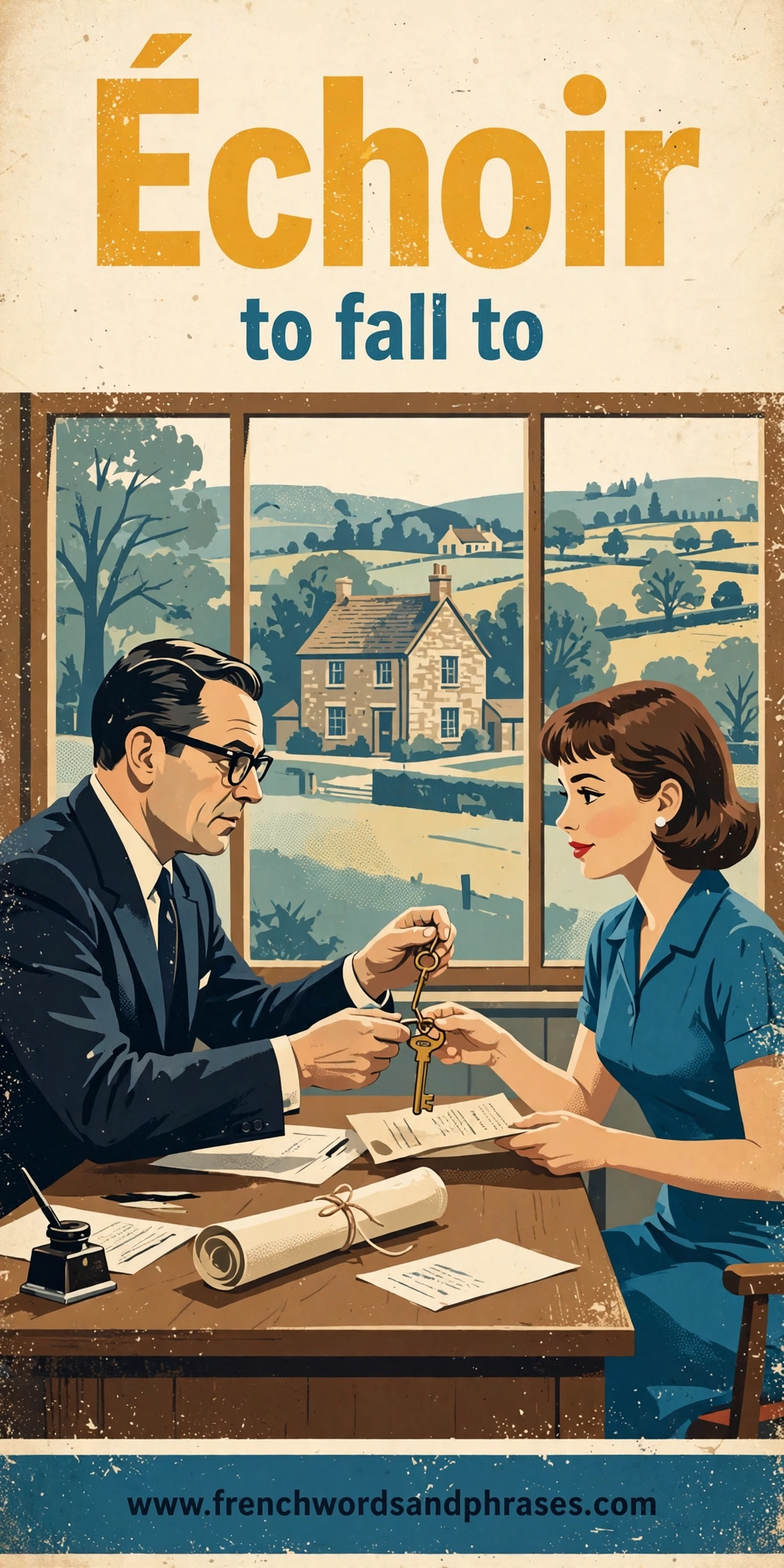
Imagine a notary’s office after a funeral. The old house, the fields, the debts: the notary reads the will aloud, and each share échoit to a different cousin, whether they wanted it or not.
Nobody chose anything in that room. Everything simply fell — to one the house, to another the field, to a third the debt.
How to Conjugate Échoir: Complete French Conjugation Guide
Let’s explore every major conjugation of échoir, beginning with the indicative mood.
How to Conjugate Échoir in the Indicative Mood
The indicative mood is used to express facts, observations, actions, and events.
How to Conjugate Échoir in the Present Tense (Présent)
Used for actions happening now, habitual actions, and general truths.
| Subject | Conjugation |
|---|---|
| je | — |
| tu | — |
| il / elle | échoit |
| nous | — |
| vous | — |
| ils / elles | échoient |
Example
La plus grande part échoit au fils aîné.
The largest share falls to the eldest son.
Quick Quiz 1
Complete the sentence:
La plus grande part ______ au fils aîné.
Reveal the answer
échoit
La plus grande part échoit au fils aîné.
The largest share falls to the eldest son.
How to Conjugate Échoir in the Passé Composé
Used for completed actions in the past. Échoir takes the auxiliary verb avoir.
| Subject | Conjugation |
|---|---|
| j’ | ai échu |
| tu | as échu |
| il / elle | a échu |
| nous | avons échu |
| vous | avez échu |
| ils / elles | ont échu |
Example
La maison a échu à sa nièce.
The house fell to his niece.
How to Conjugate Échoir in the Imparfait (Imperfect Tense)
Used for habitual past actions, descriptions, and ongoing situations in the past.
| Subject | Conjugation |
|---|---|
| je | — |
| tu | — |
| il / elle | échéait |
| nous | — |
| vous | — |
| ils / elles | échéaient |
Example
Autrefois, la terre échéait toujours au fils aîné.
In the old days, the land always fell to the eldest son.
Quick Quiz 2
Choose the correct form:
The house fell to his niece.
La maison ______ à sa nièce. (a échu / est échue)
Reveal the answer
a échu
La maison a échu à sa nièce.
Échoir takes avoir.
How to Conjugate Échoir in the Plus-que-parfait
Used to describe an action that had already been completed before another past event.
| Subject | Conjugation |
|---|---|
| j’ | avais échu |
| tu | avais échu |
| il / elle | avait échu |
| nous | avions échu |
| vous | aviez échu |
| ils / elles | avaient échu |
Example
Le domaine avait échu à une cousine éloignée.
The estate had fallen to a distant cousin.
How to Conjugate Échoir in the Passé Simple
Primarily used in formal writing, literature, and historical narratives. It is rarely used in everyday conversation.
| Subject | Conjugation |
|---|---|
| je | — |
| tu | — |
| il / elle | échut |
| nous | — |
| vous | — |
| ils / elles | échurent |
Example
Le château échut à l’État faute d’héritiers.
The castle fell to the State for want of heirs.
How to Conjugate Échoir in the Passé Antérieur
A literary tense used to express an action completed immediately before another past action, generally in the passé simple.
| Subject | Conjugation |
|---|---|
| j’ | eus échu |
| tu | eus échu |
| il / elle | eut échu |
| nous | eûmes échu |
| vous | eûtes échu |
| ils / elles | eurent échu |
Example
Quand le terme eut échu, le notaire ouvrit le dossier.
When the deadline had fallen due, the notary opened the file.
How to Conjugate Échoir in the Future Tense (Futur Simple)
Used to describe actions that will take place in the future.
| Subject | Conjugation |
|---|---|
| je | — |
| tu | — |
| il / elle | écherra |
| nous | — |
| vous | — |
| ils / elles | écherront |
Example
En cas d’égalité, la décision écherra au président.
In the event of a tie, the decision will fall to the chairman.
How to Conjugate Échoir in the Futur Antérieur (Future Perfect)
Used for an action that will have been completed before a particular point in the future.
| Subject | Conjugation |
|---|---|
| j’ | aurai échu |
| tu | auras échu |
| il / elle | aura échu |
| nous | aurons échu |
| vous | aurez échu |
| ils / elles | auront échu |
Example
À la fin du mois, le loyer aura échu.
By the end of the month, the rent will have fallen due.
How to Conjugate Échoir in the Near Future (Futur Proche)
Used to describe something that is going to happen soon. Formed with aller + infinitive.
| Subject | Conjugation |
|---|---|
| je | vais échoir |
| tu | vas échoir |
| il / elle | va échoir |
| nous | allons échoir |
| vous | allez échoir |
| ils / elles | vont échoir |
Example
Le délai va échoir dans trois jours.
The deadline is going to fall due in three days.
How to Conjugate Échoir in the Conditional Mood
The conditional mood expresses what would happen under certain circumstances. It is also frequently used to make polite requests or express wishes.
How to Conjugate Échoir in the Present Conditional
| Subject | Conjugation |
|---|---|
| je | — |
| tu | — |
| il / elle | écherrait |
| nous | — |
| vous | — |
| ils / elles | écherraient |
Example
Sans testament, la maison écherrait aux enfants.
Without a will, the house would fall to the children.
How to Conjugate Échoir in the Past Conditional
| Subject | Conjugation |
|---|---|
| j’ | aurais échu |
| tu | aurais échu |
| il / elle | aurait échu |
| nous | aurions échu |
| vous | auriez échu |
| ils / elles | auraient échu |
Example
La part aurait échu à sa sœur si elle avait accepté.
The share would have fallen to his sister if she had accepted.
Échoir in the Literary Past Conditional Form
This less common literary form uses the imperfect subjunctive of avoir.
| Subject | Conjugation |
|---|---|
| j’ | eusse échu |
| tu | eusses échu |
| il / elle | eût échu |
| nous | eussions échu |
| vous | eussiez échu |
| ils / elles | eussent échu |
Example
Le domaine eût échu au fils cadet, selon l’ancien droit.
The estate would have fallen to the younger son, under the old law.
How to Conjugate Échoir in the Subjunctive Mood
The subjunctive is used to express wishes, emotions, doubts, necessity, and uncertainty. It frequently follows expressions such as il faut que (it is necessary that) or bien que (although).
How to Conjugate Échoir in the Present Subjunctive
| Subject | Conjugation |
|---|---|
| que je | — |
| que tu | — |
| qu’il / qu’elle | échoie |
| que nous | — |
| que vous | — |
| qu’ils / qu’elles | échoient |
Example
Il est possible que la charge échoie au plus jeune.
It is possible that the burden will fall to the youngest.
Quick Quiz 3
Complete the sentence using the subjunctive:
Il est possible que la charge ______ au plus jeune.
Reveal the answer
échoie
Il est possible que la charge échoie au plus jeune.
It is possible the burden will fall to the youngest.
How to Conjugate Échoir in the Imperfect Subjunctive
A literary tense, rarely encountered in modern spoken French.
| Subject | Conjugation |
|---|---|
| que je | — |
| que tu | — |
| qu’il / qu’elle | échût |
| que nous | — |
| que vous | — |
| qu’ils / qu’elles | échussent |
Example
On craignait que la dette échût aux héritiers.
People feared the debt might fall to the heirs.
How to Conjugate Échoir in the Pluperfect Subjunctive
A literary construction used to express an action completed before another past action.
| Subject | Conjugation |
|---|---|
| que j’ | eusse échu |
| que tu | eusses échu |
| qu’il / qu’elle | eût échu |
| que nous | eussions échu |
| que vous | eussiez échu |
| qu’ils / qu’elles | eussent échu |
Example
Il semblait que la maison fût échue à un inconnu.
It seemed the house had fallen to a stranger.
How to Conjugate Échoir in the Past Subjunctive
| Subject | Conjugation |
|---|---|
| que j’ | aie échu |
| que tu | aies échu |
| qu’il / qu’elle | ait échu |
| que nous | ayons échu |
| que vous | ayez échu |
| qu’ils / qu’elles | aient échu |
Example
Je suis surpris que ce rôle ait échu à un débutant.
I am surprised this role fell to a beginner.
How to Conjugate Échoir in the Imperative
The imperative is used to give commands, instructions, invitations, or suggestions. Subject pronouns are omitted.
How to Conjugate Échoir in the Present Imperative
| Person | Conjugation |
|---|---|
| (tu) | — |
| (nous) | — |
| (vous) | — |
Example
Échoir n’a pas d’impératif : on ne commande pas au sort.
Échoir has no imperative: you cannot give orders to fate.
Quick Quiz 4
How would you say If applicable, in French?
Reveal the answer
Le cas échéant.
French Participles of Échoir
Participles are verb forms that can be used in compound tenses and other grammatical constructions.
Present Participle of Échoir
échéant
Le cas échéant, la somme sera versée aux héritiers.
Should the case arise, the sum will be paid to the heirs.
Past Participle of Échoir
échu
Le terme échu, le contrat prend fin.
Once the term has fallen due, the contract ends.
Échoir in Everyday French: Real-Life Examples
Now that you know the conjugations, let’s see how échoir appears in everyday French.
Example 1 — Present
La corvée échoit toujours au même.
The chore always falls to the same person.
Example 2 — Passé composé
La maison a échu à sa nièce.
The house fell to his niece.
Example 3 — Imparfait
La terre échéait au fils aîné.
The land used to fall to the eldest son.
Example 4 — Future
Le délai écherra lundi prochain.
The deadline will fall due next Monday.
Example 5 — Conditional
La part écherrait aux enfants.
The share would fall to the children.
Example 6 — Imperative
Échoir n’a pas d’impératif.
Échoir has no imperative.
Beyond Translation: The Meaning of Échoir
English says a thing falls to someone and leaves the verb half-finished; French échoir made a whole verb of it — a half-verb, in fact, since it refuses most of its own conjugation.
A verb that only speaks of things.
Shares, deadlines, duties: échoir is the grammar of fate administered by notaries. And in le cas échéant, its participle sits in every contract in France, quietly meaning: if it comes to that.
How to Remember the French Verb Échoir
Remember it this way: Échoir is about the share that falls to you — a verb that lives in the third person.
- Échoir is defective: only the third person lives — il échoit, ils échoient.
- Échoir à quelqu’un — to fall to someone as their share or lot.
- Le cas échéant — if applicable; the participle échu is the form you will meet most.
The key idea is the share that falls to you — a verb that lives in the third person.
Test Your Knowledge of Échoir
Let’s see how much you’ve learned. Try answering these questions before revealing the answers.
Question 1
Why does échoir have gaps in its tables?
Reveal the answer
It is a defective verb — only the third person (il, ils) is really used, because its subjects are things: shares, deadlines, duties.
Question 2
How do you say The house fell to his niece in French?
Reveal the answer
La maison a échu à sa nièce.
Question 3
Translate: The largest share falls to the eldest son.
Reveal the answer
La plus grande part échoit au fils aîné.
Question 4
What is the past participle of échoir?
Reveal the answer
Échu — as in à terme échu, payable at the due date.
Question 5
Complete the sentence:
Le cas ______, la somme sera versée aux héritiers.
Reveal the answer
échéant
Le cas échéant, la somme sera versée aux héritiers.
Should the case arise, the sum will be paid to the heirs.
Your Final Challenge
Can You Use It?
How would you say this in French?
The deadline falls due on Monday, and the house will fall to whoever the will names.
Reveal the answer
Le terme échoit lundi, et la maison écherra à qui le testament désignera.
The deadline falls due on Monday, and the house will fall to whoever the will names.
A little French. A little curiosity. A richer everyday life.
LEARN FRENCH ONE WORD AT A TIME




