
A French Word to Live By
How to Conjugate Échopper in French
/e.ʃɔ.pe/
Échopper means to gouge.
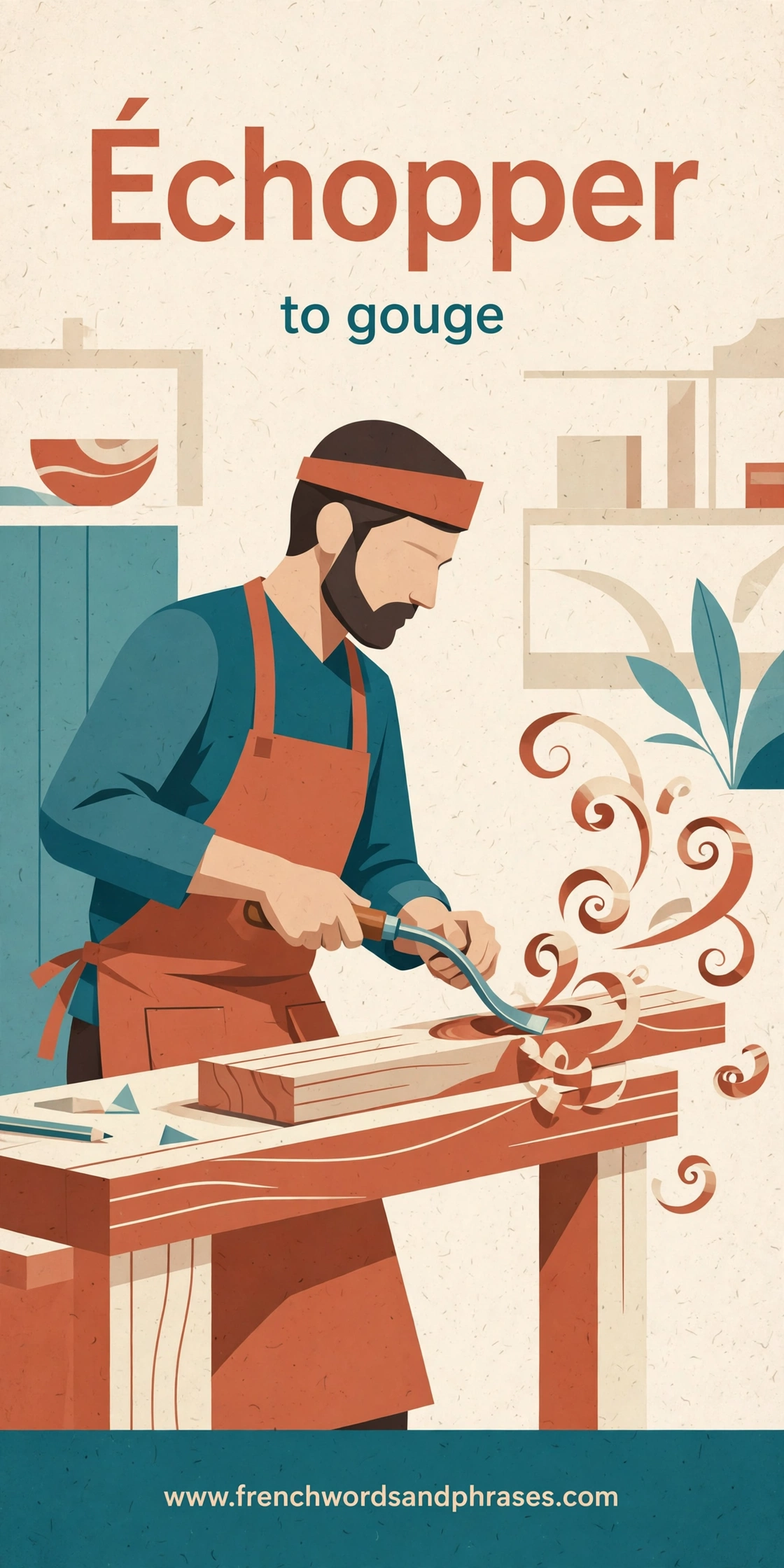
A graver’s chisel biting into copper, a leatherworker cutting a clean groove for the stitching, the tiny tool that gives the verb its name — échopper is the craftsman’s verb for gouging with the échoppe: small strokes, deep precision.
In this guide, you’ll learn how to conjugate échopper in all the major French tenses and moods. Explore complete conjugation tables, French examples, English translations, and practice quizzes.
Understanding the French Verb Échopper
Échopper is a regular French verb belonging to the first group of verbs, those ending in -er.
It means to gouge. It is commonly used in engraving for cutting lines into copper and wood, in leatherwork for grooving and trimming hides, and in traditional crafts wherever a small sharp tool gouges a clean line.
Verb classification: First group (-er)
Auxiliary verb: Avoir
Past participle: échoppé
Present participle: échoppant
English equivalents: To gouge, to cut with a graver; une échoppe — a burin, a small engraving chisel (the same word also means a market stall).
One important detail: échopper is the verb of une échoppe, the engraver’s and leatherworker’s small chisel — not the other échoppe, the street stall, though the two words share a long history. Engravers échoppent the copper plate line by line before printing; leatherworkers échoppent grooves for the stitches. The double p is faithful in every form: j’échoppe, nous échoppons, past participle échoppé.
Experience the Word
Échopper is the verb of the controlled cut — the hand guides, the tool bites, the line appears.
Imagine an engraver’s bench by a north-facing window. The copper plate is warm from his hand; the échoppe moves in tiny pushes, and a face slowly appears in the metal, one gouged line at a time.
Nothing here is carved in grand gestures. It is gouged — patiently, precisely, line by line.
How to Conjugate Échopper: Complete French Conjugation Guide
Let’s explore every major conjugation of échopper, beginning with the indicative mood.
How to Conjugate Échopper in the Indicative Mood
The indicative mood is used to express facts, observations, actions, and events.
How to Conjugate Échopper in the Present Tense (Présent)
Used for actions happening now, habitual actions, and general truths.
| Subject | Conjugation |
|---|---|
| je | échoppe |
| tu | échoppes |
| il / elle | échoppe |
| nous | échoppons |
| vous | échoppez |
| ils / elles | échoppent |
Example
Le graveur échoppe la plaque de cuivre avec lenteur.
The engraver gouges the copper plate slowly.
Quick Quiz 1
Complete the sentence:
Nous ______ le bois pour la gravure.
Reveal the answer
échoppons
Nous échoppons le bois pour la gravure.
We gouge the wood for the print.
How to Conjugate Échopper in the Passé Composé
Used for completed actions in the past. Échopper takes the auxiliary verb avoir.
| Subject | Conjugation |
|---|---|
| j’ | ai échoppé |
| tu | as échoppé |
| il / elle | a échoppé |
| nous | avons échoppé |
| vous | avez échoppé |
| ils / elles | ont échoppé |
Example
Il a échoppé les contours du portrait ce matin.
He gouged the outlines of the portrait this morning.
How to Conjugate Échopper in the Imparfait (Imperfect Tense)
Used for habitual past actions, descriptions, and ongoing situations in the past.
| Subject | Conjugation |
|---|---|
| je | échoppais |
| tu | échoppais |
| il / elle | échoppait |
| nous | échoppions |
| vous | échoppiez |
| ils / elles | échoppaient |
Example
Autrefois, les artisans échoppaient le cuir à la main.
In the old days, craftsmen used to gouge the leather by hand.
Quick Quiz 2
Choose the correct form:
He gouged the outlines.
Il ______ les contours. (a échoppé / est échoppé)
Reveal the answer
a échoppé
Il a échoppé les contours.
Échopper takes avoir.
How to Conjugate Échopper in the Plus-que-parfait
Used to describe an action that had already been completed before another past event.
| Subject | Conjugation |
|---|---|
| j’ | avais échoppé |
| tu | avais échoppé |
| il / elle | avait échoppé |
| nous | avions échoppé |
| vous | aviez échoppé |
| ils / elles | avaient échoppé |
Example
Elle avait échoppé la rainure avant de coudre.
She had gouged the groove before stitching.
How to Conjugate Échopper in the Passé Simple
Primarily used in formal writing, literature, and historical narratives. It is rarely used in everyday conversation.
| Subject | Conjugation |
|---|---|
| je | échoppai |
| tu | échoppas |
| il / elle | échoppa |
| nous | échoppâmes |
| vous | échoppâtes |
| ils / elles | échoppèrent |
Example
Le maître échoppa la planche en une après-midi.
The master gouged the plate in one afternoon.
How to Conjugate Échopper in the Passé Antérieur
A literary tense used to express an action completed immediately before another past action, generally in the passé simple.
| Subject | Conjugation |
|---|---|
| j’ | eus échoppé |
| tu | eus échoppé |
| il / elle | eut échoppé |
| nous | eûmes échoppé |
| vous | eûtes échoppé |
| ils / elles | eurent échoppé |
Example
Quand il eut échoppé les lettres, il encra la plaque.
When he had gouged the letters, he inked the plate.
How to Conjugate Échopper in the Future Tense (Futur Simple)
Used to describe actions that will take place in the future.
| Subject | Conjugation |
|---|---|
| je | échopperai |
| tu | échopperas |
| il / elle | échoppera |
| nous | échopperons |
| vous | échopperez |
| ils / elles | échopperont |
Example
Demain, nous échopperons le bois pour la gravure.
Tomorrow, we will gouge the wood for the print.
How to Conjugate Échopper in the Futur Antérieur (Future Perfect)
Used for an action that will have been completed before a particular point in the future.
| Subject | Conjugation |
|---|---|
| j’ | aurai échoppé |
| tu | auras échoppé |
| il / elle | aura échoppé |
| nous | aurons échoppé |
| vous | aurez échoppé |
| ils / elles | auront échoppé |
Example
À la fin du cours, vous aurez échoppé votre première plaque.
By the end of the course, you will have gouged your first plate.
How to Conjugate Échopper in the Near Future (Futur Proche)
Used to describe something that is going to happen soon. Formed with aller + infinitive.
| Subject | Conjugation |
|---|---|
| je | vais échopper |
| tu | vas échopper |
| il / elle | va échopper |
| nous | allons échopper |
| vous | allez échopper |
| ils / elles | vont échopper |
Example
Je vais échopper une rainure dans ce cuir.
I am going to gouge a groove in this leather.
How to Conjugate Échopper in the Conditional Mood
The conditional mood expresses what would happen under certain circumstances. It is also frequently used to make polite requests or express wishes.
How to Conjugate Échopper in the Present Conditional
| Subject | Conjugation |
|---|---|
| je | échopperais |
| tu | échopperais |
| il / elle | échopperait |
| nous | échopperions |
| vous | échopperiez |
| ils / elles | échopperaient |
Example
Avec un outil plus fin, on échopperait des lignes plus nettes.
With a finer tool, we would gouge cleaner lines.
How to Conjugate Échopper in the Past Conditional
| Subject | Conjugation |
|---|---|
| j’ | aurais échoppé |
| tu | aurais échoppé |
| il / elle | aurait échoppé |
| nous | aurions échoppé |
| vous | auriez échoppé |
| ils / elles | auraient échoppé |
Example
Il aurait échoppé la plaque si sa main n’avait pas tremblé.
He would have gouged the plate if his hand had not shaken.
Échopper in the Literary Past Conditional Form
This less common literary form uses the imperfect subjunctive of avoir.
| Subject | Conjugation |
|---|---|
| j’ | eusse échoppé |
| tu | eusses échoppé |
| il / elle | eût échoppé |
| nous | eussions échoppé |
| vous | eussiez échoppé |
| ils / elles | eussent échoppé |
Example
Le graveur eût échoppé le cuivre toute la nuit.
The engraver would have gouged the copper all night.
How to Conjugate Échopper in the Subjunctive Mood
The subjunctive is used to express wishes, emotions, doubts, necessity, and uncertainty. It frequently follows expressions such as il faut que (it is necessary that) or bien que (although).
How to Conjugate Échopper in the Present Subjunctive
| Subject | Conjugation |
|---|---|
| que je | échoppe |
| que tu | échoppes |
| qu’il / qu’elle | échoppe |
| que nous | échoppions |
| que vous | échoppiez |
| qu’ils / qu’elles | échoppent |
Example
Il faut que tu échoppes doucement, sans forcer.
You must gouge gently, without forcing.
Quick Quiz 3
Complete the sentence using the subjunctive:
Il faut que vous ______ sans forcer.
Reveal the answer
échoppiez
Il faut que vous échoppiez sans forcer.
You must gouge without forcing.
How to Conjugate Échopper in the Imperfect Subjunctive
A literary tense, rarely encountered in modern spoken French.
| Subject | Conjugation |
|---|---|
| que je | échoppasse |
| que tu | échoppasses |
| qu’il / qu’elle | échoppât |
| que nous | échoppassions |
| que vous | échoppassiez |
| qu’ils / qu’elles | échoppassent |
Example
Le maître voulait que l’apprenti échoppât sa propre planche.
The master wanted the apprentice to gouge his own plate.
How to Conjugate Échopper in the Pluperfect Subjunctive
A literary construction used to express an action completed before another past action.
| Subject | Conjugation |
|---|---|
| que j’ | eusse échoppé |
| que tu | eusses échoppé |
| qu’il / qu’elle | eût échoppé |
| que nous | eussions échoppé |
| que vous | eussiez échoppé |
| qu’ils / qu’elles | eussent échoppé |
Example
On admirait qu’il eût échoppé des lignes si fines.
People admired that he had gouged such fine lines.
How to Conjugate Échopper in the Past Subjunctive
| Subject | Conjugation |
|---|---|
| que j’ | aie échoppé |
| que tu | aies échoppé |
| qu’il / qu’elle | ait échoppé |
| que nous | ayons échoppé |
| que vous | ayez échoppé |
| qu’ils / qu’elles | aient échoppé |
Example
Je suis fier que tu aies échoppé cette plaque seul.
I am proud that you gouged this plate on your own.
How to Conjugate Échopper in the Imperative
The imperative is used to give commands, instructions, invitations, or suggestions. Subject pronouns are omitted.
How to Conjugate Échopper in the Present Imperative
| Person | Conjugation |
|---|---|
| (tu) | échoppe |
| (nous) | échoppons |
| (vous) | échoppez |
Example
Échoppe lentement, la ligne doit rester nette !
Gouge slowly, the line must stay clean!
Quick Quiz 4
How would you say Gouge slowly (tu form)?
Reveal the answer
Échoppe lentement !
French Participles of Échopper
Participles are verb forms that can be used in compound tenses and other grammatical constructions.
Present Participle of Échopper
échoppant
En échoppant le cuivre, il écoutait la radio.
While gouging the copper, he listened to the radio.
Past Participle of Échopper
échoppé
Échoppée avec soin, la plaque donne une image parfaite.
Gouged with care, the plate gives a perfect image.
Échopper in Everyday French: Real-Life Examples
Now that you know the conjugations, let’s see how échopper appears in everyday French.
Example 1 — Present
Le graveur échoppe le cuivre chaque matin.
The engraver gouges the copper every morning.
Example 2 — Passé composé
Elle a échoppé une rainure dans le cuir.
She gouged a groove in the leather.
Example 3 — Imparfait
Les artisans échoppaient le bois à la main.
The craftsmen used to gouge the wood by hand.
Example 4 — Future
Nous échopperons la planche demain.
We will gouge the plate tomorrow.
Example 5 — Conditional
Tu échopperais plus droit avec ce guide.
You would gouge straighter with this guide.
Example 6 — Imperative
Échoppez doucement, sans forcer !
Gouge gently, without forcing!
Beyond Translation: The Meaning of Échopper
English gouge sounds rough, almost violent; French échopper is gouging as an art form.
The tool is small, the lines are fine.
Every print in an old book began this way: a hand, an échoppe, and a copper plate slowly learning to hold a picture in its grooves.
How to Remember the French Verb Échopper
Remember it this way: Échopper is about the graver’s small chisel — lines gouged patiently into copper.
- Une échoppe — the graver’s little chisel: échopper is to work with it.
- Mind the other échoppe: the same spelling also means a market stall.
- Regular -er with double p: j’échoppe, nous échoppons, past participle échoppé.
The key idea is the graver’s small chisel — lines gouged patiently into copper.
Test Your Knowledge of Échopper
Let’s see how much you’ve learned. Try answering these questions before revealing the answers.
Question 1
What is une échoppe, the tool?
Reveal the answer
A burin — the engraver’s small chisel that gives échopper its name.
Question 2
How do you say The engraver gouges the copper plate in French?
Reveal the answer
Le graveur échoppe la plaque de cuivre.
Question 3
Translate: She gouged a groove in the leather.
Reveal the answer
Elle a échoppé une rainure dans le cuir.
Question 4
What is the past participle of échopper?
Reveal the answer
Échoppé.
Question 5
Complete the sentence:
Il faut que tu ______ doucement, sans forcer.
Reveal the answer
échoppes
Il faut que tu échoppes doucement, sans forcer.
You must gouge gently, without forcing.
Your Final Challenge
Can You Use It?
How would you say this in French?
The engraver gouges the copper plate, and the portrait is born line by line.
Reveal the answer
Le graveur échoppe la plaque de cuivre, et le portrait naît ligne par ligne.
The engraver gouges the copper plate, and the portrait is born line by line.
A little French. A little curiosity. A richer everyday life.
LEARN FRENCH ONE WORD AT A TIME




