A French Word to Live By
How to Conjugate Échiner in French
/e.ʃi.ne/
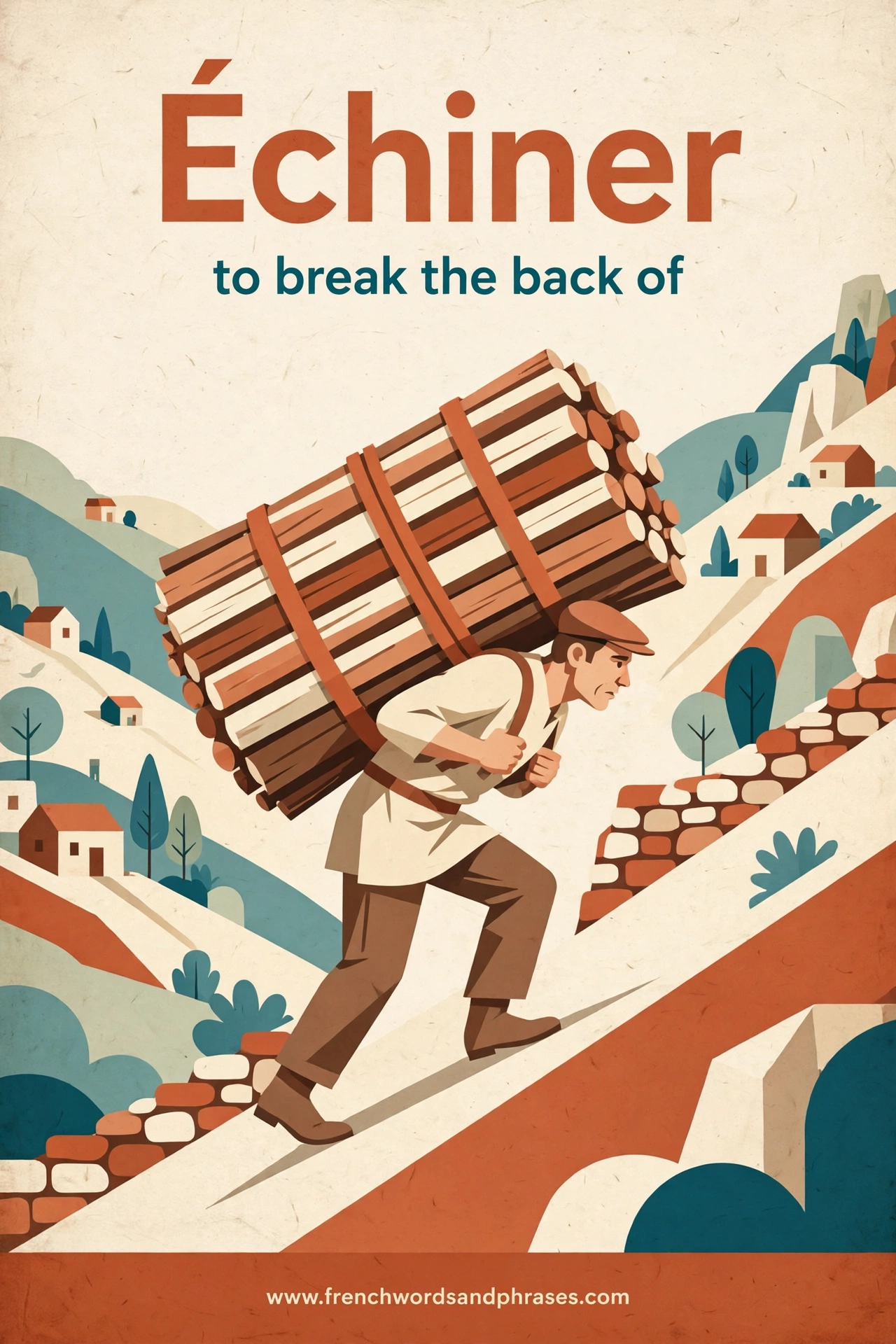
Échiner means to break the back of.
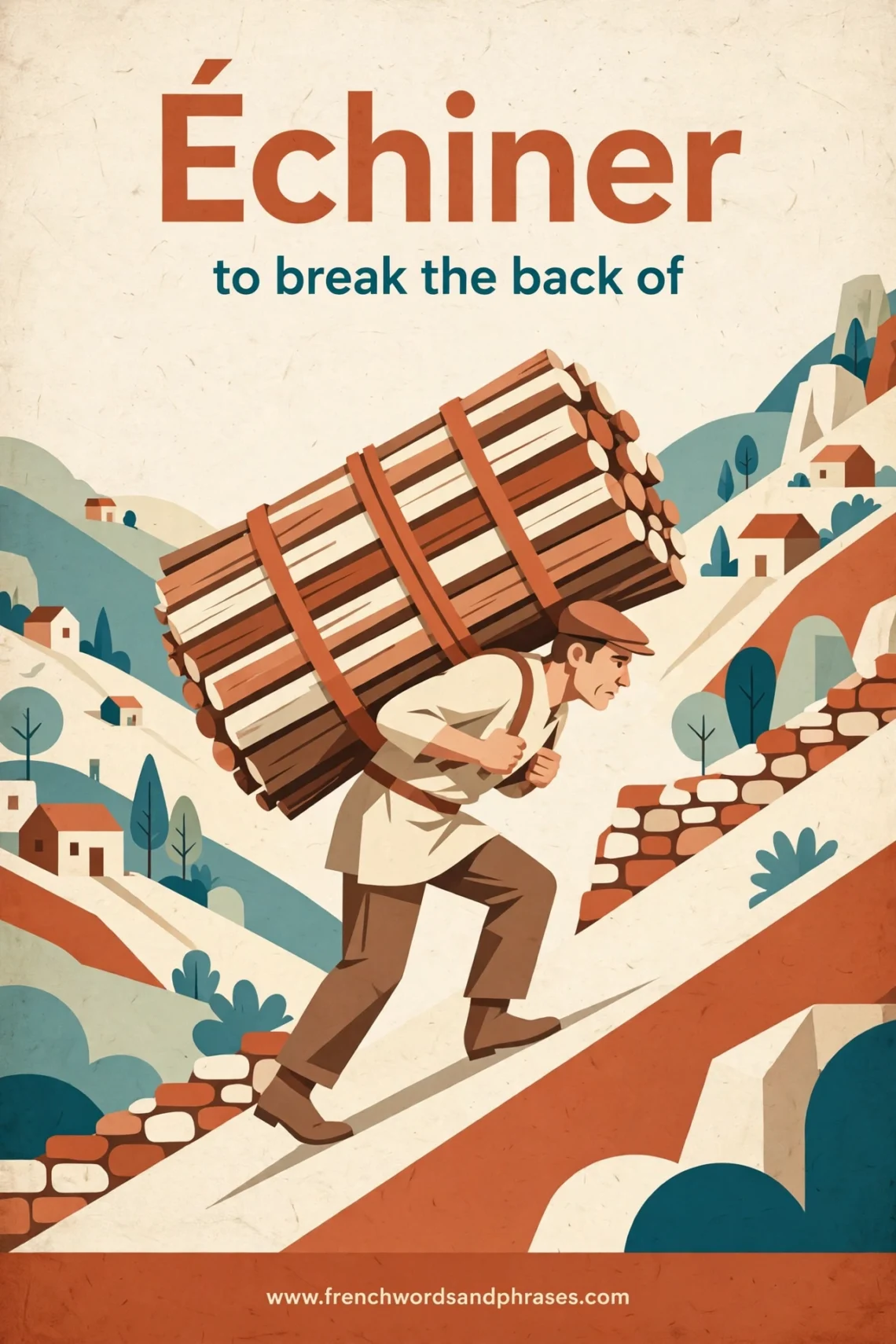
A porter bent double under a trunk, a horse worked until its back gives, a labourer wrecking his spine on someone else’s load — échiner is the harsh verb of breaking backs; and in its reflexive form, s’échiner, of breaking your own with work.
In this guide, you’ll learn how to conjugate échiner in all the major French tenses and moods. Explore complete conjugation tables, French examples, English translations, and practice quizzes.
Understanding the French Verb Échiner
Échiner is a regular French verb belonging to the first group of verbs, those ending in -er.
It means to break the back of. It is commonly used in the reflexive for exhausting labour and thankless effort (s’échiner pour rien — to slave away for nothing), for porters, movers and harvesters under heavy loads, and in complaints about work that ruins the body.
Verb classification: First group (-er)
Auxiliary verb: Avoir
Past participle: échiné
Present participle: échinant
English equivalents: To break the back of, to work (someone) to exhaustion; s’échiner — to wear oneself out, to slave away; l’échine — the spine, the backbone.
One important detail: échiner is built on l’échine, the spine — and modern French mostly uses it backwards, in the reflexive: s’échiner au travail, to slave away, to break your own back working; je m’échine à te le répéter, I wear myself out repeating it to you. The plain transitive — échiner un cheval, to break a horse’s back with loads — survives in older and crueller contexts. Either way, the spine pays. The verb is a regular -er: j’échine, nous échinons.
Experience the Word
Échiner is the verb of the load too heavy — effort measured in vertebrae.
Imagine the removal men on a fifth-floor staircase in August, a piano on straps between them. Step by step they s’échinent — nobody speaks, everybody counts the landings.
The piano will arrive, of course. The question is what their backs will pay for the journey.
How to Conjugate Échiner: Complete French Conjugation Guide
Let’s explore every major conjugation of échiner, beginning with the indicative mood.
How to Conjugate Échiner in the Indicative Mood
The indicative mood is used to express facts, observations, actions, and events.
How to Conjugate Échiner in the Present Tense (Présent)
Used for actions happening now, habitual actions, and general truths.
| Subject | Conjugation |
|---|---|
| je | échine |
| tu | échines |
| il / elle | échine |
| nous | échinons |
| vous | échinez |
| ils / elles | échinent |
Example
Ce travail échine les ouvriers en quelques mois.
This work breaks the workers’ backs in a few months.
Quick Quiz 1
Complete the sentence:
Ce travail ______ les ouvriers.
Reveal the answer
échine
Ce travail échine les ouvriers.
This work breaks the workers’ backs.
How to Conjugate Échiner in the Passé Composé
Used for completed actions in the past. Échiner takes the auxiliary verb avoir.
| Subject | Conjugation |
|---|---|
| j’ | ai échiné |
| tu | as échiné |
| il / elle | a échiné |
| nous | avons échiné |
| vous | avez échiné |
| ils / elles | ont échiné |
Example
Il a échiné son cheval avec des charges trop lourdes.
He broke his horse’s back with loads that were too heavy.
How to Conjugate Échiner in the Imparfait (Imperfect Tense)
Used for habitual past actions, descriptions, and ongoing situations in the past.
| Subject | Conjugation |
|---|---|
| je | échinais |
| tu | échinais |
| il / elle | échinait |
| nous | échinions |
| vous | échiniez |
| ils / elles | échinaient |
Example
Les porteurs échinaient leurs bêtes sur les cols de montagne.
The porters used to break their animals’ backs on the mountain passes.
Quick Quiz 2
Choose the correct form:
She slaved away at this report.
Elle ______ sur ce rapport. (s’est échinée / a échinée)
Reveal the answer
s’est échinée
Elle s’est échinée sur ce rapport.
S’échiner is reflexive.
How to Conjugate Échiner in the Plus-que-parfait
Used to describe an action that had already been completed before another past event.
| Subject | Conjugation |
|---|---|
| j’ | avais échiné |
| tu | avais échiné |
| il / elle | avait échiné |
| nous | avions échiné |
| vous | aviez échiné |
| ils / elles | avaient échiné |
Example
Ils avaient échiné l’équipe avant même la récolte.
They had worked the team’s backs to breaking point even before the harvest.
How to Conjugate Échiner in the Passé Simple
Primarily used in formal writing, literature, and historical narratives. It is rarely used in everyday conversation.
| Subject | Conjugation |
|---|---|
| je | échinai |
| tu | échinas |
| il / elle | échina |
| nous | échinâmes |
| vous | échinâtes |
| ils / elles | échinèrent |
Example
Le maître échina ses porteurs pendant tout l’été.
The master broke his porters’ backs all summer long.
How to Conjugate Échiner in the Passé Antérieur
A literary tense used to express an action completed immediately before another past action, generally in the passé simple.
| Subject | Conjugation |
|---|---|
| j’ | eus échiné |
| tu | eus échiné |
| il / elle | eut échiné |
| nous | eûmes échiné |
| vous | eûtes échiné |
| ils / elles | eurent échiné |
Example
Quand il eut échiné deux chevaux, on lui retira les transports.
When he had broken two horses’ backs, they took the transport work away from him.
How to Conjugate Échiner in the Future Tense (Futur Simple)
Used to describe actions that will take place in the future.
| Subject | Conjugation |
|---|---|
| je | échinerai |
| tu | échineras |
| il / elle | échinera |
| nous | échinerons |
| vous | échinerez |
| ils / elles | échineront |
Example
Ce chantier échinera les maçons si rien ne change.
This building site will break the masons’ backs if nothing changes.
How to Conjugate Échiner in the Futur Antérieur (Future Perfect)
Used for an action that will have been completed before a particular point in the future.
| Subject | Conjugation |
|---|---|
| j’ | aurai échiné |
| tu | auras échiné |
| il / elle | aura échiné |
| nous | aurons échiné |
| vous | aurez échiné |
| ils / elles | auront échiné |
Example
À ce rythme, ils auront échiné toute l’équipe avant l’hiver.
At this rate, they will have broken the whole team’s backs before winter.
How to Conjugate Échiner in the Near Future (Futur Proche)
Used to describe something that is going to happen soon. Formed with aller + infinitive.
| Subject | Conjugation |
|---|---|
| je | vais échiner |
| tu | vas échiner |
| il / elle | va échiner |
| nous | allons échiner |
| vous | allez échiner |
| ils / elles | vont échiner |
Example
Je vais m’échiner sur ce dossier toute la nuit.
I am going to slave away at this file all night.
How to Conjugate Échiner in the Conditional Mood
The conditional mood expresses what would happen under certain circumstances. It is also frequently used to make polite requests or express wishes.
How to Conjugate Échiner in the Present Conditional
| Subject | Conjugation |
|---|---|
| je | échinerais |
| tu | échinerais |
| il / elle | échinerait |
| nous | échinerions |
| vous | échineriez |
| ils / elles | échineraient |
Example
Un bon chef n’échinerait jamais ses hommes ainsi.
A good boss would never break his men’s backs like that.
How to Conjugate Échiner in the Past Conditional
| Subject | Conjugation |
|---|---|
| j’ | aurais échiné |
| tu | aurais échiné |
| il / elle | aurait échiné |
| nous | aurions échiné |
| vous | auriez échiné |
| ils / elles | auraient échiné |
Example
Elle se serait échinée pour rien sans ton aide.
She would have slaved away for nothing without your help.
Échiner in the Literary Past Conditional Form
This less common literary form uses the imperfect subjunctive of avoir.
| Subject | Conjugation |
|---|---|
| j’ | eusse échiné |
| tu | eusses échiné |
| il / elle | eût échiné |
| nous | eussions échiné |
| vous | eussiez échiné |
| ils / elles | eussent échiné |
Example
Le contremaître eût échiné ses porteurs sans la loi nouvelle.
The foreman would have broken his porters’ backs without the new law.
How to Conjugate Échiner in the Subjunctive Mood
The subjunctive is used to express wishes, emotions, doubts, necessity, and uncertainty. It frequently follows expressions such as il faut que (it is necessary that) or bien que (although).
How to Conjugate Échiner in the Present Subjunctive
| Subject | Conjugation |
|---|---|
| que je | échine |
| que tu | échines |
| qu’il / qu’elle | échine |
| que nous | échinions |
| que vous | échiniez |
| qu’ils / qu’elles | échinent |
Example
Il ne faut pas que ce métier échine les jeunes.
This trade must not break young people’s backs.
Quick Quiz 3
Complete the sentence using the subjunctive:
Il ne faut pas que vous ______ vos porteurs.
Reveal the answer
échiniez
Il ne faut pas que vous échiniez vos porteurs.
You must not break your porters’ backs.
How to Conjugate Échiner in the Imperfect Subjunctive
A literary tense, rarely encountered in modern spoken French.
| Subject | Conjugation |
|---|---|
| que je | échinasse |
| que tu | échinasses |
| qu’il / qu’elle | échinât |
| que nous | échinassions |
| que vous | échinassiez |
| qu’ils / qu’elles | échinassent |
Example
On craignait que le chantier échinât les maçons.
People feared the site might break the masons’ backs.
How to Conjugate Échiner in the Pluperfect Subjunctive
A literary construction used to express an action completed before another past action.
| Subject | Conjugation |
|---|---|
| que j’ | eusse échiné |
| que tu | eusses échiné |
| qu’il / qu’elle | eût échiné |
| que nous | eussions échiné |
| que vous | eussiez échiné |
| qu’ils / qu’elles | eussent échiné |
Example
Il regrettait qu’on eût échiné les chevaux du village.
He regretted that the village horses’ backs had been broken.
How to Conjugate Échiner in the Past Subjunctive
| Subject | Conjugation |
|---|---|
| que j’ | aie échiné |
| que tu | aies échiné |
| qu’il / qu’elle | ait échiné |
| que nous | ayons échiné |
| que vous | ayez échiné |
| qu’ils / qu’elles | aient échiné |
Example
Je suis triste qu’il se soit échiné pour si peu.
I am sad that he slaved away for so little.
How to Conjugate Échiner in the Imperative
The imperative is used to give commands, instructions, invitations, or suggestions. Subject pronouns are omitted.
How to Conjugate Échiner in the Present Imperative
| Person | Conjugation |
|---|---|
| (tu) | échine |
| (nous) | échinons |
| (vous) | échinez |
Example
N’échine pas tes hommes, ménage-les !
Do not break your men’s backs, spare them!
Quick Quiz 4
How would you say Do not wear yourself out (tu form)?
Reveal the answer
Ne t’échine pas !
French Participles of Échiner
Participles are verb forms that can be used in compound tenses and other grammatical constructions.
Present Participle of Échiner
échinant
En échinant ses porteurs, il a fini par manquer de bras.
By breaking his porters’ backs, he ended up short of hands.
Past Participle of Échiner
échiné
Échiné par des années de chantier, il marche lentement.
His back broken by years on building sites, he walks slowly.
Échiner in Everyday French: Real-Life Examples
Now that you know the conjugations, let’s see how échiner appears in everyday French.
Example 1 — Present
Je m’échine au travail depuis l’aube.
I have been slaving away at work since dawn.
Example 2 — Passé composé
Elle s’est échinée sur ce rapport toute la semaine.
She slaved away at this report all week.
Example 3 — Imparfait
Les déménageurs s’échinaient dans l’escalier.
The removal men used to break their backs on the staircase.
Example 4 — Future
Tu t’échineras pour rien si tu continues ainsi.
You will slave away for nothing if you go on like this.
Example 5 — Conditional
On s’échinerait moins avec une machine.
We would break our backs less with a machine.
Example 6 — Imperative
Ne t’échine pas pour si peu !
Do not wear yourself out for so little!
Beyond Translation: The Meaning of Échiner
English to break someone’s back is mostly a threat or a metaphor; French échiner keeps the spine in plain view — and then turns the verb on the worker himself.
S’échiner is the honest version.
Nobody needs to échiner you in modern French life: je m’échine — I am breaking my own back, slaving away — usually at something thankless, and usually said with a sigh.
How to Remember the French Verb Échiner
Remember it this way: Échiner is about the spine pays — breaking backs, and breaking your own with work.
- L’échine — the spine: échiner is about what a load does to a spine.
- S’échiner — to slave away, to break your own back working: je m’échine pour rien.
- Regular -er: j’échine, nous échinons, past participle échiné.
The key idea is the spine pays — breaking backs, and breaking your own with work.
Test Your Knowledge of Échiner
Let’s see how much you’ve learned. Try answering these questions before revealing the answers.
Question 1
What does s’échiner mean?
Reveal the answer
To slave away — to wear yourself out working, literally to break your own back.
Question 2
How do you say I slave away for nothing in French?
Reveal the answer
Je m’échine pour rien.
Question 3
Translate: This work breaks the workers’ backs.
Reveal the answer
Ce travail échine les ouvriers.
Question 4
What is the past participle of échiner?
Reveal the answer
Échiné.
Question 5
Complete the sentence:
Il ne faut pas que ce métier ______ les jeunes.
Reveal the answer
échine
Il ne faut pas que ce métier échine les jeunes.
This trade must not break young people’s backs.
Your Final Challenge
Can You Use It?
How would you say this in French?
He has been slaving away at work since dawn, and by evening he can barely stand.
Reveal the answer
Il s’échine au travail depuis l’aube, et le soir, il tient à peine debout.
He has been slaving away at work since dawn, and by evening he can barely stand.
A little French. A little curiosity. A richer everyday life.
LEARN FRENCH ONE WORD AT A TIME