A French Word to Live By
How to Conjugate Écacher in French
/e.ka.ʃe/
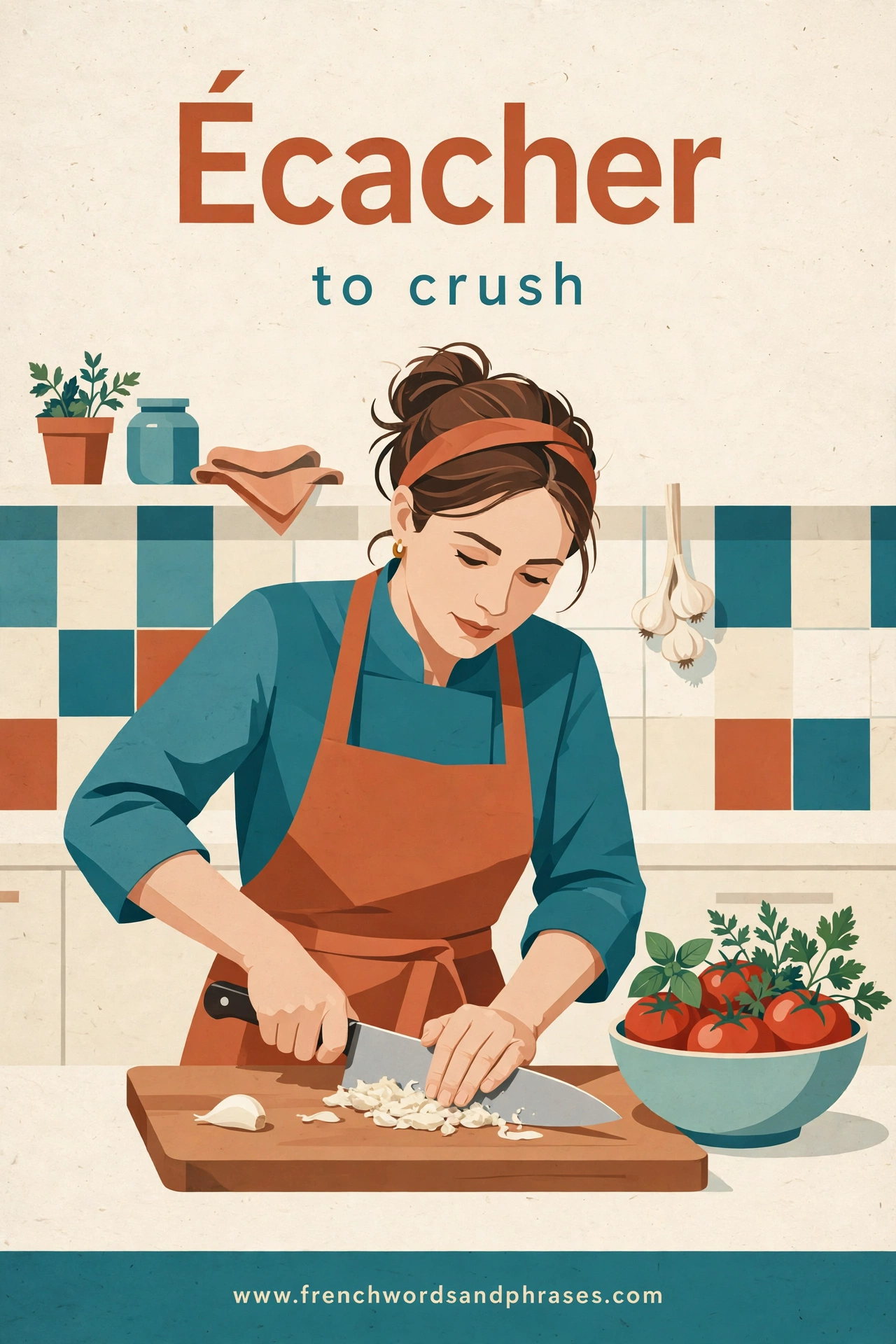
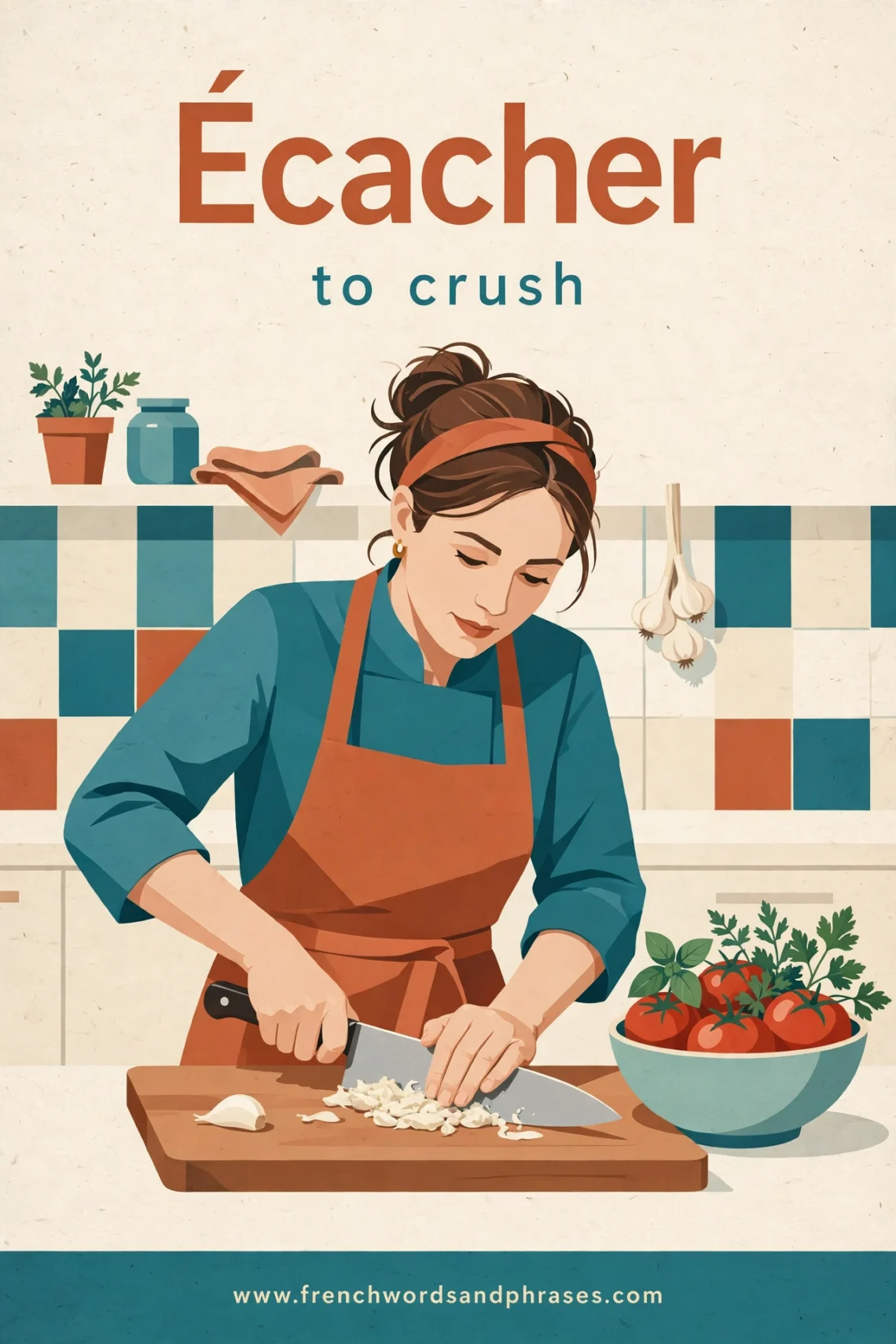
Écacher means to crush — to squash something soft flat.
A garlic clove flattened under the broad side of a knife, a ripe tomato giving way under a fork, walnuts cracked beneath a grandmother’s heel — écacher is the older, homelier verb for crushing soft things flat, the rustic cousin of écraser.
In this guide, you’ll learn how to conjugate écacher in all the major French tenses and moods. Explore complete conjugation tables, French examples, English translations, and practice quizzes.
Understanding the French Verb Écacher
Écacher is a regular French verb belonging to the first group of verbs, those ending in -er.
It means to crush. It is commonly used for crushing garlic, fruit and vegetables in cooking, for squashing small soft things underfoot, and in descriptions of faces — un nez écaché, des traits écachés — where it means flattened by a blow or by nature.
Verb classification: First group (-er)
Auxiliary verb: Avoir
Past participle: écaché
Present participle: écachant
English equivalents: To crush, to squash flat; un nez écaché — a squashed, flattened nose (a boxer’s or a bulldog’s nose).
One important detail: écacher is the older and regional cousin of écraser — same meaning, to squash flat, but you will meet it more in older writing, in the countryside and in set descriptions than in a modern office. Its most famous survivor is un nez écaché, the flattened, squashed nose of a boxer or a bulldog. Where écraser serves everywhere, écacher keeps the smell of the farmhouse kitchen and the old novel.
Experience the Word
Écacher is the verb of the soft thing meeting the hard surface — a brief resistance, then flatness.
Imagine a farmhouse kitchen a century ago. Dinner is being prepared the old way: garlic écaché under the knife’s flat side, walnuts under a heel, overripe plums under a thumb — everything crushed by hand, by weight, by habit.
Nothing is chopped or sliced. It has been crushed — pressed flat until it gives up its juice, its smell, its shape.
How to Conjugate Écacher: Complete French Conjugation Guide
Let’s explore every major conjugation of écacher, beginning with the indicative mood.
How to Conjugate Écacher in the Indicative Mood
The indicative mood is used to express facts, observations, actions, and events.
How to Conjugate Écacher in the Present Tense (Présent)
Used for actions happening now, habitual actions, and general truths.
| Subject | Conjugation |
|---|---|
| je | écache |
| tu | écaches |
| il / elle | écache |
| nous | écachons |
| vous | écachez |
| ils / elles | écachent |
Example
Il écache une gousse d’ail avec le plat du couteau.
He crushes a clove of garlic with the flat of the knife.
Quick Quiz 1
Complete the sentence:
Nous ______ les pommes de terre à la fourchette.
Reveal the answer
écachons
Nous écachons les pommes de terre à la fourchette.
We crush the potatoes with a fork.
How to Conjugate Écacher in the Passé Composé
Used for completed actions in the past. Écacher takes the auxiliary verb avoir.
| Subject | Conjugation |
|---|---|
| j’ | ai écaché |
| tu | as écaché |
| il / elle | a écaché |
| nous | avons écaché |
| vous | avez écaché |
| ils / elles | ont écaché |
Example
Elle a écaché la tomate avec une fourchette.
She crushed the tomato with a fork.
How to Conjugate Écacher in the Imparfait (Imperfect Tense)
Used for habitual past actions, descriptions, and ongoing situations in the past.
| Subject | Conjugation |
|---|---|
| je | écachais |
| tu | écachais |
| il / elle | écachait |
| nous | écachions |
| vous | écachiez |
| ils / elles | écachaient |
Example
Grand-mère écachait les noix sous son talon.
Grandmother used to crush the walnuts under her heel.
Quick Quiz 2
Choose the correct form:
She crushed the tomato.
Elle ______ la tomate. (a écaché / est écachée)
Reveal the answer
a écaché
Elle a écaché la tomate.
Écacher takes avoir.
How to Conjugate Écacher in the Plus-que-parfait
Used to describe an action that had already been completed before another past event.
| Subject | Conjugation |
|---|---|
| j’ | avais écaché |
| tu | avais écaché |
| il / elle | avait écaché |
| nous | avions écaché |
| vous | aviez écaché |
| ils / elles | avaient écaché |
Example
Le cuisinier avait écaché les épices dans le mortier.
The cook had crushed the spices in the mortar.
How to Conjugate Écacher in the Passé Simple
Primarily used in formal writing, literature, and historical narratives. It is rarely used in everyday conversation.
| Subject | Conjugation |
|---|---|
| je | écachai |
| tu | écachas |
| il / elle | écacha |
| nous | écachâmes |
| vous | écachâtes |
| ils / elles | écachèrent |
Example
D’un geste, elle écacha la prune trop mûre.
With one movement, she crushed the overripe plum.
How to Conjugate Écacher in the Passé Antérieur
A literary tense used to express an action completed immediately before another past action, generally in the passé simple.
| Subject | Conjugation |
|---|---|
| j’ | eus écaché |
| tu | eus écaché |
| il / elle | eut écaché |
| nous | eûmes écaché |
| vous | eûtes écaché |
| ils / elles | eurent écaché |
Example
Quand il eut écaché l’ail, il le jeta dans la poêle.
When he had crushed the garlic, he threw it into the pan.
How to Conjugate Écacher in the Future Tense (Futur Simple)
Used to describe actions that will take place in the future.
| Subject | Conjugation |
|---|---|
| je | écacherai |
| tu | écacheras |
| il / elle | écachera |
| nous | écacherons |
| vous | écacherez |
| ils / elles | écacheront |
Example
Tu écacheras les pommes de terre à la fourchette.
You will crush the potatoes with a fork.
How to Conjugate Écacher in the Futur Antérieur (Future Perfect)
Used for an action that will have been completed before a particular point in the future.
| Subject | Conjugation |
|---|---|
| j’ | aurai écaché |
| tu | auras écaché |
| il / elle | aura écaché |
| nous | aurons écaché |
| vous | aurez écaché |
| ils / elles | auront écaché |
Example
À ce rythme, tu auras écaché toutes les tomates avant midi.
At this rate, you will have crushed all the tomatoes before noon.
How to Conjugate Écacher in the Near Future (Futur Proche)
Used to describe something that is going to happen soon. Formed with aller + infinitive.
| Subject | Conjugation |
|---|---|
| je | vais écacher |
| tu | vas écacher |
| il / elle | va écacher |
| nous | allons écacher |
| vous | allez écacher |
| ils / elles | vont écacher |
Example
Je vais écacher ces fraises pour la confiture.
I am going to crush these strawberries for the jam.
How to Conjugate Écacher in the Conditional Mood
The conditional mood expresses what would happen under certain circumstances. It is also frequently used to make polite requests or express wishes.
How to Conjugate Écacher in the Present Conditional
| Subject | Conjugation |
|---|---|
| je | écacherais |
| tu | écacherais |
| il / elle | écacherait |
| nous | écacherions |
| vous | écacheriez |
| ils / elles | écacheraient |
Example
Avec un presse-ail, tu écacherais l’ail en une seconde.
With a garlic press, you would crush the garlic in a second.
How to Conjugate Écacher in the Past Conditional
| Subject | Conjugation |
|---|---|
| j’ | aurais écaché |
| tu | aurais écaché |
| il / elle | aurait écaché |
| nous | aurions écaché |
| vous | auriez écaché |
| ils / elles | auraient écaché |
Example
Sans le mortier, il n’aurait pas écaché les grains de poivre.
Without the mortar, he would not have crushed the peppercorns.
Écacher in the Literary Past Conditional Form
This less common literary form uses the imperfect subjunctive of avoir.
| Subject | Conjugation |
|---|---|
| j’ | eusse écaché |
| tu | eusses écaché |
| il / elle | eût écaché |
| nous | eussions écaché |
| vous | eussiez écaché |
| ils / elles | eussent écaché |
Example
Le paysan eût écaché les olives sous la meule.
The farmer would have crushed the olives under the millstone.
How to Conjugate Écacher in the Subjunctive Mood
The subjunctive is used to express wishes, emotions, doubts, necessity, and uncertainty. It frequently follows expressions such as il faut que (it is necessary that) or bien que (although).
How to Conjugate Écacher in the Present Subjunctive
| Subject | Conjugation |
|---|---|
| que je | écache |
| que tu | écaches |
| qu’il / qu’elle | écache |
| que nous | écachions |
| que vous | écachiez |
| qu’ils / qu’elles | écachent |
Example
Il faut que tu écaches bien les avocats pour le guacamole.
You must crush the avocados well for the guacamole.
Quick Quiz 3
Complete the sentence using the subjunctive:
Il faut que vous ______ les avocats.
Reveal the answer
écachiez
Il faut que vous écachiez les avocats.
You must crush the avocados.
How to Conjugate Écacher in the Imperfect Subjunctive
A literary tense, rarely encountered in modern spoken French.
| Subject | Conjugation |
|---|---|
| que je | écachasse |
| que tu | écachasses |
| qu’il / qu’elle | écachât |
| que nous | écachassions |
| que vous | écachassiez |
| qu’ils / qu’elles | écachassent |
Example
Elle voulait que l’on écachât les noix avant le dîner.
She wanted the walnuts to be crushed before dinner.
How to Conjugate Écacher in the Pluperfect Subjunctive
A literary construction used to express an action completed before another past action.
| Subject | Conjugation |
|---|---|
| que j’ | eusse écaché |
| que tu | eusses écaché |
| qu’il / qu’elle | eût écaché |
| que nous | eussions écaché |
| que vous | eussiez écaché |
| qu’ils / qu’elles | eussent écaché |
Example
Il regrettait qu’on eût écaché les fleurs du jardin.
He regretted that the garden flowers had been crushed.
How to Conjugate Écacher in the Past Subjunctive
| Subject | Conjugation |
|---|---|
| que j’ | aie écaché |
| que tu | aies écaché |
| qu’il / qu’elle | ait écaché |
| que nous | ayons écaché |
| que vous | ayez écaché |
| qu’ils / qu’elles | aient écaché |
Example
Je suis content que vous ayez écaché l’ail, pas haché.
I am glad you crushed the garlic, not chopped it.
How to Conjugate Écacher in the Imperative
The imperative is used to give commands, instructions, invitations, or suggestions. Subject pronouns are omitted.
How to Conjugate Écacher in the Present Imperative
| Person | Conjugation |
|---|---|
| (tu) | écache |
| (nous) | écachons |
| (vous) | écachez |
Example
Écache les bananes pour le gâteau !
Crush the bananas for the cake!
Quick Quiz 4
How would you say Crush the bananas (tu form)?
Reveal the answer
Écache les bananes !
French Participles of Écacher
Participles are verb forms that can be used in compound tenses and other grammatical constructions.
Present Participle of Écacher
écachant
En écachant la tomate, il a éclaboussé sa chemise.
While crushing the tomato, he splashed his shirt.
Past Participle of Écacher
écaché
Écaché sous la botte, le champignon n’était plus qu’une tache.
Crushed under the boot, the mushroom was no more than a stain.
Écacher in Everyday French: Real-Life Examples
Now that you know the conjugations, let’s see how écacher appears in everyday French.
Example 1 — Present
On écache l’ail avec le plat du couteau.
We crush the garlic with the flat of the knife.
Example 2 — Passé composé
Elle a écaché les fraises pour la confiture.
She crushed the strawberries for the jam.
Example 3 — Imparfait
Grand-père écachait les noix sous son talon.
Grandfather used to crush walnuts under his heel.
Example 4 — Future
Nous écacherons les pommes de terre à la fourchette.
We will crush the potatoes with a fork.
Example 5 — Conditional
Tu écacherais cet avocat pour moi ?
Would you crush this avocado for me?
Example 6 — Imperative
Écache les bananes bien mûres !
Crush the ripe bananas!
Beyond Translation: The Meaning of Écacher
English crush is a strong, modern word; French keeps two registers of squashing — écraser for the everyday, écacher for the old kitchen and the old book.
Choosing écacher is choosing a flavour.
Say un nez écaché and you are in a Balzac novel; say it of the garlic and you are in a farmhouse where crushing is done by hand, as it always has been.
How to Remember the French Verb Écacher
Remember it this way: Écacher is about the homely crush — garlic under the knife, walnuts under the heel.
- Un nez écaché — a squashed, flattened nose: the phrase where écacher survives best.
- Écacher is the older, rustic twin of écraser — same crush, older flavour.
- Regular -er: j’écache, nous écachons, past participle écaché.
The key idea is the homely crush — garlic under the knife, walnuts under the heel.
Test Your Knowledge of Écacher
Let’s see how much you’ve learned. Try answering these questions before revealing the answers.
Question 1
What does un nez écaché describe?
Reveal the answer
A squashed, flattened nose — like a boxer’s or a bulldog’s.
Question 2
How do you say She crushed the strawberries for the jam in French?
Reveal the answer
Elle a écaché les fraises pour la confiture.
Question 3
Translate: Grandmother used to crush the walnuts under her heel.
Reveal the answer
Grand-mère écachait les noix sous son talon.
Question 4
What is the past participle of écacher?
Reveal the answer
Écaché.
Question 5
Complete the sentence:
Il faut que tu ______ bien les avocats.
Reveal the answer
écaches
Il faut que tu écaches bien les avocats.
You must crush the avocados well.
Your Final Challenge
Can You Use It?
How would you say this in French?
She crushes the garlic, the tomatoes and the walnuts, and the old kitchen fills with scent.
Reveal the answer
Elle écache l’ail, les tomates et les noix, et la vieille cuisine embaume.
She crushes the garlic, the tomatoes and the walnuts, and the old kitchen fills with scent.
A little French. A little curiosity. A richer everyday life.
LEARN FRENCH ONE WORD AT A TIME