A French Word to Live By
How to Conjugate Méditer in French
/me.di.te/
Méditer means to meditate.
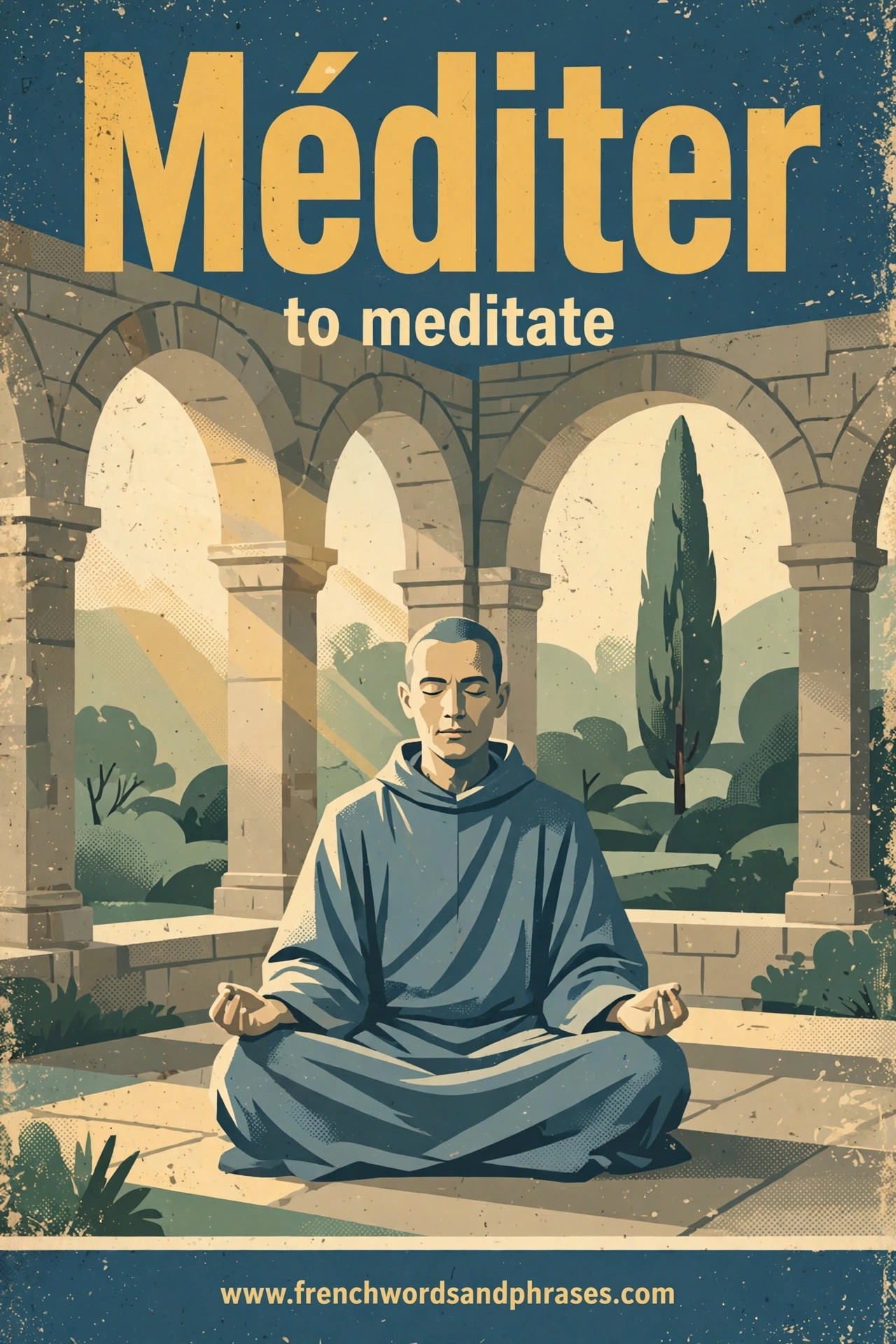
A monk at dawn, a walker pausing above a valley, a chess player silent before the board — méditer is the verb of deep, unhurried thought: to turn something over in the mind until it gives up its meaning.
In this guide, you’ll learn how to conjugate méditer in all the major French tenses and moods. Explore complete conjugation tables, French examples, English translations, and practice quizzes.
Understanding the French Verb Méditer
Méditer is a regular French verb belonging to the first group of verbs, those ending in -er.
It means to meditate. It is commonly used for spiritual practice and deep reflection (méditer chaque matin, méditer sur la vie), for studying a text or a question slowly (méditer un passage), for quietly forming plans (méditer de voyager, méditer un projet), and in the expression méditer sur — to ponder over.
Verb classification: First group (-er)
Auxiliary verb: Avoir
Past participle: médité
Present participle: méditant
English equivalents: To meditate, to ponder, to reflect deeply on; méditer de + infinitive — to plan to, to contemplate doing.
One important detail: méditer thinks in two directions. Followed by a thing — méditer un texte, méditer une parole, méditer sur un sujet — it is contemplation, the mind dwelling slowly. Followed by de plus an infinitive — il médite de partir — it becomes a plan quietly forming: he is thinking of leaving. And a plotted deed can darken it: méditer un mauvais coup, to plot a nasty trick.
Experience the Word
Méditer is the verb of thought at walking pace — nothing is decided quickly, and that is the point.
Imagine a small garden behind an old house, early in the morning. A woman sits with her tea going cold, watching the light move across the wall, méditant sur la journée qui commence — not worrying, just letting her thoughts settle like sediment.
Nothing has been solved out loud. But inside, the water has cleared.
How to Conjugate Méditer: Complete French Conjugation Guide
Let’s explore every major conjugation of méditer, beginning with the indicative mood.
How to Conjugate Méditer in the Indicative Mood
The indicative mood is used to express facts, observations, actions, and events.
How to Conjugate Méditer in the Present Tense (Présent)
Used for actions happening now, habitual actions, and general truths.
| Subject | Conjugation |
|---|---|
| je | médite |
| tu | médites |
| il / elle | médite |
| nous | méditons |
| vous | méditez |
| ils / elles | méditent |
Example
Chaque matin, elle médite pendant vingt minutes.
Every morning, she meditates for twenty minutes.
Quick Quiz 1
Complete the sentence:
Nous ______ en silence chaque matin.
Reveal the answer
méditons
Nous méditons en silence chaque matin.
We meditate in silence every morning.
How to Conjugate Méditer in the Passé Composé
Used for completed actions in the past. Méditer takes the auxiliary verb avoir.
| Subject | Conjugation |
|---|---|
| j’ | ai médité |
| tu | as médité |
| il / elle | a médité |
| nous | avons médité |
| vous | avez médité |
| ils / elles | ont médité |
Example
Il a médité longuement sur cette décision.
He meditated at length on this decision.
How to Conjugate Méditer in the Imparfait (Imperfect Tense)
Used for habitual past actions, descriptions, and ongoing situations in the past.
| Subject | Conjugation |
|---|---|
| je | méditais |
| tu | méditais |
| il / elle | méditait |
| nous | méditions |
| vous | méditiez |
| ils / elles | méditaient |
Example
Le vieux sage méditait sous le même arbre depuis des années.
The old sage had been meditating under the same tree for years.
Quick Quiz 2
Choose the correct form:
He pondered the question.
Il ______ sur la question. (a médité / est médité)
Reveal the answer
a médité
Il a médité sur la question.
Méditer takes avoir.
How to Conjugate Méditer in the Plus-que-parfait
Used to describe an action that had already been completed before another past event.
| Subject | Conjugation |
|---|---|
| j’ | avais médité |
| tu | avais médité |
| il / elle | avait médité |
| nous | avions médité |
| vous | aviez médité |
| ils / elles | avaient médité |
Example
Nous avions médité ce projet pendant des mois avant d’en parler.
We had been turning this project over in our minds for months before speaking of it.
How to Conjugate Méditer in the Passé Simple
Primarily used in formal writing, literature, and historical narratives. It is rarely used in everyday conversation.
| Subject | Conjugation |
|---|---|
| je | méditai |
| tu | méditas |
| il / elle | médita |
| nous | méditâmes |
| vous | méditâtes |
| ils / elles | méditèrent |
Example
Elle médita toute la nuit sur les paroles de son maître.
She meditated all night on her master’s words.
How to Conjugate Méditer in the Passé Antérieur
A literary tense used to express an action completed immediately before another past action, generally in the passé simple.
| Subject | Conjugation |
|---|---|
| j’ | eus médité |
| tu | eus médité |
| il / elle | eut médité |
| nous | eûmes médité |
| vous | eûtes médité |
| ils / elles | eurent médité |
Example
Quand il eut médité la réponse, il prit enfin la plume.
When he had pondered the answer, he finally took up his pen.
How to Conjugate Méditer in the Future Tense (Futur Simple)
Used to describe actions that will take place in the future.
| Subject | Conjugation |
|---|---|
| je | méditerai |
| tu | méditeras |
| il / elle | méditera |
| nous | méditerons |
| vous | méditerez |
| ils / elles | méditeront |
Example
Demain, je méditerai au bord du lac à l’aube.
Tomorrow, I will meditate by the lake at dawn.
How to Conjugate Méditer in the Futur Antérieur (Future Perfect)
Used for an action that will have been completed before a particular point in the future.
| Subject | Conjugation |
|---|---|
| j’ | aurai médité |
| tu | auras médité |
| il / elle | aura médité |
| nous | aurons médité |
| vous | aurez médité |
| ils / elles | auront médité |
Example
À la fin de la retraite, vous aurez médité cent heures.
By the end of the retreat, you will have meditated for a hundred hours.
How to Conjugate Méditer in the Near Future (Futur Proche)
Used to describe something that is going to happen soon. Formed with aller + infinitive.
| Subject | Conjugation |
|---|---|
| je | vais méditer |
| tu | vas méditer |
| il / elle | va méditer |
| nous | allons méditer |
| vous | allez méditer |
| ils / elles | vont méditer |
Example
Je vais méditer un moment avant de répondre.
I am going to think deeply for a moment before answering.
How to Conjugate Méditer in the Conditional Mood
The conditional mood expresses what would happen under certain circumstances. It is also frequently used to make polite requests or express wishes.
How to Conjugate Méditer in the Present Conditional
| Subject | Conjugation |
|---|---|
| je | méditerais |
| tu | méditerais |
| il / elle | méditerait |
| nous | méditerions |
| vous | méditeriez |
| ils / elles | méditeraient |
Example
Avec plus de calme, nous méditerions mieux sur la question.
With more calm, we would ponder the question better.
How to Conjugate Méditer in the Past Conditional
| Subject | Conjugation |
|---|---|
| j’ | aurais médité |
| tu | aurais médité |
| il / elle | aurait médité |
| nous | aurions médité |
| vous | auriez médité |
| ils / elles | auraient médité |
Example
Elle aurait médité de partir si la lettre n’était pas arrivée.
She would have planned to leave if the letter had not arrived.
Méditer in the Literary Past Conditional Form
This less common literary form uses the imperfect subjunctive of avoir.
| Subject | Conjugation |
|---|---|
| j’ | eusse médité |
| tu | eusses médité |
| il / elle | eût médité |
| nous | eussions médité |
| vous | eussiez médité |
| ils / elles | eussent médité |
Example
Il eût médité un mauvais coup contre son rival.
He would have plotted a nasty trick against his rival.
How to Conjugate Méditer in the Subjunctive Mood
The subjunctive is used to express wishes, emotions, doubts, necessity, and uncertainty. It frequently follows expressions such as il faut que (it is necessary that) or bien que (although).
How to Conjugate Méditer in the Present Subjunctive
| Subject | Conjugation |
|---|---|
| que je | médite |
| que tu | médites |
| qu’il / qu’elle | médite |
| que nous | méditions |
| que vous | méditiez |
| qu’ils / qu’elles | méditent |
Example
Il est bon que tu médites avant de décider.
It is good that you reflect before deciding.
Quick Quiz 3
Complete the sentence using the subjunctive:
Il est bon que vous ______ sur ce texte.
Reveal the answer
méditiez
Il est bon que vous méditiez sur ce texte.
It is good that you reflect on this text.
How to Conjugate Méditer in the Imperfect Subjunctive
A literary tense, rarely encountered in modern spoken French.
| Subject | Conjugation |
|---|---|
| que je | méditasse |
| que tu | méditasses |
| qu’il / qu’elle | méditât |
| que nous | méditassions |
| que vous | méditassiez |
| qu’ils / qu’elles | méditassent |
Example
Le maître souhaitait que l’élève méditât chaque parole.
The master wished the pupil to meditate on every word.
How to Conjugate Méditer in the Pluperfect Subjunctive
A literary construction used to express an action completed before another past action.
| Subject | Conjugation |
|---|---|
| que j’ | eusse médité |
| que tu | eusses médité |
| qu’il / qu’elle | eût médité |
| que nous | eussions médité |
| que vous | eussiez médité |
| qu’ils / qu’elles | eussent médité |
Example
Elle doutait qu’il eût médité sérieusement la question.
She doubted that he had seriously pondered the question.
How to Conjugate Méditer in the Past Subjunctive
| Subject | Conjugation |
|---|---|
| que j’ | aie médité |
| que tu | aies médité |
| qu’il / qu’elle | ait médité |
| que nous | ayons médité |
| que vous | ayez médité |
| qu’ils / qu’elles | aient médité |
Example
Je suis content que vous ayez médité sur mes conseils.
I am glad you reflected on my advice.
How to Conjugate Méditer in the Imperative
The imperative is used to give commands, instructions, invitations, or suggestions. Subject pronouns are omitted.
How to Conjugate Méditer in the Present Imperative
| Person | Conjugation |
|---|---|
| (tu) | médite |
| (nous) | méditons |
| (vous) | méditez |
Example
Médite sur cette phrase avant de t’endormir !
Meditate on this sentence before you fall asleep!
Quick Quiz 4
How would you say Meditate on this sentence (tu form)?
Reveal the answer
Médite sur cette phrase !
French Participles of Méditer
Participles are verb forms that can be used in compound tenses and other grammatical constructions.
Present Participle of Méditer
méditant
En méditant chaque jour, il est devenu plus patient.
By meditating every day, he became more patient.
Past Participle of Méditer
médité
Longuement médité, le projet a fini par convaincre tout le monde.
Long pondered, the project ended up convincing everyone.
Méditer in Everyday French: Real-Life Examples
Now that you know the conjugations, let’s see how méditer appears in everyday French.
Example 1 — Present
Je médite dix minutes avant le travail.
I meditate for ten minutes before work.
Example 2 — Passé composé
Nous avons médité sur la question toute la soirée.
We pondered the question all evening.
Example 3 — Imparfait
Mon grand-père méditait en marchant dans les bois.
My grandfather used to meditate while walking in the woods.
Example 4 — Future
Il méditera de partir l’an prochain.
He will plan to leave next year.
Example 5 — Conditional
Tu méditerais mieux loin du téléphone.
You would reflect better away from the phone.
Example 6 — Imperative
Méditez en silence, puis ouvrez les yeux lentement !
Meditate in silence, then open your eyes slowly!
Beyond Translation: The Meaning of Méditer
English meditate now smells of incense and apps; French méditer keeps its older, broader mind — contemplation, yes, but also the slow turning-over of any serious matter.
And it can quietly make plans.
Méditer de partir, méditer un projet, méditer un mauvais coup — to be thinking of leaving, to turn a project over, even to plot something: in French, the meditating mind is never entirely idle.
How to Remember the French Verb Méditer
Remember it this way: Méditer is about deep, unhurried thought — and, with de, a plan quietly forming.
- Méditer sur — to ponder over; méditer un texte — to dwell on a text slowly.
- Méditer de + infinitive — to be quietly planning to do something.
- Regular -er: je médite, nous méditons, past participle médité.
The key idea is deep, unhurried thought — and, with de, a plan quietly forming.
Test Your Knowledge of Méditer
Let’s see how much you’ve learned. Try answering these questions before revealing the answers.
Question 1
What does il médite de partir mean?
Reveal the answer
He is planning to leave — méditer de + infinitive means to contemplate doing something.
Question 2
How do you say She meditates every morning in French?
Reveal the answer
Elle médite chaque matin.
Question 3
Translate: He meditated at length on this decision.
Reveal the answer
Il a médité longuement sur cette décision.
Question 4
What is the past participle of méditer?
Reveal the answer
Médité.
Question 5
Complete the sentence:
Il est bon que tu ______ avant de décider.
Reveal the answer
médites
Il est bon que tu médites avant de décider.
It is good that you reflect before deciding.
Your Final Challenge
Can You Use It?
How would you say this in French?
She meditates by the lake, and her thoughts become as clear as the water.
Reveal the answer
Elle médite au bord du lac, et ses idées deviennent claires comme l’eau.
She meditates by the lake, and her thoughts become as clear as the water.
A little French. A little curiosity. A richer everyday life.
LEARN FRENCH ONE WORD AT A TIME