A French Word to Live By
How to Conjugate Médicamenter in French
/me.di.ka.mɑ̃.te/
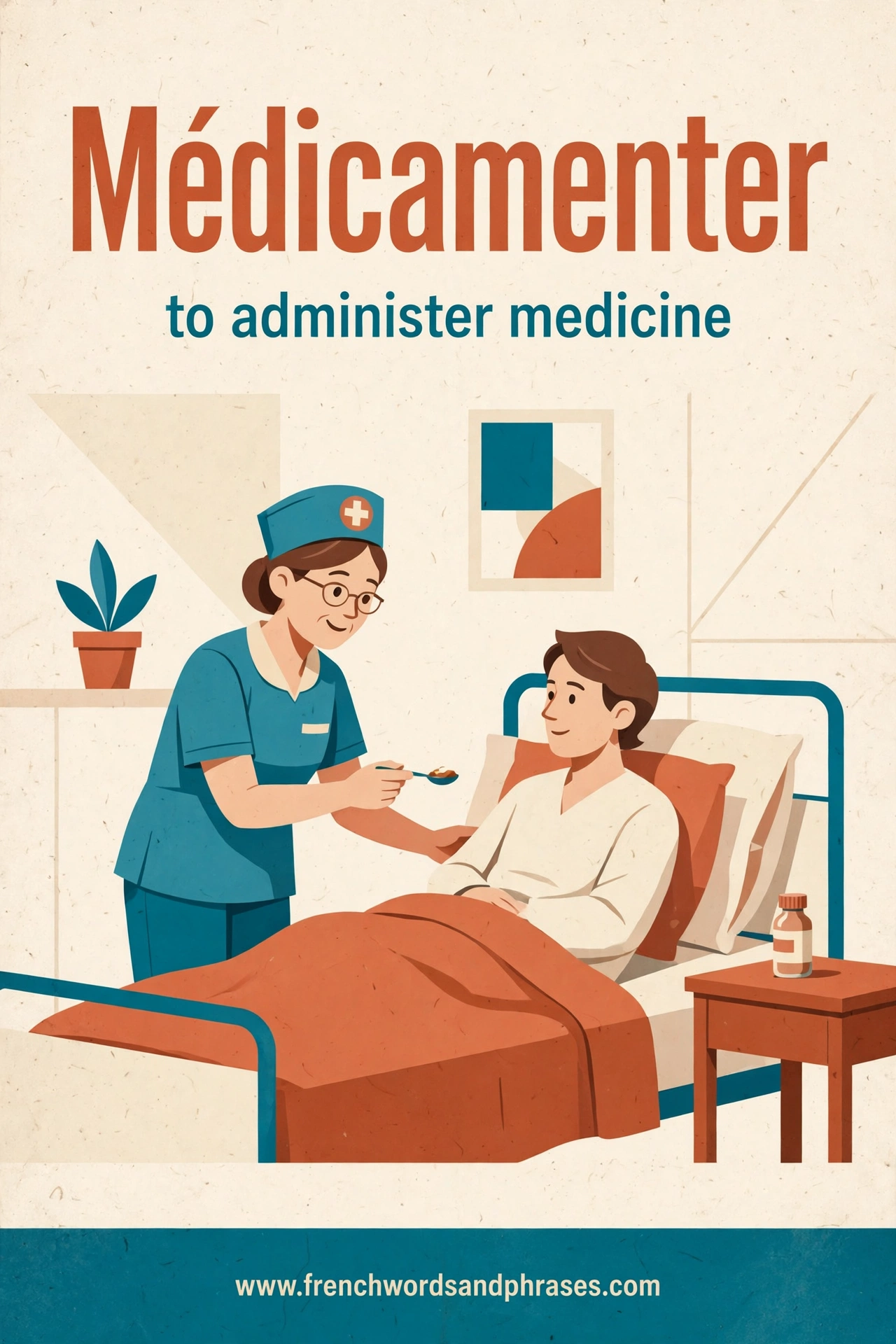
Médicamenter means to administer medicine.
A nurse measures out the evening doses, a farmer treats a sick calf, a grandfather lines up his little boxes by weekday — médicamenter is the practical verb of giving medicine: the right dose, to the right patient, at the right time.
In this guide, you’ll learn how to conjugate médicamenter in all the major French tenses and moods. Explore complete conjugation tables, French examples, English translations, and practice quizzes.
Understanding the French Verb Médicamenter
Médicamenter is a regular French verb belonging to the first group of verbs, those ending in -er.
It means to administer medicine. It is commonly used in medical and veterinary care for giving treatment (médicamenter un patient, un animal), in farming for treating livestock, and in the reflexive for people taking medicine on their own — se médicamenter sans avis médical, dosing oneself without medical advice.
Verb classification: First group (-er)
Auxiliary verb: Avoir
Past participle: médicamenté
Present participle: médicamentant
English equivalents: To administer medicine to, to treat with medication; se médicamenter — to take medicine, to dose oneself.
One important detail: médicamenter is built on un médicament, a medicine, and it works two ways. Transitive, it is the professional’s verb — le vétérinaire médicamente le cheval, the vet gives the horse its medicine. Reflexive, se médicamenter is what the patient does alone at the kitchen table: to dose oneself, to take one’s medicine — sometimes wisely, sometimes a little too freely, which is why doctors warn against l’automédication, self-medication.
Experience the Word
Médicamenter is the verb of care measured in spoonfuls and tablets — medicine as a daily act of attention.
Imagine a small country clinic at dusk. The nurse goes from bed to bed with her tray, checks each name twice, and médicamente every patient exactly as the chart prescribes.
Nothing dramatic has happened. Health has simply been looked after, dose by dose.
How to Conjugate Médicamenter: Complete French Conjugation Guide
Let’s explore every major conjugation of médicamenter, beginning with the indicative mood.
How to Conjugate Médicamenter in the Indicative Mood
The indicative mood is used to express facts, observations, actions, and events.
How to Conjugate Médicamenter in the Present Tense (Présent)
Used for actions happening now, habitual actions, and general truths.
| Subject | Conjugation |
|---|---|
| je | médicamente |
| tu | médicamentes |
| il / elle | médicamente |
| nous | médicamentons |
| vous | médicamentez |
| ils / elles | médicamentent |
Example
L’infirmière médicamente les patients à heures fixes.
The nurse gives the patients their medicine at fixed times.
Quick Quiz 1
Complete the sentence:
Nous ______ les patients à huit heures.
Reveal the answer
médicamentons
Nous médicamentons les patients à huit heures.
We give the patients their medicine at eight o’clock.
How to Conjugate Médicamenter in the Passé Composé
Used for completed actions in the past. Médicamenter takes the auxiliary verb avoir.
| Subject | Conjugation |
|---|---|
| j’ | ai médicamenté |
| tu | as médicamenté |
| il / elle | a médicamenté |
| nous | avons médicamenté |
| vous | avez médicamenté |
| ils / elles | ont médicamenté |
Example
Le vétérinaire a médicamenté le cheval dès le matin.
The vet treated the horse with medicine first thing in the morning.
How to Conjugate Médicamenter in the Imparfait (Imperfect Tense)
Used for habitual past actions, descriptions, and ongoing situations in the past.
| Subject | Conjugation |
|---|---|
| je | médicamentais |
| tu | médicamentais |
| il / elle | médicamentait |
| nous | médicamentions |
| vous | médicamentiez |
| ils / elles | médicamentaient |
Example
Autrefois, on médicamentait les enfants au sirop de violette.
In the old days, children were dosed with violet syrup.
Quick Quiz 2
Choose the correct form:
The vet treated the horse.
Le vétérinaire ______ le cheval. (a médicamenté / est médicamenté)
Reveal the answer
a médicamenté
Le vétérinaire a médicamenté le cheval.
Médicamenter takes avoir.
How to Conjugate Médicamenter in the Plus-que-parfait
Used to describe an action that had already been completed before another past event.
| Subject | Conjugation |
|---|---|
| j’ | avais médicamenté |
| tu | avais médicamenté |
| il / elle | avait médicamenté |
| nous | avions médicamenté |
| vous | aviez médicamenté |
| ils / elles | avaient médicamenté |
Example
Elle avait médicamenté le chat avant de partir en vacances.
She had given the cat its medicine before leaving on holiday.
How to Conjugate Médicamenter in the Passé Simple
Primarily used in formal writing, literature, and historical narratives. It is rarely used in everyday conversation.
| Subject | Conjugation |
|---|---|
| je | médicamentai |
| tu | médicamentas |
| il / elle | médicamenta |
| nous | médicamentâmes |
| vous | médicamentâtes |
| ils / elles | médicamentèrent |
Example
Le médecin médicamenta le malade et revint le lendemain.
The doctor gave the patient medicine and came back the next day.
How to Conjugate Médicamenter in the Passé Antérieur
A literary tense used to express an action completed immediately before another past action, generally in the passé simple.
| Subject | Conjugation |
|---|---|
| j’ | eus médicamenté |
| tu | eus médicamenté |
| il / elle | eut médicamenté |
| nous | eûmes médicamenté |
| vous | eûtes médicamenté |
| ils / elles | eurent médicamenté |
Example
Quand l’infirmier eut médicamenté le dernier patient, il éteignit les lumières.
When the nurse had given the last patient his medicine, he switched off the lights.
How to Conjugate Médicamenter in the Future Tense (Futur Simple)
Used to describe actions that will take place in the future.
| Subject | Conjugation |
|---|---|
| je | médicamenterai |
| tu | médicamenteras |
| il / elle | médicamentera |
| nous | médicamenterons |
| vous | médicamenterez |
| ils / elles | médicamenteront |
Example
Demain, nous médicamenterons les agneaux malades.
Tomorrow, we will give medicine to the sick lambs.
How to Conjugate Médicamenter in the Futur Antérieur (Future Perfect)
Used for an action that will have been completed before a particular point in the future.
| Subject | Conjugation |
|---|---|
| j’ | aurai médicamenté |
| tu | auras médicamenté |
| il / elle | aura médicamenté |
| nous | aurons médicamenté |
| vous | aurez médicamenté |
| ils / elles | auront médicamenté |
Example
À huit heures, elle aura médicamenté tous les pensionnaires.
By eight o’clock, she will have given all the residents their medicine.
How to Conjugate Médicamenter in the Near Future (Futur Proche)
Used to describe something that is going to happen soon. Formed with aller + infinitive.
| Subject | Conjugation |
|---|---|
| je | vais médicamenter |
| tu | vas médicamenter |
| il / elle | va médicamenter |
| nous | allons médicamenter |
| vous | allez médicamenter |
| ils / elles | vont médicamenter |
Example
Je vais médicamenter le chien, il a encore de la fièvre.
I am going to give the dog his medicine, he still has a fever.
How to Conjugate Médicamenter in the Conditional Mood
The conditional mood expresses what would happen under certain circumstances. It is also frequently used to make polite requests or express wishes.
How to Conjugate Médicamenter in the Present Conditional
| Subject | Conjugation |
|---|---|
| je | médicamenterais |
| tu | médicamenterais |
| il / elle | médicamenterait |
| nous | médicamenterions |
| vous | médicamenteriez |
| ils / elles | médicamenteraient |
Example
Sans ordonnance, je ne médicamenterais jamais un enfant.
Without a prescription, I would never give a child medicine.
How to Conjugate Médicamenter in the Past Conditional
| Subject | Conjugation |
|---|---|
| j’ | aurais médicamenté |
| tu | aurais médicamenté |
| il / elle | aurait médicamenté |
| nous | aurions médicamenté |
| vous | auriez médicamenté |
| ils / elles | auraient médicamenté |
Example
Un vétérinaire aurait médicamenté la jument plus tôt.
A vet would have treated the mare earlier.
Médicamenter in the Literary Past Conditional Form
This less common literary form uses the imperfect subjunctive of avoir.
| Subject | Conjugation |
|---|---|
| j’ | eusse médicamenté |
| tu | eusses médicamenté |
| il / elle | eût médicamenté |
| nous | eussions médicamenté |
| vous | eussiez médicamenté |
| ils / elles | eussent médicamenté |
Example
Elle eût médicamenté le malade avec les herbes du jardin.
She would have treated the patient with herbs from the garden.
How to Conjugate Médicamenter in the Subjunctive Mood
The subjunctive is used to express wishes, emotions, doubts, necessity, and uncertainty. It frequently follows expressions such as il faut que (it is necessary that) or bien que (although).
How to Conjugate Médicamenter in the Present Subjunctive
| Subject | Conjugation |
|---|---|
| que je | médicamente |
| que tu | médicamentes |
| qu’il / qu’elle | médicamente |
| que nous | médicamentions |
| que vous | médicamentiez |
| qu’ils / qu’elles | médicamentent |
Example
Il faut que l’on médicamente ce patient deux fois par jour.
This patient must be given medicine twice a day.
Quick Quiz 3
Complete the sentence using the subjunctive:
Il faut que vous ______ le chat ce soir.
Reveal the answer
médicamentiez
Il faut que vous médicamentiez le chat ce soir.
You must give the cat its medicine this evening.
How to Conjugate Médicamenter in the Imperfect Subjunctive
A literary tense, rarely encountered in modern spoken French.
| Subject | Conjugation |
|---|---|
| que je | médicamentasse |
| que tu | médicamentasses |
| qu’il / qu’elle | médicamentât |
| que nous | médicamentassions |
| que vous | médicamentassiez |
| qu’ils / qu’elles | médicamentassent |
Example
Le protocole exigeait que l’infirmière médicamentât les malades à jeun.
The protocol required the nurse to give the patients their medicine on an empty stomach.
How to Conjugate Médicamenter in the Pluperfect Subjunctive
A literary construction used to express an action completed before another past action.
| Subject | Conjugation |
|---|---|
| que j’ | eusse médicamenté |
| que tu | eusses médicamenté |
| qu’il / qu’elle | eût médicamenté |
| que nous | eussions médicamenté |
| que vous | eussiez médicamenté |
| qu’ils / qu’elles | eussent médicamenté |
Example
Il regrettait que l’on eût médicamenté le chien sans avis du vétérinaire.
He regretted that the dog had been given medicine without the vet’s advice.
How to Conjugate Médicamenter in the Past Subjunctive
| Subject | Conjugation |
|---|---|
| que j’ | aie médicamenté |
| que tu | aies médicamenté |
| qu’il / qu’elle | ait médicamenté |
| que nous | ayons médicamenté |
| que vous | ayez médicamenté |
| qu’ils / qu’elles | aient médicamenté |
Example
Je suis content que le médecin ait médicamenté ta grand-mère à temps.
I am glad the doctor gave your grandmother her medicine in time.
How to Conjugate Médicamenter in the Imperative
The imperative is used to give commands, instructions, invitations, or suggestions. Subject pronouns are omitted.
How to Conjugate Médicamenter in the Present Imperative
| Person | Conjugation |
|---|---|
| (tu) | médicamente |
| (nous) | médicamentons |
| (vous) | médicamentez |
Example
Médicamente le chat, puis donne-lui à boire !
Give the cat its medicine, then give it some water!
Quick Quiz 4
How would you say Give the cat its medicine (tu form)?
Reveal the answer
Médicamente le chat !
French Participles of Médicamenter
Participles are verb forms that can be used in compound tenses and other grammatical constructions.
Present Participle of Médicamenter
médicamentant
En médicamentant les patients, elle vérifie chaque dossier deux fois.
While giving the patients their medicine, she checks each file twice.
Past Participle of Médicamenter
médicamenté
Médicamenté dès les premiers symptômes, le veau s’est vite rétabli.
Treated with medicine from the first symptoms, the calf recovered quickly.
Médicamenter in Everyday French: Real-Life Examples
Now that you know the conjugations, let’s see how médicamenter appears in everyday French.
Example 1 — Present
Le vétérinaire médicamente les chevaux du haras.
The vet gives medicine to the horses at the stud farm.
Example 2 — Passé composé
Elle s’est médicamentée sans demander conseil.
She dosed herself without asking for advice.
Example 3 — Imparfait
Ma grand-mère médicamentait toute la famille à l’huile de foie de morue.
My grandmother used to dose the whole family with cod liver oil.
Example 4 — Future
Nous médicamenterons les brebis ce printemps.
We will give the ewes their medicine this spring.
Example 5 — Conditional
Je ne médicamenterais pas un enfant sans ordonnance.
I would not give a child medicine without a prescription.
Example 6 — Imperative
Médicamentez le patient avant le repas !
Give the patient his medicine before the meal!
Beyond Translation: The Meaning of Médicamenter
English needs the phrase administer medicine; French médicamenter builds the verb straight out of the noun médicament.
And it turns round on the patient.
Se médicamenter — to dose oneself — is the verb behind the doctor’s favourite warning, l’automédication: self-medication, the medicine cabinet used without advice.
How to Remember the French Verb Médicamenter
Remember it this way: Médicamenter is about the right dose, to the right patient — and se médicamenter, dosing yourself.
- Built on un médicament — the verb is simply ‘to medicine’ someone.
- Se médicamenter — to dose oneself; its shadow is l’automédication, self-medication.
- Regular -er: je médicamente, nous médicamentons, past participle médicamenté.
The key idea is the right dose, to the right patient — and se médicamenter, dosing yourself.
Test Your Knowledge of Médicamenter
Let’s see how much you’ve learned. Try answering these questions before revealing the answers.
Question 1
What does se médicamenter mean?
Reveal the answer
To dose oneself — to take medicine on your own, without it being administered by someone else.
Question 2
How do you say The vet gave the horse its medicine in French?
Reveal the answer
Le vétérinaire a médicamenté le cheval.
Question 3
Translate: She dosed herself without asking for advice.
Reveal the answer
Elle s’est médicamentée sans demander conseil.
Question 4
What is the past participle of médicamenter?
Reveal the answer
Médicamenté.
Question 5
Complete the sentence:
Il faut que l’on ______ ce patient deux fois par jour.
Reveal the answer
médicamente
Il faut que l’on médicamente ce patient deux fois par jour.
This patient must be given medicine twice a day.
Your Final Challenge
Can You Use It?
How would you say this in French?
The nurse gives each patient their medicine, then she writes everything in the file.
Reveal the answer
L’infirmière médicamente chaque patient, puis elle note tout dans le dossier.
The nurse gives each patient their medicine, then she writes everything in the file.
A little French. A little curiosity. A richer everyday life.
LEARN FRENCH ONE WORD AT A TIME