
A French Word to Live By
How to Conjugate Méduser in French
/me.dy.ze/
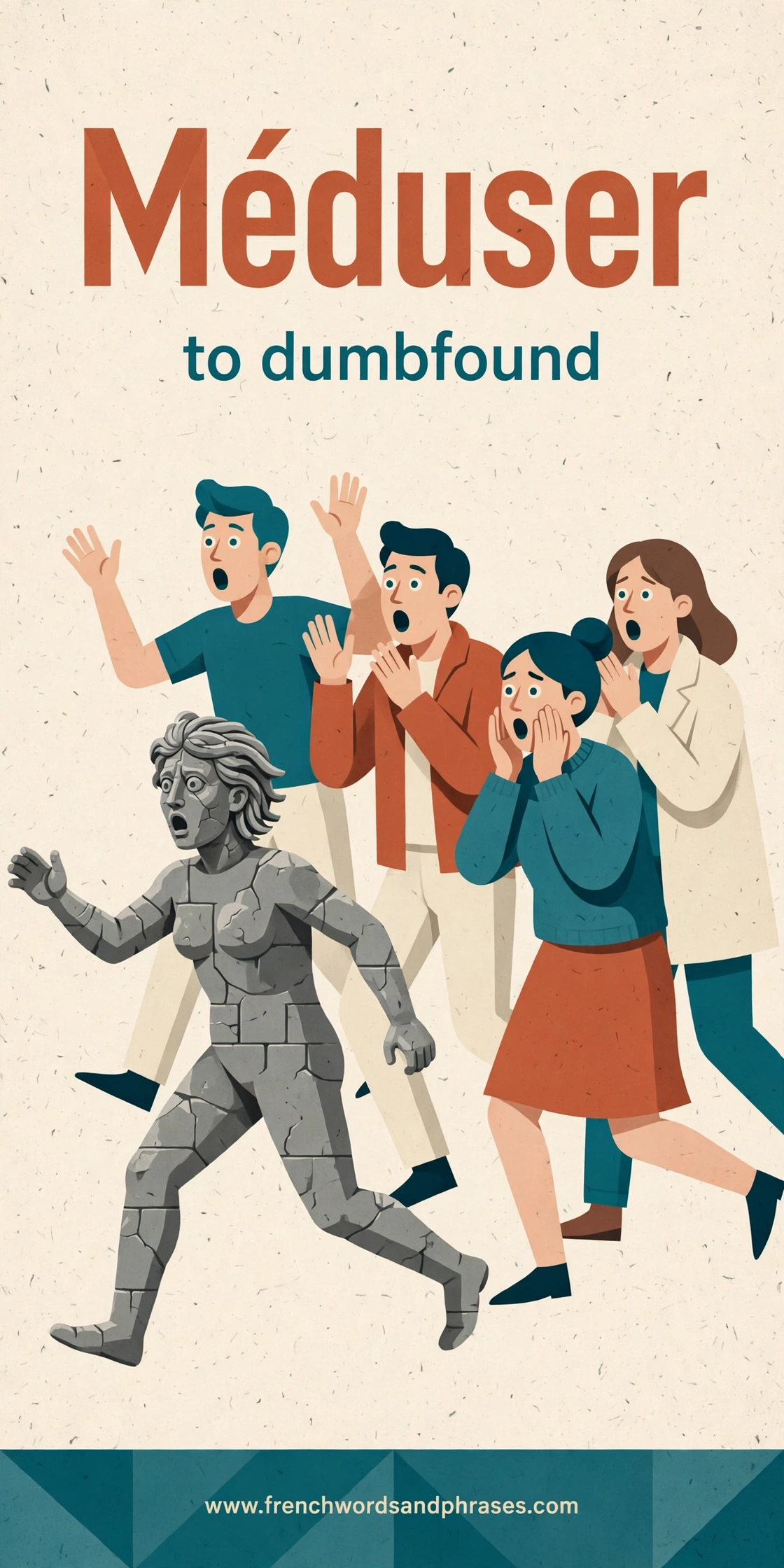
Méduser means to dumbfound.
A magician pulls a rabbit from an empty hat, a quiet pupil answers the impossible question, a price tag shows six zeros — méduser is the verb of the frozen stare: to leave someone rooted to the spot, mouth open, exactly as Medusa’s gaze once did.
In this guide, you’ll learn how to conjugate méduser in all the major French tenses and moods. Explore complete conjugation tables, French examples, English translations, and practice quizzes.
Understanding the French Verb Méduser
Méduser is a regular French verb belonging to the first group of verbs, those ending in -er.
It means to dumbfound. It is commonly used for astonishing news, performances and sights that leave people speechless (méduser le public, méduser l’assistance), and above all in the passive picture — rester médusé, être médusé devant quelque chose.
Verb classification: First group (-er)
Auxiliary verb: Avoir
Past participle: médusé
Present participle: médusant
English equivalents: To dumbfound, to stun, to leave speechless with astonishment; être médusé — to be dumbfounded, rooted to the spot.
One important detail: méduser carries its myth in its name — la Méduse, Medusa, the Gorgon whose gaze turned onlookers to stone. The verb rarely works actively in conversation; French far prefers its participle as an adjective — je suis resté médusé, I stood dumbfounded; un public médusé, an astonished audience. Learn the pair together: méduser quelqu’un, être médusé.
Experience the Word
Méduser is the verb of the stopped moment — the second in which the brain has seen, but not yet believed.
Imagine a street performer in a crowded square. He lifts an empty box, opens it, and a white dove flies out — the whole circle of strangers stands médusé, applauding a second too late because astonishment came first.
Nobody has been harmed, only halted. Turned, for one delicious second, to stone.
How to Conjugate Méduser: Complete French Conjugation Guide
Let’s explore every major conjugation of méduser, beginning with the indicative mood.
How to Conjugate Méduser in the Indicative Mood
The indicative mood is used to express facts, observations, actions, and events.
How to Conjugate Méduser in the Present Tense (Présent)
Used for actions happening now, habitual actions, and general truths.
| Subject | Conjugation |
|---|---|
| je | méduse |
| tu | méduses |
| il / elle | méduse |
| nous | médusons |
| vous | médusez |
| ils / elles | médusent |
Example
Ce magicien méduse son public à chaque spectacle.
This magician dumbfounds his audience at every show.
Quick Quiz 1
Complete the sentence:
Nous ______ le public avec ce tour.
Reveal the answer
médusons
Nous médusons le public avec ce tour.
We dumbfound the audience with this trick.
How to Conjugate Méduser in the Passé Composé
Used for completed actions in the past. Méduser takes the auxiliary verb avoir.
| Subject | Conjugation |
|---|---|
| j’ | ai médusé |
| tu | as médusé |
| il / elle | a médusé |
| nous | avons médusé |
| vous | avez médusé |
| ils / elles | ont médusé |
Example
La nouvelle a médusé toute la rédaction.
The news dumbfounded the whole newsroom.
How to Conjugate Méduser in the Imparfait (Imperfect Tense)
Used for habitual past actions, descriptions, and ongoing situations in the past.
| Subject | Conjugation |
|---|---|
| je | médusais |
| tu | médusais |
| il / elle | médusait |
| nous | médusions |
| vous | médusiez |
| ils / elles | médusaient |
Example
Son calme médusait ses adversaires pendant les débats.
His calm used to dumbfound his opponents during debates.
Quick Quiz 2
Choose the correct form:
The news dumbfounded everyone.
La nouvelle ______ tout le monde. (a médusé / est médusée)
Reveal the answer
a médusé
La nouvelle a médusé tout le monde.
Méduser takes avoir.
How to Conjugate Méduser in the Plus-que-parfait
Used to describe an action that had already been completed before another past event.
| Subject | Conjugation |
|---|---|
| j’ | avais médusé |
| tu | avais médusé |
| il / elle | avait médusé |
| nous | avions médusé |
| vous | aviez médusé |
| ils / elles | avaient médusé |
Example
Le résultat avait médusé les experts eux-mêmes.
The result had dumbfounded the experts themselves.
How to Conjugate Méduser in the Passé Simple
Primarily used in formal writing, literature, and historical narratives. It is rarely used in everyday conversation.
| Subject | Conjugation |
|---|---|
| je | médusai |
| tu | médusas |
| il / elle | médusa |
| nous | médusâmes |
| vous | médusâtes |
| ils / elles | médusèrent |
Example
L’apparition médusa la foule rassemblée sur la place.
The apparition dumbfounded the crowd gathered in the square.
How to Conjugate Méduser in the Passé Antérieur
A literary tense used to express an action completed immediately before another past action, generally in the passé simple.
| Subject | Conjugation |
|---|---|
| j’ | eus médusé |
| tu | eus médusé |
| il / elle | eut médusé |
| nous | eûmes médusé |
| vous | eûtes médusé |
| ils / elles | eurent médusé |
Example
Quand le dernier tour eut médusé les enfants, le magicien s’inclina.
When the last trick had dumbfounded the children, the magician bowed.
How to Conjugate Méduser in the Future Tense (Futur Simple)
Used to describe actions that will take place in the future.
| Subject | Conjugation |
|---|---|
| je | méduserai |
| tu | méduseras |
| il / elle | médusera |
| nous | méduserons |
| vous | méduserez |
| ils / elles | méduseront |
Example
Ta réponse médusera le jury, j’en suis sûr.
Your answer will dumbfound the jury, I am sure of it.
How to Conjugate Méduser in the Futur Antérieur (Future Perfect)
Used for an action that will have been completed before a particular point in the future.
| Subject | Conjugation |
|---|---|
| j’ | aurai médusé |
| tu | auras médusé |
| il / elle | aura médusé |
| nous | aurons médusé |
| vous | aurez médusé |
| ils / elles | auront médusé |
Example
À la fin du spectacle, il aura médusé trois cents spectateurs.
By the end of the show, he will have dumbfounded three hundred spectators.
How to Conjugate Méduser in the Near Future (Futur Proche)
Used to describe something that is going to happen soon. Formed with aller + infinitive.
| Subject | Conjugation |
|---|---|
| je | vais méduser |
| tu | vas méduser |
| il / elle | va méduser |
| nous | allons méduser |
| vous | allez méduser |
| ils / elles | vont méduser |
Example
Ce chiffre va méduser les journalistes.
This figure is going to dumbfound the journalists.
How to Conjugate Méduser in the Conditional Mood
The conditional mood expresses what would happen under certain circumstances. It is also frequently used to make polite requests or express wishes.
How to Conjugate Méduser in the Present Conditional
| Subject | Conjugation |
|---|---|
| je | méduserais |
| tu | méduserais |
| il / elle | méduserait |
| nous | méduserions |
| vous | méduseriez |
| ils / elles | méduseraient |
Example
Un tel talent méduserait n’importe quel public.
Such talent would dumbfound any audience.
How to Conjugate Méduser in the Past Conditional
| Subject | Conjugation |
|---|---|
| j’ | aurais médusé |
| tu | aurais médusé |
| il / elle | aurait médusé |
| nous | aurions médusé |
| vous | auriez médusé |
| ils / elles | auraient médusé |
Example
Sans les projecteurs, l’effet n’aurait médusé personne.
Without the spotlights, the effect would have dumbfounded no one.
Méduser in the Literary Past Conditional Form
This less common literary form uses the imperfect subjunctive of avoir.
| Subject | Conjugation |
|---|---|
| j’ | eusse médusé |
| tu | eusses médusé |
| il / elle | eût médusé |
| nous | eussions médusé |
| vous | eussiez médusé |
| ils / elles | eussent médusé |
Example
Elle eût médusé la cour entière par son audace.
She would have dumbfounded the whole court with her boldness.
How to Conjugate Méduser in the Subjunctive Mood
The subjunctive is used to express wishes, emotions, doubts, necessity, and uncertainty. It frequently follows expressions such as il faut que (it is necessary that) or bien que (although).
How to Conjugate Méduser in the Present Subjunctive
| Subject | Conjugation |
|---|---|
| que je | méduse |
| que tu | méduses |
| qu’il / qu’elle | méduse |
| que nous | médusions |
| que vous | médusiez |
| qu’ils / qu’elles | médusent |
Example
Il est rare qu’un spectacle méduse autant les enfants.
It is rare for a show to dumbfound children this much.
Quick Quiz 3
Complete the sentence using the subjunctive:
Il est rare que vous ______ le jury.
Reveal the answer
médusiez
Il est rare que vous médusiez le jury.
It is rare for you to dumbfound the jury.
How to Conjugate Méduser in the Imperfect Subjunctive
A literary tense, rarely encountered in modern spoken French.
| Subject | Conjugation |
|---|---|
| que je | médusasse |
| que tu | médusasses |
| qu’il / qu’elle | médusât |
| que nous | médusassions |
| que vous | médusassiez |
| qu’ils / qu’elles | médusassent |
Example
On craignait que la nouvelle ne médusât les plus fragiles.
There were fears the news might dumbfound the most fragile.
How to Conjugate Méduser in the Pluperfect Subjunctive
A literary construction used to express an action completed before another past action.
| Subject | Conjugation |
|---|---|
| que j’ | eusse médusé |
| que tu | eusses médusé |
| qu’il / qu’elle | eût médusé |
| que nous | eussions médusé |
| que vous | eussiez médusé |
| qu’ils / qu’elles | eussent médusé |
Example
Elle souriait, heureuse que son annonce eût médusé l’assemblée.
She smiled, happy that her announcement had dumbfounded the assembly.
How to Conjugate Méduser in the Past Subjunctive
| Subject | Conjugation |
|---|---|
| que j’ | aie médusé |
| que tu | aies médusé |
| qu’il / qu’elle | ait médusé |
| que nous | ayons médusé |
| que vous | ayez médusé |
| qu’ils / qu’elles | aient médusé |
Example
Je suis ravi que le spectacle ait médusé les enfants.
I am delighted the show dumbfounded the children.
How to Conjugate Méduser in the Imperative
The imperative is used to give commands, instructions, invitations, or suggestions. Subject pronouns are omitted.
How to Conjugate Méduser in the Present Imperative
| Person | Conjugation |
|---|---|
| (tu) | méduse |
| (nous) | médusons |
| (vous) | médusez |
Example
Méduse-les avec ton dernier tour !
Dumbfound them with your last trick!
Quick Quiz 4
How would you say Dumbfound them (tu form)?
Reveal the answer
Méduse-les !
French Participles of Méduser
Participles are verb forms that can be used in compound tenses and other grammatical constructions.
Present Participle of Méduser
médusant
En médusant la salle, l’orateur a gagné le silence total.
By dumbfounding the hall, the speaker won total silence.
Past Participle of Méduser
médusé
Médusé par la nouvelle, il est resté sans voix une minute entière.
Dumbfounded by the news, he stayed speechless for a whole minute.
Méduser in Everyday French: Real-Life Examples
Now that you know the conjugations, let’s see how méduser appears in everyday French.
Example 1 — Present
Ce tour de magie méduse toujours les enfants.
This magic trick always dumbfounds the children.
Example 2 — Passé composé
Le prix affiché m’a médusé.
The displayed price dumbfounded me.
Example 3 — Imparfait
Sa mémoire médusait tous ses professeurs.
His memory used to dumbfound all his teachers.
Example 4 — Future
Le final médusera le public, attends voir.
The finale will dumbfound the audience, just wait and see.
Example 5 — Conditional
Une telle somme méduserait n’importe qui.
Such a sum would dumbfound anyone.
Example 6 — Imperative
Médusez le jury avec votre première phrase !
Dumbfound the jury with your first sentence!
Beyond Translation: The Meaning of Méduser
English dumbfound hides its parts; French méduser wears its story openly — Medusa, the gaze, the stone.
The participle does the everyday work.
Je suis resté médusé — I stood there dumbfounded — is the sentence French actually uses, at the magic show, at the announcement, at the price tag. The myth became an adjective for every astonished stare.
How to Remember the French Verb Méduser
Remember it this way: Méduser is about Medusa’s gaze — astonishment that roots you to the spot.
- From la Méduse — Medusa, whose gaze turned people to stone.
- Être médusé, rester médusé — to be, to stand dumbfounded: the participle is the everyday form.
- Regular -er: je méduse, nous médusons, past participle médusé.
The key idea is Medusa’s gaze — astonishment that roots you to the spot.
Test Your Knowledge of Méduser
Let’s see how much you’ve learned. Try answering these questions before revealing the answers.
Question 1
Which mythological figure hides inside méduser?
Reveal the answer
Medusa (la Méduse) — the Gorgon whose gaze turned onlookers to stone.
Question 2
How do you say I stood dumbfounded in French?
Reveal the answer
Je suis resté médusé.
Question 3
Translate: The news dumbfounded the whole newsroom.
Reveal the answer
La nouvelle a médusé toute la rédaction.
Question 4
What is the past participle of méduser?
Reveal the answer
Médusé.
Question 5
Complete the sentence:
Il est rare qu’un spectacle ______ autant les enfants.
Reveal the answer
méduse
Il est rare qu’un spectacle méduse autant les enfants.
It is rare for a show to dumbfound children this much.
Your Final Challenge
Can You Use It?
How would you say this in French?
The magician opens the empty box, a pigeon flies out, and the hall stands dumbfounded.
Reveal the answer
Le magicien ouvre la boîte vide, un pigeon s’envole, et la salle reste médusée.
The magician opens the empty box, a pigeon flies out, and the hall stands dumbfounded.
A little French. A little curiosity. A richer everyday life.
LEARN FRENCH ONE WORD AT A TIME




