
A French Word to Live By
How to Conjugate Marner in French
/maʁ.ne/
Marner means to work hard.
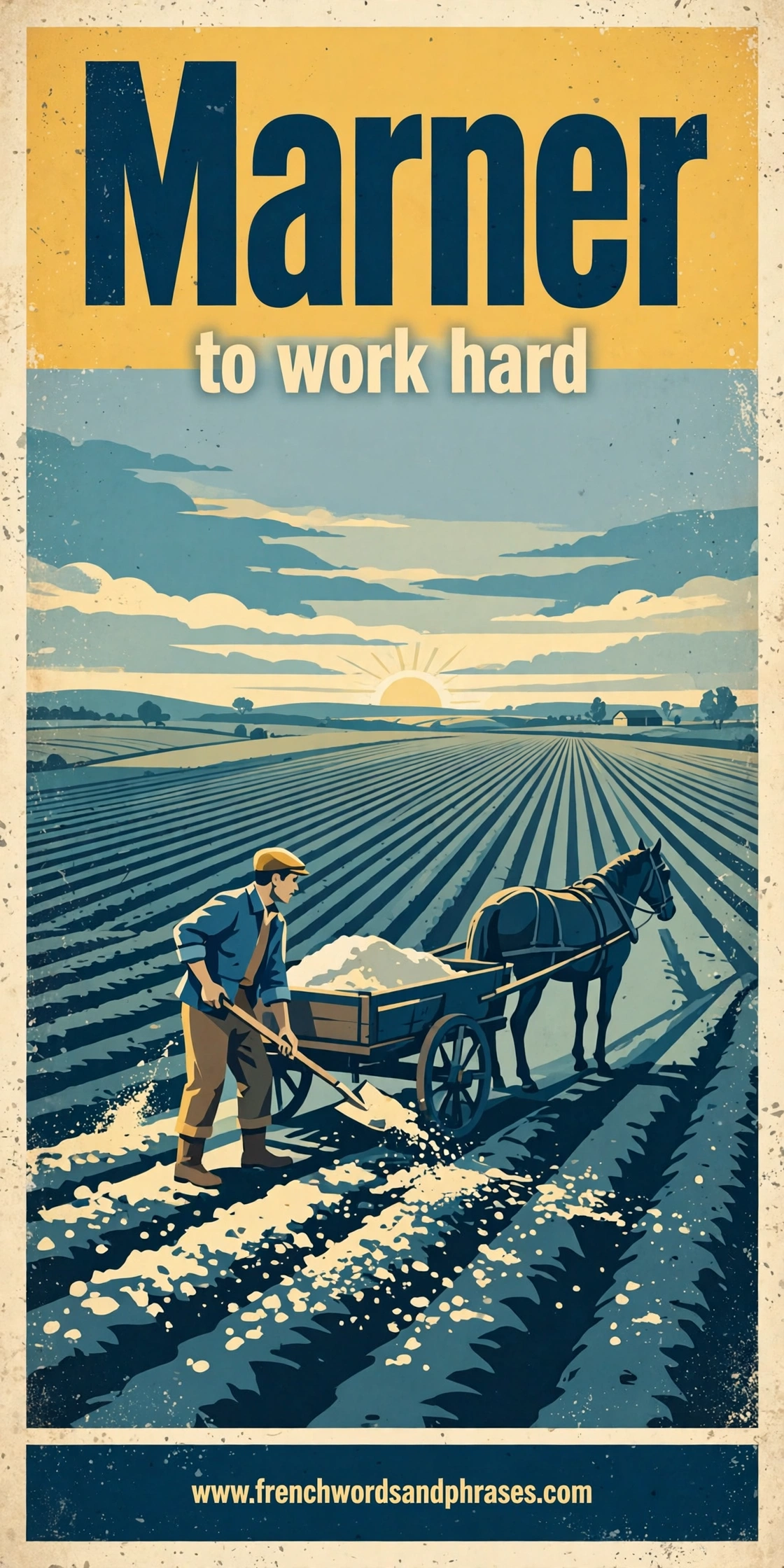
Cartloads of pale marl spread over poor fields, then, by extension, any long day of graft — marner lives two lives: the farmer’s verb for enriching soil, and familiar French for working hard.
In this guide, you’ll learn how to conjugate marner in all the major French tenses and moods. Explore complete conjugation tables, French examples, English translations, and practice quizzes.
Understanding the French Verb Marner
Marner is a regular French verb belonging to the first group of verbs, those ending in -er.
It means to work hard. It is commonly used on farms for spreading marl over fields, and in familiar speech everywhere else for slogging at a job — marner au bureau, marner sur un chantier, marner pour un examen.
Verb classification: First group (-er)
Auxiliary verb: Avoir
Past participle: marné
Present participle: marnant
English equivalents: To marl (spread marl on fields); (familiar) to work hard, to slog, to graft.
One important detail: marner is built on la marne — marl, a pale, lime-rich earth that farmers carted onto poor fields to enrich them. Spreading it was the heaviest work of autumn, so familiar French borrowed the verb for any hard slog: marner au bureau, marner sur un chantier. The work-hard sense is familiar register; in careful writing, travailler dur takes its place.
Experience the Word
Marner is the verb of honest graft — work you feel in your shoulders at the end of the day.
Imagine a farm in Picardy a century ago. All autumn the carts creak between the marl pit and the pale fields, and the whole village marne so that next year’s wheat will stand taller.
The soil is not rich yet. But it has been worked — marled, and earned.
How to Conjugate Marner: Complete French Conjugation Guide
Let’s explore every major conjugation of marner, beginning with the indicative mood.
How to Conjugate Marner in the Indicative Mood
The indicative mood is used to express facts, observations, actions, and events.
How to Conjugate Marner in the Present Tense (Présent)
Used for actions happening now, habitual actions, and general truths.
| Subject | Conjugation |
|---|---|
| je | marne |
| tu | marnes |
| il / elle | marne |
| nous | marnons |
| vous | marnez |
| ils / elles | marnent |
Example
En automne, les fermiers marnent les champs pauvres.
In autumn, the farmers marl the poor fields.
Quick Quiz 1
Complete the sentence:
Nous ______ sur le chantier depuis l’aube.
Reveal the answer
marnons
Nous marnons sur le chantier depuis l’aube.
We have been slogging on the site since dawn.
How to Conjugate Marner in the Passé Composé
Used for completed actions in the past. Marner takes the auxiliary verb avoir.
| Subject | Conjugation |
|---|---|
| j’ | ai marné |
| tu | as marné |
| il / elle | a marné |
| nous | avons marné |
| vous | avez marné |
| ils / elles | ont marné |
Example
Il a marné toute la semaine pour finir le rapport.
He slogged all week to finish the report.
How to Conjugate Marner in the Imparfait (Imperfect Tense)
Used for habitual past actions, descriptions, and ongoing situations in the past.
| Subject | Conjugation |
|---|---|
| je | marnais |
| tu | marnais |
| il / elle | marnait |
| nous | marnions |
| vous | marniez |
| ils / elles | marnaient |
Example
Autrefois, on marnait les terres avec des tombereaux de marne.
In the old days, the land was marled with cartloads of marl.
Quick Quiz 2
Choose the correct form:
They worked hard all day.
Ils ______ toute la journée. (ont marné / sont marnés)
Reveal the answer
ont marné
Ils ont marné toute la journée.
Marner takes avoir.
How to Conjugate Marner in the Plus-que-parfait
Used to describe an action that had already been completed before another past event.
| Subject | Conjugation |
|---|---|
| j’ | avais marné |
| tu | avais marné |
| il / elle | avait marné |
| nous | avions marné |
| vous | aviez marné |
| ils / elles | avaient marné |
Example
Elle avait marné des mois avant de réussir l’examen.
She had worked hard for months before passing the exam.
How to Conjugate Marner in the Passé Simple
Primarily used in formal writing, literature, and historical narratives. It is rarely used in everyday conversation.
| Subject | Conjugation |
|---|---|
| je | marnai |
| tu | marnas |
| il / elle | marna |
| nous | marnâmes |
| vous | marnâtes |
| ils / elles | marnèrent |
Example
Les ouvriers marnèrent du matin au soir sans se plaindre.
The workers slogged from morning to night without complaining.
How to Conjugate Marner in the Passé Antérieur
A literary tense used to express an action completed immediately before another past action, generally in the passé simple.
| Subject | Conjugation |
|---|---|
| j’ | eus marné |
| tu | eus marné |
| il / elle | eut marné |
| nous | eûmes marné |
| vous | eûtes marné |
| ils / elles | eurent marné |
Example
Quand ils eurent marné le champ, la pluie commença.
When they had marled the field, the rain began.
How to Conjugate Marner in the Future Tense (Futur Simple)
Used to describe actions that will take place in the future.
| Subject | Conjugation |
|---|---|
| je | marnerai |
| tu | marneras |
| il / elle | marnera |
| nous | marnerons |
| vous | marnerez |
| ils / elles | marneront |
Example
Demain, nous marnerons sur ce dossier jusqu’à la fin.
Tomorrow, we will slog away at this file to the end.
How to Conjugate Marner in the Futur Antérieur (Future Perfect)
Used for an action that will have been completed before a particular point in the future.
| Subject | Conjugation |
|---|---|
| j’ | aurai marné |
| tu | auras marné |
| il / elle | aura marné |
| nous | aurons marné |
| vous | aurez marné |
| ils / elles | auront marné |
Example
À la fin du mois, elle aura marné sur trois projets à la fois.
By the end of the month, she will have slogged on three projects at once.
How to Conjugate Marner in the Near Future (Futur Proche)
Used to describe something that is going to happen soon. Formed with aller + infinitive.
| Subject | Conjugation |
|---|---|
| je | vais marner |
| tu | vas marner |
| il / elle | va marner |
| nous | allons marner |
| vous | allez marner |
| ils / elles | vont marner |
Example
Je vais marner tout le week-end pour l’examen.
I am going to work hard all weekend for the exam.
How to Conjugate Marner in the Conditional Mood
The conditional mood expresses what would happen under certain circumstances. It is also frequently used to make polite requests or express wishes.
How to Conjugate Marner in the Present Conditional
| Subject | Conjugation |
|---|---|
| je | marnerais |
| tu | marnerais |
| il / elle | marnerait |
| nous | marnerions |
| vous | marneriez |
| ils / elles | marneraient |
Example
Sans cette machine, nous marnerions encore plus longtemps.
Without this machine, we would slog even longer.
How to Conjugate Marner in the Past Conditional
| Subject | Conjugation |
|---|---|
| j’ | aurais marné |
| tu | aurais marné |
| il / elle | aurait marné |
| nous | aurions marné |
| vous | auriez marné |
| ils / elles | auraient marné |
Example
Il aurait marné davantage si le salaire avait suivi.
He would have worked harder if the pay had matched.
Marner in the Literary Past Conditional Form
This less common literary form uses the imperfect subjunctive of avoir.
| Subject | Conjugation |
|---|---|
| j’ | eusse marné |
| tu | eusses marné |
| il / elle | eût marné |
| nous | eussions marné |
| vous | eussiez marné |
| ils / elles | eussent marné |
Example
Il eût marné la terre de ses mains jusqu’au soir.
He would have worked the soil with his hands until evening.
How to Conjugate Marner in the Subjunctive Mood
The subjunctive is used to express wishes, emotions, doubts, necessity, and uncertainty. It frequently follows expressions such as il faut que (it is necessary that) or bien que (although).
How to Conjugate Marner in the Present Subjunctive
| Subject | Conjugation |
|---|---|
| que je | marne |
| que tu | marnes |
| qu’il / qu’elle | marne |
| que nous | marnions |
| que vous | marniez |
| qu’ils / qu’elles | marnent |
Example
Il faut que tu marnes un peu plus avant les vacances.
You need to work a bit harder before the holidays.
Quick Quiz 3
Complete the sentence using the subjunctive:
Il faut que vous ______ sur ce dossier.
Reveal the answer
marniez
Il faut que vous marniez sur ce dossier.
You must work hard on this file.
How to Conjugate Marner in the Imperfect Subjunctive
A literary tense, rarely encountered in modern spoken French.
| Subject | Conjugation |
|---|---|
| que je | marnasse |
| que tu | marnasses |
| qu’il / qu’elle | marnât |
| que nous | marnassions |
| que vous | marnassiez |
| qu’ils / qu’elles | marnassent |
Example
Le chef voulait que l’équipe marnât sur le chantier le samedi.
The boss wanted the team to slog on the site on Saturday.
How to Conjugate Marner in the Pluperfect Subjunctive
A literary construction used to express an action completed before another past action.
| Subject | Conjugation |
|---|---|
| que j’ | eusse marné |
| que tu | eusses marné |
| qu’il / qu’elle | eût marné |
| que nous | eussions marné |
| que vous | eussiez marné |
| qu’ils / qu’elles | eussent marné |
Example
Elle raconta qu’ils eussent marné tout l’hiver dans les champs.
She told how they had slogged all winter in the fields.
How to Conjugate Marner in the Past Subjunctive
| Subject | Conjugation |
|---|---|
| que j’ | aie marné |
| que tu | aies marné |
| qu’il / qu’elle | ait marné |
| que nous | ayons marné |
| que vous | ayez marné |
| qu’ils / qu’elles | aient marné |
Example
Je suis fier que vous ayez marné sans jamais abandonner.
I am proud that you worked hard without ever giving up.
How to Conjugate Marner in the Imperative
The imperative is used to give commands, instructions, invitations, or suggestions. Subject pronouns are omitted.
How to Conjugate Marner in the Present Imperative
| Person | Conjugation |
|---|---|
| (tu) | marne |
| (nous) | marnons |
| (vous) | marnez |
Example
Marne encore un peu, la récolte approche !
Work a little harder, the harvest is coming!
Quick Quiz 4
How would you say Work a little harder (tu form)?
Reveal the answer
Marne encore un peu !
French Participles of Marner
Participles are verb forms that can be used in compound tenses and other grammatical constructions.
Present Participle of Marner
marnant
En marnant les champs, les fermiers préparaient l’année suivante.
By marling the fields, the farmers were preparing the following year.
Past Participle of Marner
marné
Marnée avec soin, la terre donnait de belles récoltes.
Carefully marled, the soil gave fine harvests.
Marner in Everyday French: Real-Life Examples
Now that you know the conjugations, let’s see how marner appears in everyday French.
Example 1 — Present
Je marne au bureau depuis sept heures.
I have been slogging at the office since seven.
Example 2 — Passé composé
On a marné toute la journée sur ce toit.
We worked hard all day on this roof.
Example 3 — Imparfait
Mon grand-père marnait dans les champs dès l’aube.
My grandfather used to slog in the fields from dawn.
Example 4 — Future
Vous marnerez moins avec la nouvelle machine.
You will work less hard with the new machine.
Example 5 — Conditional
Elle marnerait volontiers pour un meilleur salaire.
She would gladly work hard for better pay.
Example 6 — Imperative
Marnons encore une heure, puis on rentre !
Let’s work one more hour, then we go home!
Beyond Translation: The Meaning of Marner
English to marl exists on farms but never left them; French marner escaped into everyday slang.
From the field to the office.
Spreading marl was the hardest autumn work, so the word came to mean any slog: on marne au bureau, on marne pour un examen. Keep it familiar — it is slang with soil on its boots.
How to Remember the French Verb Marner
Remember it this way: Marner is about from marling fields to slogging at any job.
- La marne is marl — the farm sense came first.
- Familiar for any hard slog: marner au bureau, marner pour un examen.
- Regular -er: je marne, nous marnons, past participle marné.
The key idea is from marling fields to slogging at any job.
Test Your Knowledge of Marner
Let’s see how much you’ve learned. Try answering these questions before revealing the answers.
Question 1
What is la marne?
Reveal the answer
Marl — a lime-rich earth spread on fields to enrich them.
Question 2
How do you say (familiar) He slogged all week in French?
Reveal the answer
Il a marné toute la semaine.
Question 3
Translate: We work hard in the fields.
Reveal the answer
Nous marnons dans les champs.
Question 4
What is the past participle of marner?
Reveal the answer
Marné.
Question 5
Complete the sentence:
Il faut que tu ______ avant l’examen.
Reveal the answer
marnes
Il faut que tu marnes avant l’examen.
You must work hard before the exam.
Your Final Challenge
Can You Use It?
How would you say this in French?
She works hard all week, and on Friday the file is finally finished.
Reveal the answer
Elle marne toute la semaine, et le vendredi, le dossier est enfin terminé.
She works hard all week, and on Friday the file is finally finished.
A little French. A little curiosity. A richer everyday life.
LEARN FRENCH ONE WORD AT A TIME




