
A French Word to Live By
How to Conjugate Maronner in French
/ma.ʁɔ.ne/
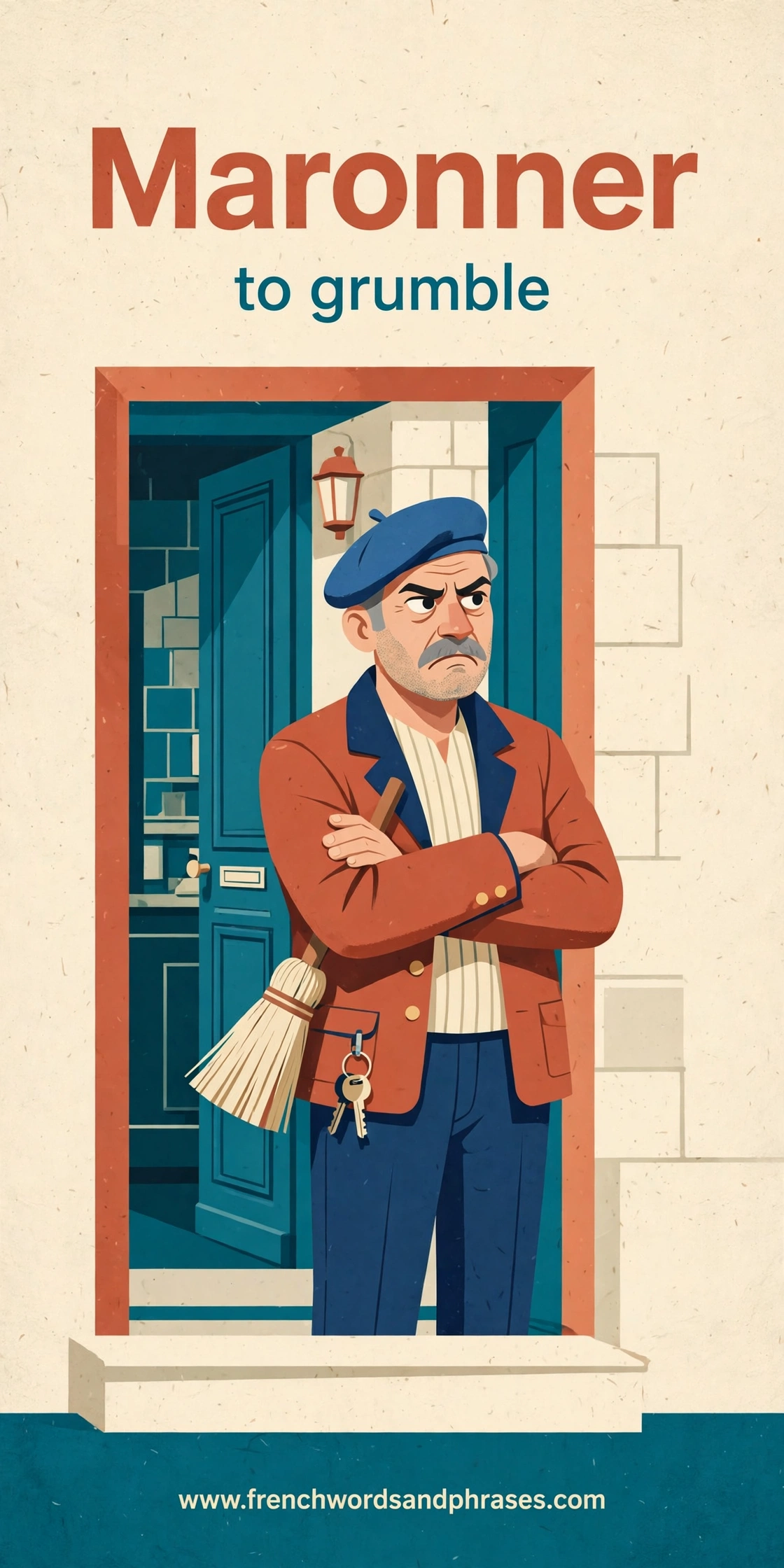
Maronner means to grumble.
The queue is too long, the coffee costs too much, it is raining again — maronner is familiar French’s verb for the low, steady grumble that accompanies an ordinary bad day.
In this guide, you’ll learn how to conjugate maronner in all the major French tenses and moods. Explore complete conjugation tables, French examples, English translations, and practice quizzes.
Understanding the French Verb Maronner
Maronner is a regular French verb belonging to the first group of verbs, those ending in -er.
It means to grumble. It is commonly used, always in familiar register, for grumbling about delays, prices, weather and work — often dans son coin, in one’s corner, as the background music of a bad day.
Verb classification: First group (-er)
Auxiliary verb: Avoir
Past participle: maronné
Present participle: maronnant
English equivalents: To grumble, to moan (familiar); maronner dans son coin — to grumble away in one’s corner.
One important detail: maronner is familiar register from head to toe — the verb of the grumble among friends, never of the formal letter, where se plaindre takes over. It keeps its double n in every form — je maronne, nous maronnons, maronné — and it loves a place to grumble from: maronner dans son coin, in one’s corner, half to oneself.
Experience the Word
Maronner is the verb of the small daily protest — never a speech, always a soundtrack.
Imagine a platform on a rainy Monday. The train is late, a hundred umbrellas drip, and a soft chorus rises from the crowd: everyone maronne, nobody is really surprised.
Nothing will change because of it. It has been grumbled — and somehow the day feels lighter.
How to Conjugate Maronner: Complete French Conjugation Guide
Let’s explore every major conjugation of maronner, beginning with the indicative mood.
How to Conjugate Maronner in the Indicative Mood
The indicative mood is used to express facts, observations, actions, and events.
How to Conjugate Maronner in the Present Tense (Présent)
Used for actions happening now, habitual actions, and general truths.
| Subject | Conjugation |
|---|---|
| je | maronne |
| tu | maronnes |
| il / elle | maronne |
| nous | maronnons |
| vous | maronnez |
| ils / elles | maronnent |
Example
Il maronne contre le prix du café.
He grumbles about the price of coffee.
Quick Quiz 1
Complete the sentence:
Nous ______ contre la file d’attente.
Reveal the answer
maronnons
Nous maronnons contre la file d’attente.
We grumble about the queue.
How to Conjugate Maronner in the Passé Composé
Used for completed actions in the past. Maronner takes the auxiliary verb avoir.
| Subject | Conjugation |
|---|---|
| j’ | ai maronné |
| tu | as maronné |
| il / elle | a maronné |
| nous | avons maronné |
| vous | avez maronné |
| ils / elles | ont maronné |
Example
Elle a maronné toute la matinée à cause de la pluie.
She grumbled all morning because of the rain.
How to Conjugate Maronner in the Imparfait (Imperfect Tense)
Used for habitual past actions, descriptions, and ongoing situations in the past.
| Subject | Conjugation |
|---|---|
| je | maronnais |
| tu | maronnais |
| il / elle | maronnait |
| nous | maronnions |
| vous | maronniez |
| ils / elles | maronnaient |
Example
Le concierge maronnait chaque fois qu’on oubliait la lumière.
The caretaker used to grumble every time someone forgot the light.
Quick Quiz 2
Choose the correct form:
She grumbled all morning.
Elle ______ toute la matinée. (a maronné / est maronnée)
Reveal the answer
a maronné
Elle a maronné toute la matinée.
Maronner takes avoir.
How to Conjugate Maronner in the Plus-que-parfait
Used to describe an action that had already been completed before another past event.
| Subject | Conjugation |
|---|---|
| j’ | avais maronné |
| tu | avais maronné |
| il / elle | avait maronné |
| nous | avions maronné |
| vous | aviez maronné |
| ils / elles | avaient maronné |
Example
Il avait maronné pendant des heures avant de se décider.
He had grumbled for hours before making up his mind.
How to Conjugate Maronner in the Passé Simple
Primarily used in formal writing, literature, and historical narratives. It is rarely used in everyday conversation.
| Subject | Conjugation |
|---|---|
| je | maronnai |
| tu | maronnas |
| il / elle | maronna |
| nous | maronnâmes |
| vous | maronnâtes |
| ils / elles | maronnèrent |
Example
Elle maronna quelques mots et reprit son travail.
She grumbled a few words and went back to work.
How to Conjugate Maronner in the Passé Antérieur
A literary tense used to express an action completed immediately before another past action, generally in the passé simple.
| Subject | Conjugation |
|---|---|
| j’ | eus maronné |
| tu | eus maronné |
| il / elle | eut maronné |
| nous | eûmes maronné |
| vous | eûtes maronné |
| ils / elles | eurent maronné |
Example
Quand il eut maronné un moment, il accepta enfin l’invitation.
When he had grumbled for a while, he finally accepted the invitation.
How to Conjugate Maronner in the Future Tense (Futur Simple)
Used to describe actions that will take place in the future.
| Subject | Conjugation |
|---|---|
| je | maronnerai |
| tu | maronneras |
| il / elle | maronnera |
| nous | maronnerons |
| vous | maronnerez |
| ils / elles | maronneront |
Example
Demain, les clients maronneront encore pour la file d’attente.
Tomorrow, the customers will grumble again about the queue.
How to Conjugate Maronner in the Futur Antérieur (Future Perfect)
Used for an action that will have been completed before a particular point in the future.
| Subject | Conjugation |
|---|---|
| j’ | aurai maronné |
| tu | auras maronné |
| il / elle | aura maronné |
| nous | aurons maronné |
| vous | aurez maronné |
| ils / elles | auront maronné |
Example
À la fin de la semaine, il aura maronné pour tout et pour rien.
By the end of the week, he will have grumbled about everything and nothing.
How to Conjugate Maronner in the Near Future (Futur Proche)
Used to describe something that is going to happen soon. Formed with aller + infinitive.
| Subject | Conjugation |
|---|---|
| je | vais maronner |
| tu | vas maronner |
| il / elle | va maronner |
| nous | allons maronner |
| vous | allez maronner |
| ils / elles | vont maronner |
Example
Il va maronner, je le connais.
He is going to grumble, I know him.
How to Conjugate Maronner in the Conditional Mood
The conditional mood expresses what would happen under certain circumstances. It is also frequently used to make polite requests or express wishes.
How to Conjugate Maronner in the Present Conditional
| Subject | Conjugation |
|---|---|
| je | maronnerais |
| tu | maronnerais |
| il / elle | maronnerait |
| nous | maronnerions |
| vous | maronneriez |
| ils / elles | maronneraient |
Example
Sans ce retard, personne ne maronnerait ce matin.
Without this delay, nobody would be grumbling this morning.
How to Conjugate Maronner in the Past Conditional
| Subject | Conjugation |
|---|---|
| j’ | aurais maronné |
| tu | aurais maronné |
| il / elle | aurait maronné |
| nous | aurions maronné |
| vous | auriez maronné |
| ils / elles | auraient maronné |
Example
Elle aurait maronné davantage si le train avait été annulé.
She would have grumbled more if the train had been cancelled.
Maronner in the Literary Past Conditional Form
This less common literary form uses the imperfect subjunctive of avoir.
| Subject | Conjugation |
|---|---|
| j’ | eusse maronné |
| tu | eusses maronné |
| il / elle | eût maronné |
| nous | eussions maronné |
| vous | eussiez maronné |
| ils / elles | eussent maronné |
Example
Il eût maronné dans son coin jusqu’au départ du train.
He would have grumbled in his corner until the train left.
How to Conjugate Maronner in the Subjunctive Mood
The subjunctive is used to express wishes, emotions, doubts, necessity, and uncertainty. It frequently follows expressions such as il faut que (it is necessary that) or bien que (although).
How to Conjugate Maronner in the Present Subjunctive
| Subject | Conjugation |
|---|---|
| que je | maronne |
| que tu | maronnes |
| qu’il / qu’elle | maronne |
| que nous | maronnions |
| que vous | maronniez |
| qu’ils / qu’elles | maronnent |
Example
Je comprends que tu maronnes, la journée a été longue.
I understand you grumbling, the day has been long.
Quick Quiz 3
Complete the sentence using the subjunctive:
Il faut que vous ______ un peu moins.
Reveal the answer
maronniez
Il faut que vous maronniez un peu moins.
You must grumble a little less.
How to Conjugate Maronner in the Imperfect Subjunctive
A literary tense, rarely encountered in modern spoken French.
| Subject | Conjugation |
|---|---|
| que je | maronnasse |
| que tu | maronnasses |
| qu’il / qu’elle | maronnât |
| que nous | maronnassions |
| que vous | maronnassiez |
| qu’ils / qu’elles | maronnassent |
Example
Il fallait qu’elle maronnât un peu avant d’accepter.
She had to grumble a little before accepting.
How to Conjugate Maronner in the Pluperfect Subjunctive
A literary construction used to express an action completed before another past action.
| Subject | Conjugation |
|---|---|
| que j’ | eusse maronné |
| que tu | eusses maronné |
| qu’il / qu’elle | eût maronné |
| que nous | eussions maronné |
| que vous | eussiez maronné |
| qu’ils / qu’elles | eussent maronné |
Example
On disait qu’il eût maronné toute la soirée contre le menu.
They said he had grumbled all evening about the menu.
How to Conjugate Maronner in the Past Subjunctive
| Subject | Conjugation |
|---|---|
| que j’ | aie maronné |
| que tu | aies maronné |
| qu’il / qu’elle | ait maronné |
| que nous | ayons maronné |
| que vous | ayez maronné |
| qu’ils / qu’elles | aient maronné |
Example
Je suis content que tu aies maronné seulement cinq minutes.
I am glad you only grumbled for five minutes.
How to Conjugate Maronner in the Imperative
The imperative is used to give commands, instructions, invitations, or suggestions. Subject pronouns are omitted.
How to Conjugate Maronner in the Present Imperative
| Person | Conjugation |
|---|---|
| (tu) | maronne |
| (nous) | maronnons |
| (vous) | maronnez |
Example
Ne maronne pas, aide-moi plutôt !
Do not grumble, help me instead!
Quick Quiz 4
How would you say Do not grumble (tu form)?
Reveal the answer
Ne maronne pas !
French Participles of Maronner
Participles are verb forms that can be used in compound tenses and other grammatical constructions.
Present Participle of Maronner
maronnant
En maronnant, il a quand même porté les valises.
Grumbling, he still carried the suitcases.
Past Participle of Maronner
maronné
Maronnée entre amis, la plainte devenait presque une blague.
Grumbled among friends, the complaint became almost a joke.
Maronner in Everyday French: Real-Life Examples
Now that you know the conjugations, let’s see how maronner appears in everyday French.
Example 1 — Present
Il maronne dès le matin, c’est son habitude.
He grumbles from the morning on, it is his habit.
Example 2 — Passé composé
On a maronné pour le retard, puis on a ri.
We grumbled about the delay, then we laughed.
Example 3 — Imparfait
Les voyageurs maronnaient sur le quai bondé.
The travellers used to grumble on the crowded platform.
Example 4 — Future
Tu maronneras moins quand le soleil reviendra.
You will grumble less when the sun comes back.
Example 5 — Conditional
Je maronnerais aussi à ta place.
I would grumble too in your place.
Example 6 — Imperative
Maronnez si vous voulez, le train part à l’heure !
Grumble if you like, the train leaves on time!
Beyond Translation: The Meaning of Maronner
English grumble is neutral; French maronner wears its register on its sleeve.
It is the grumble of friends.
You maronnez in the queue, at the office, dans votre coin — never in a formal letter, where se plaindre takes over. Half complaint, half habit, it rarely expects an answer.
How to Remember the French Verb Maronner
Remember it this way: Maronner is about the friendly grumble — complaint as background music.
- Familiar register — for friends, queues and offices, not formal letters.
- Maronner dans son coin — to grumble away in one’s corner.
- Regular -er: je maronne, nous maronnons, past participle maronné.
The key idea is the friendly grumble — complaint as background music.
Test Your Knowledge of Maronner
Let’s see how much you’ve learned. Try answering these questions before revealing the answers.
Question 1
Is maronner formal or familiar?
Reveal the answer
Familiar — the everyday verb of grumbling, not for formal writing.
Question 2
How do you say He grumbles about the price in French?
Reveal the answer
Il maronne contre le prix.
Question 3
Translate: Do not grumble, help me!
Reveal the answer
Ne maronne pas, aide-moi !
Question 4
What is the past participle of maronner?
Reveal the answer
Maronné.
Question 5
Complete the sentence:
Je comprends que tu ______.
Reveal the answer
maronnes
Je comprends que tu maronnes.
I understand you grumbling.
Your Final Challenge
Can You Use It?
How would you say this in French?
He grumbles about the rain, but he still takes his umbrella and goes out.
Reveal the answer
Il maronne contre la pluie, mais il prend quand même son parapluie et sort.
He grumbles about the rain, but he still takes his umbrella and goes out.
A little French. A little curiosity. A richer everyday life.
LEARN FRENCH ONE WORD AT A TIME




