
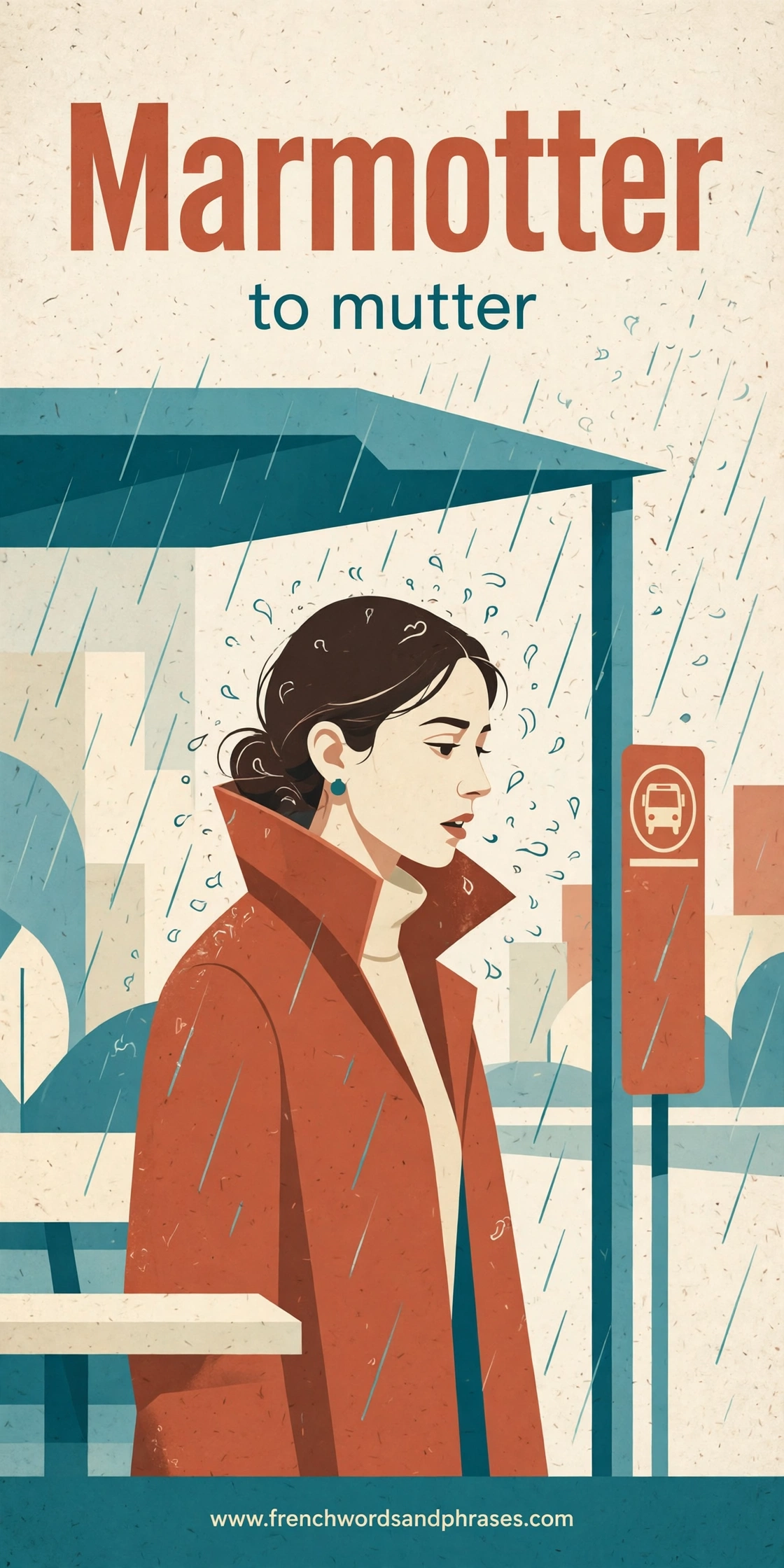
A French Word to Live By
How to Conjugate Marmotter in French
/maʁ.mɔ.te/
Marmotter means to mutter.
A password said too quietly, a complaint squeezed between clenched teeth — marmotter is the verb of the short, broken mutter, words that come out in pieces.
In this guide, you’ll learn how to conjugate marmotter in all the major French tenses and moods. Explore complete conjugation tables, French examples, English translations, and practice quizzes.
Understanding the French Verb Marmotter
Marmotter is a regular French verb belonging to the first group of verbs, those ending in -er.
It means to mutter. It is commonly used for muttering passwords and codes, for complaints and prayers said too quietly to catch, and for anything squeezed out entre ses dents — between the teeth.
Verb classification: First group (-er)
Auxiliary verb: Avoir
Past participle: marmotté
Present participle: marmottant
English equivalents: To mutter, to murmur indistinctly; marmotter entre ses dents — to mutter between one’s teeth.
One important detail: marmotter keeps its double t in every form — je marmotte, nous marmottons, marmotté — and its classic home is the phrase marmotter entre ses dents, to mutter between one’s teeth. It is the broken, stop-and-start cousin of marmonner: where marmonner drones on in one low stream, marmotter chops the words into little pieces nobody can quite catch.
Experience the Word
Marmotter is the verb of words in pieces — too quiet, too fast, too close to the teeth to be understood.
Imagine a concierge at midnight, woken by a late visitor. He opens the door still marmottant something between a greeting and a complaint, and nobody will ever know which.
Nothing has been explained. It has been muttered — and the teeth kept most of it.
How to Conjugate Marmotter: Complete French Conjugation Guide
Let’s explore every major conjugation of marmotter, beginning with the indicative mood.
How to Conjugate Marmotter in the Indicative Mood
The indicative mood is used to express facts, observations, actions, and events.
How to Conjugate Marmotter in the Present Tense (Présent)
Used for actions happening now, habitual actions, and general truths.
| Subject | Conjugation |
|---|---|
| je | marmotte |
| tu | marmottes |
| il / elle | marmotte |
| nous | marmottons |
| vous | marmottez |
| ils / elles | marmottent |
Example
Elle marmotte une réponse entre ses dents.
She mutters an answer between her teeth.
Quick Quiz 1
Complete the sentence:
Nous ______ le code à voix basse.
Reveal the answer
marmottons
Nous marmottons le code à voix basse.
We mutter the code in a low voice.
How to Conjugate Marmotter in the Passé Composé
Used for completed actions in the past. Marmotter takes the auxiliary verb avoir.
| Subject | Conjugation |
|---|---|
| j’ | ai marmotté |
| tu | as marmotté |
| il / elle | a marmotté |
| nous | avons marmotté |
| vous | avez marmotté |
| ils / elles | ont marmotté |
Example
Il a marmotté le mot de passe sans regarder l’écran.
He muttered the password without looking at the screen.
How to Conjugate Marmotter in the Imparfait (Imperfect Tense)
Used for habitual past actions, descriptions, and ongoing situations in the past.
| Subject | Conjugation |
|---|---|
| je | marmottais |
| tu | marmottais |
| il / elle | marmottait |
| nous | marmottions |
| vous | marmottiez |
| ils / elles | marmottaient |
Example
Le gardien marmottait des ordres que personne n’entendait.
The caretaker used to mutter orders that nobody heard.
Quick Quiz 2
Choose the correct form:
She muttered thank you.
Elle ______ merci. (a marmotté / est marmottée)
Reveal the answer
a marmotté
Elle a marmotté merci.
Marmotter takes avoir.
How to Conjugate Marmotter in the Plus-que-parfait
Used to describe an action that had already been completed before another past event.
| Subject | Conjugation |
|---|---|
| j’ | avais marmotté |
| tu | avais marmotté |
| il / elle | avait marmotté |
| nous | avions marmotté |
| vous | aviez marmotté |
| ils / elles | avaient marmotté |
Example
Elle avait marmotté la formule avant d’ouvrir la porte.
She had muttered the formula before opening the door.
How to Conjugate Marmotter in the Passé Simple
Primarily used in formal writing, literature, and historical narratives. It is rarely used in everyday conversation.
| Subject | Conjugation |
|---|---|
| je | marmottai |
| tu | marmottas |
| il / elle | marmotta |
| nous | marmottâmes |
| vous | marmottâtes |
| ils / elles | marmottèrent |
Example
Il marmotta quelques mots et raccrocha.
He muttered a few words and hung up.
How to Conjugate Marmotter in the Passé Antérieur
A literary tense used to express an action completed immediately before another past action, generally in the passé simple.
| Subject | Conjugation |
|---|---|
| j’ | eus marmotté |
| tu | eus marmotté |
| il / elle | eut marmotté |
| nous | eûmes marmotté |
| vous | eûtes marmotté |
| ils / elles | eurent marmotté |
Example
Quand elle eut marmotté sa prière, elle souffla la bougie.
When she had muttered her prayer, she blew out the candle.
How to Conjugate Marmotter in the Future Tense (Futur Simple)
Used to describe actions that will take place in the future.
| Subject | Conjugation |
|---|---|
| je | marmotterai |
| tu | marmotteras |
| il / elle | marmottera |
| nous | marmotterons |
| vous | marmotterez |
| ils / elles | marmotteront |
Example
Demain, il marmottera encore contre la machine à café.
Tomorrow, he will mutter at the coffee machine again.
How to Conjugate Marmotter in the Futur Antérieur (Future Perfect)
Used for an action that will have been completed before a particular point in the future.
| Subject | Conjugation |
|---|---|
| j’ | aurai marmotté |
| tu | auras marmotté |
| il / elle | aura marmotté |
| nous | aurons marmotté |
| vous | aurez marmotté |
| ils / elles | auront marmotté |
Example
À la fin de la journée, vous aurez marmotté ce code cent fois.
By the end of the day, you will have muttered this code a hundred times.
How to Conjugate Marmotter in the Near Future (Futur Proche)
Used to describe something that is going to happen soon. Formed with aller + infinitive.
| Subject | Conjugation |
|---|---|
| je | vais marmotter |
| tu | vas marmotter |
| il / elle | va marmotter |
| nous | allons marmotter |
| vous | allez marmotter |
| ils / elles | vont marmotter |
Example
Elle va marmotter quelque chose, écoute bien.
She is going to mutter something, listen carefully.
How to Conjugate Marmotter in the Conditional Mood
The conditional mood expresses what would happen under certain circumstances. It is also frequently used to make polite requests or express wishes.
How to Conjugate Marmotter in the Present Conditional
| Subject | Conjugation |
|---|---|
| je | marmotterais |
| tu | marmotterais |
| il / elle | marmotterait |
| nous | marmotterions |
| vous | marmotteriez |
| ils / elles | marmotteraient |
Example
Sans ses lunettes, il marmotterait les chiffres au hasard.
Without his glasses, he would mutter the numbers at random.
How to Conjugate Marmotter in the Past Conditional
| Subject | Conjugation |
|---|---|
| j’ | aurais marmotté |
| tu | aurais marmotté |
| il / elle | aurait marmotté |
| nous | aurions marmotté |
| vous | auriez marmotté |
| ils / elles | auraient marmotté |
Example
Elle aurait marmotté plus distinctement si on le lui avait demandé.
She would have muttered more distinctly if she had been asked.
Marmotter in the Literary Past Conditional Form
This less common literary form uses the imperfect subjunctive of avoir.
| Subject | Conjugation |
|---|---|
| j’ | eusse marmotté |
| tu | eusses marmotté |
| il / elle | eût marmotté |
| nous | eussions marmotté |
| vous | eussiez marmotté |
| ils / elles | eussent marmotté |
Example
Il eût marmotté la formule jusqu’à l’aube.
He would have muttered the formula until dawn.
How to Conjugate Marmotter in the Subjunctive Mood
The subjunctive is used to express wishes, emotions, doubts, necessity, and uncertainty. It frequently follows expressions such as il faut que (it is necessary that) or bien que (although).
How to Conjugate Marmotter in the Present Subjunctive
| Subject | Conjugation |
|---|---|
| que je | marmotte |
| que tu | marmottes |
| qu’il / qu’elle | marmotte |
| que nous | marmottions |
| que vous | marmottiez |
| qu’ils / qu’elles | marmottent |
Example
Je n’aime pas qu’il marmotte au lieu d’expliquer.
I do not like him muttering instead of explaining.
Quick Quiz 3
Complete the sentence using the subjunctive:
Il faut que vous ______ la formule.
Reveal the answer
marmottiez
Il faut que vous marmottiez la formule.
You must mutter the formula.
How to Conjugate Marmotter in the Imperfect Subjunctive
A literary tense, rarely encountered in modern spoken French.
| Subject | Conjugation |
|---|---|
| que je | marmottasse |
| que tu | marmottasses |
| qu’il / qu’elle | marmottât |
| que nous | marmottassions |
| que vous | marmottassiez |
| qu’ils / qu’elles | marmottassent |
Example
Il fallait qu’elle marmottât le code sans se tromper.
She had to mutter the code without making a mistake.
How to Conjugate Marmotter in the Pluperfect Subjunctive
A literary construction used to express an action completed before another past action.
| Subject | Conjugation |
|---|---|
| que j’ | eusse marmotté |
| que tu | eusses marmotté |
| qu’il / qu’elle | eût marmotté |
| que nous | eussions marmotté |
| que vous | eussiez marmotté |
| qu’ils / qu’elles | eussent marmotté |
Example
On prétendait qu’il eût marmotté un secret avant de partir.
They claimed he had muttered a secret before leaving.
How to Conjugate Marmotter in the Past Subjunctive
| Subject | Conjugation |
|---|---|
| que j’ | aie marmotté |
| que tu | aies marmotté |
| qu’il / qu’elle | ait marmotté |
| que nous | ayons marmotté |
| que vous | ayez marmotté |
| qu’ils / qu’elles | aient marmotté |
Example
Je suis surpris qu’elle ait marmotté la réponse si bas.
I am surprised she muttered the answer so quietly.
How to Conjugate Marmotter in the Imperative
The imperative is used to give commands, instructions, invitations, or suggestions. Subject pronouns are omitted.
How to Conjugate Marmotter in the Present Imperative
| Person | Conjugation |
|---|---|
| (tu) | marmotte |
| (nous) | marmottons |
| (vous) | marmottez |
Example
Ne marmotte pas, répète ta phrase !
Do not mutter, repeat your sentence!
Quick Quiz 4
How would you say Mutter the code (tu form)?
Reveal the answer
Marmotte le code !
French Participles of Marmotter
Participles are verb forms that can be used in compound tenses and other grammatical constructions.
Present Participle of Marmotter
marmottant
En marmottant, il cherchait ses clés dans ses poches.
Muttering, he searched his pockets for his keys.
Past Participle of Marmotter
marmotté
Marmottée à voix basse, la menace passait inaperçue.
Muttered in a low voice, the threat went unnoticed.
Marmotter in Everyday French: Real-Life Examples
Now that you know the conjugations, let’s see how marmotter appears in everyday French.
Example 1 — Present
Il marmotte toujours entre ses dents.
He always mutters between his teeth.
Example 2 — Passé composé
Elle a marmotté merci du bout des lèvres.
She muttered thank you from the edge of her lips.
Example 3 — Imparfait
Le vieux voisin marmottait en arrosant ses fleurs.
The old neighbour used to mutter while watering his flowers.
Example 4 — Future
Tu marmotteras le code, comme d’habitude.
You will mutter the code, as usual.
Example 5 — Conditional
Je marmotterais moins si je dormais mieux.
I would mutter less if I slept better.
Example 6 — Imperative
Marmotte le code une dernière fois !
Mutter the code one last time!
Beyond Translation: The Meaning of Marmotter
French has two near-twins for low speech: marmotter and marmonner.
The difference is in the rhythm.
Marmonner drones on in one low stream; marmotter breaks the words into short pieces — entre ses dents, between the teeth, where complaints and passwords hide.
How to Remember the French Verb Marmotter
Remember it this way: Marmotter is about broken words between the teeth.
- Marmotter entre ses dents — muttering between one’s teeth.
- Short broken words, unlike marmonner’s long low drone.
- Regular -er: je marmotte, nous marmottons, past participle marmotté.
The key idea is broken words between the teeth.
Test Your Knowledge of Marmotter
Let’s see how much you’ve learned. Try answering these questions before revealing the answers.
Question 1
What does marmotter entre ses dents mean?
Reveal the answer
To mutter between one’s teeth.
Question 2
How do you say He muttered the password in French?
Reveal the answer
Il a marmotté le mot de passe.
Question 3
Translate: She mutters an answer.
Reveal the answer
Elle marmotte une réponse.
Question 4
What is the past participle of marmotter?
Reveal the answer
Marmotté.
Question 5
Complete the sentence:
Je n’aime pas qu’il ______ au lieu d’expliquer.
Reveal the answer
marmotte
Je n’aime pas qu’il marmotte au lieu d’expliquer.
I do not like him muttering instead of explaining.
Your Final Challenge
Can You Use It?
How would you say this in French?
She mutters the code between her teeth, and the door opens.
Reveal the answer
Elle marmotte le code entre ses dents, et la porte s’ouvre.
She mutters the code between her teeth, and the door opens.
A little French. A little curiosity. A richer everyday life.
LEARN FRENCH ONE WORD AT A TIME




