A French Word to Live By
Translate Éponge to English
/e.pɔ̃ʒ/
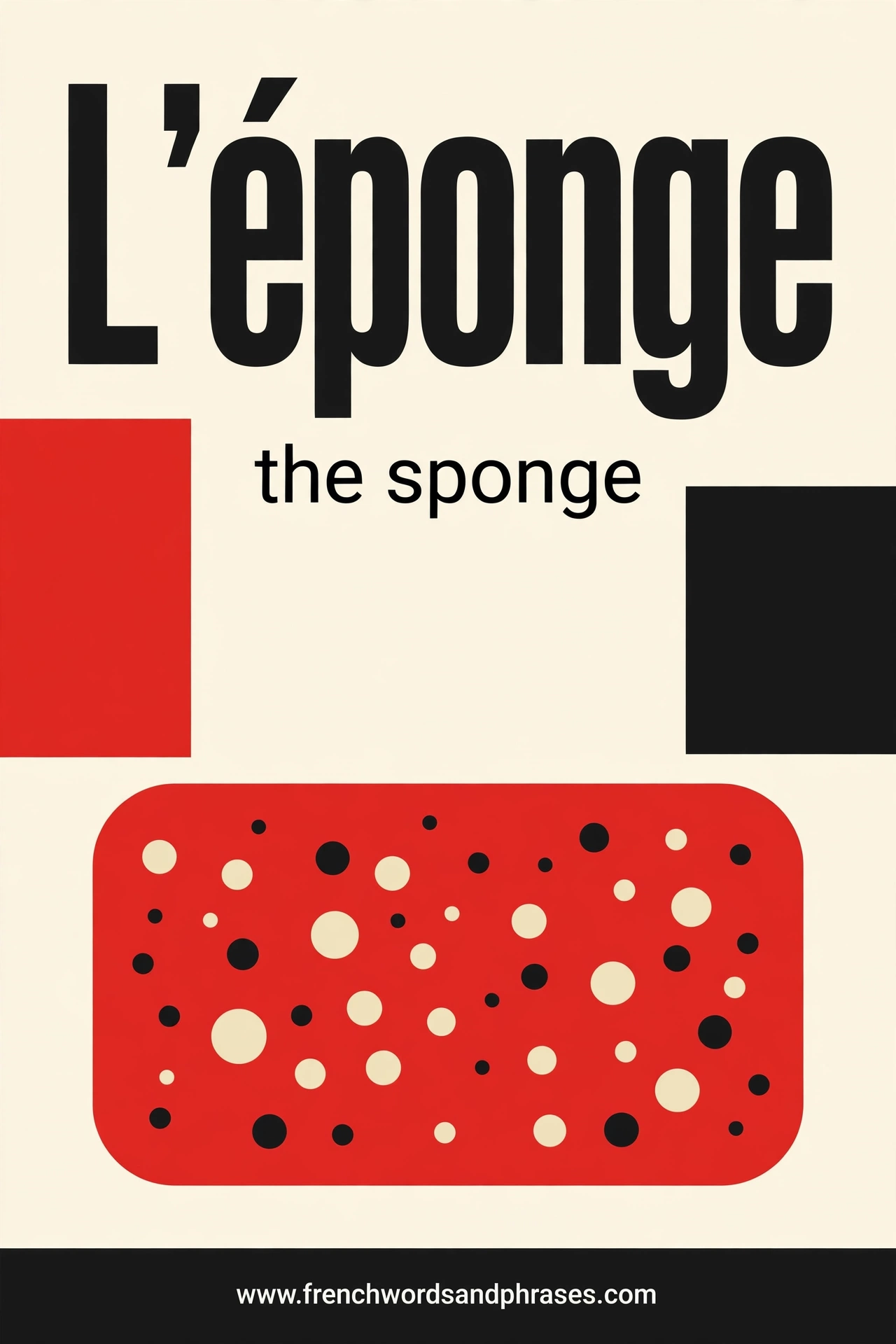
L’éponge means a sponge.
Breakfast is over, the sink is full of soapy water, and someone reaches for the yellow rectangle that lives by the tap. One squeeze, one wipe, and the table shines again. Humble, silent, indispensable: l’éponge.
In this guide, you’ll learn what éponge means in English, how to use it with its articles, how to form its plural, and how it appears in everyday French. Explore French examples, English translations, and practice quizzes.
Understanding the French Noun Éponge
Éponge is a feminine French noun. It is learned together with its article: l’éponge, une éponge — the article shrinks to l’ because the word begins with a vowel. It names the soft, thirsty block that soaks up water in the kitchen, the bathroom and the car wash.
It means a sponge — the porous block, natural or synthetic, that drinks up liquid and carries soap across a surface: une éponge humide (a damp sponge), passer l’éponge (to wipe with a sponge). The word also lives in a famous figurative phrase: passer l’éponge sur quelque chose means to wipe the slate clean — to forgive and forget.
Gender: Feminine
Definite article: l’ — l’éponge (the sponge)
Indefinite article: une — une éponge (a sponge)
Plural: les éponges
English equivalents: A sponge; also, figuratively, a clean slate in passer l’éponge.
One important usage detail: because éponge is feminine but begins with a vowel, the possessives play a trick — you say mon éponge, not « ma éponge », because ma cannot stand before a vowel. The same happens with ton and son: ton éponge, son éponge, even though the sponge belongs to the feminine team.
Experience the Word
Éponge is more than a cleaning tool. It is the quiet hero of every French kitchen — the object nobody photographs and everybody reaches for, twenty times a day.
Imagine the end of a long family lunch: plates stacked, glasses everywhere, the tablecloth decorated with the whole menu. Then the sponge passes, slowly, and the table becomes a table again. Order returns, one wipe at a time.
You have not just cleaned a surface. You have passed l’éponge — and, in the French phrase, forgiven the mess entirely.
How to Use Éponge in French: Complete Guide
Let’s explore how éponge works in French, beginning with its articles.
Éponge with the Definite Article (L’, Les)
Used for the sponge everyone knows — the one by the sink, the one in your hand.
| Number | French |
|---|---|
| Singular | l’éponge |
| Plural | les éponges |
Example
L’éponge est sur le bord de l’évier.
The sponge is on the edge of the sink.
Éponge with the Indefinite Article (Une, Des)
Used for a sponge in general — the new one in the packet, the one you are asking for.
| Number | French |
|---|---|
| Singular | une éponge |
| Plural | des éponges |
Example
Il faut acheter une éponge neuve.
We need to buy a new sponge.
Where the Éponge Works
Sink, bath and bodywork — the sponge has a post in every wet corner of the house.
| French | In English |
|---|---|
| une éponge de cuisine | a kitchen sponge |
| une éponge de bain | a bath sponge |
| une éponge naturelle | a natural sponge |
| une éponge grattante | a scouring sponge |
| une éponge pour la voiture | a sponge for the car |
| une éponge humide | a damp sponge |
Example
Elle utilise une éponge naturelle pour le bain du bébé.
She uses a natural sponge for the baby’s bath.
Quick Quiz 1
What does passer l’éponge sur une erreur mean, figuratively?
Reveal the answer
To wipe the slate clean — to forgive the mistake and forget it.
Passons l’éponge sur cette dispute et restons amis.
Let’s wipe the slate clean over this argument and stay friends.
The Plural of Éponge
Éponge adds an -s in the plural — les éponges, sold in packets of two or three.
| Number | French |
|---|---|
| Singular | l’éponge |
| Plural | les éponges |
Example
Les éponges sont vendues par paquets de trois.
Sponges are sold in packets of three.
Éponge with Possessive Adjectives (Mon, Ton, Son…)
Possessives agree with the noun — but éponge begins with a vowel, so even the feminine noun takes mon, ton, son.
| Owner | French |
|---|---|
| my | mon éponge |
| your (tu) | ton éponge |
| his / her | son éponge |
| our | notre éponge |
| your (vous) | votre éponge |
| their | leur éponge |
Example
Mon éponge est déjà usée, il faut la changer.
My sponge is already worn out, it needs changing.
Quick Quiz 2
Complete the sentence:
______ éponge est tombée dans l’évier. (My)
Reveal the answer
Mon
Mon éponge est tombée dans l’évier.
My sponge fell into the sink — mon, because éponge starts with a vowel.
Éponge with Demonstrative Adjectives (Cette, Ces)
Used to point: this sponge here, those sponges there.
| Number | French |
|---|---|
| Singular | cette éponge |
| Plural | ces éponges |
Example
Cette éponge gratte trop, prends l’autre.
This sponge scratches too much, take the other one.
Éponge with Adjectives
Adjectives agree with éponge, feminine — neuve, humide, douce.
| Adjective | With Éponge |
|---|---|
| neuve (new) | une éponge neuve |
| humide (damp) | une éponge humide |
| douce (soft) | une éponge douce |
| usée (worn out) | une éponge usée |
| naturelle (natural) | une éponge naturelle |
Example
Passe une éponge douce sur le visage du bébé.
Pass a soft sponge over the baby’s face.
Quick Quiz 3
Complete the sentence:
Elle achète une éponge ______. (new)
Reveal the answer
neuve
Elle achète une éponge neuve.
She is buying a new sponge.
Everyday Expressions with Éponge
Forgiveness, drinking and hard work — the éponge phrases of daily life.
| Expression | In English |
|---|---|
| passer l’éponge | to wipe with a sponge; to let bygones be bygones |
| jeter l’éponge | to throw in the towel, to give up |
| boire comme une éponge | to drink like a fish |
| presser l’éponge | to squeeze the sponge |
| une éponge imbibée d’eau | a sponge soaked in water |
| nettoyer à l’éponge | to clean with a sponge |
Example
Après trois essais, il a jeté l’éponge.
After three attempts, he threw in the towel.
Words from the Same Family as Éponge
Soaking, wiping and squeezing — the words that travel with éponge.
| French | In English |
|---|---|
| éponger | to sponge up, to mop up |
| absorber | to absorb |
| essuyer | to wipe |
| le torchon | the dish towel |
| le savon | the soap |
| mouiller | to wet |
Example
Il éponge l’eau renversée avec un torchon.
He mops up the spilt water with a dish towel.
Quick Quiz 4
Your friend says he drinks « comme une éponge ». What does he mean?
Reveal the answer
He drinks a lot — like a sponge soaking up liquid, the French version of drinking like a fish.
Attention, il boit comme une éponge quand il est en vacances.
Careful, he drinks like a fish when he is on holiday.
Éponge in Everyday French: Real-Life Examples
Now that you know the word, let’s see how éponge appears in everyday French.
Example 1 — In the kitchen
Passe-moi l’éponge, s’il te plaît.
Pass me the sponge, please.
Example 2 — Cleaning up
Elle passe l’éponge sur la table après le repas.
She wipes the table with the sponge after the meal.
Example 3 — At the shop
Les éponges sont au rayon des produits ménagers.
The sponges are in the household products aisle.
Example 4 — Bath time
Le bébé joue avec son éponge de bain.
The baby plays with his bath sponge.
Example 5 — Forgiving
Allez, on passe l’éponge et on recommence.
Come on, let’s wipe the slate clean and start again.
Example 6 — A spill
Vite, une éponge ! Le café se répand partout.
Quick, a sponge! The coffee is spreading everywhere.
Beyond Translation: The Meaning of Éponge
The sponge gave French two of its most human metaphors. To pass the sponge over something is to forgive it — the slate wiped clean, the debt forgotten. And to throw the sponge, jeter l’éponge, borrowed from the boxing corner where the sponge became the towel, is to admit defeat with dignity. Few cleaning tools carry so much philosophy.
To say éponge is to hold the power to erase — a spill, a stain, or an old grudge.
It evokes soapy water and second chances, the sink after Sunday lunch and the argument nobody mentions anymore — because someone, kindly, passed the sponge.
How to Remember the French Noun Éponge
Remember it this way: Éponge is the sponge — feminine, beginning with a vowel, so its article is l’ and its possessives are mon, ton, son.
- You wipe with it — passer l’éponge sur la table, et tout est propre.
- You forgive with it — passer l’éponge sur une erreur, c’est pardonner.
- You give up with it — jeter l’éponge, comme le boxeur fatigué.
The key idea is l’éponge cleans the table — and wipes the slate clean.
Test Your Knowledge of Éponge
Let’s see how much you’ve learned. Try answering these questions before revealing the answers.
Question 1
Is éponge masculine or feminine?
Reveal the answer
Feminine — l’éponge, une éponge.
Question 2
Why do we say mon éponge and not ma éponge?
Reveal the answer
Because éponge begins with a vowel — mon, ton and son are used before vowel sounds, even for feminine nouns.
Question 3
Translate: Pass me the sponge, please.
Reveal the answer
Passe-moi l’éponge, s’il te plaît.
Question 4
What does jeter l’éponge mean?
Reveal the answer
To throw in the towel — to give up, borrowed from the boxing corner.
Question 5
Complete the sentence:
Elle nettoie la baignoire avec ______ éponge douce. (a)
Reveal the answer
une
Elle nettoie la baignoire avec une éponge douce.
She cleans the bath with a soft sponge.
Your Final Challenge
Can You Use It?
How would you say this in French?
“She wipes the table with a damp sponge.”
Reveal the answer
Elle passe l’éponge humide sur la table.
She wipes the table with a damp sponge.
A little French. A little curiosity. A richer everyday life.
LEARN FRENCH ONE WORD AT A TIME