
A French Word to Live By
Translate Budget to English
/by.dʒɛ/
Le budget means a budget.
Sunday evening, the kitchen table covered with receipts, a notebook, and two cups of coffee going cold. Like thousands of families across France, they are doing the same monthly ceremony: le budget.
In this guide, you’ll learn what budget means in English, how to use it with its articles, how to form its plural, and how it appears in everyday French. Explore French examples, English translations, and practice quizzes.
Understanding the French Noun Budget
Budget is a masculine French noun. It is learned together with its article: le budget, un budget. And it carries a secret: budget is a French word that emigrated. It comes from the old French bougette, a little leather bag for money — it travelled into English, grew up there, and came home wearing an English accent.
It means a budget — the plan that matches money coming in to money going out. There is le budget familial, the family budget balanced at the kitchen table; le budget de l’État, the state budget voted in parliament; and the small, hopeful ones: le budget vacances, the holiday budget, counted out in advance like a promise.
Gender: Masculine
Definite article: le — le budget (the budget)
Indefinite article: un — un budget (a budget)
Plural: les budgets
English equivalents: A budget — of a family, a company, or a state.
One important usage detail: the adjective to know is serré — un budget serré is a tight budget, the one most families recognise. And a film made cheaply is un film à petit budget, a low-budget film — petit budget works for holidays, weddings and kitchens too.
Experience the Word
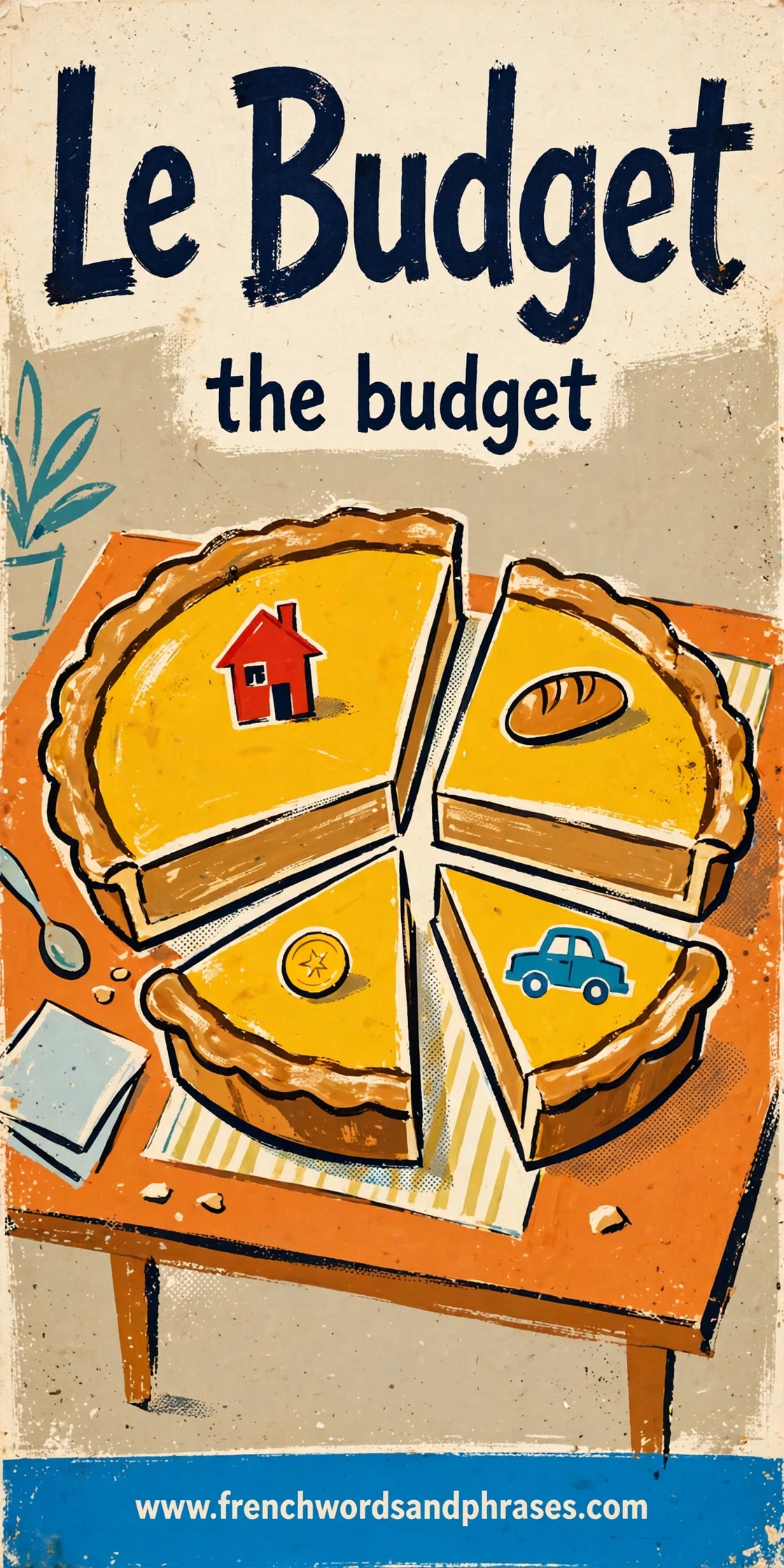
Budget is more than a spreadsheet. It is where a household’s hopes meet its arithmetic — the holiday, the car, the new roof, all waiting politely for their month to come.
Imagine the notebook on the kitchen table: rent, courses, essence, vacances — every line a decision, every total a small negotiation between what life costs and what life is for. Le budget is not the enemy of pleasure; it is the plan that pays for it.
You have not just counted money. You have drawn the map of your year.
How to Use Budget in French: Complete Guide
Let’s explore how budget works in French, beginning with its articles.
Budget with the Definite Article (Le, Les)
Used for the budget everyone knows — the state’s in the autumn, the family’s at the kitchen table.
| Number | French |
|---|---|
| Singular | le budget |
| Plural | les budgets |
Example
Le budget de l’État est voté à l’automne.
The state budget is voted on in the autumn.
Budget with the Indefinite Article (Un, Des)
Used for a budget in general — the one you set before a holiday, a wedding, a renovation.
| Number | French |
|---|---|
| Singular | un budget |
| Plural | des budgets |
Example
Pour les vacances, nous avons un budget de mille euros.
For the holidays, we have a budget of a thousand euros.
Budgets Everywhere
Tight, annual, exceeded — the budgets of French life.
| French | In English |
|---|---|
| le budget familial | the family budget |
| le budget de l’État | the state budget |
| un budget serré | a tight budget |
| le budget vacances | the holiday budget |
| dépasser le budget | to go over budget |
| un petit budget | a small budget |
Example
Avec un budget serré, on cuisine plus à la maison.
With a tight budget, we cook more at home.
Quick Quiz 1
What is « un budget serré »?
Reveal the answer
A tight budget — serré means tight, squeezed, with no room to spare.
Avec un budget serré, on fait attention à tout.
With a tight budget, you watch everything.
The Plural of Budget
Budget adds an -s in the plural — les budgets, from town halls to film studios.
| Number | French |
|---|---|
| Singular | le budget |
| Plural | les budgets |
Example
Les budgets des petites communes sont difficiles à équilibrer.
The budgets of small municipalities are hard to balance.
Budget with Possessive Adjectives (Mon, Ton, Son…)
Possessives agree with the noun, not with the owner — and budget is masculine, so it takes mon, ton, son.
| Owner | French |
|---|---|
| my | mon budget |
| your (tu) | ton budget |
| his / her | son budget |
| our | notre budget |
| your (vous) | votre budget |
| their | leur budget |
Example
Je prépare mon budget au début de chaque mois.
I prepare my budget at the start of each month.
Quick Quiz 2
Complete the sentence:
Elle dépasse ______ budget chaque été. (Her)
Reveal the answer
son
Elle dépasse son budget chaque été.
She goes over her budget every summer.
Budget with Demonstrative Adjectives (Ce, Ces)
Used to point: this budget here, those budgets there.
| Number | French |
|---|---|
| Singular | ce budget |
| Plural | ces budgets |
Example
Ce budget ne prévoit rien pour les réparations.
This budget provides nothing for repairs.
Budget with Adjectives
Adjectives agree with budget, masculine — serré, annuel, équilibré.
| Adjective | With Budget |
|---|---|
| serré (tight) | un budget serré |
| annuel (annual) | le budget annuel |
| équilibré (balanced) | un budget équilibré |
| limité (limited) | un budget limité |
| énorme (huge) | un budget énorme |
Example
Un budget équilibré évite les dettes.
A balanced budget avoids debts.
Quick Quiz 3
Complete the sentence:
Avec un budget ______, on choisit un petit hôtel. (limited)
Reveal the answer
limité
Avec un budget limité, on choisit un petit hôtel.
With a limited budget, you choose a small hotel.
Everyday Expressions with Budget
Sticking to it, blowing it, voting it — the budget phrases of daily life.
| Expression | In English |
|---|---|
| tenir son budget | to stick to your budget |
| dépasser le budget | to go over budget |
| un budget serré | a tight budget |
| prévoir un budget | to set aside a budget |
| le vote du budget | the budget vote |
| à petit budget | on a small budget, low-budget |
Example
Ce film à petit budget a gagné un grand prix.
This low-budget film won a major prize.
Words from the Same Family as Budget
Spending, saving and the little bag it all came from — the words that travel with budget.
| French | In English |
|---|---|
| budgétaire | budgetary, budget- (adjective) |
| la bougette (old French) | the little bag — the ancestor of the word |
| les dépenses | expenses, spending |
| les recettes | income, revenue |
| économiser | to save money |
| un compte | an account |
Example
Elle note toutes ses dépenses dans un carnet.
She writes all her expenses down in a notebook.
Quick Quiz 4
« Budget is a pure English invention. » True or false?
Reveal the answer
False — budget comes from the old French bougette, a little leather money bag; English borrowed it and French borrowed it back.
Le mot budget vient de la bougette, le petit sac en cuir.
The word budget comes from the bougette, the little leather bag.
Budget in Everyday French: Real-Life Examples
Now that you know the word, let’s see how budget appears in everyday French.
Example 1 — Holiday planning
Notre budget vacances est de huit cents euros.
Our holiday budget is eight hundred euros.
Example 2 — At home
Chaque mois, ils refont le budget familial ensemble.
Every month, they redo the family budget together.
Example 3 — In the news
Le vote du budget occupe les députés cette semaine.
The budget vote is keeping the MPs busy this week.
Example 4 — Shopping
Avec mon petit budget, je vais au marché en fin de journée.
With my small budget, I go to the market at the end of the day.
Example 5 — A warning
Attention, le voyage dépasse déjà notre budget.
Careful, the trip is already going over our budget.
Example 6 — At the cinema
Ce film à petit budget est une belle surprise.
This low-budget film is a lovely surprise.
Beyond Translation: The Meaning of Budget
Budget is the great travelling word of finance: born in France as bougette, the little leather bag a treasurer carried, it crossed to England, became the name of the Chancellor’s money speech — the bag he opened — and then sailed home to France with an English accent and a worldwide career.
To say budget is to open the little bag and count, honestly, what is inside.
It evokes the deputies voting late into the autumn night and the couple at the kitchen table with the receipts — the same ceremony at two scales: deciding, in advance, what the money is for.
How to Remember the French Noun Budget
Remember it this way: Budget is a budget — masculine, the family’s plan and the state’s alike, and a French word that came home from England.
- You plan it — je prépare mon budget au début du mois.
- You squeeze it — un budget serré, un film à petit budget.
- You remember its journey — le budget vient de la bougette, le petit sac en cuir.
The key idea is le budget is the little bag, opened and counted.
Test Your Knowledge of Budget
Let’s see how much you’ve learned. Try answering these questions before revealing the answers.
Question 1
Is budget masculine or feminine?
Reveal the answer
Masculine — le budget, un budget.
Question 2
Where does the word budget come from?
Reveal the answer
From the old French bougette — a little leather bag for money, borrowed by English and borrowed back.
Question 3
Translate: We have a budget of a thousand euros.
Reveal the answer
Nous avons un budget de mille euros.
Question 4
What does « dépasser le budget » mean?
Reveal the answer
To go over budget — to spend more than the plan allowed.
Question 5
Complete the sentence:
Je prépare ______ budget chaque mois.
Reveal the answer
mon
Je prépare mon budget chaque mois.
I prepare my budget every month.
Your Final Challenge
Can You Use It?
How would you say this in French?
“For the holidays, we have a budget of a thousand euros.”
Reveal the answer
Pour les vacances, nous avons un budget de mille euros.
For the holidays, we have a budget of a thousand euros.
A little French. A little curiosity. A richer everyday life.
LEARN FRENCH ONE WORD AT A TIME




