A French Word to Live By
Translate Impôt to English
/ɛ̃.po/
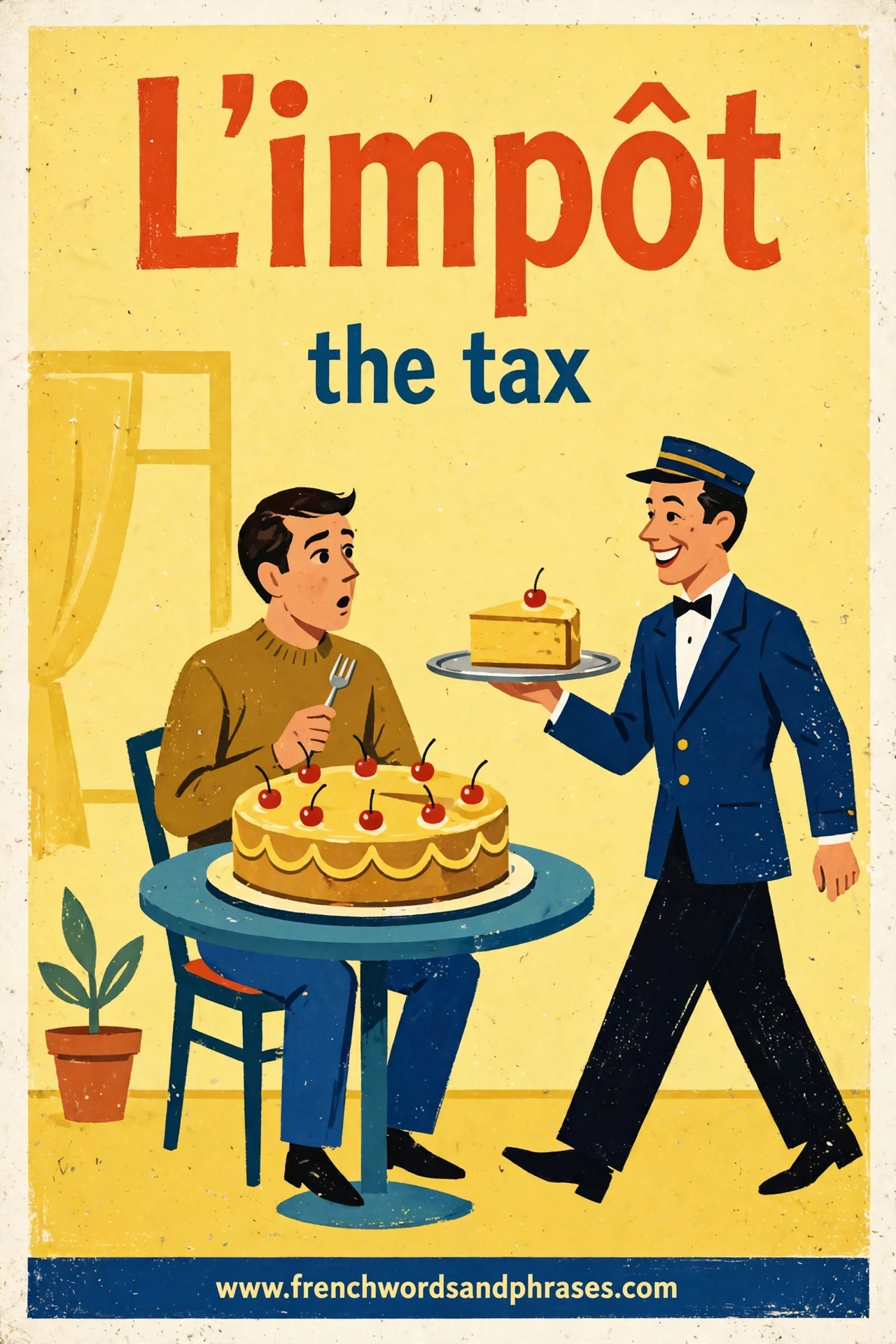
L’impôt means the tax.
A spring evening at the kitchen table: a laptop, a pile of payslips, a mug of coffee going cold. All over France, the same ritual is under way — the season of l’impôt, when everyone sits down to declare what they earned.
In this guide, you’ll learn what impôt means in English, how to use it with its articles, how to form its plural, and how it appears in everyday French. Explore French examples, English translations, and practice quizzes.
Understanding the French Noun Impôt
Impôt is a masculine French noun. It is learned together with its article: l’impôt, un impôt. Because it begins with a vowel, the definite article shrinks to l’. It is the word for the money the state takes from what you earn and own to pay for public life.
It means the tax — above all in its most famous form, l’impôt sur le revenu, income tax. In the plural, les impôts is the everyday word for taxes in general: payer ses impôts, to pay your taxes, is a sentence every adult in France knows by heart. The money goes to schools, hospitals, roads and pensions — the shared machinery of the country.
Gender: Masculine
Definite article: l’ — l’impôt (the tax)
Indefinite article: un — un impôt (a tax)
Plural: les impôts
English equivalents: The tax; income tax in l’impôt sur le revenu; taxes in general in les impôts.
One important usage detail: French has two words in this territory. L’impôt is the big, general word — income tax, and taxes as a whole in the plural. La taxe names particular levies, like la TVA (VAT) or la taxe foncière (the property tax). In everyday conversation, les impôts covers almost everything the state asks you to pay.
Experience the Word
Impôt is more than a bill. It is the price of the shared country — the school at the end of the street, the hospital on the hill, the train that arrives on time.
Imagine the payslip at the end of the month: one line for what you earned, one line for what the state has already taken. In France today, l’impôt sur le revenu is often collected at source, quietly, before the money even reaches your account.
You have not just lost money. You have paid your share of France.
How to Use Impôt in French: Complete Guide
Let’s explore how impôt works in French, beginning with its articles.
Impôt with the Definite Article (L’, Les)
Impôt begins with a vowel, so le shrinks to l’ — l’impôt — while the plural is les impôts.
| Number | French |
|---|---|
| Singular | l’impôt |
| Plural | les impôts |
Example
L’impôt sur le revenu finance les écoles et les hôpitaux.
Income tax funds schools and hospitals.
Impôt with the Indefinite Article (Un, Des)
Used for a tax in general — the one in the news, the one the government has just announced.
| Number | French |
|---|---|
| Singular | un impôt |
| Plural | des impôts |
Example
Le gouvernement annonce un nouvel impôt sur les grandes entreprises.
The government announces a new tax on large companies.
The Taxes of French Life
Income tax, VAT and the local levies — the impôt family you meet every year.
| French | In English |
|---|---|
| l’impôt sur le revenu | income tax |
| la TVA | VAT (value-added tax) |
| les impôts locaux | local taxes |
| la taxe foncière | the property tax |
| la taxe d’habitation | the housing tax |
| payer ses impôts | to pay your taxes |
Example
La TVA est déjà comprise dans le prix affiché.
VAT is already included in the displayed price.
Quick Quiz 1
What is l’impôt sur le revenu?
Reveal the answer
Income tax — the tax on what you earn, the most famous impôt of all.
L’impôt sur le revenu est calculé chaque année.
Income tax is calculated every year.
The Plural of Impôt
Impôt adds an -s in the plural — les impôts, the everyday word for taxes in general.
| Number | French |
|---|---|
| Singular | l’impôt |
| Plural | les impôts |
Example
Les impôts augmentent cette année, dit le journal.
Taxes are going up this year, says the newspaper.
Impôt with Possessive Adjectives (Mon, Ton, Son…)
Possessives agree with the noun, not with the owner — and impôt is masculine, so it takes mon, ton, son.
| Owner | French |
|---|---|
| my | mon impôt |
| your (tu) | ton impôt |
| his / her | son impôt |
| our | notre impôt |
| your (vous) | votre impôt |
| their | leur impôt |
Example
Il a déjà payé son impôt cette année.
He has already paid his tax this year.
Quick Quiz 2
Complete the sentence:
Je déclare ______ impôts en ligne au printemps. (My)
Reveal the answer
mes
Je déclare mes impôts en ligne au printemps.
I declare my taxes online in the spring.
Impôt with Demonstrative Adjectives (Cet, Ces)
Used to point: because impôt begins with a vowel, ce becomes cet — cet impôt.
| Number | French |
|---|---|
| Singular | cet impôt |
| Plural | ces impôts |
Example
Cet impôt concerne surtout les propriétaires.
This tax mainly concerns homeowners.
Impôt with Adjectives
Adjectives agree with impôt, masculine — and before a vowel, nouveau becomes nouvel.
| Adjective | With Impôt |
|---|---|
| nouveau (new) | un nouvel impôt |
| élevé (high) | un impôt élevé |
| juste (fair) | un impôt juste |
| annuel (annual) | un impôt annuel |
| lourd (heavy) | un impôt lourd |
Example
Un impôt juste tient compte des revenus de chacun.
A fair tax takes everyone’s income into account.
Quick Quiz 3
Complete the sentence:
Un ______ impôt entre en vigueur en janvier. (new)
Reveal the answer
nouvel
Un nouvel impôt entre en vigueur en janvier.
A new tax comes into force in January — nouvel, because impôt begins with a vowel.
Everyday Expressions with Impôt
Declaring, paying and dodging — the impôt phrases of the year.
| Expression | In English |
|---|---|
| payer ses impôts | to pay your taxes |
| déclarer ses impôts | to declare, to file your taxes |
| une déclaration d’impôts | a tax return |
| avant impôts | before tax |
| après impôts | after tax |
| échapper à l’impôt | to dodge tax |
Example
Elle déclare ses impôts sur internet en dix minutes.
She files her taxes on the internet in ten minutes.
Words from the Same Family as Impôt
Imposing, taxing and the taxman — the words that travel with impôt.
| French | In English |
|---|---|
| imposer | to impose, to tax |
| imposable | taxable |
| la taxe | a tax, a levy |
| le fisc | the tax authorities |
| la déclaration | the return, the declaration |
| exonéré | exempt, let off |
Example
Les petits revenus sont parfois exonérés d’impôt.
Small incomes are sometimes exempt from tax.
Quick Quiz 4
A friend translates income tax as « la taxe de revenu ». What is wrong?
Reveal the answer
Income tax is l’impôt sur le revenu — the big tax on earnings takes impôt, not taxe.
L’impôt sur le revenu est payé par les salariés et les indépendants.
Income tax is paid by employees and the self-employed.
Impôt in Everyday French: Real-Life Examples
Now that you know the word, let’s see how impôt appears in everyday French.
Example 1 — At the kitchen table
Chaque printemps, nous déclarons nos impôts en ligne.
Every spring, we declare our taxes online.
Example 2 — Reading the news
Le journal annonce une baisse des impôts pour les familles.
The newspaper announces a tax cut for families.
Example 3 — On the payslip
Son salaire après impôts arrive à la fin du mois.
His salary after tax arrives at the end of the month.
Example 4 — Talking politics
Les impôts sont toujours un grand sujet avant les élections.
Taxes are always a big topic before elections.
Example 5 — Buying a house
Avec une maison, il faut aussi payer la taxe foncière.
With a house, you also have to pay the property tax.
Example 6 — At the café
Les impôts paient les routes, les écoles et les hôpitaux.
Taxes pay for roads, schools and hospitals.
Beyond Translation: The Meaning of Impôt
Few words carry as much of French history as impôt. Revolutions have started over it, and the modern French state — its schools, hospitals, railways and pensions — is built on it. To complain about les impôts is a national pastime; to defend what they pay for is a national argument, held at every dinner table in the country.
To say impôt is to argue about what a country owes its people — and what its people owe the country.
It evokes the spring declaration, the payslip’s quiet deduction, the fisc’s official envelopes — and the services publics that the money brings to life.
How to Remember the French Noun Impôt
Remember it this way: Impôt is the tax — masculine with l’, the word for what the state takes to pay for schools, roads and hospitals.
- You pay them every year — tu paies tes impôts au printemps.
- You name the big one — l’impôt sur le revenu, income tax.
- You sort the pair — l’impôt is the general tax, la taxe a particular levy like la TVA.
The key idea is l’impôt — the state takes its share.
Test Your Knowledge of Impôt
Let’s see how much you’ve learned. Try answering these questions before revealing the answers.
Question 1
Is impôt masculine or feminine?
Reveal the answer
Masculine — l’impôt, un impôt.
Question 2
How do you say income tax in French?
Reveal the answer
L’impôt sur le revenu — literally, the tax on income.
Question 3
Translate: We pay our taxes in the spring.
Reveal the answer
Nous payons nos impôts au printemps.
Question 4
What is la TVA?
Reveal the answer
VAT — value-added tax, already included in French prices.
Question 5
Complete the sentence:
Elle déclare ______ impôts en ligne.
Reveal the answer
ses
Elle déclare ses impôts en ligne.
She files her taxes online.
Your Final Challenge
Can You Use It?
How would you say this in French?
“Every spring, we declare our taxes online.”
Reveal the answer
Chaque printemps, nous déclarons nos impôts en ligne.
Every spring, we declare our taxes online.
A little French. A little curiosity. A richer everyday life.
LEARN FRENCH ONE WORD AT A TIME