A French Word to Live By
Translate Dette to English
/dɛt/
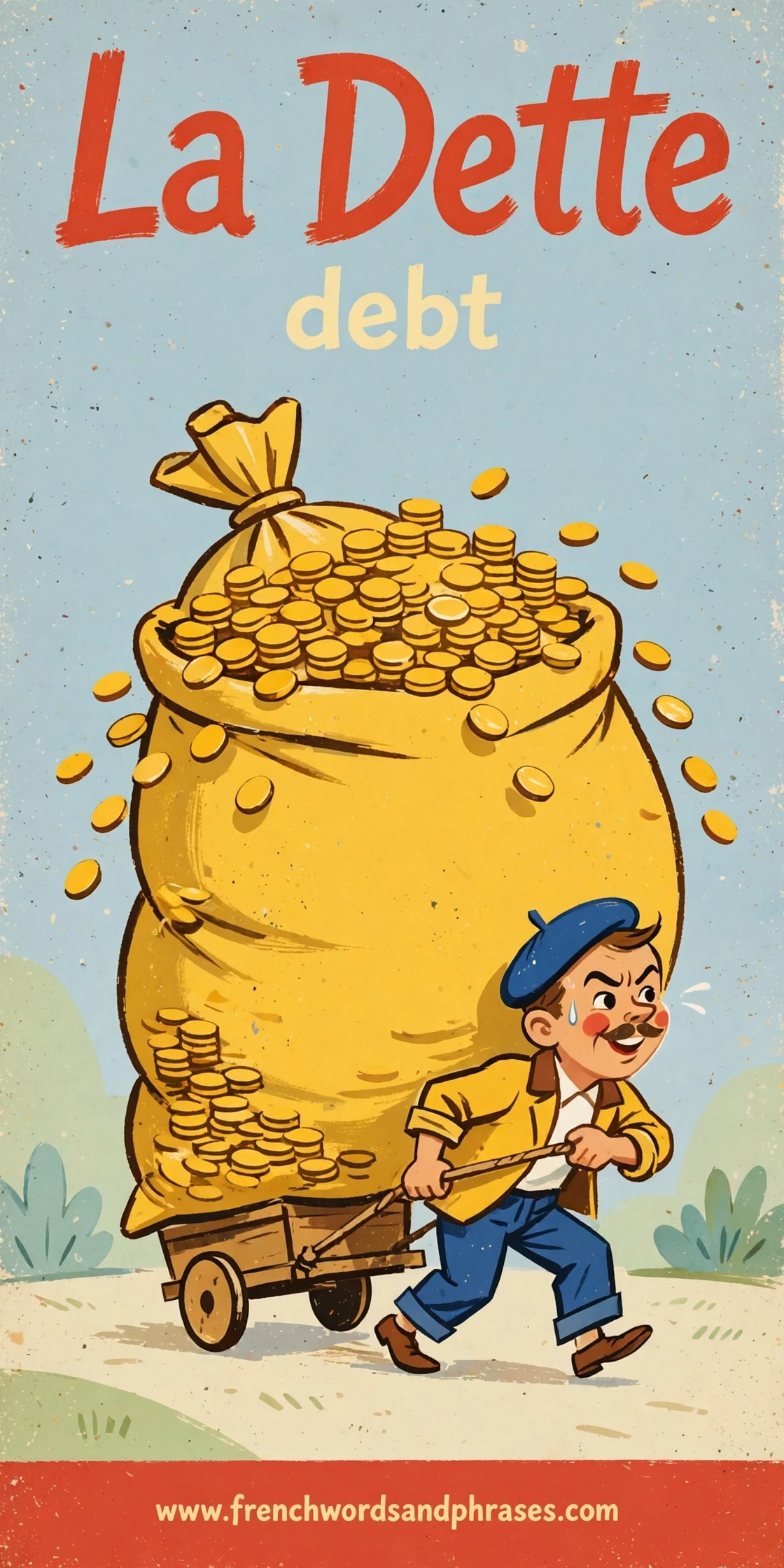
La dette means debt.
On the first page of the newspaper, a number with too many zeros: the country’s debt has passed another thousand billion. At the café counter, a man reads it, shakes his head, and says the word everyone owes something to: la dette.
In this guide, you’ll learn what dette means in English, how to use it with its articles, how to form its plural, and how it appears in everyday French. Explore French examples, English translations, and practice quizzes.
Understanding the French Noun Dette
Dette is a feminine French noun. It is learned together with its article: la dette, une dette. It comes from the Latin debitum, what is owed — and it keeps both of its lives in French: the enormous dette of nations, and the ten euros you owe a friend.
It means debt — money that must be paid back. At the top of the scale stands la dette publique, the public debt of the state, counted in thousands of billions. At the kitchen-table end: une dette envers un ami, a debt to a friend, a student loan, a month of rent. The verb that powers the whole family is devoir — to owe.
Gender: Feminine
Definite article: la — la dette (debt, the debt)
Indefinite article: une — une dette (a debt)
Plural: les dettes
English equivalents: Debt — of a state, a company, or a person.
One important usage detail: the verb devoir works two jobs in French — it means both to owe and must. Je te dois dix euros is I owe you ten euros; je dois partir is I must leave. Context — and money — tells you which one is meant.
Experience the Word
Dette is more than a number. It is a promise walking behind you — the loan signed in a good year, still being repaid in a harder one, month by month.
Imagine the young couple at the bank, signing for their first flat: thirty years of payments in a neat column, and a strange mixture of pride and vertigo. La dette is the price of starting — and rembourser sa dette, paying it back, is the long road home.
You have not just borrowed money. You have borrowed from your own future.
How to Use Dette in French: Complete Guide
Let’s explore how dette works in French, beginning with its articles.
Dette with the Definite Article (La, Les)
Used for the debt everyone knows — the country’s, the family’s, the one in the letter on the table.
| Number | French |
|---|---|
| Singular | la dette |
| Plural | les dettes |
Example
La dette du pays inquiète les économistes.
The country’s debt worries economists.
Dette with the Indefinite Article (Une, Des)
Used for a debt in general — one loan, one obligation, one name on a list.
| Number | French |
|---|---|
| Singular | une dette |
| Plural | des dettes |
Example
Il a une petite dette envers son frère.
He has a small debt to his brother.
Dettes Big and Small
Honour, gambling and the state itself — the dettes of French life.
| French | In English |
|---|---|
| la dette publique | the public debt |
| une dette de jeu | a gambling debt |
| une dette d’honneur | a debt of honour |
| rembourser une dette | to pay back a debt |
| contracter une dette | to take on a debt |
| une dette envers quelqu’un | a debt to someone |
Example
Elle rembourse sa dette petit à petit.
She is paying back her debt little by little.
Quick Quiz 1
What does « rembourser une dette » mean?
Reveal the answer
To pay back a debt — rembourser is the verb of paying money back.
Il rembourse sa dette chaque mois.
He pays back his debt every month.
The Plural of Dette
Dette adds an -s in the plural — les dettes, the debts that pile up when times are hard.
| Number | French |
|---|---|
| Singular | la dette |
| Plural | les dettes |
Example
Après des années difficiles, il a enfin payé toutes ses dettes.
After difficult years, he has finally paid all his debts.
Dette with Possessive Adjectives (Ma, Ta, Sa…)
Possessives agree with the noun, not with the owner — and dette is feminine, so it takes ma, ta, sa.
| Owner | French |
|---|---|
| my | ma dette |
| your (tu) | ta dette |
| his / her | sa dette |
| our | notre dette |
| your (vous) | votre dette |
| their | leur dette |
Example
Je connais ma dette par cœur : trois cents euros.
I know my debt by heart: three hundred euros.
Quick Quiz 2
Complete the sentence:
Il rembourse ______ dette chaque mois. (His)
Reveal the answer
sa
Il rembourse sa dette chaque mois.
He pays back his debt every month.
Dette with Demonstrative Adjectives (Cette, Ces)
Used to point: this debt here, those debts there.
| Number | French |
|---|---|
| Singular | cette dette |
| Plural | ces dettes |
Example
Cette dette vient d’un prêt étudiant.
This debt comes from a student loan.
Dette with Adjectives
Adjectives agree with dette, feminine — énorme, petite, croissante.
| Adjective | With Dette |
|---|---|
| énorme (enormous) | une dette énorme |
| petite (small) | une petite dette |
| publique (public) | la dette publique |
| ancienne (old) | une vieille dette |
| croissante (growing) | une dette croissante |
Example
Une dette énorme pèse sur le budget de la famille.
An enormous debt weighs on the family’s budget.
Quick Quiz 3
Complete the sentence:
Une dette ______ grandit chaque année. (growing)
Reveal the answer
croissante
Une dette croissante grandit chaque année.
A growing debt gets bigger every year.
Everyday Expressions with Dette
Owing, repaying and drowning — the dette phrases of daily life.
| Expression | In English |
|---|---|
| avoir des dettes | to have debts, to be in debt |
| rembourser une dette | to pay off a debt |
| s’endetter | to get into debt |
| la dette publique | the national debt |
| être criblé de dettes | to be riddled with debt |
| une dette de reconnaissance | a debt of gratitude |
Example
Il est criblé de dettes depuis la fermeture de son commerce.
He has been riddled with debt since his business closed.
Words from the Same Family as Dette
Owing, lending and borrowing — the words that travel with dette.
| French | In English |
|---|---|
| devoir | to owe; must |
| un débiteur | a debtor |
| un créancier | a creditor |
| un prêt | a loan |
| emprunter | to borrow |
| l’endettement | indebtedness, the level of debt |
Example
Je te dois vingt euros pour le restaurant.
I owe you twenty euros for the restaurant.
Quick Quiz 4
Your friend says: « Je te dois dix euros. » Does dois mean « must » here?
Reveal the answer
No — it means « owe ». Devoir does both jobs; money in the sentence means owing.
Je te dois dix euros pour le déjeuner.
I owe you ten euros for lunch.
Dette in Everyday French: Real-Life Examples
Now that you know the word, let’s see how dette appears in everyday French.
Example 1 — The headline
La dette publique fait la une des journaux.
The public debt is making the headlines.
Example 2 — Family budget
Ils remboursent leur dette avant Noël.
They are paying off their debt before Christmas.
Example 3 — Student life
Sa dette d’étudiant lui prend dix ans à rembourser.
Her student debt is taking her ten years to pay back.
Example 4 — Between friends
Oublie cette petite dette, le café est pour moi.
Forget that small debt, the coffee is on me.
Example 5 — Gratitude
Je te dois une vraie dette de reconnaissance.
I owe you a real debt of gratitude.
Example 6 — A warning
Attention à ne pas t’endetter pour des vacances.
Careful not to get into debt for a holiday.
Beyond Translation: The Meaning of Dette
Dette is one of the oldest ideas in any language: before money existed, there were debts — a favour owed, a harvest borrowed, a promise to repay. French kept the word close to its Latin root, debitum, and uses it at every scale, from the dette publique of three thousand billion down to the five euros chalked on the café slate.
To say dette is to name a promise that money makes to the future.
It evokes the bank’s neat column of payments, the friend who waves away the coins — « oublie cette dette » — and the oldest entry in the family: la dette de reconnaissance, the debt of gratitude, the one nobody wants to finish paying.
How to Remember the French Noun Dette
Remember it this way: Dette is debt — feminine, from the great dette publique down to the ten euros you owe a friend.
- You owe it — je te dois dix euros, c’est ma dette.
- You pay it back — rembourser sa dette, petit à petit.
- You feel the weight — être criblé de dettes, avoir des dettes partout.
The key idea is la dette is owed — rembourser is how it ends.
Test Your Knowledge of Dette
Let’s see how much you’ve learned. Try answering these questions before revealing the answers.
Question 1
Is dette masculine or feminine?
Reveal the answer
Feminine — la dette, une dette.
Question 2
How do you say the public debt in French?
Reveal the answer
La dette publique — the debt of the state.
Question 3
Translate: I owe you twenty euros.
Reveal the answer
Je te dois vingt euros.
Question 4
What does « s’endetter » mean?
Reveal the answer
To get into debt — to take on debts, often by borrowing.
Question 5
Complete the sentence:
Il rembourse ______ dette petit à petit.
Reveal the answer
sa
Il rembourse sa dette petit à petit.
He is paying back his debt little by little.
Your Final Challenge
Can You Use It?
How would you say this in French?
“He is paying back his debt little by little.”
Reveal the answer
Il rembourse sa dette petit à petit.
He is paying back his debt little by little.
A little French. A little curiosity. A richer everyday life.
LEARN FRENCH ONE WORD AT A TIME